




Originally published 28 July 2026. Republished and updated 10 November 2026.
A supplementary international search is an optional second prior art search on a PCT application, carried out by an Authority other than the one that ran the main search. The request must reach WIPO before 22 months from the priority date expire. It produces an extra search report, not a second opinion on patentability.
This article covers the PCT Regulations in force from 1 January 2026, for applicants and agents filing from India. The priority date is normally the filing date of the earliest application whose priority is claimed, or the international filing date where no priority is claimed. Where the international application went in at the end of the priority year, the 22-month deadline falls roughly ten months after international filing. The request goes to WIPO’s International Bureau, and the search is carried out by a participating International Searching Authority. No Indian form or Indian Patent Office fee is involved, though compliance with any national security rules on filing abroad stays your responsibility.
Quick answer: Buy a supplementary search only if you can name a search gap your first Authority does not cover and the result could change a filing decision. The request must reach the International Bureau before 22 months from priority, the handling fee is CHF 200 (CHF 20 for a qualifying Indian individual), and the Authority’s own fee runs from CHF 10 to CHF 1,734.
Before you read further
- Deadline: the request must reach the International Bureau before 22 months from the priority date expire.
- Fees: a handling fee to the International Bureau, plus the chosen Authority’s own search fee, which currently ranges from CHF 10 to CHF 1,734 depending on Authority and search scope.
- Who cannot do it: the Authority that carried out your main international search.
- Eligibility: language, subject matter, search scope and capacity conditions differ by Authority and are set out in Annex SISA of the WIPO PCT Applicant’s Guide.
- Search basis: the international application as filed, not later Article 19 or Article 34 amendments.
- Report: the supplementary report, or a declaration that none will be made, is due within 28 months from the priority date.
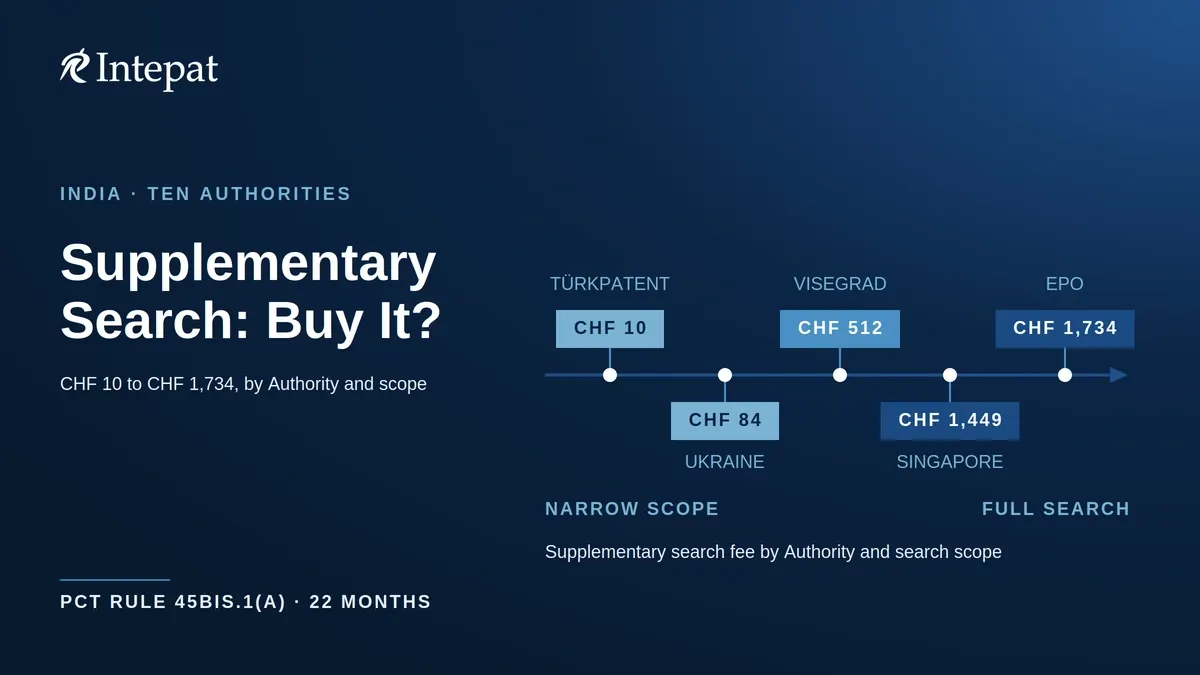
What a supplementary international search actually buys you
A PCT application ordinarily undergoes one main international search, though the searching Authority may in limited cases declare that no search report will be established (Article 17(2)(a)). A supplementary search adds an optional second search on the same application, by a different Authority, at the applicant’s expense.
The report cites additional prior art documents. It is not a patentability opinion. The Regulations provide for citations, with explanations of the citations and of the scope searched, and not for a written opinion.
The value is coverage. No search can be completely exhaustive, and WIPO describes the service as particularly relevant where the second Authority has language specialisations the first does not. A second search can bring that discovery forward, ahead of national phase entry.
It is a different instrument from Chapter II preliminary examination, which produces a reasoned patentability assessment and can take amended claims into account. The two answer different risks and are sometimes used together, hence the sequencing point below.
For communication to designated Offices the supplementary report is treated as part of the international search report, so the rules on communicating that report to designated Offices apply to it too (Rule 45bis.8).
Which Authorities can do it, and the one that cannot
Two constraints narrow the field. Only an Authority that has told the International Bureau it is prepared to carry out supplementary searches can be specified, and its agreement may limit what it searches. And the Authority that carried out your main search is not competent to carry out the supplementary one (Rule 45bis.9).
Ten Authorities are listed for supplementary search in the International Bureau’s entry in the WIPO PCT Applicant’s Guide: the Austrian Patent Office, the European Patent Office, the Finnish Patent and Registration Office, Rospatent, the Swedish Intellectual Property Office, the Intellectual Property Office of Singapore, TÜRKPATENT, the Ukrainian National Office for Intellectual Property and Innovations, the Nordic Patent Institute and the Visegrad Patent Institute. The list and each Authority’s conditions change; Annex SISA carries the current position.
The exclusion bites in one case that matters from India. Austria, the EPO and Sweden are competent as main Authorities for Indian applicants and are also listed for supplementary search, so whichever of them you chose for the main search drops out of your options for the second. If the Indian Patent Office ran your main search, no listed Authority is excluded on this ground alone. Even then you must still satisfy the chosen Authority’s language, subject matter, search scope and capacity conditions. Our guide to choosing an International Searching Authority from India covers the earlier decision that shapes this one.
You may request more than one supplementary search from different Authorities, each with its own request and fees.
The 22-month request deadline and the 28-month reporting deadline
The request must reach the International Bureau before 22 months from the priority date expire. A late request is declared not to have been submitted (Rule 45bis.1), and the period is not extendable on request.
Narrow routes exist, and none is a plan. A period that ends on a day the Bureau is not open to the public for official business, or on which ordinary mail is not delivered in Geneva, runs to the next day on which neither is true (Rule 80.5). Registered airmail posted at least five days before the deadline can excuse a late arrival if you prove the posting to the Bureau’s satisfaction and send the evidence within one month of noticing the delay (Rule 82.1). Registered surface mail qualifies only where it normally arrives within two days.
Three further routes sit in one rule. If the Bureau’s ePCT system or its Business Continuity Service is unavailable for at least one continuous hour on a working day, and that is why you miss a time limit falling that day, the Bureau treats the delay as excused where you act on the next working day on which the relevant system is available again (Rule 82quater.2, which the Bureau has chosen to offer). A delay caused by war, civil disorder, strike, natural calamity, epidemic, a general outage of electronic communications or a like reason, where you reside, work or are staying, can be excused if you acted as soon as reasonably possible, the Bureau is satisfied, and you send the evidence within six months after the deadline expires (Rule 82quater.1).
And where such an event generally disrupts the State in which the Bureau sits and its operations, the Bureau may publish an extension of up to two months at a time (Rule 82quater.3). A designated Office where you have already started national processing need not honour either excuse or extension.
The other end is slower than expected. Once the request is in order and the fees are paid, the Bureau sends the file to the Authority promptly, but not before it has the search report or 17 months from priority have passed, whichever comes first. The Authority may then delay starting until it also has the search report and written opinion, or until 22 months, whichever comes first. The report is due within 28 months.
Twenty-eight months is an outer limit, not a delivery date, and a report may come earlier. Plan for the late case: India’s national phase deadline is 31 months (see our guide to Indian national phase entry fees), so a report completed near the deadline leaves roughly three months to absorb it and decide whether the entry list still holds.
| Milestone | Timing |
|---|---|
| Request must reach the International Bureau | Before 22 months |
| Fees payable | Within 1 month of the Bureau receiving the request |
| Bureau sends file to the Authority | Promptly after the search report arrives or 17 months pass, whichever first, once the request is in order and fees are paid |
| Authority may defer starting the search until | Search report and written opinion received, or 22 months, whichever first |
| Supplementary report (or declaration that none will be made) due | Within 28 months |
Verified as of 10 November 2026 against the PCT Regulations in force from 1 January 2026.
What it costs, and the reduction that does not reach it
Two fees, both collected by the International Bureau, both due within one month of the Bureau receiving the request. The handling fee is fixed at CHF 200 by the PCT Schedule of Fees. The search fee is set by each Authority for its own benefit, with no ceiling in the Regulations. Pay late and the Bureau invites payment within one month, with a late payment fee of half the handling fee (CHF 100 at the full rate). If the fees in full, including the late payment fee, or a required correction do not arrive in that month, the request is considered not submitted (Rule 45bis.4).
Authority fees are not comparable, because the Authorities are not selling the same thing. Some search a full collection; others confine the search to a language collection and price accordingly. The scope you buy matters more than the Authority’s name.
Now the reductions, where two separate schemes are easy to confuse. The PCT Schedule of Fees gives a 90% reduction to a natural person who is a national of and resides in a qualifying State, and India is on that list. It reaches the international filing fee, the supplementary search handling fee and the Chapter II handling fee, so a qualifying Indian individual pays CHF 20 rather than CHF 200. It does not reach an Authority’s own search fee, which is not a Schedule item.
That is not the end of it, because an Authority may reduce its own fee separately. The EPO reduces its supplementary search fee by 75% on two grounds. First, where the applicant, or each applicant if there are several, is a natural person who is a national of and resides in a State outside the European Patent Convention that appears on the EPO’s yearly published list of States the World Bank classifies as low-income or lower-middle-income, tested on the date the supplementary search fee is paid (the decision also refers to the filing date, so confirm the test date with the EPO). Second, where the applicant, or each applicant, is a natural or legal person who, within the meaning of Rule 18 of the PCT, is a national of and resident in a State in which a validation agreement with the European Patent Organisation is in force. Check the EPO’s list before assuming either way, because a qualifying individual pays a quarter of the CHF 1,734 fee, which moves the arithmetic far more than the CHF 180 saved on the handling fee.
Where there are several applicants, each must qualify independently under whichever scheme is claimed. The 90% reduction carries two further conditions. At the time of filing there must be no beneficial owner of the application who would not qualify (Schedule of Fees, item 5). And under an Understanding adopted by the PCT Assembly, the reduction is meant for applicants who are the sole and true owners of the application, under no obligation to assign or license the rights to a party that would not qualify. A founder who is under an obligation to assign the rights to a company that would not qualify does not.
One more fee effect sits outside this request. If the EPO later acts as a designated Office, its search fee is reduced by EUR 1,365 where Austria, Finland, the Nordic Patent Institute, Sweden, TÜRKPATENT or the Visegrad Patent Institute established a supplementary search report. The same reduction follows a main search by Austria or Sweden, the only two of these Authorities competent for Indian applications. It is a reason to weigh those Authorities if Europe is a likely destination.
| Authority | Search scope offered | Fee |
|---|---|---|
| TÜRKPATENT (TR) | Turkish-language documents in its collection | CHF 10 |
| Ukraine (UA) | Russian-language documents of the former USSR and Ukrainian-language documents | CHF 65 |
| Ukraine (UA) | Its collection with the PCT minimum, or European and North American documents only | CHF 84 |
| Rospatent (RU) | At least the Russian-language and certain other patent documents of the former Soviet Union and CIS States | CHF 112 |
| Nordic Patent Institute (XN) | Danish, Icelandic, Norwegian and Swedish documents | CHF 499 |
| Visegrad Patent Institute (XV) | Czech, Hungarian, Polish and Slovak documents | CHF 512 |
| Austrian Patent Office (AT) | German-language documentation | CHF 792 |
| Austrian Patent Office (AT) | European and North American documentation | CHF 1,109 |
| Singapore (SG) | PCT minimum plus English and Chinese documents in its collection | CHF 1,449 |
| Austrian Patent Office (AT) | PCT minimum documentation | CHF 1,584 |
| EPO, Finland (FI), Sweden (SE) | PCT minimum plus the Authority’s collection (FI and SE: Danish, Finnish, Norwegian and Swedish documents) | CHF 1,734 |
| TÜRKPATENT, Nordic, Visegrad | Full search | CHF 1,734 |
WIPO PCT Applicant’s Guide, Annex SISA entries for each Authority, read on 10 November 2026; the Rospatent figures are those valid from 1 November 2026. The CHF 200 handling fee (CHF 20 where the 90% reduction applies) is payable to the International Bureau in addition. Where an Article 17(2)(a) declaration was made on methods-of-treatment grounds, Rospatent charges CHF 177 and Ukraine CHF 56.
Four limits that decide whether the search is useful to you
The search runs on the application as filed. The basis is the international application as filed, or a translation of it, taking due account of the search report and written opinion where the Authority has them before it starts. WIPO’s stated reason is that searching the original text produces a more genuinely complementary result. The commercial consequence: the Authority does not use your amended claim wording as the basis of the search. If the claim set you now care about rests on an Article 19 or Article 34 amendment that adds or reshapes features, the search may not reflect it.
Claims left out of the first search may be left out again. An Authority may exclude claims it would not itself search, for clarity or subject matter reasons or a sequence listing not supplied after a warning and an opportunity to comply. Where the international search report is available before the supplementary search starts, it may also exclude claims not covered by the main search. Where the main Authority declared that no search report would be established, and that declaration is available before the supplementary search starts, the supplementary Authority may decide not to establish a report at all.
A lack of unity limits the report to one invention. Where the Authority finds it, the report is established on the main invention, normally the one first mentioned in the claims, and the Authority notifies you with reasons. Unlike the main international search, there is no right to pay additional fees for the other inventions. One exception matters: where the first Authority already found a lack of unity, your request may ask for the search to be directed at one of the other inventions it identified. The Regulations provide for that indication in the request itself, so plan to include it when you file. You can ask for a review within one month of the notification, possibly against a review fee the Authority sets (Annex SISA shows one for the EPO, Rospatent, Singapore, the Nordic Patent Institute and the Visegrad Patent Institute, and none for Austria, Finland, Sweden, TÜRKPATENT or Ukraine); if the opinion proves entirely unjustified, the Authority searches all parts of the application, within any restriction it may apply, and refunds the review fee (Rule 45bis.6). Our guide to unity of invention and divisionals at Indian national phase covers what a unity finding does downstream in India.
The Authority’s own limits apply. Its agreement with the Bureau may restrict searching by subject matter, by the number of searches it runs in a period, or by the number of claims, and it may restrict the search to certain claims, in which case the report says so. If a limitation excludes your case entirely, other than where the Authority declines to search for subject matter it need not search or because the text is too defective for a meaningful search, the request is considered not submitted (Rule 45bis.5). The Authority refunds its search fee as its agreement provides if it had not started, and the handling fee is not refunded.
Four questions that decide whether to buy one
Wider coverage is valuable in the abstract, which helps nobody decide. These four questions do.
- Is there an identifiable search gap? Not “could there be more prior art”, which is always true, but a specific collection your first Authority does not reach. If you cannot name it, you are buying reassurance rather than coverage.
- Could additional prior art change a commercial decision? Dropping a jurisdiction, narrowing claims, opening a licensing conversation, discontinuing. If you would enter the same countries with the same claims regardless, it does not earn its cost.
- Are the original claims still the commercially important ones? The search runs on the application as filed, so a position resting on amended claims gets less from it.
- Will the Authority you want take the case? Check its language requirement, subject matter limits, search scope, claim limits and any capacity cap in Annex SISA first. Remember that the Authority you chose for the main search is unavailable.
One sequencing point sits across all four. A preliminary examining Authority need not take the supplementary report into account if it arrives after that Authority has begun drawing up its opinion or report, so an applicant doing both should set the order deliberately. Where the first written opinion was negative, read this alongside our note on responding to a negative PCT written opinion at the FER stage.
Requesting one: what to send, and where
The request goes to the International Bureau, not to the Indian Patent Office and not to the Authority that will search. It must give the applicant’s and agent’s (if any) details, the title, the international filing date and application number, and name the Authority. Where the application was filed in a language that Authority does not accept, it must also say whether a translation furnished to the receiving Office is to be the basis of the search. Where that Authority accepts neither the language of filing nor a translation already on file, a translation into an accepted language must accompany the request. A sequence listing in electronic form should accompany it where the Authority requires one. If the request omits a required indication or a required translation, the Bureau invites correction within one month of the invitation; if you do not correct, the request is considered not submitted (Rule 45bis.4).
You can withdraw at any time before the report, or a declaration that no report will be made, is transmitted to you and to the Bureau. Withdrawal takes effect when a notice signed by the applicant (all applicants, if several; a common representative cannot sign for the others) is received by the Bureau or the Authority, and the search is then discontinued. If the notice reaches the Authority too late to stop transmittal, the report or declaration is still communicated to the designated Offices (Rule 90bis.3bis). Refunds are narrower. If the application is withdrawn or considered withdrawn, or the request is withdrawn, before the Bureau has sent the request and the application to the Authority, both fees are refunded. If the request is held not submitted before then, the search fee is refunded, but the handling fee only where the request was late or the Authority was not prepared or not competent (Rules 45bis.2 and 45bis.3). After that there is no general entitlement under the Regulations; any refund of the Authority’s fee depends on its agreement with the Bureau or its own practice.
For the earlier decisions, see our guide to filing a PCT application from India and the Patent Cooperation Treaty in India guide.
Deciding before the 22-month mark
Put a date in the docket at 20 months from priority. By then the search report and written opinion should be in hand, leaving two months to identify the gap, confirm the Authority will take the case, and clear the fees.
Run the four questions with the report in front of you. If the gap is real and could move a decision, request the search. If not, spend the money on the national phase. What you cannot do is defer it past 22 months: a late request is declared not to have been submitted.
FAQ
A supplementary international search is an optional second prior art search on a PCT international application (Rule 45bis). It is carried out by an International Searching Authority other than the one that performed the main search, at the applicant’s request, and produces a supplementary international search report.
The request must reach the International Bureau before 22 months from the priority date expire (Rule 45bis.1). A request received after that is declared not to have been submitted. The period is not extended on request, but a few narrow rules can excuse or extend it (Rules 80.5, 82.1 and 82quater), so do not plan around them.
Ten Authorities are listed in the WIPO PCT Applicant’s Guide: Austria, the EPO, Finland, Rospatent, Sweden, Singapore, TÜRKPATENT, Ukraine, the Nordic Patent Institute and the Visegrad Patent Institute. The Authority that carried out the main search is never among the options. Each Authority’s languages, scope and limitations sit in Annex SISA.
No (Rule 45bis.9). The Authority that carried out the main international search is not competent to carry out a supplementary search on the same application. Austria, the EPO and Sweden are both competent main Authorities for Indian applicants and listed for supplementary search, so choosing one of them for the main search removes it from the second.
Two fees apply: a handling fee of CHF 200 to the International Bureau (CHF 20 for a qualifying Indian individual), and the Authority’s own search fee. That second fee ranges from CHF 10 for a Turkish-language search to CHF 1,734 at several Authorities. No Indian Patent Office fee is payable.
The Regulations provide for citations and for explanations of those citations and of the scope of the search. They do not provide for a written opinion on novelty or inventive step. An applicant seeking a reasoned patentability assessment, particularly of amended claims, files a Chapter II demand instead.
No. The Indian Patent Office acts as Receiving Office, International Searching Authority and International Preliminary Examining Authority, and it is not among the ten Authorities the International Bureau lists for supplementary search. Verified as of 10 November 2026.
Not as such. The search is carried out on the international application as filed, or on a translation of it (Rule 45bis.5). Amendments made under Article 19 or Article 34 do not form the basis of the search, although the Authority takes due account of the earlier search report and written opinion where it has them.
This article explains the law on supplementary international search under the Patent Cooperation Treaty as at 10 November 2026 and is for general information only. It is not legal advice. Fees, search scopes and the list of participating Authorities change without notice; confirm the current position in Annex SISA before you instruct. Deadlines in this area are strict, and a missed deadline normally closes the option, subject to the limited relief described above. For advice on your specific application, consult a registered patent agent.
Sources
- WIPO, PCT Treaty and Regulations: Treaty Articles 2, 17, 19 and 34; Regulations Rules 18, 45bis, 80.5, 82quater and 90bis.3bis, and the Schedule of Fees, in force from 1 January 2026.
- WIPO, PCT International Search and Preliminary Examination Guidelines, paragraphs 15.76 to 15.97, in force from 1 January 2026.
- WIPO, PCT Applicant’s Guide, Annex SISA entries and International Bureau entry, read 10 November 2026.
- WIPO, PCT fees and fee reductions, including the 90% reduction list applicable from 7 January 2025 and the 2017 PCT Assembly Understanding.