




An applicant filing a PCT application from India (RO/IN) chooses the International Searching Authority (ISA) at the moment of filing, and that choice should be treated as fixed. Eight authorities are available, including the IPO, EPO and USPTO. The right one depends on target markets and budget, not search fee alone.
This guide covers the ISA decision for an applicant filing a PCT international application from India (RO/IN). It compares the eight available authorities and reflects the search fees published in the WIPO PCT Applicant’s Guide as at October 2026 and Section 39 of the Patents Act 1970. National phase entry, a separate stage, is covered in our Patent Cooperation Treaty in India guide.
Quick answer
- Eight ISAs are open to an applicant filing at RO/IN: Austria (AT), Australia (AU), China (CN), the EPO (EP), India (IN), Japan (JP), Sweden (SE) and the USPTO (US).
- The Indian Patent Office is by far the lowest-cost ISA. Startups, small entities, natural persons and educational institutions pay a further reduced search fee.
- Choose the IPO when India is the main market or budget is the binding constraint.
- Choose the EPO when Europe is a core market, because an EPO search report carries directly into European prosecution.
- The choice is locked at filing and sits separate from Section 39 clearance, which is handled first.
Terms at a glance: The receiving office (RO) is where you file the PCT application; an Indian resident usually files at RO/IN. The ISA is the office that searches prior art during the international phase. The ISR is its search report and the Written Opinion is its first view on patentability. The national phase is the later, country-by-country stage where grant decisions are made.
What an International Searching Authority does for your PCT application
After a PCT application is filed, one patent office carries out the international search. That office is the ISA. It produces two documents: the International Search Report (ISR), listing prior art that may bear on whether the claims are new and inventive, and a Written Opinion on patentability. Both are normally available before publication, often around 16 months from the priority date, well before any money is committed to individual countries.
The PCT route includes an international-search stage for every application, but the reach of that search depends on the subject matter. For some excluded or hard-to-search claims, including certain business-method, diagnostic-method, information-presentation or computer-program claims, the chosen ISA may issue a partial search or a no-search declaration under Article 17(2). Each authority searches such subject matter only to the extent its own national patent law would, so the same claims can receive a full search at one ISA and a no-search declaration at another; check your technology against the authority’s practice before filing. The main question is which office does the search and how well. For a founder, the ISR is the first independent read on whether the invention is likely to hold up. A clean report supports the decision to spend on national phase entries and strengthens an investor or licensing conversation. An unfavourable report is a signal to amend the claims, narrow the filing programme, or stop before the large national phase costs arrive.
The report also opens a strategic window. After the ISR issues, the applicant has one opportunity to amend the claims under Article 19. The deadline under Rule 46.1 is generally two months from transmittal of the ISR or 16 months from the priority date, whichever is later, and amendments filed early enough appear in the international publication at 18 months. A founder can use the ISA’s findings to tighten the claims to what the search suggests is defensible. Unless a Chapter II demand is filed, the Written Opinion becomes the International Preliminary Report on Patentability (Chapter I), which the International Bureau sends to the designated offices after 30 months from priority. National examiners open the file with that report in front of them, so the authority that produced it, and the quality of its search, shapes the first impression in every country the application reaches.
The ISA also sets up later options, because it limits which authority can carry out international preliminary examination if the applicant later files a Chapter II Demand. From RO/IN, the EPO can act as examining authority only if the EPO, Austria or Sweden did the search, and China, Japan or the USPTO only if that same office did the search; Austria, Australia, India and Sweden are open whatever the search. An IPO, Australian, Chinese, Japanese or USPTO search therefore rules out the EPO at Chapter II. The sibling decision of which authority to use for that examination is covered in our PCT Chapter II demand strategy guide.
Section 39 first: clear this before any ISA decision
Before any of this matters, an Indian resident must clear Section 39 of the Patents Act 1970. No person resident in India may file a patent application outside India without a written permit, unless an application for the same invention was first filed in India at least six weeks earlier and no secrecy direction is in force.
Section 39 applies to a PCT application whether it is filed at RO/IN or at RO/IB. Where the PCT application claims priority from an Indian application filed at least six weeks earlier, with no secrecy direction in force, no permit is needed. Where no Indian application for the same invention was filed at least six weeks earlier (the Patent Office Manual treats a direct filing without an Indian priority claim this way), prior permission on Form 25 is needed first, and the Patent Office’s practice is that a PCT application filed at RO/IN without that permission will not be treated as an international application. The Controller ordinarily disposes of a Form 25 request within twenty-one days; where the invention is relevant for defence purpose or atomic energy, the permit needs the prior consent of the Central Government. Getting this wrong is not a formality.
A filing abroad in breach of Section 39 means the Indian application is deemed abandoned and any patent granted is liable to be revoked (Sections 40 and 64). The contravention can also carry imprisonment of up to two years, or a fine, or both, although since 1 June 2026 a proviso to the penalty section disapplies that punishment where the Central Government is of the opinion that the invention was not relevant for defence purpose or atomic energy at the time of the contravention. The proviso removes only the criminal punishment; the abandonment and revocation consequences still apply. The detail of the permit and the foreign filing licence is in our foreign filing licence guide. The ISA decision is made only once this clearance is in hand.
Which ISAs can an Indian applicant choose?
The receiving office decides which ISAs are open to an applicant. An applicant filing at the Indian Patent Office as receiving office (RO/IN) may choose from eight authorities: the Austrian Patent Office (AT), IP Australia (AU), the China National Intellectual Property Administration (CN), the European Patent Office (EP), the Indian Patent Office (IN), the Japan Patent Office (JP), the Swedish Intellectual Property Office (SE) and the United States Patent and Trademark Office (US). This list is set out in the WIPO PCT Applicant’s Guide, Annex C(IN), and in the PCT fee tables.
The same menu applies if an Indian resident files instead with the International Bureau as receiving office (RO/IB), because for a single Indian applicant the competent authorities are those that would have been competent had the filing been made at the applicant’s national office. Where there are multiple applicants of different nationalities or residences, the competence position should be checked separately, since RO/IB can sometimes widen the options. The receiving-office choice between RO/IN and RO/IB does not, by itself, change the ISA menu for a single Indian applicant, and it does not change the Section 39 position covered above.
Two points carry weight for the rest of the decision. First, the Korean Intellectual Property Office is not on the list for an RO/IN filer. Second, the Indian Patent Office is competent as an ISA only for applications filed at three receiving offices: India, Iran and Japan. That restriction does not affect an Indian resident filing at RO/IN; what affects the later examining authority is the ISA chosen, as explained above.
The ISA is nominated in the Request form (PCT/RO/101) at filing. Once the application is filed, it should be treated as a locked filing-stage decision; an applicant should not assume the search authority can be changed later. The decision is made before filing, with the patent agent, not discovered at national phase. An applicant filing in English clears the language question with every authority relevant here, since each accepts English. RO/IN also accepts filings in Hindi, but none of the eight authorities searches in Hindi, so a Hindi filing needs a translation for the search whichever ISA is chosen.
What happened to the IP5 collaborative search pilot?
Between 1 July 2018 and 30 June 2020, the IP5 offices (the EPO, the USPTO and the patent offices of China, Japan and Korea) ran a collaborative search pilot for selected PCT applications; 468 applications were accepted. One office acted as the main searching authority and prepared a draft search report and written opinion. Examiners from the other IP5 offices reviewed the draft and could carry out further searching, and the main office then issued the final report. The Indian Patent Office did not take part, and no new applications have been accepted since June 2020.
The final assessment was presented to the IP5 heads of office in June 2023, and they decided not to propose collaborative search for the PCT system for the time being. The reasons included the lack of agreement on how to set a fee and practical difficulties with applications lacking unity of invention. The pilot is closed. Today, the only way to involve a second authority in the international search stage is supplementary international search, which we cover in our supplementary international search guide.
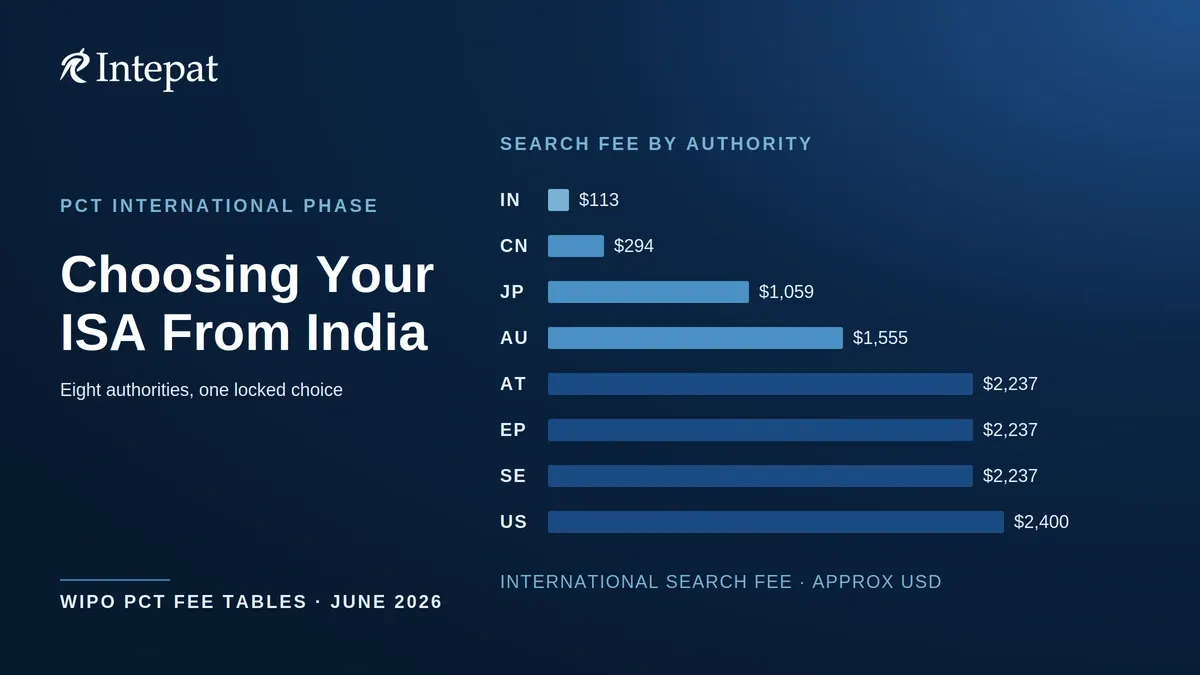
ISA search fees compared: IPO, EPO, USPTO and others
A PCT filing carries three international-phase fees: a transmittal fee to the receiving office (nil at the Indian Patent Office for an electronic filing), an international filing fee to WIPO of CHF 1,330 (USD 1,667 at RO/IN, plus USD 19 per sheet over 30, before reductions for electronic filing; reduced by 90% where every applicant is a natural person who is a national of and resides in India), and the search fee. The ISA choice moves only the search fee. The other two are the same whichever authority searches the application. The search fee, though, is the most variable line on the bill, and the spread is wide.
The figures below are the search fees as published in each authority’s Annex D of the WIPO PCT Applicant’s Guide, checked on 24 October 2026, with WIPO’s published US dollar equivalent; the same amounts appear in the WIPO PCT fee tables. For an RO/IN filer, the fee is collected by the Indian Patent Office and remitted to the chosen authority; the rupee amount payable tracks the published equivalent and moves with exchange rates.
| ISA | Search fee (as fixed by the authority) | WIPO USD equivalent | Note for an Indian applicant |
| India (IN) | INR 10,000; INR 2,500 reduced* | USD 104; USD 26* | Lowest cost; search in English |
| China (CN) | CNY 2,100 | USD 310 | Low cost; relevant if China is a target |
| Japan (JP) | JPY 169,000 (English) | USD 1,059 | English applications accepted |
| Australia (AU) | AUD 2,200 | USD 1,555 | Mid-range |
| Austria (AT) | EUR 1,885 | USD 2,237 | Upper tier; 75% less for an Indian natural person†; reduces EPO supplementary fee |
| EPO (EP) | EUR 1,885 | USD 2,237 | Upper tier; 75% less for an Indian natural person†; weight in Europe |
| Sweden (SE) | SEK 19,950 | USD 2,237 | Upper tier; reduces EPO supplementary fee |
| USPTO (US) | USD 2,400 (small entity USD 960; micro USD 480) | USD 2,400 | Highest; reduced for a qualifying small or micro entity |
*Reduced rate applies to a natural person, startup, small entity or educational institution filing with the IPO as ISA; under the fee structure of the Patents Rules, a joint filing that includes any other applicant pays the full fee. †Applies only where the applicant, or each applicant if there are several, is a natural person who is a national of and resides in India. Confirm the current WIPO annex before filing; the amounts are revised from time to time and all equivalents move with exchange rates.
The gap is not marginal. The Indian Patent Office search fee is roughly one twentieth of the EPO or USPTO fee, and the reduced IPO rate for a startup is lower still. Two nuances narrow the gap for some applicants. An applicant who is an individual, filing alone or with other individuals, pays a quarter of the standard Austrian or EPO search fee, provided every applicant is a natural person who is both a national and a resident of India. And the USPTO charges a reduced search fee to a small entity (USD 960) or micro entity (USD 480); an Indian applicant can claim it if it meets the USPTO’s small or micro entity criteria, which brings the USPTO figure down materially. For most early-stage companies counting every rupee, though, the IPO remains far cheaper, provided the cheaper search serves the markets the company actually wants. That proviso is the rest of the analysis. One point holds whichever authority you pick: the search fee does not buy a grant or a guarantee, it buys a report. A favourable report lowers risk and cost at national phase, but it does not bind any national examiner, who applies local law afresh.
Note: The cheapest ISA is not always the best. The IPO fee is lowest, but the EPO can be more efficient where Europe is a committed market, because its search carries into European prosecution.
How your ISA choice affects national phase in your target markets
Search fee is one side of the ledger. The other is how much the search report does for prosecution once the application reaches the countries that matter. The two pull in different directions, which is the heart of the decision.
The strongest downstream link belongs to the EPO. If the EPO conducted the international search and the applicant later enters the European regional phase, the EPO does not draw up a supplementary European search report there. If a different authority did the international search, the EPO carries out a supplementary European search at regional phase entry, at a further fee, though that fee is reduced where the search was drawn up by certain European offices, including Austria and Sweden. The full dispensation applies only when the EPO itself was the ISA or carried out a supplementary international search. For an applicant whose real market is Europe, an EPO search bought at the international phase is therefore partly recovered at the European phase. That can outweigh the higher search fee.
The USPTO link is weaker. A US examiner is not bound by the international search report and examines the application under US law. A USPTO search report is useful for US-facing prosecution, and any acceleration route should be checked separately; it does not carry the automatic prosecution saving that an EPO search carries into Europe.
The Indian Patent Office as ISA suits an applicant whose primary market is India, both because the search is in English and inexpensive and because designating the IPO as ISA is one of several grounds for expedited examination on Form 18A at the Indian national phase under Rule 24C. It is not the only ground: a startup or small entity already qualifies on its own status, so an India-first founder often has this route regardless of the ISA chosen. The grounds, and the related IPEA route, are explained in our guide on designating India as ISA. The China and Japan options follow the same logic at lower cost than the European and US tier: a CNIPA or JPO search aligns with prosecution in those offices and reads naturally there.
Note: India as ISA is one Form 18A ground, not the only one. Startups and small entities qualify for expedited examination on their own status under Rule 24C, whatever ISA they choose.
For an India-first applicant there is a quiet efficiency to the IPO search beyond price. When the application reaches the Indian national phase, the same office’s international search is already on file. Austria and Sweden charge the same standard search fee as the EPO (an Indian natural person gets the 75% reduction at Austria and the EPO but not at Sweden), and because either reduces the later EPO supplementary search fee, they can be alternatives for a Europe-facing applicant.
There is a partial hedge for an applicant who takes a cheaper search but worries about prior art in another language or market. A supplementary international search by a second authority can be requested under Rule 45bis, before 22 months from priority. It reduces the risk of unfamiliar prior art surfacing later at national phase. It is an added cost and an optional step, not a default, but it lets an applicant pair a low-cost main search with broader reach where the stakes justify it.
Choosing your ISA: a decision framework for founders
The decision turns on three questions: where is the real market, how strong is the budget constraint, and how much does downstream prosecution weight matter. The table below maps the common founder situations to a starting choice. It is a starting point for the conversation with your patent agent, not a substitute for it.
| Your situation | Starting choice | Why |
| India is the main or only target market | IPO (IN) | Lowest fee, English search, a Form 18A ground at Indian national phase |
| Tight budget; markets still being validated | IPO (IN) | Defers cost while the ISR tests the invention; markets can be chosen later at national phase |
| Europe is a core market | EPO (EP) | Search report carries into European prosecution; no repeat EPO search at the European phase |
| China is a core market and cost matters | CNIPA (CN) | Low fee with a search aligned to Chinese prosecution |
| United States is the main market | USPTO (US) or EPO (EP) | USPTO aligns with US practice; EPO is often chosen for search quality where Europe is also in scope |
| Spread across several markets, no single dominant one | EPO (EP) | One report sent to every office the application enters, and no supplementary European search if Europe is among them |
A worked example shows how the factors interact. Take a Bengaluru SaaS company, DPIIT-recognised as a startup, that has filed in India and is now filing a PCT application. Its near-term revenue plan is India, with Europe as a serious second market within two years. On cost alone the IPO wins, at the reduced startup rate, and the startup keeps its Form 18A ground in India regardless. But if the European filing is close to certain, naming the EPO as ISA buys a search that the company would otherwise pay the EPO to repeat at the European phase, and it sets up smoother European prosecution. The resolution turns on conviction about Europe: if EU entry is firmly planned, the EPO is often worth the higher fee; if Europe is only a possibility, the startup can take the cheap IPO search now and revisit the European question at national phase. Either way, the choice is made deliberately against the company’s own market plan, not by reaching for the cheapest or the best-known authority.
Two practical notes sit underneath the table. A founder filing in English at RO/IN and naming the IPO as ISA takes the simplest and cheapest route, with no translation needed for the search. And the report’s procedural effect is most concrete for the EPO, where it removes the supplementary European search; no authority’s report binds a national examiner, so the search fee buys a search and an opinion rather than a guaranteed downstream saving.
Confirming your ISA choice before you file
The ISA decision is small in paperwork and large in consequence: a single box on the Request form that should be treated as fixed once the application is filed. Settle three things with your patent agent before filing. Confirm Section 39 is cleared. Confirm the authority that fits your real markets and budget, using the framework above rather than defaulting to the cheapest or the best known. And confirm the chosen authority will search your technology and accepts your filing language. Get those three right, and the search report works for the filing programme you actually intend, at a cost you chose on purpose. The mechanics of filing the PCT application itself, including the receiving office choice and the fee payment, are set out in our guide on filing a PCT application from India, and the Indian national phase fees that follow are in our PCT entry fee in India guide.
Frequently asked questions
An applicant filing a PCT application at the Indian Patent Office (RO/IN) may choose from eight International Searching Authorities: Austria, Australia, China, the EPO, India, Japan, Sweden and the USPTO. The list is set out in the WIPO PCT Applicant’s Guide, Annex C(IN). Korea is not available to RO/IN filers.
The Indian Patent Office, with a search fee of INR 10,000, reduced to INR 2,500 for a natural person, startup, small entity or educational institution (WIPO PCT Applicant’s Guide, October 2026). That is roughly one twentieth of the EPO or USPTO search fee, about USD 2,237 to USD 2,400.
No. The Korean Intellectual Property Office is not among the eight competent ISAs for an applicant filing at RO/IN. The available authorities are Austria, Australia, China, the EPO, India, Japan, Sweden and the USPTO (WIPO Applicant’s Guide, Annex C(IN)). Korea can be used from some other receiving offices, but not from India.
Treat it as fixed. The ISA is selected in the Request form at filing, and an applicant should not assume the search authority can be changed later, so the decision is made before filing, with your patent agent. If broader reach is needed, a supplementary search by a second authority can be requested under Rule 45bis.
Yes. Where the EPO acted as ISA, the supplementary European search is dispensed with at European regional phase entry. If Austria or Sweden conducted the international search, the EPO charges a reduced, rather than waived, supplementary search fee. Any other ISA leaves the full fee payable, unless the EPO (dispensed) or Austria, Sweden or another listed European office (reduced) also carried out a supplementary international search.
Not always. The IPO is the cheapest option and suits an applicant whose main market is India or whose budget is tight. If Europe is a core market, the EPO is often better, because its search report carries directly into European prosecution and avoids a repeat search at the European regional phase.
No. India as ISA or IPEA is one ground for expedited examination on Form 18A under Rule 24C. Startups, small entities, certain Government applicants and other notified categories qualify independently of the ISA chosen, so an eligible applicant keeps the expedited route whatever authority searches the application.
Yes. An Indian resident must satisfy Section 39 of the Patents Act 1970 before filing a PCT application, whether at RO/IN or RO/IB: either the PCT application follows an Indian application filed at least six weeks earlier with no secrecy direction in force, or a permit on Form 25 is obtained first. The ISA decision is made only after that clearance is in hand.
This article explains the law on choosing an International Searching Authority from India in India as at October 2026 and is for general information only. It is not legal advice. Government fees, forms, and procedures change; confirm current figures with the Indian Patent Office before you file. For advice on your specific invention, consult a registered patent agent.
Sources
- WIPO PCT Applicant’s Guide, India (Annexes C and D), valid from 1 July 2026, and the Annex D of each other authority: pctlegal.wipo.int
- WIPO PCT fee tables and the 90% fee reduction list: WIPO
- Patents Act 1970 (Sections 35, 39, 40, 64 and 118), with the Jan Vishwas (Amendment of Provisions) Act 2026, Schedule serial 35: IP India, Act e-version
- EPO Guidelines for Examination, Part B-II 4.3, supplementary European search, current edition: EPO
- WIPO, Review of the Supplementary International Search System, PCT/MIA/33/4, 17 September 2026 (the IP5 collaborative search pilot): WIPO