




This guide is for foreign counsel and in-house teams whose PCT families will enter India. It reflects the PCT Regulations in force from 1 January 2026, the WIPO Applicant’s Guide annexes current in October 2026, and the Indian Patents Act and Rules in force in October 2026.
Quick answer: File a demand when the written opinion is negative and you can answer it, by argument, by amendment or by both, or when India is a priority market and you can elect the Indian Patent Office as examining authority, which is often the route to expedited examination on Form 18A. Docket the demand deadline the day the search report arrives. A demand does not change India’s 31-month entry date.
Chapter I or Chapter II: what changes for your application
Under Chapter I, the written opinion becomes a report the International Bureau sends to your designated offices no earlier than 30 months, which binds no office. Chapter II adds a written exchange with an examiner, the right to amend the description and drawings as well as the claims, and a report on the application as it then stands.
If you do nothing after the search, the International Bureau issues an “international preliminary report on patentability (Chapter I of the Patent Cooperation Treaty)” with the same content as the written opinion, or sends the written opinion itself where you ask an office to start early. No Chapter I report is issued where a Chapter II report has been or is to be established, so a pending demand already displaces it.
The two amendment routes differ in scope. Article 19 gives one chance to amend the claims only, filed with the International Bureau after the search report. Article 34 lets you amend the claims, the description and the drawings before the Chapter II report is established, and you may answer the examiner in writing or orally. Neither route may add matter beyond the application as filed, and both are compared in our guide to PCT amendments under Article 19 and Article 34.
Filing a demand elects every designated country bound by Chapter II, so you do not choose them yourself. You may file one if you, or a co-applicant, is a resident or national of such a country and the application went to a receiving Office of or acting for one. The demand goes on Form PCT/IPEA/401, filed with the competent authority through a channel it accepts. It says whether earlier Article 19 amendments should be taken into account, and carries two fees: a handling fee and the examining authority’s own preliminary examination fee. Article 19 amendments made before the demand are taken into account unless you replace or reverse them in Chapter II.
An authority need not examine claims that went unsearched, and India leaves out the subject matter the treaty lets it leave out unless Indian law examines it at grant anyway. One feature cuts the other way: the authority must normally run a top-up search for prior art that has appeared or become available to it since the search report, so a favourable search opinion does not close the prior art question. Both reports are opinions, claim by claim, on novelty, inventive step and industrial application. Neither decides patentability under national law, and each office may apply criteria of its own.
Which authorities you can elect
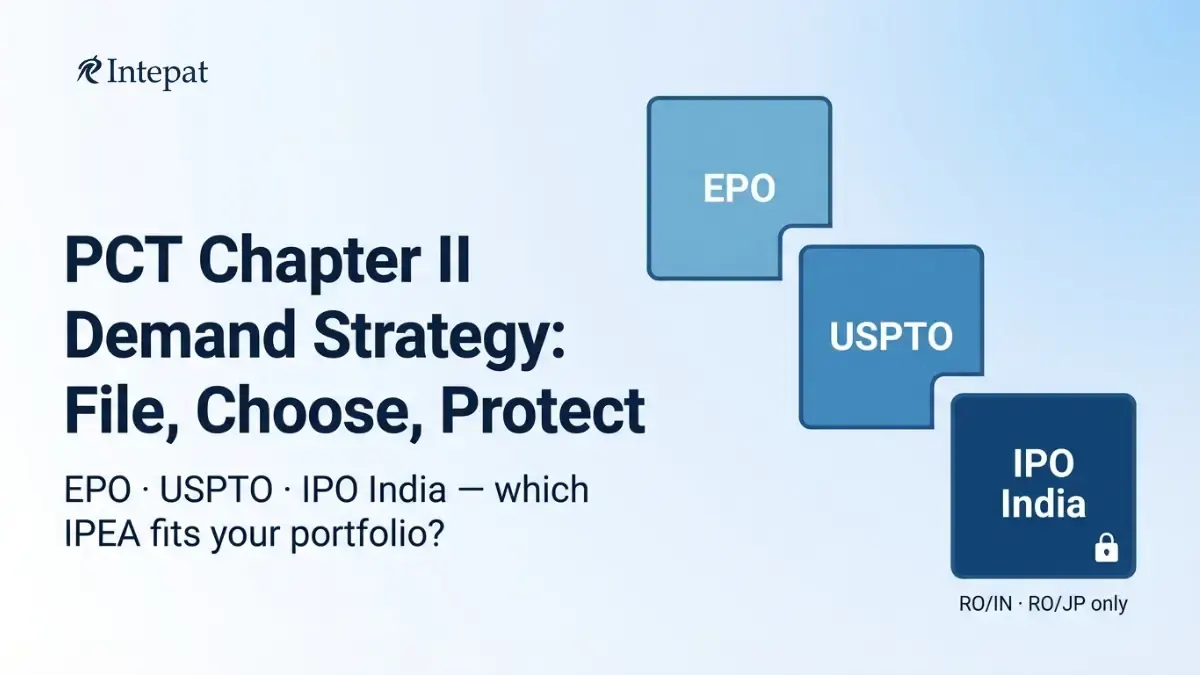
Your choice depends on your receiving Office and, for several authorities including the EPO, the USPTO, the Japan Patent Office and CNIPA, on who carried out your search. India can be elected from the Indian, Iranian and Japanese receiving Offices, and from the International Bureau where at least one applicant is a national or resident of one of those States.
| Authority | Who can elect it | Preliminary examination fee |
| Indian Patent Office | Filed at RO/IN, RO/IR or RO/JP; or at RO/IB where an applicant is a national or resident of India, Iran or Japan | ₹12,000 (₹10,000 if India did the search); ₹3,000 (₹2,500) where every applicant is a natural person, startup, small entity or educational institution |
| European Patent Office | Only after a search by the EPO or another European search authority; for RO/IN filings, the EPO, Austria or Sweden | EUR 2,010; cut by 75 per cent where every applicant is a natural person from a low or lower-middle-income State, or a natural or legal person from a validation State |
| USPTO | Only after a USPTO search, except where an applicant is a US national or resident, the filing went to RO/US or RO/IB, and the chosen search authority is competent for US applicants | USD 880 (USD 705 if the USPTO searched); lower rates for small and micro entities |
Indian fees from the WIPO Applicant’s Guide India chapter, European fees from its EPO annex and US fees from its United States annex, all verified as of October 2026. Confirm the amount on the payment date. The search authority choice behind these conditions is compared in choosing your ISA from India. Budget for one more charge: if the authority finds more than one invention in the claims, it can ask you to cut the claims back or pay again for each extra invention, which at IPEA India repeats the examination fee.
At the International Bureau, an authority is competent if it would have been competent had the application gone to the receiving Office of a State of which an applicant is a national or resident. So an Indian applicant, or one with a co-applicant from India, Iran or Japan, can still elect India there. A home-office filing is different: a US or European applicant filing at its own receiving Office cannot elect India at all, because neither office offers India, and an Indian co-applicant does not change that.
Language is a separate step. If your authority accepts neither the language the application was filed in nor the one it was published in, a translation goes in with the demand, into a language that authority accepts which is also a language of publication. IPEA India takes English only, so a Japanese-language filing at the Japanese receiving Office needs one, unless that authority also did the search and holds it already. Miss it and you get an invitation with at least a month to comply; only if you let that pass is the demand treated as not submitted.
The search conditions bite hardest on Indian filings: an applicant who chose the USPTO can elect the USPTO but not the EPO, and one who chose the Indian Patent Office can elect India, Austria, Australia or Sweden, but neither the EPO nor the USPTO.
A demand sent to an authority that is not competent is not lost at once. Whichever office or authority receives it marks the date and either forwards it to a competent authority or routes it through the International Bureau, which may instead ask you to choose where more than one is competent, by the demand deadline or 15 days from that invitation, whichever is later. The demand keeps the date first marked; fail to choose in time and it is treated as not submitted. Formal defects are curable on a similar invitation. Both are correction routes, not extra time.
All authorities collect the handling fee, CHF 200, shown as USD 251 in the India chapter. The 90 per cent cut is essentially for individuals from the countries on WIPO’s list, and for applicants of any kind from a least developed country, and only where every applicant, and every beneficial owner at the international filing date, meets one of those tests. Corporate applicants from most countries, India included, do not qualify.
What Chapter II does at the Indian Patent Office
The Chapter II report does not bind the Indian examiner, but electing India is one ground for expedited examination on Form 18A, and the amendments can be carried into the Indian application at your option.
The Rules list the grounds for expedited examination: India named as search authority or elected as examining authority; a startup or small entity applicant; natural-person applicants of whom at least one is female; government departments, institutions established by a Central, Provincial or State Act and owned or controlled by the government, government companies and bodies substantially financed by the government; an application in a sector the Central Government has notified; or an arrangement with a foreign office. For a foreign company holding none of the others, electing India is usually the way in, as our guide to choosing India as ISA and the IPEA route to Form 18A sets out, and the form requires the examining authority number IPEA India issued as mandatory evidence of that ground. Two limits: the Office may cap, by notice in its official journal, how many expedited requests it takes in a year, and a request that misses the conditions proceeds as an ordinary one, keeping the date it was filed.
Form 18A is filed only electronically, at ₹8,000 for the reduced classes and ₹60,000 for other applicants, with a request for publication unless the application is published or such a request is already on file. A Form 18 request already made converts to an expedited one on the balance fee, ₹4,000 or ₹40,000, with the evidence for the ground relied on. Once the request is in order, the Office works to internal periods that run from procedural events rather than from your filing: the examiner reports within one month of the application being referred and not more than two, the Controller disposes of that report within a month of receiving it, and the First Examination Report follows within fifteen days of that disposal.
Asking India to start before 31 months is a separate step. The express request sits on Form 18 at ₹4,000 or ₹20,000 for ordinary examination and ₹5,600 or ₹28,000 for the express request itself, those being the electronic rates and paper filing allowed at a higher one. Form 18A carries the same early-processing wording, so an applicant who already holds an expedited ground can ask for both together. Where an office is asked to begin early, it or you must ask the International Bureau for the papers, and the Bureau sends the written opinion if the report is not yet ready.
For applications filed on or after 15 March 2024, the request for examination, on Form 18 or Form 18A, is due within 31 months from the priority date or the filing date, whichever is earlier. The filing date of an Indian national phase application is the international filing date, so a PCT application filed before 15 March 2024 should keep the old 48-month period. Miss it and the application is treated as withdrawn. Entry carries its own penalty: an international application designating India is deemed withdrawn if the entry requirements are not met in time, which for most families means the national and other fees and, where the application was neither filed nor published in English, a verified English translation.
Three questions are often run together here. The 31-month date is fixed by the Rules, India does not allow reinstatement under the PCT, and the Controller’s power to correct irregularities expressly excludes both the entry date and the examination deadline. Rule 138 is a different power: up to six months on Form 4, no exclusions on its face, and you may ask more than once, but only before those six months expire. Whether it reaches these two deadlines is untested. WIPO’s India chapter still describes the version of the rule that applied before 2024, and it lists national phase entry and the request for examination among the things no extension reaches. Docket 31 months as fixed, and treat a date already missed as its own question.
Translation decides whether those amendments survive. Where India is elected and the application was not filed or published in English, the translation filed at entry must include the amendments annexed to the Chapter II report; where India was designated but not elected, it is the Article 19 claims and any statement. Either way, if it does not arrive even after the Office invites it, the amendments are disregarded.
A favourable report does not resolve objections under India’s own exclusions. Section 3(d) excludes the mere discovery of a new form of a known substance without enhanced known efficacy, of a new property or new use of a known substance, and the mere use of a known process, machine or apparatus unless the known process yields a new product or employs at least one new reactant. Section 3(k) excludes mathematical or business methods, computer programmes per se and algorithms. The Indian examiner applies both whatever the international report said. Answering the written opinion still pays, because the prior art raised internationally sits on the record India receives, and claims already narrowed to meet it arrive in that form.
When to file a demand: decision guide
Four questions settle most cases: is the opinion negative and answerable; is India a priority without another Form 18A ground; did India already search; and can you elect India at all.
- Negative written opinion you can answer: file the demand with a substantive response, amending where the objection is sound and arguing where it is not, with India as examining authority if you can elect it and India matters.
- Positive written opinion, India a priority, no other Form 18A ground: a demand with India as examining authority secures the ground, and neither amendments nor arguments may be needed.
- India was the search authority: the Form 18A ground is already held. File if you need the wider Article 34 amendments, or a second opinion on amended claims before you commit to national filings.
- Filed at a home receiving Office that does not offer India, or at the International Bureau with no applicant from India, Iran or Japan: you cannot elect India. Choose the authority that suits your other markets, or another Form 18A ground.
- India is not a target: the Form 18A point falls away; decide on the written opinion alone.
- Demand deadline passed: the India-as-examiner ground is gone. Other grounds, and India as search authority where it applied, are unaffected.
Deadlines, fees and when the report arrives
The demand is due by the later of two dates: three months from transmittal of the written opinion with either the search report or the declaration that none will be established, or 22 months from the priority date. Both fees follow within a month of the demand or by 22 months, whichever is later.
For a forwarded demand, that month runs from the competent authority’s receipt, or 22 months from priority, whichever is later; and where the authority wants to examine alongside the search it invites the fees and they fall due a month later. If the fees are short or unpaid, you get an invitation with a month to pay, and a late fee of half the unpaid amount may be added, not less than the handling fee and not more than twice it. Ignore that invitation and the demand is treated as not submitted, taking the India-as-examiner ground with it.
| Step | Time limit or amount |
| Article 19 amendment | 2 months from transmittal of the search report or 16 months from priority, whichever expires later |
| Chapter II demand | 3 months from transmittal of the search report, or the no-search declaration, with the written opinion, or 22 months from priority, whichever expires later |
| Handling fee and preliminary examination fee | 1 month from the demand or 22 months from priority, whichever expires later |
| Reply to the examiner’s written opinion | Set by the authority, normally 2 months, not under 1 or over 3, and at least 2 where the search report arrives with it; extendable if you ask before it expires |
| Chapter II report established | 28 months from priority, or later in two cases |
| Report sent to elected offices | Not before 30 months, unless you ask an office to start early |
| Withdrawal of the demand | Before 30 months from priority |
| Indian national phase entry | 31 months from priority |
| Form 18 or Form 18A in India (international application filed on or after 15 March 2024) | 31 months from priority or filing date, whichever is earlier |
| Form 18A fee, e-filing only | ₹8,000 (natural person, startup, small entity, educational institution); ₹60,000 (others) |
Indian fees from the First Schedule to the Patents Rules, verified as of October 2026. Paper filing of Form 18 costs more; Form 18A has no paper option.
A demand made after its deadline is treated as if it had not been submitted, and the examining authority will say so. There is no ordinary extension. A delay can be excused where war, revolution, civil disorder, a strike, a natural calamity, an epidemic, a general unavailability of electronic communications services or a like reason where you live, work or are staying caused it, provided you acted as soon as you reasonably could and satisfy the office with evidence offered within six months of the missed date. An office hit by a general disruption may also publish an extension of up to two months for everyone before it, and further periods if it lasts. Neither is something a docket should plan on.
A late Article 19 amendment still counts if it reaches the International Bureau before the technical preparations for publication are complete. Where the search report and written opinion are transmitted within 19 months from the priority date, the 22-month date governs the demand; a later transmittal moves it out.
File your response with the demand, and where it includes amendments add a letter showing where each one is supported in the application as filed. Without that letter the report may be drawn up as if the amendment had not been made. Timing matters: the authority need not consider amendments or arguments that reach it after it has begun to draw up its written opinion or report.
The search authority’s written opinion normally counts as the examining authority’s first opinion, so an authority can go straight to its report without a further round. Of the three authorities above, the EPO is the exception: it has told WIPO it will not treat any other authority’s written opinion as its own first opinion, so after an Austrian or Swedish search it issues its own opinion where objections remain, and may go straight to the report where none do. You can ask for another opportunity to amend, and for the start of examination to be postponed to the demand deadline.
The report is due by 28 months from the priority date, or six months from the time the Rules provide for examination to start, or six months from receipt of a required translation, whichever falls last. The International Bureau sends it to the elected offices not before 30 months, unless you expressly ask an office to start early.
India’s entry date stays at 31 months whether or not you file a demand: the Patents Rules fix it, as the PCT allows each country to do.
Common mistakes in filing a PCT Chapter II demand
Four mistakes recur: docketing the demand from the wrong date, misreading the rule for filings at the International Bureau, filing a demand that leaves the objections unanswered, and expecting the report to resolve India’s own exclusions. Each is avoidable on the day the search report arrives.
Missing the demand deadline
The deadline is the later of two dates, and a late search report moves it beyond 22 months. Docket both on the day the report arrives and take the later. A late demand is treated as not submitted, and the India-as-examiner ground is lost with it.
Misreading the RO/IB rule
Filing at the International Bureau neither closes nor opens the India route by itself. It turns on whether an applicant is a national or resident of India, Iran or Japan.
Failing to address the negative written opinion
A bare demand that leaves the objections unanswered is likely to produce a report that repeats the opinion, because the search authority’s written opinion normally counts as the examining authority’s first opinion. The mistake is silence, not the absence of amendments: the Rules let you respond by amending, by arguing, or by both, and a reasoned answer that keeps the claims can defeat an objection you think is wrong while preserving scope you would otherwise give away. Amend where the objection is sound. Where the opinion is positive and the aim is the Form 18A ground, a demand needing neither is a reasonable choice. If the objections survive into India, the negative written opinion and the Indian FER covers the response there.
Treating a positive report as clearing India’s exclusions
A positive Chapter II report helps on prior art but does not resolve objections under Section 3(d) or Section 3(k). Draft the claims for India with those exclusions in view before entry, not after the First Examination Report raises them.
The decision in plain terms
File a demand when you can answer a negative written opinion, by argument or amendment, or when electing India is your route to Form 18A and you can elect it. Otherwise Chapter I is usually enough. Either way, the demand deadline is the one to docket first.
Before filing, confirm the competent authorities for your receiving Office and search authority, the later of the two demand dates, and whether you already hold a Form 18A ground. For the entry sequence that follows, see PCT national phase entry in India.
Frequently Asked Questions
Only if at least one applicant is a national or resident of India, Iran or Japan, in which case India is a competent examining authority and can be elected in a timely demand. Otherwise Chapter II gives no India route, and Form 18A needs another ground, such as startup or small entity status, or the application proceeds on Form 18.
Indirectly, and mainly on prior art: a report on amended claims means the Indian examiner starts from narrowed claims and a debated citation list. It does not bind the examiner and does not resolve objections under Section 3(d) or Section 3(k), so for pharmaceutical and software claims it is not a reliable predictor.
There is no switch: withdraw and file again inside the demand deadline. It needs every applicant’s signature and takes effect on receipt by the Bureau. IPEA India refunds the examination fee, less a processing charge, if examination has not started. Withdrawal does not withdraw the application if it precedes the 31-month entry limit, though some countries attach conditions.
No. You may answer by argument alone where you disagree with the opinion, by amendment, or by both. What yields a report repeating the opinion is a demand that answers nothing, since the search opinion already counts as the examiner’s first. Where the opinion is positive and the aim is the Form 18A ground, a bare demand is sensible.
The office that receives it marks the date and either sends it straight to a competent authority or routes it through the International Bureau, which forwards it or asks you to choose if several are competent. The demand keeps the date first marked, but fail to choose in time and it is treated as not submitted.
Yes. Without a demand, the written opinion reaches India as a Chapter I report, no earlier than 30 months, unless you expressly ask the Office to begin sooner. If the opinion is positive and you do not need the Form 18A ground through India as examining authority, staying in Chapter I is often the sensible choice.
Each office examines under its own law and may apply criteria of its own, so no international report binds it. Where European or US prosecution matters most, choose an authority with those offices in view, within the competence rules for your filing. India as examining authority suits families where Indian speed matters and India can be elected.
No. India’s entry deadline is 31 months from the priority date with or without a demand. The PCT lets each country set a later national limit than its own, and the Indian Patents Rules fix 31 months; filing a demand neither extends nor shortens it.
This article explains the law on PCT Chapter II demands and their effect in India as at October 2026 and is for general information only. It is not legal advice. Government fees, forms, and procedures change; confirm current figures with the Indian Patent Office before you file. For advice on your specific invention, consult a registered patent agent.
Sources
- Patent Cooperation Treaty and Regulations under the PCT, in force from 1 January 2026, WIPO.
- PCT Applicant’s Guide, India (Annexes C, D and E), valid from 1 July 2026, WIPO.
- PCT Applicant’s Guide, International Bureau as receiving Office (Annex C), valid from 17 September 2026, WIPO.
- The Patents Rules 2003, consolidated (Rules 20, 22, 24B, 24C, 137, 138 and the First Schedule), IP India, as amended by G.S.R. 211(E) of 15 March 2024.
- The Patents Act 1970, as amended (Sections 3, 7, 11B and 138), IP India.