




Originally published 21 April 2026. Republished and updated 9 November 2026.
A negative PCT written opinion does not bind the Indian Patent Office. The Indian examiner applies Indian law and searches again, but the documents your international search report cited often come back in the first examination report. Use the time before India entry to amend or argue, and prepare the Section 3 points the written opinion did not test.
This guide is for applicants and their counsel taking a PCT application into the national phase in India under the Patents Act 1970 and the Patents Rules 2003, as amended, most recently by the Patent (Amendment) Rules 2025. It covers what the opinion means in India, your options before entry, and the deadlines and fees once the first examination report (FER) issues. Fees are verified as of November 2026.
Quick answer: Read the written opinion as a preview of the FER, not a verdict. Before entry, you can narrow the claims at the International Bureau or ask for international preliminary examination. After the FER, you have six months to put the application in order, and a Form 4 filed in time can add three more.
What a negative PCT written opinion means in India
The written opinion is the International Searching Authority’s view on novelty, inventive step and industrial applicability. It is preliminary and does not bind India. The Indian examiner applies the tests in the Patents Act and runs a separate search. A negative opinion is still the clearest early guide to what the FER will raise.
The treaty itself leaves each country free to apply its own or additional criteria for patentability. If no international preliminary examination report is established, the International Bureau reissues the opinion as an international preliminary report on patentability (Chapter I) and sends it to India, not before 30 months from the priority date. The examiner therefore sees it.
In our practice, the documents cited in the international search report often reappear in the Indian FER. So map each objection in the opinion to the claims you plan to enter with. You will then know, before you pay the entry fees, which objections you can answer and which need a narrower claim.
Where the Indian examiner’s prior art comes from
The examiner draws on three main sources: the international search report and opinion on the file, what you disclose about your foreign applications, and the examiner’s own search. A clean search report lowers the risk but does not remove it. The Indian search can turn up documents the international search did not.
You must tell the Indian office about your corresponding applications abroad on Form 3. The Controller can also ask for details of how those applications are being examined, and may check accessible databases. Art raised by the US, European or other offices can therefore reach the Indian file.
Keep that disclosure complete and current. Failing to disclose the required information, or giving information you know to be false in a material particular, is a ground for opposition and for revocation. Before entry, list the art each office in the family has cited. That list, with the international search report, is your working map of the FER.
Your options before India entry
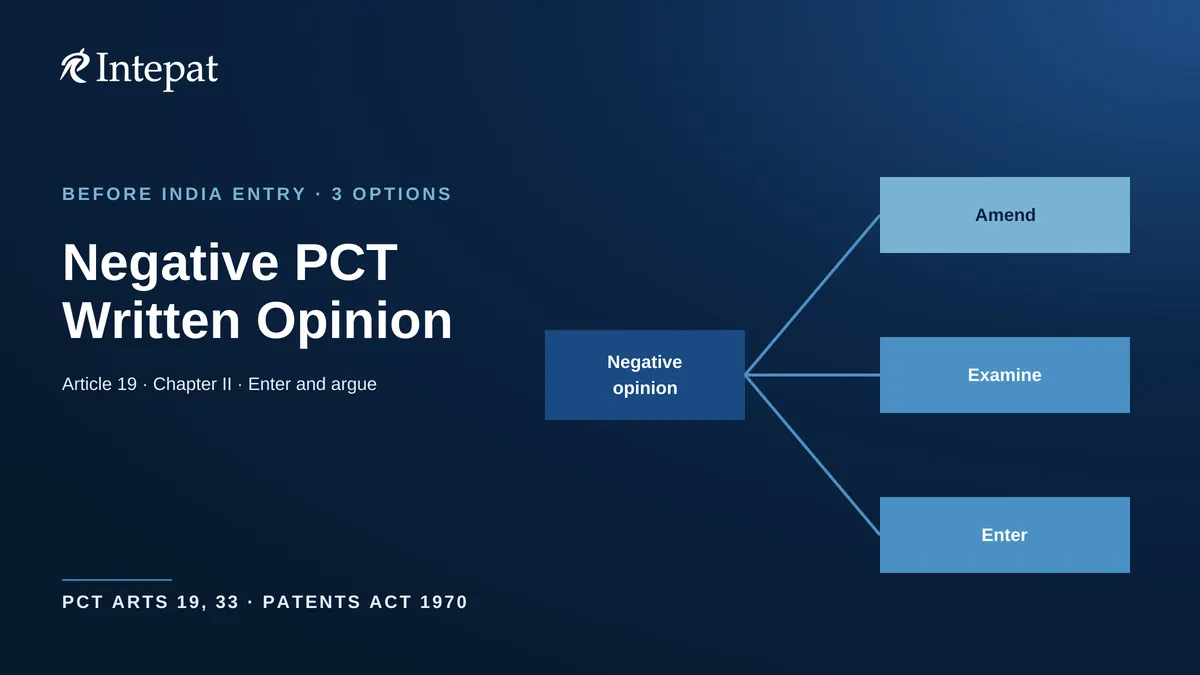
While the application is still international, you have three main options. You can amend the claims at the International Bureau under Article 19, file a demand for international preliminary examination under Chapter II, or enter India and argue at the FER. The right choice depends on the kind of objection and how much time is left.
| Option | Time limit | Effect in India |
|---|---|---|
| Article 19 amendment (claims only, filed with the International Bureau) | 2 months from transmittal of the search report, or 16 months from the priority date, whichever is later | If you wish, the amended claims become part of the application you enter with |
| Chapter II demand, with argument and amendments | 3 months from transmittal of the search report and opinion, or 22 months from the priority date, whichever is later | Ends in an international preliminary report on patentability, which India receives; choosing the Indian Patent Office as International Preliminary Examining Authority is also a ground for expedited examination |
| Enter and answer the FER | Entry within 31 months from the priority date | No international round; argue or amend in India |
An Article 19 amendment is a single opportunity, and it cannot go beyond the disclosure as filed. One that arrives after the time limit still counts if it reaches the International Bureau before the technical preparations for publication are complete. If you wish, India takes those amended claims, and amendments annexed to a Chapter II report, as part of the application you enter with. Where the application was not filed or published in English, file a translation of the amended claims, or of the annexes to the Chapter II report. If you still do not file it after the office invites you to, the amendments are disregarded.
At entry, you can delete claims, and make the changes in claim dependency that follow, without a separate request; any other change needs a Form 13 amendment request. As we understand current e-filing practice, the entry form charges the excess claims fee on the claims you file, so deleting claims at entry would lower the fee paid; no IP India document we hold says so. The Manual and WIPO count the fee on the claims in the international application as they stand at entry, so budget for a balance and pay it before month 31. Our PCT national phase fees guide gives the figures.
If an X category document takes away your main claim and nothing in the specification supports a narrower one, ask whether India entry is worth the cost before you pay for it. Our guides to amendments in the international phase and the Chapter II demand explain each tool.
What the written opinion does not test: Section 3
The written opinion does not assess Section 3 of the Patents Act, which lists things that are not inventions in India. An opinion with no objection says nothing about whether a pharmaceutical form or a software claim will clear it. Prepare those arguments before the FER arrives.
Section 3(d) has three limbs. It excludes the mere discovery of a new form of a known substance that does not enhance its known efficacy. It also excludes the mere discovery of a new property or new use for a known substance, and the mere use of a known process, machine or apparatus, unless the known process results in a new product or employs at least one new reactant. Salts, esters, polymorphs, isomers and other derivatives count as the same substance unless they differ significantly in properties with regard to efficacy.
So a new salt or polymorph needs evidence of enhanced efficacy, gathered before the FER, and a new formulation may also need it. Section 3(k) excludes a mathematical or business method, a computer programme per se and algorithms. A claim to a method carried out by software can draw this objection whatever the written opinion said. Our guide to patentability objections at PCT national phase covers how they arise.
Deadlines and fees once the FER issues
You have six months from the date the FER issues to put the application in order for grant. A Form 4 request can add three months. If the application is still not in order after that, and no further extension is allowed, it is deemed abandoned. Separately, update your Form 3 within three months of the FER.
| Step | Time limit | Official fee, online: lower / other |
|---|---|---|
| Put the application in order for grant | 6 months from the date the FER issues | No separate fee |
| Extend that period on Form 4 | 3 more months | Rs 1,000 / Rs 4,000 a month |
| Same, on the expedited route | 6 months, then 3 more on Form 4 | Rs 2,000 / Rs 10,000 a month |
| Update Form 3 on foreign applications | 3 months from the date the FER issues | No fee |
| Extend or condone a late Form 3 on Form 4 | Up to 3 months | Rs 2,000 / Rs 10,000 a month |
| Voluntary amendment before grant on Form 13 | Any time before grant | Rs 800 / Rs 4,000 |
Source: First Schedule to the Patents Rules (verified as of November 2026). The lower fee applies to individuals, startups, small entities and educational institutions; startups, small entities and educational institutions file Form 28 to claim it. Paper filing costs about ten per cent more.
Here is how the dates run. Suppose the FER issued on 16 January 2026. You have until 16 July 2026, and an extension takes that to 16 October 2026; three months at the lower fee cost Rs 3,000.
The rule asks for the request “before expiry of the period specified herein”. The words “specified herein”, substituted in March 2024, support making the request inside the three months, but the office has not confirmed that reading. In our practice we file it before the first six months end.
After nine months, treat the date as final. The general six-month extension in the Rules lists no exclusions, and IP India’s Patent FAQ says it can add up to six more months here. The FAQ is guidance with no legal effect and relief is discretionary, so do not plan on it. Your undertaking on foreign filings runs until grant, so record later foreign filings as well. Our guides to the first examination report and to foreign filing disclosure at PCT national phase give the detail.
Faster examination when India searched or examined
If India was the International Searching Authority, or you elected it as the International Preliminary Examining Authority, you can ask for expedited examination on Form 18A. The Rules then set shorter internal periods for the examiner and the Controller. They do not promise a date for your FER.
File Form 18A electronically, within the period for requesting examination, with the search or examination number India issued as evidence. The fee is Rs 8,000 at the lower rate and Rs 60,000 for others. Unless the application has already been published early on request, or a request for early publication is on file, the request must go with a request for early publication on Form 9.
On the ordinary route, the examiner ordinarily reports within one month of reference, and not more than three. On the expedited route the outer limit is two months. The Controller then has one month to deal with the report on the expedited route, and ordinarily one month on the ordinary route. The FER issues within one month of that on the ordinary route, or fifteen days on the expedited one. How long an application waits before it is referred to an examiner is not fixed. Our guide to choosing your ISA from India explains the search side.
Building the FER response for a negative-opinion application
Start from the written opinion. For each objection, decide whether to argue, amend or both, and check every amendment against the four limits Indian law sets. Run any argument on excluded subject matter in parallel, because it needs different evidence from a prior art reply. If you reply in time and the examiner still objects, ask for a hearing at least ten days before the put-in-order period ends.
An amendment must be by way of disclaimer, correction or explanation. It may only incorporate actual fact. It must not add matter that was not in substance disclosed, and every amended claim must fall wholly within the scope of a claim before the amendment. For a voluntary amendment, apply on Form 13 with the fee shown above. Amendments made only to meet the FER objections go in with your response.
Where you narrowed the claims before entry, show that the amendment answers the cited documents, point to the support in the specification, and deal with any new citations. Where you did not, argue novelty and inventive step under Indian law, or amend within the four limits. Keep your Indian positions consistent with those taken abroad, since the office can see how corresponding applications were examined. Our PCT national phase guide for India covers the entry formalities.
FAQ
Not automatically. India is not bound by the written opinion, and the examiner runs a separate search under Indian law. A positive opinion helps your arguments, but the FER can still cite documents the international search missed, or raise Section 3. Treat a clean report as lower risk, not as clearance.
Yes. You can apply to amend on Form 13 at any time before grant, paying Rs 800 or Rs 4,000 online. Each amendment must be a disclaimer, correction or explanation, only incorporate actual fact, add no new matter and keep every claim within an existing claim. At entry, deleting claims, and the dependency changes that follow, need no separate request.
Often, yes, if the specification supports a narrower claim. An Article 19 amendment narrows the claims for every designated country at once, and, if you wish, India takes it into the application you enter with. Check first that the narrower claim still works in your other markets, and file within the time limit.
No. The written opinion applies the treaty’s tests and does not assess Section 3(d). A new form of a known substance, such as a salt or polymorph, counts as the same substance unless it differs significantly in properties with regard to efficacy. Gather efficacy data before the FER arrives.
You can still enter by month 31 and answer the FER, amending within Indian limits. The ordinary Article 19 deadline has also passed, because it ends before the Chapter II deadline. You lose the international examination round and the chance to have the Indian Patent Office examine it as International Preliminary Examining Authority, which is a ground for expedited examination.
This article explains the law on how a negative PCT written opinion affects examination in India as at November 2026 and is for general information only. It is not legal advice. Government fees, forms, and procedures change; confirm current figures with the Indian Patent Office before you file. For advice on your specific invention, consult a registered patent agent.
Sources
- The Patents Act 1970, incorporating all amendments till 1 August 2024, IP India, accessed 9 November 2026.
- The Patents Rules 2003, consolidated, IP India, accessed 9 November 2026.
- First Schedule of fees, Patents Rules 2003, IP India, file dated 31 July 2026, accessed 9 November 2026.
- Regulations under the PCT, in force from 1 January 2026, WIPO, accessed 9 November 2026.
- PCT Applicant’s Guide, National Phase, India, WIPO, applicable from 1 July 2026, accessed 9 November 2026.