




Originally published 23 April 2026. Republished and updated 19 November 2026.
Unity of invention in India is decided by the Indian Patent Office, not by the International Searching Authority (ISA) that raised an objection. The Office looks at the claims again under the Patents Act, 1970 once the application enters the national phase, and a divisional application in India can keep the other inventions alive.
This guide is for foreign counsel and applicants whose PCT application is heading for India after a lack-of-unity finding. It explains what the finding means, how the Indian Patent Office treats unity, and how divisional applications keep the other inventions alive.
Quick answer: An ISA unity finding does not bind the Indian Patent Office, which applies the Patents Act’s own test to the claims it receives. We have found nothing in the Act or Rules that treats inventions the ISA did not search as withdrawn. A divisional application under Section 16 can be filed at any time before the patent is granted, for an invention disclosed in the specification. The Act and the Patents Rules look to disclosure in the specification; the 2019 Manual, written before the 2024 Rules, still ties divisional claims to the parent’s claims, so confirm with local counsel how the Office treats never-claimed matter.
What an ISA unity objection means before India entry
When an ISA considers that an international application lacks unity of invention, it invites the applicant to pay additional search fees, and the applicant has one month from the date of the invitation to pay. The ISA searches the invention first mentioned in the claims and, if the fees are paid, the other inventions they cover. An applicant can pay under protest, with a reasoned statement that the application has unity or that the fees are excessive. A review body examines the protest, and on request the protest and the decision are notified to the designated Offices with the search report; the applicant supplies any required translation. If the ISA requires a protest fee, it must be paid within the same one month, or the protest is treated as not made.
If the applicant pays nothing, the search report ordinarily covers the first-mentioned invention only, so check the report to see which claims were actually searched.
On the Chapter II route, an International Preliminary Examining Authority (IPEA) that finds a lack of unity may invite the applicant either to restrict the claims or to pay additional fees, within one month of the invitation. If the applicant does neither, the report covers what appears to be the main invention.
The treaty lets a country provide that, where its Office finds the ISA’s invitation justified and the applicant has not paid all the additional fees, the unsearched parts are treated as withdrawn there unless a special fee is paid, and it allows similar provisions for the IPEA stage. We have found no such provision in the Indian Patents Act or Rules. Even so, none of these international choices decides the Indian unity assessment, which the Office makes under the Patents Act on the claims it receives once the application enters the national phase. For the entry steps, see PCT national phase entry in India.
Unity of invention in India: does the Patent Office adopt the ISA’s finding?
No. The Patents Act asks that the claims of a complete specification relate to a single invention, or to a group of inventions linked so as to form a single inventive concept. The Patent Office Manual says that where an application comprises a plurality of inventive concepts, the examiner refers to this in the examiner’s report, and that the application may be divided to meet the objection. The Manual says the opinions of the ISA and IPEA are non-binding on member countries, and we have found nothing in the Act, the Rules or the Manual that makes a unity finding binding on the Office.
The PCT has its own test in its Regulations: one invention, or a group linked as a single general inventive concept, with a technical relationship through the same or corresponding special technical features that contribute over the prior art. That test governs the international phase (Regulations under the PCT). The Indian text speaks of a single inventive concept and does not use the PCT’s special technical features test. The PCT bars national law from requiring requirements for the international application different from or additional to those in the Treaty and Regulations (Article 27(1)), and we have not found Office practice on how that applies to unity, so ask local counsel. The two assessments can differ: an application the ISA found lacking unity may pass in India, and one it passed may draw an objection.
When the Indian Patent Office raises a unity objection
If the examiner considers that the claimed inventions are not linked as a single inventive concept, the Manual indicates that the examiner’s report will refer to it, and it may be raised in the first statement of objections. The application must be put in order within six months of that statement. The Rules allow a further three months on a request made on Form 4 with the prescribed fee. The Rule requires the request before expiry of “the period specified herein”. The 2019 Manual, written before the 2024 amendment, says the Form 4 request is made within the prescribed six months, and we have not found the Office addressing the point under the current Rule, so file the request before the first six months end.
An application not put in order in time is deemed abandoned. We have not found Office practice confirming relief for this period, so we do not rely on any. Treat nine months from the first statement of objections as the last date. Our First Examination Report guide covers the timeline.
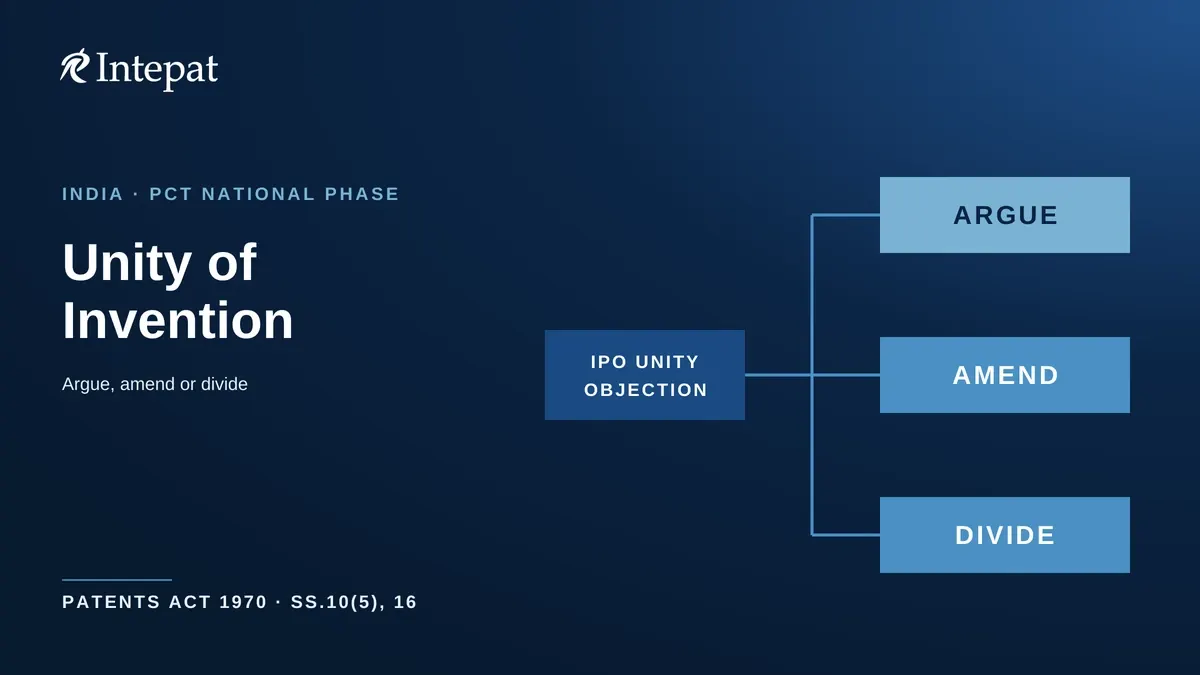
Three responses are available. The first is to argue that the claims form one inventive concept. That works only if the claims are in fact so linked, which is a judgment for the Indian agent. A protest decision can be put forward, but we have found nothing that makes it binding.
The second is to amend the claims to one inventive concept. The Act allows amendment only by disclaimer, correction or explanation, only for incorporating actual fact, and bars any amendment that would claim or describe matter not in substance disclosed or shown in the specification before the amendment, or that would take a claim outside the scope of a claim as it stood before.
The third is to file a divisional application for the claims you are setting aside. That keeps the subject matter alive without abandoning it, but it is a separate application: the objection in the parent must still be answered by its own deadline.
Filing a divisional application after a PCT unity objection
The Act lets an applicant file a further application, called a divisional, at any time before the grant of the patent, either voluntarily or to remedy an objection that the claims relate to more than one invention. It must be for an invention disclosed in the provisional or complete specification already filed. Its complete specification must not include matter not in substance disclosed in the parent’s complete specification, and the Controller may require amendment of either so that neither claims what the other claims.
The Patents Rules state this freedom expressly and also cover a further application filed from an earlier further application: an applicant may file one or more further applications, including for an invention disclosed in the provisional or complete specification or in a further application filed under section 16. A divisional can therefore be made from a divisional.
Because the Act already speaks of an invention disclosed in the specification, unclaimed matter can support a divisional. The 2019 Manual, however, says the claims of a divisional shall be based on the claims of the application it is divided from, and that no claims outside their scope are allowable. Ask local counsel which basis the Office is applying before you draft divisional claims for unclaimed matter.
| Point | Position for a PCT national phase application |
|---|---|
| Filing date | Treated as filed on the parent’s date, which is the international filing date; the parent’s priority carries over |
| Patent term | Twenty years from the international filing date, as the Manual puts it for applications divided out of a national phase application |
| Where to file | At the appropriate office of the parent application |
| Papers | A complete specification referring to the parent’s application number; all fees that apply to a patent application are payable again |
| Power of attorney | Not required again only if the parent’s power expressly covers divisionals; otherwise file a fresh one |
| Proof of right | Not required again if it was filed with the parent in the prescribed manner |
| Request for examination | Within 31 months from the parent’s priority date (or filing date if none), or six months from filing the divisional, whichever is later; with the divisional itself if the parent has already been referred to the examiner (applications filed before the 2024 amendment keep the former period) |
| If the parent is already with the examiner | The divisional must be filed with its request for examination, is published within one month and then referred to the examiner within one month |
| Examination | Reference to the examiner follows the parent’s order, and the divisional is examined against the parent and earlier divisionals to avoid double patenting |
Do not wait for the grant. The Act’s cut-off is the grant of the patent, so file well before the parent is put in order. Whether a divisional can still be filed once the parent has been refused or has lapsed is a question for local counsel, and you should not rely on it.
What foreign counsel should settle before entry
Before a PCT application enters India after an ISA unity objection, foreign counsel should settle four points with the Indian agent: what was unsearched, what was amended out, when to divide, and how the protest is used. Entry is due within 31 months from the priority date, preferably on Form 1, with payment of the prescribed national and other fees and a verified English translation if the international application was not filed or not published in English. Entry does not itself request examination: for applications under the 2024 Rules, request it separately on Form 18 by the same date. India has opted out of PCT reinstatement of rights, so plan on that date as final, and take immediate advice under Indian law if it is missed.
First, list every invention the ISA did not search or the IPEA did not examine. Each remains in the specification unless it was amended out in the international phase, and the Act allows a divisional for an invention disclosed there. Ask local counsel how the Office applies the Manual’s parent-claims rule to matter never claimed, and check what the parent and earlier divisionals already claim.
Second, separate inventions that were simply unsearched from claims that were amended out in the international phase. On the Indian entry form only deletion of claims is allowed, with the dependency changes that follow, and amendments made in the international phase can be taken as amendments before the Indian Office if the applicant so desires, with a translation of amended claims where one is required. If the translation is not filed even after the Office invites it, the Office disregards the amended claims. Any other change needs a separate request for amendment under the Act, which the Controller allows at their discretion. Where an international amendment is taken as an amendment before the Indian Office, the deleted claims are not in the Indian parent, but the disclosure may still support a divisional. See amendments made in the international phase.
Third, brief the Indian agent on the divisional option before the examination report issues. A voluntary divisional can be filed on your own timetable, ideally before any objection arrives, while one filed to remedy an objection responds to the Controller’s unity objection. In either case the Controller may require amendment so that neither application claims what the other claims. Our guide to divisional applications in India covers the general practice.
Fourth, treat the ISA’s finding and any protest outcome as background only, because the Indian Office assesses unity on the claims as entered.
FAQ
The ISA normally records the paid groups in one search report, and the Indian Patent Office is not bound by it. It examines the claims it receives under the Patents Act and may reach a different unity conclusion, or raise no unity objection at all.
Check first which claim set was taken forward in India, because the claims that enter depend on whether a replacement set was filed under Article 19 or 34. If the inventions are disclosed in the specification but not in the Indian claims, the Act allows a divisional for them, but ask local counsel how the Office applies the Manual’s parent-claims rule.
The Act permits a divisional for an invention disclosed in the specification, and the Rules confirm that further applications may be filed on that basis. The 2019 Manual speaks of divisional claims being based on the parent’s claims, so ask local counsel which basis the Office applies to matter that was never claimed.
You can argue it. Show that the claims share one inventive concept, with the technical link between them set out clearly. A divisional is not the sole route, and the Act allows it at any time before grant, but file it well before the parent is put in order, because an abandoned parent may not support one.
The Act allows a divisional at any time before the grant of the patent. For the divisional’s own request for examination, the period is 31 months from the parent’s filing or priority date, or six months from filing the divisional, whichever is later. If the parent has already been referred to the examiner, file the request with the divisional.
This article reflects the Patents Act as consolidated to 1 August 2024, the Patents Rules as read on 27 October 2026 and the 2019 Manual, checked in November 2026. It covers PCT national phase practice before the Indian Patent Office and is for general information only. It is not legal advice. Readers should seek specific advice based on their facts.
Sources
- The Patents Act, 1970, incorporating all amendments till 1 August 2024, Office of the Controller General of Patents, Designs and Trade Marks. https://ipindia.gov.in/storage/uploads/docs-operator/73b5bf10-b04e-4f45-abef-87ff117315dc.pdf
- The Patents Rules, 2003, as amended, rule by rule text, Office of the Controller General of Patents, Designs and Trade Marks, read November 2026. https://ipindia.gov.in/acts/patent-rules-2003
- Manual of Patent Office Practice and Procedure, 2019, Office of the Controller General of Patents, Designs and Trade Marks. https://ipindia.gov.in/storage/uploads/docs-operator/e1adfe40-7af3-4180-ba04-2e0099c6dca5.pdf
- Patent Cooperation Treaty, Articles 17, 27 and 34, World Intellectual Property Organization. https://www.wipo.int/en/web/pct-system/texts/articles/a17
- Regulations under the Patent Cooperation Treaty, as in force from 1 January 2026, Rules 13 and 40, World Intellectual Property Organization. https://www.wipo.int/en/web/pct-system/texts/rules/rtoc1