




Originally published 30 July 2026. Republished and updated 9 November 2026.
A PCT application has two routes for voluntary amendment in the international phase. An Article 19 amendment is one early opportunity to amend the claims alone. Article 34 reaches the claims, description and drawings once a Chapter II Demand is filed, and runs until the report is established, though the authority need not take into account amendments that reach it after it has begun drafting.
This is an international phase guide under the Patent Cooperation Treaty (PCT). For the full national phase picture once India is a target, read Intepat’s guide to the Patent Cooperation Treaty in India. The Indian position is flagged near the end.
Quick answer: Article 19 amends claims only, filed with the International Bureau, within two months of transmittal of the search report or 16 months from priority, whichever is later. Article 34 amends claims, description and drawings before the examining authority, and needs a Chapter II Demand. Neither route may add matter beyond the application as filed, though a designated state’s law may excuse a breach of that limit for Article 19.
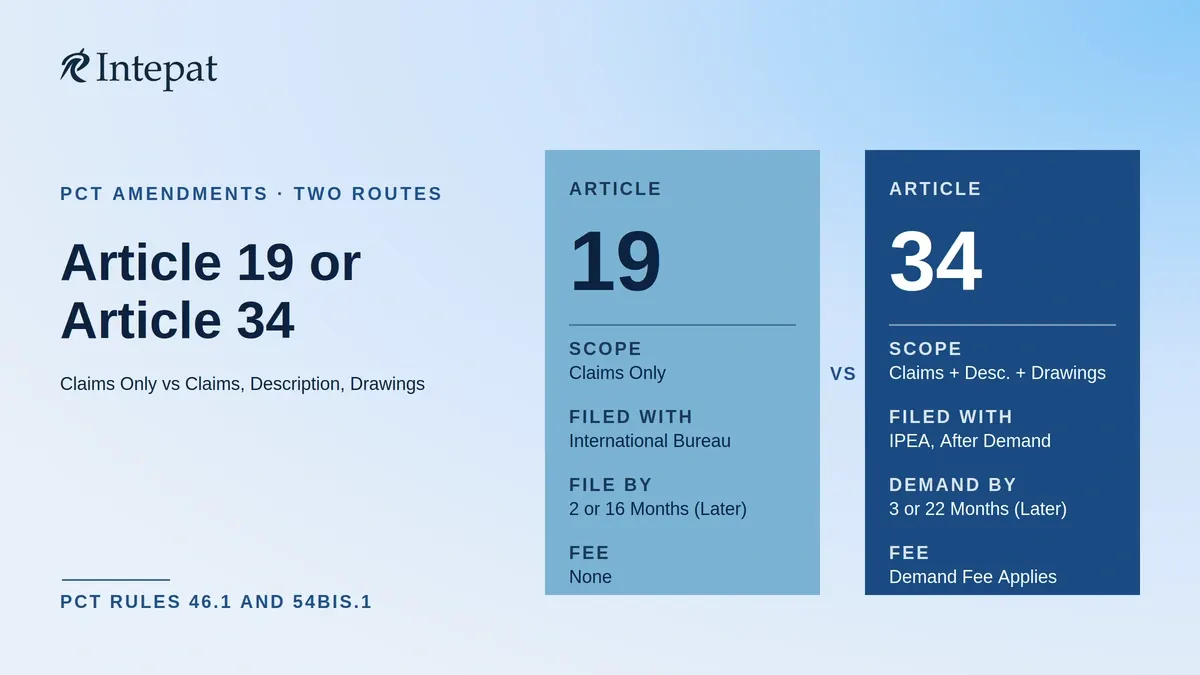
Article 19: Amending the Claims After the Search Report
Article 19 gives one opportunity, after you receive the international search report, to amend the claims by filing with the International Bureau. The period is two months from transmittal of the search report or 16 months from the priority date, whichever expires later. The description and drawings stay as filed.
The amendment is filed directly with the International Bureau. The search report itself comes from the searching authority you chose at filing; for that choice, see our guide to the International Searching Authority from India.
An amendment that arrives after the period is treated as received on the last day of that period, but only if it reaches the International Bureau before the technical preparations for international publication are complete. The Treaty ties the opportunity to receipt of the international search report.
Filing an Article 19 Amendment
An Article 19 amendment is a complete replacement set of claims. It must come with a letter that identifies the claims that differ from those filed, identifies any claims that are cancelled, and gives the basis for the amendments in the application as filed.
You may add a short statement explaining the amendment and its effect on the description and drawings. It may not exceed 500 words in English, must carry a heading such as “Statement under Article 19(1)”, and may not disparage the search report or the relevance of its citations. A citation can be mentioned only in connection with an amendment to the claim it was raised against.
The amendment must be in the language in which the application is published. Where a translation of the application was required for the examining authority, a translation of an Article 19 amendment that is to be taken into account in the preliminary examination, and of its letter, must also be submitted in the language of that translation. If you have already filed a Demand, you should preferably file a copy of the amendment, the statement and the letter with the examining authority at the same time as you file with the International Bureau. The Bureau forwards them in any case.
When Article 19 Is Worth Filing
One reason to use Article 19 is to replace the claims with an amended set without filing a Demand. Where claims are amended under Article 19, the international publication carries the claims both as filed and as amended, together with any compliant statement. The Regulations set no fee for the amendment itself.
You do not need to repeat an Article 19 amendment after a Demand. Amendments made before the Demand are taken into account in the international preliminary examination unless a later Article 34 amendment replaces or reverses them. An applicant who is going to file a Demand anyway can skip Article 19 and amend the claims, description and drawings together under Article 34, but the amended claims are then not published with the application, and the authority need not consider amendments that reach it late.
Article 34: Broader Amendment Through the Chapter II Demand
Article 34 opens only once you file a Demand for international preliminary examination. You then have the right to amend the claims, the description and the drawings before the examining authority, with the Demand or afterwards, until the report is established. For the decision on whether a Demand is worth filing at all, see our Chapter II Demand strategy guide.
The Demand must be made within three months from transmittal of the search report (or of the declaration that none will be established) and the Written Opinion, or 22 months from the priority date, whichever expires later. A Demand made after that is treated as not submitted, and the examining authority declares so.
An amendment need not be taken into account for a written opinion or the report if it reaches the authority after it has begun to draw up that opinion or report. File with the Demand where you can, and answer any written opinion with your amendments in hand.
Within the international phase, only Article 34 permits amendment, as the Regulations define it, of the description and the drawings. An obvious mistake can be rectified separately without a Demand, but only if the competent authority authorizes it. It must not add matter that was missing from the application as filed.
Filing an Article 34 Amendment
For the description or drawings, you file a replacement sheet for every sheet that changes. A letter must accompany the sheets, draw attention to the differences, and give the basis for the amendment in the application as filed. It should preferably also explain the reasons. A deleted sheet needs only a letter. Deletions of passages, or minor alterations or additions, may be made on a copy of the sheet if it stays clear and reproducible.
For the claims, the Article 19 form applies: a complete replacement set with a letter. The set replaces all claims as filed or as amended earlier under either Article. The letter must give the basis for the amendment. If it does not, the examining authority may draw up the report as if the amendment had not been made.
If the application was filed in a language other than the language of publication, the amendments and letters go in the language of publication. Where the authority required a translation of the application, they go in the language of that translation instead.
Article 19 vs Article 34 at a Glance
| Feature | Article 19 | Article 34 |
|---|---|---|
| Scope | Claims only | Claims, description and drawings |
| Precondition | Search report received | Chapter II Demand filed |
| Filed with | International Bureau | Examining authority |
| Period | Later of 2 months from search report transmittal or 16 months from priority | Demand: later of 3 months from transmittal of the search report and Written Opinion, or 22 months from priority; amendment until the report is established; the authority need not take into account amendments received after it has begun drafting |
| Number of filings | One opportunity | More than one amendment possible |
| New matter | Not permitted | Not permitted |
| Fee for the amendment | None set by the Rules | None set by the Rules; the Demand carries its own fees |
Verified as of November 2026 against the PCT Regulations in force from 1 January 2026.
Choosing the Right Amendment Route
The choice usually follows what the Written Opinion objects to, as well as cost. If the objections are about claim language, narrowing or clarifying the claims is a drafting task in its own right (see our guide on amending and deleting patent claims), and Article 19 can place a supported claim set on the record. If the objections reach the description or drawings, an Article 34 amendment through a Demand is the international phase route (obvious mistakes aside).
Where the objections are narrow and only the claims need to change, Article 19 avoids the cost of a Demand. Where the description or drawings must change, or you want amended claims examined, a Demand is the route. Whether an amended text is operative in a given country still depends on that office’s own filing and translation requirements.
The New Matter Limit Under Both Articles
Both articles use the same limit: an amendment “shall not go beyond the disclosure in the international application as filed”. The consequence of overstepping follows in the report. If the examining authority considers that an amendment goes beyond the disclosure, the report is drawn up as if the amendment had not been made, and states the reasons.
A designated Office applies its own national law at entry. The Treaty lets a designated state whose law permits amendments beyond the disclosure treat a breach of the Article 19 limit as having no consequence there, but you should not count on that.
What Happens to These Amendments When You Enter India
For Indian purposes, the application you enter with is the international application as filed, including Article 19 amendments communicated to the designated Office and any amendment made under Article 34 (Rule 20 of the Patents Rules). Article 19 amendments are therefore part of that application if they were communicated, subject to the translation condition below; confirm that before you instruct Indian counsel.
Section 138(6) of the Patents Act 1970 adds that an amendment proposed for an international application designating, or designating and electing, India before the international searching authority or the preliminary examining authority is taken as an amendment made before the Patent Office, if the applicant so desires. It does not name an Article 19 amendment, which is filed with the International Bureau, so rely on the Rule 20 definition, which does name Article 19 amendments that were communicated.
Translation is one condition for an amendment to survive. Where an English translation of the application is required, it must cover the Article 19 amended claims and any statement (if India was not elected) or the amendments annexed to the examination report (if India was elected). An amendment left untranslated is disregarded if the office invites a translation and none arrives in the time fixed. Our guide to PCT national phase translation requirements for India sets out the checklist. Amendments made after entry fall under Indian procedure and are covered in our guide to PCT national phase amendments in India.
Frequently Asked Questions on PCT Amendments Under Article 19 and Article 34
No. Article 19 lets you amend the claims only, in one opportunity, by filing a complete replacement set with the International Bureau. The description and drawings stay as filed under Article 19. If they need substantive change within the international phase, file a Chapter II Demand and amend under Article 34 (an obvious mistake can be rectified separately).
The amendment must reach the International Bureau within two months from transmittal of the international search report or 16 months from the priority date, whichever expires later. A late amendment is treated as received on the last day of that period if it arrives before the technical preparations for international publication are complete.
The Regulations set no fee for filing an Article 19 amendment. Professional charges for drafting the claims and the required letter may still apply, depending on how much changes. A Demand, if you file one, carries its own fees.
A Demand may be made until the later of three months from transmittal to the applicant of the search report, or the declaration that none will be established, and the Written Opinion, or 22 months from the priority date. A Demand made after that is treated as not submitted, and the examining authority declares so.
No. Both articles bar amendments that go beyond the disclosure in the application as filed. An examining authority that finds new matter draws up the report as if the amendment had not been made, and each designated Office applies its own law at entry.
No. The international preliminary report is not a grant decision. The Indian Patent Office processes the application after national phase entry under the Patents Act 1970 and may raise its own objections, whatever the international report says about the claims.
Not necessarily. Article 19 suits a narrow aim: replacing the claims without filing a Demand. A Demand fits where you want the amended claims examined before national phase, or where the description or drawings must change too. Weigh it against the cost and the Demand deadline (the later of three months from transmittal of the search report and Written Opinion, or 22 months from priority).
This article explains the PCT amendment routes under Article 19 and Article 34 as at November 2026, with the Indian national phase effect, and is for general information only. It is not legal advice. Treaty periods, forms and fees change; confirm current figures with the International Bureau and the Indian Patent Office before you file. For advice on your specific application, consult a registered patent agent.
Sources
- Patent Cooperation Treaty, Articles 19 and 34, WIPO (read November 2026): Article 19 and Article 34.
- Regulations under the PCT, in force from 1 January 2026, WIPO: Rule 46, Rule 54bis, Rule 55, Rule 62, Rule 66 and Rule 70.
- The Patents Rules 2003, Rule 20, IP India (read November 2026): Rule 20.
- The Patents Act 1970, section 138, IP India (read November 2026): Section 138.