




Choosing India as ISA is open only to PCT applications filed at RO/IN, RO/JP (English filings only) or RO/IR, or at RO/IB by an applicant entitled to one of them. For them, the Indian Patent Office (IPO) has the lowest published search fee of the eight ISAs at RO/IN, searches in English, and gives eligibility to request expedited examination in India regardless of applicant category.
This guide sets out who can make that choice, what it unlocks, and when another authority serves better. For a side-by-side comparison of all eight ISAs open to an applicant filing from India, see our guide on how to choose your International Searching Authority from India. For how the fast-track procedure itself works, see our guide on expedited patent examination in India.
Quick answer
- India can be ISA only for applications filed at RO/IN, RO/JP (in English) or RO/IR, or at RO/IB by an applicant entitled to one of those offices; the same offices open India as IPEA, without the English condition at RO/JP. A US, European, Korean or Chinese applicant without such an entitlement cannot choose India.
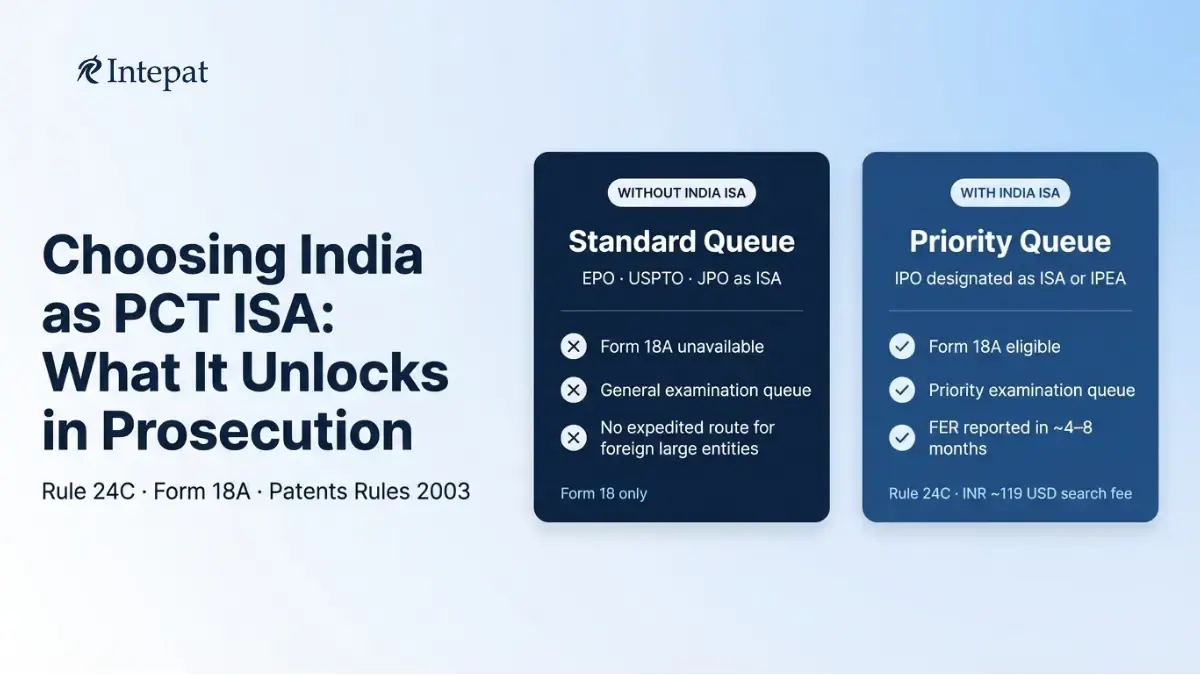
- Naming India as ISA, or electing India as IPEA, is a Rule 24C(1)(a) ground for expedited examination (Form 18A) at the Indian national phase. It matters most to a large company; startups and small entities, Indian or foreign, qualify on their own status.
- The IPO search fee is INR 10,000, or INR 2,500 for natural persons, startups, small entities and educational institutions.
- For an RO/IN filing, an IPO search rules out the EPO, the USPTO, the CNIPA and the JPO as IPEA later.
What the ISA and IPEA designations mean
Every PCT application is searched by an ISA, which issues an International Search Report (ISR) and a Written Opinion on patentability. If a Chapter II Demand is filed, an International Preliminary Examining Authority (IPEA) carries out international preliminary examination and issues an International Preliminary Report on Patentability (IPRP Chapter II). The applicant names the ISA when filing and the IPEA when filing the Demand.
The ISA choice is made at filing and should be treated as fixed; an applicant should not assume it can be changed later. India’s competence as ISA and IPEA, and its fees, are set out in the WIPO PCT Applicant’s Guide, Annexes C(IN), D(IN) and E(IN) (see Sources); this post uses the version valid from 1 July 2026.
Who can choose India as ISA
The ISAs open to an applicant depend on the receiving office (RO) where the PCT application is filed. The IPO is competent as ISA, and as IPEA, only for applications filed at three receiving offices, India (RO/IN), Japan (RO/JP) and Iran (RO/IR), or at the International Bureau (RO/IB) by an applicant entitled to one of them.
Applicants filing at RO/IN
RO/IN is the receiving office for nationals and residents of India. An applicant filing there may choose India as ISA, or any of seven other authorities: the Austrian Patent Office, IP Australia, the China National Intellectual Property Administration, the European Patent Office, the Japan Patent Office, the Swedish Intellectual Property Office and the United States Patent and Trademark Office. An Indian resident must first clear Section 39 of the Patents Act 1970, covered in our guide on filing a PCT application from India.
Applicants filing at RO/JP
The Japan Patent Office lists India among the ISAs competent for its receiving office, but only where the international application is filed in English.
Applicants filing at RO/IB
The International Bureau makes available the ISAs, and IPEAs, that would have been competent had the application been filed at the receiving office of the State of which the applicant, or at least one of the applicants, is a national or resident. India is therefore available at RO/IB only to an applicant who could have filed at RO/IN, RO/JP or RO/IR, and, as ISA through a Japanese entitlement, only for an English filing.
Key point for foreign applicants: India is not available as ISA at the US, European, Korean or Chinese receiving offices. A foreign applicant can name India only by filing at RO/IN, RO/JP (in English), RO/IR or RO/IB, and only if at least one applicant is a national or resident of India, Japan or Iran. Otherwise, Form 18A in India depends on the other Rule 24C grounds below.
The strategic case for India as ISA
Form 18A eligibility: the main benefit
Under Rule 24C of the Patents Rules 2003, a request for expedited examination on Form 18A can be filed only on a listed ground. Rule 24C(1)(a) covers an application where India was indicated as ISA or elected as IPEA in the corresponding international application; this page calls it the ISA or IPEA ground. The others are that the applicant is a startup; a small entity; a female sole applicant, or joint applicants who are all natural persons with at least one female applicant; a Government department; an institution established by a Central, Provincial or State Act and owned or controlled by the Government; a Government company; an institution wholly or substantially financed by the Government; that the application is in a sector notified by the Central Government; or that the applicant is eligible under an arrangement between the IPO and a foreign patent office.
The ISA or IPEA ground matters most to an applicant that fits none of the other grounds, typically a large company. The startup and small entity grounds are not limited to Indian entities: a foreign entity can qualify as a startup if it meets the Startup India criteria for turnover and period of incorporation and files a declaration, and as a small entity on a declaration that its investment is within the Indian MSME limits. Reduced-fee status and Rule 24C eligibility are separate questions: being a natural person or an educational institution earns the reduced fee but is not, by itself, a Rule 24C ground.
Form 18A moves the application onto the expedited examination track. Rule 24C sets time limits for the examiner and the Controller once a request is taken up in filing order, and allows the Controller to limit the number of requests in a year; no date for grant is fixed, and the outcome still depends on the objections raised and the applicant’s replies.
Illustrative scenario: A Bengaluru medical device company that is not a startup or small entity files a PCT application at RO/IN and names the EPO as ISA to support European prosecution. At the Indian national phase, it has no Form 18A ground unless it elected India as IPEA in time, or the application falls in a notified sector or under an office-to-office arrangement. Had it named India as ISA, the ground would have been in place from filing.
Search fee advantage
The IPO search fee is far lower than the fees charged by the EPO, the USPTO and the JPO. The table compares the search fees in each authority’s Annex D of the WIPO PCT Applicant’s Guide, checked on 23 and 24 October 2026, with WIPO’s published US dollar equivalents.
| ISA | Search fee | WIPO USD equivalent | Reductions and language |
| India (IPO) | INR 10,000; INR 2,500 reduced* | USD 104; USD 26* | Reduced rate for natural persons, startups, small entities and educational institutions; searches in English |
| EPO | EUR 1,885 | USD 2,237 | 75% less where every applicant is a natural person who is a national and resident of a State on the EPO’s list, which includes India; searches in English, French or German |
| USPTO | USD 2,400 | USD 2,400 | USD 960 for a small entity and USD 480 for a micro entity meeting the USPTO criteria; searches in English |
| JPO | JPY 169,000 (English) | USD 1,059 | Searches in English for applications from RO/IN |
*Annex D(IN) applies the reduced rate to filing by a natural person, startup, small entity or educational institution. Where a joint applicant falls outside those categories, confirm the applicable rate with the IPO before filing. Fees are revised from time to time and equivalents move with exchange rates; confirm the current annex at pctlegal.wipo.int before filing.
Language
The IPO searches in English only. For an applicant filing in English, there is no translation requirement for the international search. RO/IN also accepts filings in Hindi, but a Hindi filing needs an English translation for the search under PCT Rule 12.3.
Prior art coverage
Every ISA must consult at least the PCT minimum documentation. An applicant concerned about prior art in another language or region can request a supplementary international search by a second authority under PCT Rule 45bis, before 22 months from priority. It carries a separate fee and adds to the IPO search rather than replacing it; our guide on supplementary international search covers the options. The Written Opinion is not binding on any national office, which assesses patentability under its own law.
What naming India costs later
Naming India as ISA narrows the later choice of IPEA. For an RO/IN filing, an IPO search leaves Austria, Australia, India and Sweden as possible IPEAs and rules out the EPO, the USPTO, the CNIPA and the JPO, each of which acts as IPEA only after its own search (the EPO also after an Austrian or Swedish search). It also leaves the supplementary European search payable at the European phase, unless the EPO carries out a supplementary international search, which also removes it.
When not to choose India as ISA
Consider another authority where European prosecution is the main objective and an EPO search, or the EPO as IPEA, is wanted. The same applies where India is a speculative market and the applicant already qualifies for Form 18A on its own status. Where India is a genuine priority market and the applicant has no other ground, the Form 18A ground is the strongest reason to name India.
Key deadlines: from PCT filing to Form 18A
Docket the national phase and examination-request deadlines as fixed. The Controller’s general power to extend time, as substituted in 2024, allows an extension or condonation of up to six months on a Form 4 request made within that period, and lists no exclusions; the same 2024 notification excludes the entry and examination-request periods, among others, from the separate power to correct irregularities, not from the extension power (Rules 137(2) and 138). Neurocentria (Delhi High Court, 2026), a case on a 2010 filing under the earlier rules, described both timelines as mandatory and non-extendable.
In Smythe (Madras High Court, 18 December 2025) the court read the extension power together with the examination-request rule and directed the Office to accept a request for examination filed after the period, where the applicant’s agent had miscalculated it; that order concerns the examination request, not national phase entry, and turns on its facts. Any relief is discretionary; our guide on late PCT national phase entry in India explains the position.
| Milestone | Time limit | Basis |
| ISA search fee | 1 month from receipt of the international application | PCT Rules 15.3 and 16.1(f) |
| ISR and Written Opinion | 3 months from the ISA’s receipt of the search copy or 9 months from priority, whichever is later | PCT Rule 42.1 |
| International publication | Promptly after 18 months from priority | PCT Article 21 |
| Chapter II Demand (to elect India as IPEA) | 3 months from transmittal of the ISR and Written Opinion or 22 months from priority, whichever is later; a late Demand is treated as not submitted | PCT Rule 54bis.1 |
| National phase entry in India | 31 months from priority | Patents Rules, Rule 20(4)(i) |
| Request for examination (Form 18 or Form 18A) | 31 months from the priority date or the filing date, whichever is earlier; otherwise the application is treated as withdrawn | Patents Rules, Rule 24B(1)(i); Patents Act, Section 11B(4) |
Note: The 31-month examination-request period applies since the Patents (Amendment) Rules 2024 came into force on 15 March 2024. For an application filed before that date, the earlier period (48 months) continues under Rule 24B(1)(vi); for a PCT national phase application, the filing date is the international filing date. For national phase entry, fees and documents, see our PCT national phase in India guide.
Filing Form 18A at the Indian national phase
Form 18A must be filed by electronic means within the examination-request period. The fee is INR 8,000 for natural persons, startups, small entities and educational institutions, and INR 60,000 for others. Startups, small entities and educational institutions file Form 28 with each fee-bearing document to claim the reduced rate, with the evidence of status the form lists; a natural person does not file Form 28.
Three practical points apply at the national phase. First, processing of a national phase application does not begin before 31 months from priority unless the applicant asks for it under Rule 20(4)(ii). For expedited examination before 31 months, use the option in Form 18A itself to request examination immediately, without waiting for the 31 months. The Office’s 2019 Manual also refers to an express request on Form 18 in this situation (INR 5,600 or INR 28,000 by electronic filing), so confirm the current e-filing practice before paying for both. Second, if the application has not been published in India and no early publication request has been filed, Form 9 must be filed with Form 18A (INR 2,500 or INR 12,500 by electronic filing). Third, an existing request for examination can be converted to an expedited request on furnishing the required documents and paying a balance fee of INR 4,000 or INR 40,000, with a request for early publication unless the application has already been published or such a request has already been filed.
How to designate India as ISA
The ISA is named in the PCT Request form (PCT/RO/101) at the time of international filing.
- Confirm the receiving office. India as ISA is available only for applications filed at RO/IN, RO/JP (in English) or RO/IR, or at RO/IB by an applicant entitled to one of those offices. An Indian resident clears Section 39 before filing.
- Name the IPO as ISA in the Request form’s box for the choice of International Searching Authority.
- Pay the search fee to the receiving office within one month of filing. At RO/IN, the IPO search fee can be paid through the IPO’s online filing system.
- File in English, or furnish an English translation for the search if filing in Hindi at RO/IN.
- Keep the record. Retain the international file identifying India as ISA or IPEA. When filing Form 18A on the Rule 24C(1)(a) ground, provide the relevant ISA number or IPEA number issued by India, which item 4(a) of the current IP India form requires as the supporting document; the PCT application number and date entered in item 2 are a separate field.
Practitioner note: Settle the ISA choice and the applicant’s entity classification in the filing instructions at the outset of a PCT engagement, not at national phase entry. By then the ISA choice is fixed.
The IPEA route: Chapter II Demand with India as IPEA
If India was not named as ISA, one option remains for an application filed at RO/IN, RO/JP or RO/IR, or at RO/IB by an applicant entitled to one of those offices: a Chapter II Demand electing India as IPEA. For an RO/IN filing, India can act as IPEA whichever authority carried out the search. The Demand must be filed within three months from transmittal of the ISR and Written Opinion, or 22 months from the priority date, whichever is later (PCT Rule 54bis.1); a late Demand is treated as not submitted, so the ground is lost.
The IPO’s preliminary examination fee (Annex E(IN), valid from 1 July 2026) is INR 12,000, reduced to INR 10,000 where the IPO prepared the ISR. For a natural person, startup, small entity or educational institution it is INR 3,000, reduced to INR 2,500 where the IPO prepared the ISR. A handling fee of USD 251 is also payable, reduced by 90% for applicants who meet the conditions in Annex C(IB). Electing India as IPEA gives the same Rule 24C(1)(a) ground as naming India as ISA. It works as a remedy, and it can also be planned from the start where another ISA is preferred (for example, an EPO search followed by India as IPEA from RO/IN), subject to the extra fees and the Chapter II deadline.
Common pitfalls and how to avoid them
Five mistakes are easy to make at the filing stage.
- A large company at RO/IN names the EPO or USPTO as ISA and later wants speed in India. It has no Form 18A ground at the national phase unless it elected India as IPEA in time or another ground applies. If India is a priority market, name India as ISA at filing, or diarise the Chapter II deadline.
- A foreign applicant assumes RO/IB opens India as ISA. It does so only for applicants entitled to RO/IN, RO/JP (English filings only) or RO/IR. Check nationality and residence against Annex C(IB), and rely on the startup or small entity ground where it applies.
- Assuming any Chapter II Demand qualifies. Only India as ISA or IPEA counts under Rule 24C(1)(a); another IPEA does not. Check the international file before filing Form 18A.
- Missing the examination-request period. For an application filed on or after 15 March 2024 the period is 31 months, and missing it means the application is treated as withdrawn. File the national phase application and the request for examination together, at or before 31 months.
- Wrong entity classification. The applicant pays the higher rate unnecessarily, or claims the reduced rate but fails to submit Form 28 where required (startups, small entities and educational institutions; not natural persons). Confirm startup status (DPIIT recognition, or for a foreign entity the Startup India criteria and a declaration), small entity status or educational-institution status first.
Choosing an ISA for Indian prosecution
For an applicant entitled to file at RO/IN, RO/JP or RO/IR, with India as a target market and no other Rule 24C ground, the choice is between naming India as ISA at filing and planning to elect India as IPEA at Chapter II. Either gives a Rule 24C(1)(a) ground; the first costs less, the second keeps another authority’s search. Settle it with the patent agent before the PCT application is filed.
Frequently asked questions
Only by filing at RO/IN, RO/JP (in English), RO/IR or RO/IB, and only if at least one applicant is a national or resident of India, Japan or Iran. India is not available as ISA at the US, European, Korean or Chinese receiving offices. Other foreign applicants rely on the startup, small entity or other category grounds for Form 18A.
The ISR goes to every designated office and, unless a Demand is filed, the Written Opinion becomes the IPRP (Chapter I). Each office assesses patentability under its own law. An IPO search also rules out the EPO as IPEA and leaves the supplementary European search payable, unless the EPO carries out a supplementary international search.
Yes, in two ways. If the applicant is a startup, a small entity or falls within another category ground, Form 18A is available whatever the ISA. Otherwise, if the application was filed at RO/IN, RO/JP or RO/IR, or at RO/IB by an applicant entitled to one of those offices, file a Chapter II Demand electing India as IPEA within the Rule 54bis.1 deadline.
No. It makes the applicant eligible to file Form 18A, which puts the application on the expedited examination track. Rule 24C sets time limits for the examiner and the Controller, but no date for grant is fixed; it still depends on the objections raised and how quickly the applicant responds. Expedited examination does not remove substantive examination.
Electronically, within the Rule 24B period: 31 months from the priority or filing date, whichever is earlier, for applications filed on or after 15 March 2024. Before 31 months, use Form 18A’s immediate-examination option and confirm e-filing practice on the Form 18 express request. Converting a Form 18 needs the required documents and a balance fee, plus an early-publication request unless the application is already published or a Rule 24A request is already filed.
Among the eight ISAs available at RO/IN, it has the lowest published search fee as at October 2026. The IPO fee is INR 10,000 (USD 104), or INR 2,500 (USD 26) for natural persons, startups, small entities and educational institutions. The next lowest is the CNIPA at USD 310. Fees are revised from time to time; check the current annex before filing.
No. National phase filing fees, examination-request fees and renewal fees are set by the First Schedule to the Patents Rules 2003 and do not depend on the ISA. The ISA choice affects the international search fee, the IPEA fee if India is elected, and Form 18A eligibility. Current fees are on the IP India website.
Only if it qualifies in its own right as a startup, small entity or educational institution. Where a joint applicant falls outside those categories, confirm the applicable rate with the IPO before filing. A subsidiary of a large group may not meet the startup or small entity criteria. A registered patent agent should assess the classification on the actual corporate structure.
This article explains the law on choosing India as International Searching Authority in India as at October 2026 and is for general information only. It is not legal advice. Government fees, forms, and procedures change; confirm current figures with the Indian Patent Office before you file. For advice on your specific invention, consult a registered patent agent.
Sources
- WIPO PCT Applicant’s Guide, India (Annexes C, D and E; national chapter IN.13 and Annex IN.I), valid from 1 July 2026, and the Annex C and D pages of the other authorities named: pctlegal.wipo.int
- Form 18A, request for expedited examination, current IP India version
- Patents Rules 2003, Rules 7, 24B, 24C and 138, as amended by the Patents (Amendment) Rules 2024, G.S.R. 211(E), 15 March 2024: IP India, Rule 24C
- EPO Guidelines for Examination, Part B-II 4.3, supplementary European search, current edition: EPO
- Neurocentria Inc v Deputy Controller of Patents and Designs, C.A.(COMM.IPD-PAT) 5/2025, 2026:DHC:4418, Delhi High Court, 18 May 2026: court copy