




Originally published 31 July 2026. Republished and updated 10 November 2026.
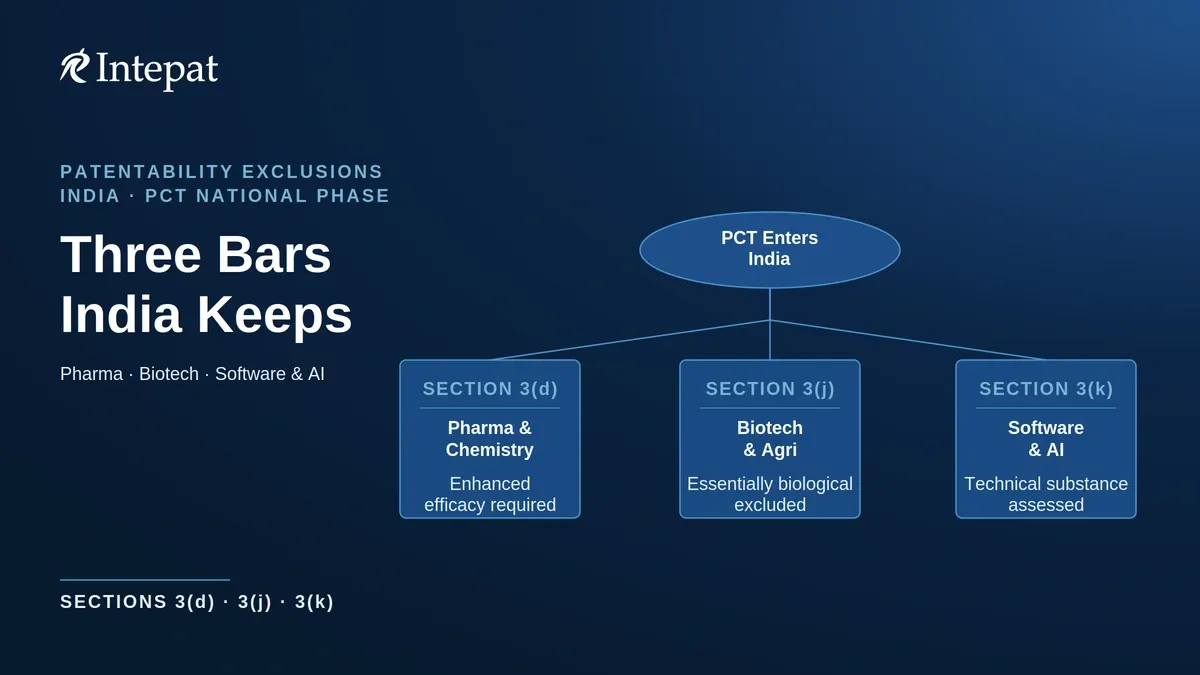
Section 3 objections in India apply to PCT national-phase applications exactly as they apply to direct filings, and a foreign grant does not settle patentability here. This article covers three exclusions that arise in pharmaceutical, biotechnology and software PCT entries: new forms of known substances, plants and animals, and computer programmes per se.
| Quick answer |
| Indian examination applies Section 3 afresh, and neither a foreign grant nor a favourable PCT Written Opinion decides it. The first statement of objections starts a six-month window to put the application in order. Rule 24B allows three more months on a Form 4 request with the prescribed fee, and the timing of that request needs care. If it is not put in order within the time allowed, it is deemed abandoned. |
Why a foreign grant does not settle patentability in India
A PCT application gives you one filing channel, not one patentability standard. Once India is designated and the applicant enters the national phase, Section 7(1A) of the Patents Act 1970 treats the international application as an application under the Act, and Section 10(4A) treats what was filed internationally as the complete specification. For the entry steps themselves, see our guide to the Patent Cooperation Treaty route into India.
Section 138(4) confirms that the international filing has the effect of filing an application for patent in India. Once a request for examination is made, Section 12 requires the Controller to refer the application to an examiner, who must report on any lawful ground of objection to grant. That applies to national-phase applications as it does to direct filings.
The consequence is direct. An application for a polymorph of a known drug, a method of producing a plant variety, or a software-implemented process faces the same Section 3 scrutiny whether it enters India through the PCT or directly under the Paris Convention. The PCT itself leaves each country free to set its own conditions of patentability, so a granted patent from the EPO or USPTO, or a favourable Written Opinion, does not decide the question in India.
PCT search and examination documents: what they do and what they do not decide
The international search is carried out by the competent International Searching Authority (ISA). Each of its documents has a distinct function, and none of them decides Section 3 in India: the ISR is the product of a search for relevant prior art, and the preliminary opinions apply PCT criteria and are non-binding.
| Document | What it does | Does it decide Section 3 in India? |
|---|---|---|
| International Search Report (ISR) | Identifies relevant prior-art documents | No |
| Written Opinion of the ISA | Gives a preliminary, non-binding view on novelty, inventive step and industrial applicability under the PCT framework | No |
| Chapter II report (IPER) | Gives a further preliminary, non-binding opinion on novelty, inventive step and industrial applicability under Article 33, with no statement on patentability under any national law | No |
| Indian FER | States objections raised under Indian law, including Section 3 | It is the Indian examination document to which the applicant must respond |
The Manual of Patent Office Practice and Procedure (2019) states that the opinions of the ISA and the IPEA are non-binding on member countries. The procedural requirements for India national-phase entry are set out in the WIPO PCT Applicant’s Guide, National Chapter India.
This cuts both ways. A negative Written Opinion does not make an Indian grant impossible, and a favourable one does not prevent a Section 3 objection, because the Written Opinion applies the PCT’s own preliminary criteria while India applies its own substantive exclusions. The same holds for a favourable report after a Chapter II demand: it applies the Article 33 criteria and leaves Section 3 open.
Treat the ISR, Written Opinion and IPER as inputs to a separate India-specific patentability assessment, not as a proxy for one. Each of the three exclusions below can arise in Indian examination of an inbound PCT application, and each needs its own pre-entry strategy.
Section 3(d): the efficacy bar for pharma and chemistry
Section 3(d) bars a new form of a known substance unless it shows enhanced efficacy, and for a medicine that means therapeutic efficacy. The provision has three limbs. It bars the mere discovery of a new form of a known substance that does not enhance the known efficacy of that substance; the mere discovery of any new property or new use for a known substance; and the mere use of a known process, machine or apparatus unless the process results in a new product or employs at least one new reactant. This section deals with the first limb, the one most relevant to derivative and polymorph claims. An Explanation to the clause lists salts, esters, ethers, polymorphs, metabolites, pure forms, particle sizes, isomers, mixtures of isomers, complexes, combinations and other derivatives. Each is treated as the same substance as the parent unless it differs significantly in properties with regard to efficacy.
The Supreme Court examined the provision in Novartis AG v Union of India (Civil Appeals 2706-2716 of 2013, decided 1 April 2013). It described Section 3(d) as aimed especially at chemical substances and pharmaceutical products, setting a second tier of qualifying standards to check repetitive patenting while leaving room for true and genuine inventions. The Court did not read Section 3(d) as a bar on every incremental pharmaceutical invention. For a medicine, efficacy means therapeutic efficacy. In Novartis the Court held that the physico-chemical gains in flow, thermodynamic stability and hygroscopicity “cannot even be taken into account” for the Section 3(d) test, and said improved bioavailability alone may not necessarily lead to enhanced therapeutic efficacy. For other substances, efficacy is judged by the function or purpose of the substance.
For a pharmaceutical derivative, the specification should therefore address efficacy directly. The 2019 Manual says the efficacy statement can be made at the time of filing or later by amendment of the specification under Section 59, and the examiner assesses it case by case.
On evidence filed after the application, the Delhi High Court decided Daewoong Pharmaceutical Co. Ltd. v Controller General of Patents (C.A.(COMM.IPD-PAT) 23/2022) on 23 March 2026. The Controller had refused the application because the evidential threshold under Section 3(d) was not met on the record before him. On appeal the Court took the applicant’s affidavit of additional data on record as additional evidence on appeal, treated the Covid-19 pandemic as an exceptional circumstance explaining why the data had not been filed earlier, and directed the Controller to reconsider the Section 3(d) objection in light of that data. The decision turned on those facts. It does not give an applicant a general right to supply efficacy data for the first time on appeal.
The Delhi High Court stated a limit on later evidence in Shaafi Naturcure LLP v Assistant Controller of Patents and Designs (C.A.(COMM.IPD-PAT) 109/2022, 22 June 2026), a case decided on inventive step, sufficiency and other grounds rather than on Section 3(d). Taking the principle from its own earlier decision in AstraZeneca v Alkem, which in turn drew on an English inventive-step decision, the Court held that evidence filed after the priority date to show technical advance can only confirm a technical effect that the specification already supports and that a skilled person could understand from it, and cannot establish that effect for the first time. The principle is not a Section 3(d) holding, but it is a reminder to ground the effect in the specification as filed.
An amendment to a complete specification must satisfy Section 59(1), which allows it only by way of disclaimer, correction or explanation, only for incorporation of actual fact, only if it does not claim or describe matter not in substance disclosed or shown in the specification before the amendment, and only if every amended claim falls wholly within the scope of a claim in that earlier specification.
As at November 2026, IP India’s guidelines page also lists draft examination guidelines for pharmaceutical applications. They are drafts, not law, and this article does not rely on them.
Section 3(j): plants, animals, and biotech at the national phase
Section 3(j) bars patents on plants and animals in whole or in any part, other than micro-organisms, including seeds, varieties and species, and on essentially biological processes for the production or propagation of plants and animals. Micro-organisms are treated differently under Section 3(j) and Section 3(c), as set out below.
Micro-organisms are not excluded under Section 3(j). A separate bar arises under Section 3(c), which also excludes the discovery of any living thing or non-living substance occurring in nature. A claim directed to the discovery of a naturally occurring micro-organism may therefore fall within Section 3(c). Whether the word “mere” qualifies that limb is a question we have not resolved from a primary judgment, so claims at the boundary need case-by-case review. A modified micro-organism, or another micro-organism-related invention that is more than a discovery, is assessed against the remaining requirements of the Act, and the Manual confirms that genetically modified micro-organisms may be patentable subject to those requirements.
Section 10(4) adds a deposit duty. Where biological material mentioned in the specification may not be described adequately and is not publicly available, the application must be completed by a deposit with an international depositary authority under the Budapest Treaty. The deposit must be made no later than the filing date in India (for a PCT national-phase application, the international filing date), with a reference to it in the specification within the prescribed period, and the Act sets further conditions on the deposit. The specification must also disclose the source and geographical origin of biological material used in the invention.
Plant varieties are outside patent protection under Section 3(j). Protection for varieties lies under the Protection of Plant Varieties and Farmers’ Rights Act, 2001 (the Manual cites it as the 2002 Act), so a variety claim needs a separate decision on that route.
The Act does not define “essentially biological”. Before entry, review every claim that touches a plant, animal, seed, variety or biological production process and ask whether it survives Section 3(j) as drafted. A sensible amendment removes the excluded feature, keeps only matter supported by the international application as filed, and meets Section 59 and the other requirements of the Act.
The draft biotechnology guidelines listed on the same page as at November 2026 are likewise drafts, not law.
Section 3(k): software and AI patents at the national phase
Section 3(k) excludes a mathematical or business method or a computer programme per se or algorithms. The words “per se” matter. The Joint Parliamentary Committee that examined the 2002 amendment explained that a computer programme may include other things ancillary to it or developed on it, that the intention was not to reject them for grant if they are inventions, and that computer programmes as such are not intended to be granted a patent. The CRI Guidelines 2025 reproduce that passage and add a working definition, taken from Black’s Law Dictionary as cited by a 2024 Madras High Court decision: “of, in, or by itself; standing alone, without reference to additional facts”.
The Guidelines, available from IP India, apply with immediate effect, and the Manual chapter on Section 3(k) stands deleted. They tell the examiner to judge the substance of the claim as a whole, whatever its form. A claim does not become patentable because it is drafted as a system, a device or a computer-readable medium. The Guidelines also treat claims confined to a programme or its instructions, to a computer programme product or to a storage medium holding instructions as excluded.
For the computer programme per se limb, the Guidelines set out four steps. The other limbs, mathematical methods, business methods and algorithms, are assessed separately in the Guidelines.
1. Construe the substance of the claimed invention as a whole and identify its essential technical features.
2. Identify the core problem the invention addresses and the solution it proposes, which fixes its technicality.
3. Decide whether that technicality produces a technical effect beyond a merely incidental effect.
4. If it does, the claim is not excluded as a computer programme per se. If it does not, the claim is excluded.
For AI, machine-learning or other software-implemented claims, the four steps point to what the specification as filed needs: the core problem, the solution and a technical effect beyond an incidental one. A specification that describes the invention only as algorithmic logic or data manipulation gives the applicant little to argue from at the FER stage. Our guide to software patents in India covers the framework in more detail. A favourable Written Opinion on a software claim does not resolve the Section 3(k) question.
Section 3 objections in India: what the FER window allows
An objection of this kind can appear in the first statement of objections, the First Examination Report (FER). The applicant has six months from the date the first statement of objections is issued to put the application in order for grant, and an application not put in order in time is deemed abandoned. Section 21(2) and (3) can add time in a related High Court appeal, on a request made before the period ends where an appeal is pending, or at the Controller’s discretion where one can still be filed. They cover the application for the main invention or, for a patent of addition, either application.
Rule 24B allows a further three months on a request in Form 4 with the prescribed fee, made to the Controller “before expiry of the period specified herein”. The 2019 Manual reads the request as due within the prescribed six months. That Manual predates the 2024 amendments to the Rules, so our practice is to file the Form 4 within the first six months.
Rule 137(2) removes these periods from the Controller’s general power to correct irregularities.
Notwithstanding anything else in the Rules, Rule 138 lets the Controller extend time, or condone delay, by up to six months on a Form 4 request. The Rule requires the request to be made “before the expiry of the said period of six months”, and allows it to be repeated within that period. Relief under it is discretionary, so treat nine months from the first statement of objections (the six months plus the three-month extension) as a working limit for planning.
Older descriptions of the Rule, including in the 2019 Manual, show a version that excluded the FER periods. The exclusions now sit in Rule 137(2), which restricts only the Controller’s general power. Our guide to responding to the FER covers the response process.
The available responses differ for each exclusion.
For Section 3(d), file a written argument supported by research data showing that the claimed form differs significantly in therapeutic or functional efficacy from the known substance. Later data is most useful where it confirms an effect already grounded in the specification. The Court stated that limit in Shaafi for inventive-step evidence, so it is not a Section 3(d) ruling. Daewoong shows the Controller can be directed to consider such data on remand in exceptional circumstances. Depending on the original disclosure and claim scope, a narrowing amendment may be considered, within the limits of Section 59.
For Section 3(j), argue that the claim falls outside the excluded category, or amend to a narrower formulation that the disclosure supports and that sits outside the excluded subject matter.
For Section 3(k), argue that the claim, read as a whole, solves a technical problem by technical means and produces a technical effect supported by the specification, following the four steps above for the computer programme per se limb. A sensible amendment points to the essential technical features the specification supports and the resulting effect. Recasting the same algorithm in a different claim format is not enough.
Amendments to a complete specification must satisfy Section 59(1). Where the international specification did not anticipate the Indian examination strategy, amendment options narrow, which is why pre-entry review pays off.
What to do before filing: pre-entry risk mapping
Pre-entry risk mapping means testing each claim against the three exclusions before the application enters India, so that amendments already made in the international phase and the later options, including claim deletion at entry and amendments within Section 59, can be planned together. The checks below take each exclusion in turn.
– Section 3(d): Check any claim to a new form or derivative of a known substance, including a salt, ester, polymorph, isomer, metabolite, complex or combination. Confirm that the specification addresses therapeutic or functional efficacy and not just physical properties.
– Section 3(j): Test every claim in agri-biotech, plant biology or animal science against the plant and animal exclusion and the essentially biological process bar, and test micro-organism claims under Section 3(c).
– Section 3(k): Check every software-implemented or AI-driven claim: the four steps above apply to the computer programme per se limb, and claims that read on a mathematical method, business method or algorithm need the Guidelines’ separate assessments.
Amendments made internationally matter here, and national-phase entry is due within 31 months from the priority date. Under Rule 20, an application corresponding to an international application includes claim amendments made before the International Bureau and communicated to India, and amendments made during Chapter II examination. Where the international application was not filed or published in English, a translation of the amendments must be filed, and if it is not filed even after invitation, the amended claims and annexures are disregarded.
Section 138(6) separately allows the applicant, if the applicant so desires, to have amendments proposed before the international authorities taken as amendments before the Indian Patent Office.
After entry, a request to amend an application or specification is made in Form 13 under Rule 81(1), and the Controller decides whether to allow it.
Section 59 also governs the amendment.
Pre-entry review is the point at which Section 3 strategy should be fixed, before the examiner reads the application. Our guide to negative PCT Written Opinion and FER strategy covers the wider response strategy.
Frequently Asked Questions
No. The Written Opinion gives a preliminary, non-binding view on novelty, inventive step and industrial applicability under the PCT framework, and the ISR separately identifies prior art. Neither evaluates compliance with India’s Section 3 exclusions or binds the Indian examiner.
You must show, with appropriate research data, that the claimed derivative produces enhanced therapeutic efficacy over the known substance. In Novartis the physico-chemical gains in that case could not be taken into account, and enhanced bioavailability alone may not necessarily lead to enhanced efficacy. The claimed form must differ significantly in properties with regard to efficacy. The evidence needed depends on the claimed invention.
Micro-organisms are not excluded under Section 3(j), but a claim directed to the discovery of a naturally occurring micro-organism may fall within Section 3(c). A modified micro-organism that is more than a discovery may be patentable on the Act’s other requirements. Plants and animals in whole or in part, and essentially biological processes for producing or propagating them, remain excluded under Section 3(j).
A computer programme per se is not patentable under Section 3(k). Under the CRI Guidelines 2025 the examiner judges the claim as a whole, looks for the essential technical features, and asks whether the invention solves a technical problem with a technical effect beyond a merely incidental one. Claim format alone does not decide the outcome.
Six months from the date the first statement of objections is issued, to put the application in order for grant, so a reply alone may not be enough. Three more months is available on a Form 4 request with the prescribed fee. The 2019 Manual reads this as the first six months, so we file within six months. Otherwise it is deemed abandoned, subject to limited relief.
Amendments to a complete specification are governed by Section 59(1). The amendment must be by way of disclaimer, correction or explanation, for incorporation of actual fact, without matter not in substance disclosed or shown in the specification before the amendment, and every amended claim must fall wholly within the scope of a claim in that earlier specification.
Yes. The objection can stay open after the first reply, and the applicant can ask for a hearing, which the Manual says to request at least ten days before the time limit expires. Any person can also raise it in a pre-grant representation before grant. After grant, any person interested can oppose within one year of publication of grant under Section 25(2) or seek revocation under Section 64.
Yes. A pre-entry review lets counsel assess Section 3 risk, check whether Article 19 or Article 34 amendments already address the issue, and decide strategy, including whether to enter India at all. It can also show which claims to delete at entry or narrow later within Section 59.
This article explains the law on Section 3 patentability exclusions in India as at November 2026 and is for general information only. It is not legal advice. Government fees, forms and procedures change; confirm current figures with the Indian Patent Office before you file. Application of Sections 3(d) and 3(k) is claim-specific and continues to develop through Patent Office practice and judicial decisions, so do not rely on this article for prosecution decisions in a specific application. For advice on your specific invention, consult a registered patent agent.