




A trademark infringement suit in India must be filed in a District Court or higher. Section 134(2) of the Trade Marks Act 1999 lets the registered proprietor sue at their own place of business, but only for registered-mark claims. A pure passing off suit follows Section 20 of the Code of Civil Procedure 1908.
This article addresses trademark infringement jurisdiction in India. The scope is civil suits filed before Indian courts. Criminal complaints under Sections 103 and 104 of the Trade Marks Act follow separate forum rules and are not covered here.
Bottom line for filing strategy
• A registered-mark infringement suit cannot be filed in any court below District Court level (Section 134(1)).
• The registered proprietor or registered user may sue at the place where they actually and voluntarily reside, carry on business, or personally work for gain, in addition to the forums available under Section 20 of the Code of Civil Procedure 1908 (Section 134(2)).
• This plaintiff-friendly forum is available only for clauses (a) and (b) of Section 134(1), which cover registered-mark disputes; a pure passing off claim falls under clause (c) and must be filed under Section 20 of the Code of Civil Procedure.
• Where the cause of action arose at the plaintiff’s principal office, the plaintiff cannot rely on a subordinate office in another city to invoke Section 134(2) at that subordinate office (IPRS v. Sanjay Dalia (2015) 10 SCC 161).
• Where the specified value of the subject matter is at least Rs 3 lakh, the suit goes to a Commercial Court designated under the Commercial Courts Act 2015; Section 12A pre-institution mediation is mandatory unless the plaint genuinely contemplates urgent interim relief (Yamini Manohar v. T.K.D. Keerthi, 2023).
| Your scenario | Where to file |
| Registered mark, plaintiff has only one office | Plaintiff’s office under Section 134(2), or any forum under Section 20 of the Code of Civil Procedure |
| Registered mark, plaintiff has principal plus subordinate offices | Apply the Ultra Home four-scenario framework set out below |
| Pure passing off (registered or unregistered mark) | Section 20 of the Code of Civil Procedure only; Section 134(2) is not available |
| Specified value at least Rs 3 lakh | Designated Commercial Court at District level, or the Commercial Division of the relevant High Court |
| Plaint seeks genuine urgent interim relief | Direct filing; Section 12A pre-institution mediation may be skipped |
What Section 134 of the Trade Marks Act actually requires
Section 134(1) of the Trade Marks Act 1999 prohibits the institution of three categories of suit in any court inferior to a District Court: (a) a suit for infringement of a registered trade mark, (b) a suit relating to any right in a registered trade mark, and (c) a suit for passing off arising out of the defendant’s use of a trade mark identical with or deceptively similar to the plaintiff’s mark, whether registered or unregistered. The District Court is therefore the statutory floor. A Civil Judge (Junior Division) or equivalent subordinate court has no jurisdiction to hear these matters.
Section 134(2) then expands the set of District Courts that count as a “District Court having jurisdiction.” Notwithstanding the Code of Civil Procedure 1908 or any other law in force, the term includes a District Court within whose local limits the person instituting the suit actually and voluntarily resides, carries on business, or personally works for gain, at the time the suit is instituted. The Explanation to Section 134(2) clarifies that “person” for this purpose includes the registered proprietor and the registered user.
This wording does two things at once: it carves out an additional forum, the plaintiff’s own place of business, that is not available in ordinary civil litigation, and it does so notwithstanding the Code of Civil Procedure. The full text of Section 134 is on the India Code repository for the Trade Marks Act 1999.
When the plaintiff can sue at its own place of business
The plaintiff-residence forum under Section 134(2) departs from the conventional civil-litigation rule that the suit follows the defendant. Section 20 of the Code of Civil Procedure 1908 lets a plaintiff file where the defendant resides or carries on business (clause (a)), where any one of multiple defendants resides subject to leave of the court or acquiescence (clause (b)), or where the cause of action arises wholly or in part (clause (c)). The Explanation to Section 20 treats a corporation as carrying on business at its sole or principal office in India, or, in respect of any cause of action arising at a place where it has also a subordinate office, at that subordinate office.
Section 134(2) layers a further forum on top of Section 20: for clauses (a) and (b) of Section 134(1), the District Court where the plaintiff resides, carries on business, or personally works for gain is also a District Court “having jurisdiction.” The provision was introduced to ease the logistical burden on proprietors whose marks are infringed in cities far from their commercial base, allowing the proprietor to sue at home, subject to the narrowing reading of Sanjay Dalia discussed below.
The expression “carries on business” is read functionally rather than formally. It does not require a registered office or a fixed branch; an established commercial presence at a place, with goods or services actually offered or supplied there, can satisfy the test. The expression “personally works for gain” covers an individual proprietor who works at a place, even without a formal office. Both formulations are factual inquiries; an isolated transaction or a passive online presence will not ordinarily meet them.
Why a pure passing off suit cannot use this forum
The plaintiff-residence forum under Section 134(2) is, on the face of the statute, narrower than it is sometimes assumed to be. The provision applies “for the purpose of clauses (a) and (b) of sub-section (1).” It does not extend to clause (c), the passing off limb.
The consequence is practical. A pure passing off suit, whether by an unregistered proprietor or by a plaintiff bringing a passing off claim disconnected from a registered-mark infringement claim, must satisfy Section 20 of the Code of Civil Procedure 1908 in the conventional way. The plaintiff cannot sue at its own place of business merely because Section 134(2) appears to allow it; the additional forum is unavailable for the passing off cause of action.
In practice, infringement plaints are commonly framed to combine a Section 29 infringement claim with a passing off claim arising on the same facts. Where the plaint is so framed and the court is satisfied that jurisdiction exists for the infringement claim under Section 134(2), the same court ordinarily proceeds to hear the joined passing off claim. The Delhi High Court took this approach in Burger King Corporation v. Techchand Shewakramani, CS (COMM) 919/2016, decided on 27 August 2018, holding that where the plaintiff invokes both Section 134 of the Trade Marks Act and Section 20 of the Code of Civil Procedure, and territorial jurisdiction is supported under either, the court is not deprived of jurisdiction. A suit framed solely as passing off, by contrast, has no recourse to Section 134(2). For the underlying doctrine on a passing off action in the domain name context, see our note on passing off in domain name disputes.
How the Supreme Court narrowed Section 134(2) in Sanjay Dalia
The narrowing of the plaintiff-residence forum was settled by the Supreme Court in Indian Performing Rights Society Ltd v. Sanjay Dalia & Anr, (2015) 10 SCC 161, decided on 1 July 2015. The Court considered Section 62(2) of the Copyright Act 1957 and Section 134(2) of the Trade Marks Act 1999, which are materially identical in language.
The Supreme Court held that Section 134(2) is an additional forum to those available under Section 20 of the Code of Civil Procedure, not an unfettered right to choose any branch office. The Court read the provision purposively to prevent a mischief: a plaintiff cannot file at a city where it has only a subordinate office and where neither the cause of action arose nor the principal office sits, since that would drag the defendant to a forum unconnected with the dispute.
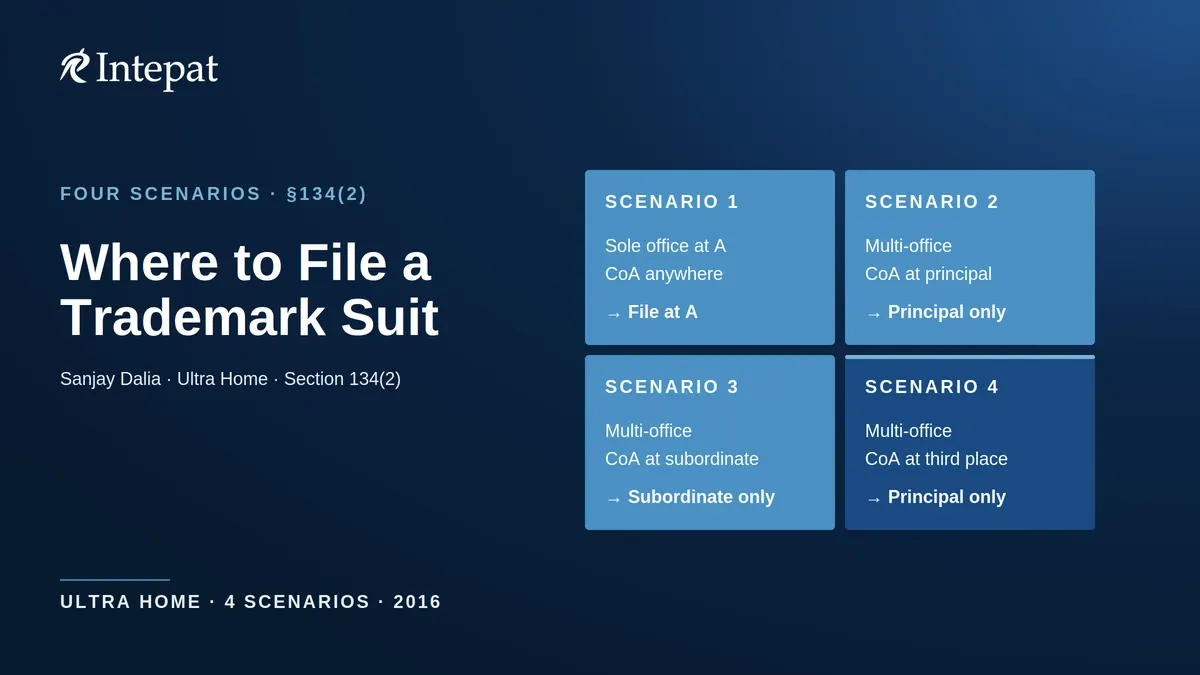
The Delhi High Court Division Bench in Ultra Home Construction Pvt Ltd v. Purushottam Kumar Chaubey, FAO (OS) 494/2015, decided on 20 January 2016, applied Sanjay Dalia to set out four scenarios for a corporate plaintiff:
| Plaintiff’s offices | Where cause of action arose | Section 134(2) forum |
| Sole office at A | Anywhere | A |
| Principal at A, subordinate at B | At A (the principal office place) | A only; the plaintiff cannot rely on B |
| Principal at A, subordinate at B | At B (the subordinate office place) | B only; the plaintiff cannot rely on A |
| Principal at A, subordinate at B | At a third place C | A only; B is barred under Section 134(2) |
Two worked examples illustrate the framework.
Example 1: single-office plaintiff. A company has its sole registered office at Hyderabad. Infringement is being committed by a retailer based at Bengaluru. The plaintiff may sue at Hyderabad under Section 134(2), or at Bengaluru under Section 20 of the Code of Civil Procedure. Both forums are open; the plaintiff chooses.
Example 2: multi-office plaintiff, third-place cause of action. A consumer goods company has its head office at Mumbai and a branch office at Delhi. Infringement is being committed at Bengaluru, where the plaintiff has no office. The plaintiff may sue at Mumbai (principal office, under Section 134(2)) or at Bengaluru (place of the cause of action, under Section 20 of the Code of Civil Procedure). The plaintiff cannot sue at Delhi merely because of the branch office, because Delhi is neither the principal office nor the place where the cause of action arose. This is the Scenario 4 case in the Ultra Home framework.
When the Commercial Courts Act 2015 changes who hears the suit
A District Court having jurisdiction under Section 134 is not, in many cases, the regular District Judge’s bench. The Commercial Courts Act 2015 sits across the trademark statute and controls which court within the hierarchy actually hears a substantial IP suit.
Section 2(1)(c)(xvii) of the Commercial Courts Act lists disputes relating to intellectual property rights, including trademark disputes, as a “commercial dispute.” The 2018 amendment reduced the specified value threshold from Rs 1 crore to Rs 3 lakh. Where the specified value of the subject matter is at least Rs 3 lakh, the suit must be instituted before a Commercial Court designated under Section 3, or, where applicable, before the Commercial Division of a High Court that exercises ordinary original civil jurisdiction (Delhi, Bombay, Calcutta, Madras). Routing within the original-side hierarchy turns on territorial nexus, valuation, the Commercial Division rules, and (where notified) the Intellectual Property Division rules of the relevant High Court; current local practice should be confirmed before filing.
The interplay with Section 134 is not fully settled. Section 21 of the Commercial Courts Act gives the Act overriding effect over inconsistent provisions in other laws. A question has arisen whether, where a state has notified Commercial Courts at the Civil Judge (Senior Division) level under Section 3, such courts can hear suits under Section 134 in light of the District Court floor in Section 134(1). The Jharkhand High Court in Khemka Food Products Pvt Ltd v. ISDS Pvt Ltd, Commercial Appeal No. 14 of 2024, decided on 8 August 2024, held that a Civil Judge (Senior Division) acting as a Commercial Court can entertain such suits, reading the Commercial Courts Act as overriding the floor. The Supreme Court has issued notice on the special leave petition; the position at the apex level is awaiting determination. Counsel should check the state notification, the specified value of the suit, and the applicable High Court practice before deciding the forum.
Section 12A of the Commercial Courts Act adds a procedural threshold. A commercial suit that does not contemplate any urgent interim relief cannot be instituted without first exhausting pre-institution mediation. The Supreme Court in Yamini Manohar v. T.K.D. Keerthi, 2023 SCC OnLine SC 1382, decided on 13 October 2023, treated this requirement as mandatory and clarified that an IP suit which genuinely seeks urgent interim relief, typically an injunction, an Anton Piller order, or an asset preservation order, is exempt. The Supreme Court added that the prayer for urgent interim relief must not be a disguise to wriggle out of Section 12A; the commercial court must examine the plaint, the documents, and the prayer to confirm the urgency is real.
Online trademark infringement jurisdiction in India
Where the alleged infringement plays out on the internet, the territorial question becomes harder. Most websites are accessible everywhere; a rule that mere accessibility confers jurisdiction would put every plaintiff at the global maximum, which the Indian courts have rejected.
Two threshold points orient the analysis. First, in a registered-mark infringement suit, Section 134(2) may independently support the plaintiff’s forum on the basis of the plaintiff’s own place of business, subject to the Sanjay Dalia and Ultra Home discipline; the Banyan Tree purposeful-availment inquiry is not strictly required to establish that forum. Second, where the plaintiff relies on online activity to show that a part of the cause of action arose in the forum, particularly under Section 20 of the Code of Civil Procedure or in pure passing off matters, the Banyan Tree test becomes determinative.
The Delhi High Court Division Bench in Banyan Tree Holding (P) Ltd v. A. Murali Krishna Reddy, 2010 (42) PTC 361 (Del), decided on 23 November 2009, settled the test. The Bench held that mere accessibility of the defendant’s website in the forum state does not confer jurisdiction on the forum court. The plaintiff must show two further elements: that the defendant purposefully availed itself of the jurisdiction of the forum by specifically targeting customers in the forum, and that this targeting resulted in commercial transactions or injury within the forum.
A passive website with no interactivity directed at the forum state will not pass the test. An interactive website that allows users in the forum to transact, supported by evidence that the defendant solicited or completed such transactions in the forum, ordinarily does. The Bench expressly displaced the earlier broader view that mere accessibility of an infringing site in the forum was sufficient.
Burger King Corporation v. Techchand Shewakramani, decided in 2018, applied a related principle under Section 20 of the Code of Civil Procedure. The court treated the defendant’s franchise-related solicitations directed at Delhi, including digital outreach and applications for approvals, as use of the mark “in relation to” goods or services in Delhi, giving the Delhi High Court territorial jurisdiction. For practical purposes, a plaintiff alleging online infringement must plead the targeting and the commercial nexus, not merely the existence of an infringing webpage accessible in the forum. The broader cross-border setting is covered in our note on cross-border trademark infringement.
A practical sequence for choosing the forum
Forum choice in a trademark infringement matter is sequential. Each step screens out forums that are not open before the next is considered. A misstep at any step risks an early dismissal under Order VII Rule 11 of the Code of Civil Procedure on grounds of jurisdiction or non-compliance with Section 12A, and the loss of valuable time in the limitation window.
- Classify the claim. Is it a registered-mark infringement claim under Section 29 (Section 134(1)(a) or (b)), a pure passing off claim (Section 134(1)(c)), or a combined claim? The classification controls whether Section 134(2) is available.
- Identify the cause of action. Where did the infringing use, sale, or solicitation occur? Where did the defendant transact? For online matters, apply the Banyan Tree purposeful availment and commercial transaction test.
- List the Section 20 CPC forums. Where does each defendant reside or carry on business? Where did the cause of action arise wholly or in part? These forums are available for any claim, including a passing off claim.
- Add Section 134(2) forums, if applicable. For a registered-mark claim, list the District Courts where the plaintiff resides, carries on business, or personally works for gain. Apply the Sanjay Dalia and Ultra Home discipline: if the cause of action arose where the plaintiff has its principal office, drop the subordinate-office options.
- Apply the Commercial Courts Act filter. Value the subject matter under Section 12 of the Commercial Courts Act. If the specified value is at least Rs 3 lakh, restrict the candidate forums to the designated Commercial Courts and, where applicable, the Commercial Division of the relevant High Court.
- Decide on Section 12A pre-institution mediation. If the plaint genuinely contemplates urgent interim relief, the matter can be filed directly. Otherwise, pre-institution mediation must be completed before institution.
The forum decision is a matter of strategy as much as compliance. The choice between, for instance, the High Court Commercial Division and a District-level Commercial Court can affect timelines, the pace of interim relief, and the appellate path. We map the available forums against the cause-of-action evidence and the relief sought, and confirm the choice with the client before the plaint is signed. For substantive heads of liability that interact with this forum analysis, see our notes on indirect trademark infringement in India and on remedies for trademark infringement.
Once the forum is identified, the plaintiff should have the following ready at the point of filing:
- Trademark registration certificate and class details, with renewal status
- Proof of the plaintiff’s principal office and any subordinate office
- Evidence of the defendant’s place of business or place of operation
- Infringing sales invoices, marketplace listings, packaging photographs, and delivery records
- Evidence of online targeting in the proposed forum (where relied on for jurisdiction)
- Specified value calculation under Section 12 of the Commercial Courts Act, with supporting valuation material
- Urgency material supporting any prayer for ex parte interim injunction and any Section 12A exemption
Frequently asked questions
Can a registered trademark infringement suit be filed in a Civil Judge’s court?
No. Section 134(1) of the Trade Marks Act 1999 bars institution of an infringement suit in any court inferior to a District Court. Where the state has designated a Commercial Court at or above District Judge level under the Commercial Courts Act 2015, that designated court hears the suit if the specified value exceeds Rs 3 lakh.
Can a passing off plaintiff use Section 134(2) to sue at its own place of business?
No. Section 134(2) applies only “for the purpose of clauses (a) and (b) of sub-section (1)” of Section 134, which cover suits on registered marks. A pure passing off claim under clause (c) falls outside the extended forum and must be filed in a court having jurisdiction under Section 20 of the Code of Civil Procedure 1908.
After Sanjay Dalia, can the plaintiff sue at its branch office?
Only if the cause of action arose at the same place. The Supreme Court in IPRS v. Sanjay Dalia (2015) held that where the cause of action arose at the plaintiff’s principal office, the plaintiff cannot rely on a subordinate office in a different city to file at that subordinate office under Section 134(2).
Does the Commercial Courts Act 2015 apply to every trademark infringement suit?
It applies where the specified value is at least Rs 3 lakh, following the 2018 amendment that lowered the threshold from Rs 1 crore. Below that, the Delhi HC Division Bench in Pankaj Ravjibhai Patel v. SSS Pharmachem (2023) held that IP suits are not automatically routed to Commercial Courts; the competent court can scrutinise an artificial valuation.
Is Section 12A pre-institution mediation always required before filing?
No. The Supreme Court in Yamini Manohar v. T.K.D. Keerthi (2023) held that pre-institution mediation under Section 12A of the Commercial Courts Act is mandatory unless the suit genuinely contemplates urgent interim relief. The commercial court must examine the plaint and prayer to confirm the urgency is real and not a device to bypass mediation.
Can a trademark infringement and passing off claim be filed together in the same suit?
Yes. Indian courts routinely accept combined plaints framing a Section 29 infringement claim and a passing off claim on the same facts. The Delhi High Court in Burger King v. Techchand (2018) confirmed that where territorial jurisdiction exists under Section 134(2) of the Trade Marks Act or Section 20 of the Code of Civil Procedure, the joined claim survives.
Does a purely online business satisfy the “carries on business” test under Section 134(2)?
A passive online presence ordinarily will not. Courts read “carries on business” as requiring an established commercial presence at the place, with goods or services actually offered or supplied there. An e-commerce business with operational nexus to a place, such as fulfilment, marketing, or customer contracts there, has a meaningfully stronger claim to the Section 134(2) forum.
Disclaimer
This article is for general information only and does not constitute legal advice. Forum selection in a trademark infringement matter turns on the specific facts of each case, including the contents of the registration, the cause of action, the specified value of the subject matter, and the position of the parties. Readers should consult qualified counsel before instituting any suit. The position stated is as at June 2026 and reflects the Trade Marks Act 1999, the Code of Civil Procedure 1908, and the Commercial Courts Act 2015 as amended, and the judgments cited.