




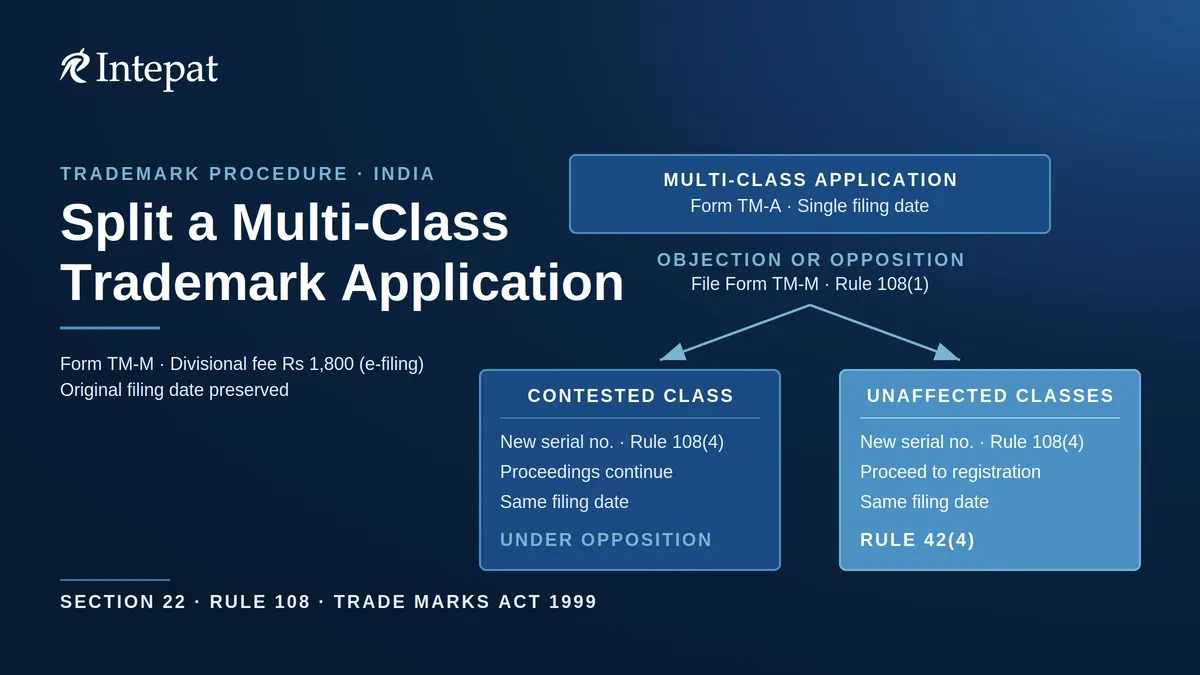
A divisional application for a multi-class trademark in India splits a pending multi-class filing into separate class applications when one class faces an examination objection or opposition. Each divided application retains the original filing date under Section 22 of the Trade Marks Act 1999 and Rule 108 of the Trade Marks Rules 2017. The request is made in Form TM-M.
When a multi-class trademark application faces an examination objection or a third-party opposition in one class, the progress of every other class in the same application can stall. A divisional application separates the affected class into its own file so the unaffected classes can continue towards registration independently.
Division is a procedural mechanism. It does not remove an objection, defeat an opposition, or make a weak mark registrable. It only separates the application file so that unaffected classes are not delayed by proceedings in the contested class.
Key facts at a glance
- When it applies: one or more classes in a multi-class application face an examination objection or a third-party opposition
- Form required: TM-M (filed by the applicant with the Trade Marks Registry)
- Fee: Rs 1,800 (e-filing) or Rs 2,000 (physical filing) (verified as of June 2026)
- Filing date: each divided application keeps the same filing date as the original application
- What division does not do: it does not remove an objection or defeat an opposition; it only separates the file
Multi-Class Trademark Applications in India
Under Section 7(1) of the Trade Marks Act 1999, the Registrar classifies goods and services in accordance with the international classification, that is, the NICE Classification (an internationally recognised system that groups goods and services into 45 numbered classes). Section 18(2) permits a single application to cover different classes of goods and services, with the fee calculated separately for each class. This single application is filed in Form TM-A, the official Trade Marks Registry application form.
Applicants file multi-class applications for practical convenience: one application number, one filing transaction, and one examination round (at least initially). The filing fee under Entry 1 of the First Schedule to the Trade Marks Rules 2017 is Rs 4,500 per class per mark on e-filing for individuals, startups, and small enterprises, and Rs 9,000 per class per mark for all other applicants (verified as of June 2026).
The structural risk in a multi-class application is that proceedings in one class can block registration in every other class. Two scenarios give rise to this:
Examination objection. Under Rule 33(2) of the Trade Marks Rules 2017, if the Registrar has any objection to acceptance of the application, he issues an examination report. Under Rule 33(4), if the applicant fails to respond within one month of receipt, the Registrar may treat the application as abandoned. In practice, where a multi-class application remains under examination because of an unresolved objection in one or more classes, the unaffected classes are also delayed while the application continues as a single file.
Third-party opposition. Under Section 21(1) of the Trade Marks Act 1999, any person may file a notice of opposition within four months from the date of advertisement of the accepted application. Where a third-party trademark opposition is filed for only a particular class or classes in a single multi-class application, Rule 42(3) of the Trade Marks Rules 2017 provides that the remaining, unopposed classes cannot proceed to registration until the applicant files a request in Form TM-M for division of the application along with the divisional fee.
These two scenarios make the divisional application mechanism operationally significant for any applicant holding a multi-class filing. For an overview of how trademark classes are structured under Indian law, see our classification guide.
When Does Division Become Necessary?
Division becomes relevant in two circumstances that arise while a multi-class application is still pending with the Trade Marks Registry, whether before or after acceptance, but before registration.
Examination objection in one class. Where the Registrar issues an examination report raising an objection in one or more classes, and the objection cannot be resolved quickly, the unaffected classes remain in the same file and cannot advance independently. Filing a divisional application separates the clean classes so they can proceed while the objected class is addressed separately.
Third-party opposition to one class. Under Rule 42(3) of the Trade Marks Rules 2017, where opposition is filed only for particular classes in a single multi-class application, the remaining classes shall not proceed to registration until the applicant files Form TM-M for division along with the divisional fee. Division is not optional in this scenario; the statute uses mandatory language.
Consider filing a divisional application when:
- the multi-class application is opposed or objected to in only one or some classes;
- the remaining classes are otherwise clear and ready to proceed;
- delay to the unaffected classes affects business use, licensing, enforcement, or brand expansion; and
- in practice, applicants weigh the official division cost against the commercial cost of waiting for the contested class to conclude.
What Is a Divisional Application under the Trade Marks Rules 2017
Rule 2(h) of the Trade Marks Rules 2017 defines “divisional application” to mean, in plain terms, a request to split a trademark application: either by separating goods or services within a single class, or by dividing a multi-class application into separate class-by-class applications. The formal statutory definition reads:
(i) an application containing a request for the division of goods or services within a class for the registration of a trade mark; or
(ii) a divided application made by the division of a single application for the registration of a trade mark for separate classes of goods or services.
The second limb covers the multi-class scenario addressed in this article. Rule 2(i) defines “divisional fee” as the fee prescribed against Entry 14 in the First Schedule.
The Legal Mechanism: Section 22 and Rule 108
Section 22 of the Trade Marks Act 1999 is the principal statutory authority. In practical terms, Section 22 allows a multi-class application to be split into separate applications by treating the split as an amendment rather than a fresh filing. The key commercial effect: each divided application is deemed to carry the same filing date as the original application. The full statutory text reads:
The Registrar may, on such terms as he thinks just, at any time, whether before or after acceptance of an application for registration under section 18, permit the correction of any error in or in connection with the application or permit an amendment of the application: Provided that if an amendment is made to a single application referred to in sub-section (2) of section 18 involving division of such application into two or more applications, the date of making of the initial application shall be deemed to be the date of making of the divided applications so divided.
Rule 108 of the Trade Marks Rules 2017 sets out the procedural detail. Its five sub-rules are:
- Rule 108(1): Where an application is made in Form TM-M under the proviso to Section 22 for the division of a single pending application, the Registrar may, on payment of a divisional fee, divide such application into two or more separate applications.
- Rule 108(2): In case of division, the Registrar treats each divisional application as a separate application for registration with the same filing date as the initial application.
- Rule 108(3): Any time limit for any action by the applicant in relation to the initial application at the time of division shall be applicable to each new separate application created by division, irrespective of the date of the division.
- Rule 108(4): In case of division, the Registrar assigns an additional separate new serial number or numbers and cross-references them with the initial application.
- Rule 108(5): For the removal of doubt, it is clarified that no new registration is effected when a single application is divided. On the contrary, the application already filed is merely separated or divided into individual files.
In plain terms: each divided application receives a new reference number but all divided applications remain linked back to the original. The division creates no new trademark registration; it is an administrative separation of the same application into individual files.
Rule 108(3) has a practical consequence that applicants sometimes overlook: the deadline clocks already running on the initial application (for example, a response deadline to an examination report) do not reset when the application is divided. Each new separate application carries the same remaining deadlines.
Statutory references: The principal provisions are Section 22 of the Trade Marks Act 1999 (correction and amendment, with the divisional proviso), and Rules 23(3), 42(3), 42(4), and 108 of the Trade Marks Rules 2017. The divisional fee is prescribed in Entry 14 of the First Schedule to the Trade Marks Rules 2017.
How to File a Divisional Application
Step 1: Confirm that division is appropriate. Division is available at any stage of a pending application, whether before or after acceptance, but before registration, as Section 22 and Rule 108(1) confirm. The applicant should identify which classes are affected by the examination objection or opposition and which classes can proceed independently.
Step 2: File Form TM-M with the divisional fee. Rule 23(3) of the Trade Marks Rules 2017 confirms that an amendment to divide an application under the proviso to Section 22 shall be made in Form TM-M. Rule 108(1) requires payment of the divisional fee at the time of filing the division request. The divisional fee under Entry 14 of the First Schedule is Rs 2,000 for physical filing and Rs 1,800 for e-filing (verified as of June 2026).
Step 3: Registrar assigns new application numbers. Under Rule 108(4), the Registrar assigns new serial numbers to the divided applications and cross-references them with the initial application. Each new application will appear separately in the Trade Marks Registry portal.
Step 4: Divided applications proceed independently. Under Rule 42(4) of the Trade Marks Rules 2017, where no opposition is filed in a class or classes, those classes proceed to registration after the division of the application, subject to Sections 19 and 23(1) of the Trade Marks Act 1999. The contested class or classes continue in opposition or examination proceedings under their separate application number.
For the overall registration process and what happens after the examination stage, see our trademark registration process guide.
Example: Opposition Filed Against One Class in a Six-Class Application
Consider an applicant who has filed a multi-class application covering Classes 5, 6, 19, 21, 23, and 35. After the application is advertised, a third party files a notice of opposition confined to Class 19.
Under Rule 42(3), the remaining five classes cannot proceed to registration while the opposition against Class 19 is pending under the same application number. To unblock those five classes, the applicant files a Form TM-M request for division along with the divisional fee.
After the Registrar processes the division under Rule 108:
- The application is separated into individual files. Under Rule 108(4), the Registrar assigns new serial numbers to the divided applications and cross-references them with the initial application.
- Each divided application carries the original filing date by operation of the Section 22 proviso and Rule 108(2).
- Under Rule 42(4), the five unopposed classes proceed to registration under their new application numbers.
- The Class 19 application continues through the opposition proceedings under its own application number.
- Under Rule 108(3), any pending time limits applicable to the initial application at the time of division remain applicable to each separated application, irrespective of the division date.
An important statutory clarification from Rule 108(5): the division does not create new registrations. The original application filed on a given date is simply separated into individual files, each carrying the same filing date.
Filing-Date Preservation: Practical Significance
The preservation of the original filing date under the Section 22 proviso and Rule 108(2) has consequences in two contexts.
Priority against later filers. Registration confers the exclusive statutory right to use the mark under Section 28 of the Trade Marks Act 1999 (subject to any challenge to the validity of the registration). Under Section 23(1), the trade mark when registered is registered as of the date of making of the initial application. For a divided application, that date is the original filing date preserved by the Section 22 proviso and Rule 108(2). A divided application therefore maintains its priority position against any application filed after the original filing date, including during the period when proceedings in the contested class were ongoing.
Convention priority (Section 154 applicants). Applicants who first filed their trademark abroad and then applied in India within six months under the Paris Convention retain that earlier international filing date, known as the priority date. Where such a multi-class application is divided, the priority date claimed in the initial application is preserved across all divided applications, subject to the six-month convention period under Section 154(2) of the Trade Marks Act 1999.
When a Divisional Application May Not Be the Right Step
Division resolves the procedural blocking problem. It does not resolve the underlying objection or opposition. Before filing a division request, an applicant should assess:
Whether the objected or opposed class is strategically important. If the contested class covers core business activities, the right approach is to address the objection or oppose the notice of opposition, not simply to file for division and let the contested class drift.
Whether the examination objection in one class reveals a weakness across all classes. An inherently non-distinctive mark objected to in one class may face the same objection once the application is examined individually in other classes. Division in that scenario does not improve the substantive position.
The cost of separate opposition proceedings. Once divided, each application carries its own opposition fee if further oppositions arise. Under Entry 2 of the First Schedule to the Trade Marks Rules 2017, the opposition fee is Rs 2,700 per class per mark on e-filing (verified as of June 2026), applicable to each mark and each class opposed.
For a practitioner’s view of how to respond to examination objections before considering division, see our trademark objection reply and examination report guide.
Multi-Class Filing vs Multiple Single-Class Applications: A Decision Table
The original multi-class filing and the division mechanism interact with an upstream choice that applicants make at the filing stage: whether to file a single multi-class application in Form TM-A or to file separate single-class applications for each class from the outset.
| Factor | Multi-class application (single TM-A) | Separate single-class applications |
| Filing administration | One application, one fee transaction | Separate applications per class |
| Filing fee | Same per-class fee under Entry 1 | Same per-class fee under Entry 1 |
| Risk of cross-class blocking | Opposition or objection in one class blocks others until division is filed | Each application is independent; no cross-class blocking |
| Division cost | Rs 1,800 (e-filing) per division request under Entry 14 | No division required or possible |
| Filing date for each class | Single original date across all classes, preserved on division | Each application has its own filing date |
| Management | Single examination round initially; separate proceedings post-division | Separate examination for each class from the outset |
The multi-class route carries a division cost if blocking arises. The separate-application route avoids division but requires separate management of each application from filing. Neither route is categorically superior; the appropriate choice depends on the number of classes, the likelihood of examination issues or opposition in any class, and the applicant’s budget for managing separate proceedings.
For a detailed analysis of the benefits and drawbacks of multi-class applications, see our multi-class trademark application guide.
Fee Summary
The following fees apply to the divisional application procedure. All figures are from the First Schedule to the Trade Marks Rules 2017, verified as of June 2026.
| Entry | Item | Physical filing (Rs) | E-filing (Rs) | Form |
| Entry 14 | Divisional application fee | 2,000 | 1,800 | TM-M |
| Entry 1 | Application for trademark registration, per class per mark (Individual / Startup / Small Enterprise) | 5,000 | 4,500 | TM-A |
| Entry 1 | Application for trademark registration, per class per mark (all other applicants) | 10,000 | 9,000 | TM-A |
| Entry 2 | Opposition fee, per class per mark (for reference) | 3,000 | 2,700 | TM-O |
Frequently Asked Questions
A divisional application is a request to divide a single pending multi-class trademark application into two or more separate applications. It is filed in Form TM-M under the proviso to Section 22 of the Trade Marks Act 1999 and Rule 108 of the Trade Marks Rules 2017. The Registrar divides the application on payment of the divisional fee.
A divisional application can be filed at any point while the trademark application is still pending with the Registry, whether before or after acceptance, but before registration. If a third party has filed an opposition against only some classes, the remaining classes are legally blocked from proceeding to registration until the applicant files Form TM-M for division and pays the divisional fee. (Statutory basis: Section 22 of the Trade Marks Act 1999; Rule 108(1) and Rule 42(3) of the Trade Marks Rules 2017.)
No. Each divided application keeps the same filing date as the original multi-class application. This means the divided applications retain their priority position against any later trademark filing. (Statutory basis: proviso to Section 22 of the Trade Marks Act 1999; Rule 108(2) of the Trade Marks Rules 2017, which deems the filing date of the initial application to be the filing date of each divided application.)
A divisional application is filed in Form TM-M. Rule 23(3) of the Trade Marks Rules 2017 confirms that an amendment to divide an application under the proviso to Section 22 shall be made in Form TM-M. The divisional fee under Entry 14 of the First Schedule to the Trade Marks Rules 2017 is Rs 2,000 for physical filing and Rs 1,800 for e-filing (verified as of June 2026).
Under Rule 108(4) of the Trade Marks Rules 2017, in case of division the Registrar assigns additional separate new serial numbers to the divided applications and cross-references them with the initial application. Rule 108(5) clarifies that no new registration is effected; the application already filed is merely separated into individual files.
No. Existing response deadlines, hearing dates, and other time limits carry over to each divided application exactly as they applied to the original. Filing for division does not pause or reset any clock already running. (Statutory basis: Rule 108(3) of the Trade Marks Rules 2017, which provides that time limits applicable to the initial application at the time of division apply to each new separate application irrespective of the division date.)
No. Division is available under Section 22 of the Trade Marks Act 1999 at any stage of a pending application and is not limited to opposition situations. An applicant may also seek division where an examination objection affects only some of the classes in the multi-class application, to allow the unaffected classes to proceed independently.
No. Division under Section 22 of the Trade Marks Act 1999 and Rule 108 of the Trade Marks Rules 2017 applies to a single pending application. Once a trade mark is registered, the application ceases to be pending. Post-registration changes to the register are governed by separate provisions such as Sections 57 and 58 of the Trade Marks Act 1999; division as a procedural mechanism is not available at that stage.
Yes. Rule 2(h)(i) of the Trade Marks Rules 2017 recognises a divisional application as an application containing a request for the division of goods or services within a class. This is a separate limb from the multi-class division addressed in this article. An applicant may seek to divide goods or services within a single class, subject to the Registrar’s satisfaction that the division is appropriate.
No. Under Rule 42(4) of the Trade Marks Rules 2017, unopposed classes proceed to registration after division, subject to Section 19 and sub-section (1) of Section 23 of the Trade Marks Act 1999. Section 19 permits the Registrar to withdraw acceptance in certain circumstances. The division separates the file; registration of each divided application still depends on the application satisfying the requirements of the Act and the Rules.
No fixed processing timeline is prescribed by the Trade Marks Rules 2017 for the Registrar’s action on a divisional application. Processing time depends on Registry workload and the status of the application at the time of filing.
This article is for general information only and does not constitute legal advice. Trade Marks Registry practice, fee schedules, and procedural timelines are subject to change. Consult a registered trademark attorney before filing or responding to proceedings. Fees verified as of June 2026 against the First Schedule to the Trade Marks Rules 2017.