




A trademark proprietor in India seeks remedies for trademark infringement through a civil suit under Sections 134 and 135 of the Trade Marks Act 1999, which delivers injunction, damages or account of profits, and delivery-up. Where the conduct involves counterfeiting or false-mark application, the proprietor may also pursue a criminal complaint under Sections 103 to 105.
Quick takeaways
- Civil suit under Section 134 before a District Court delivers injunction, damages or account of profits, and delivery-up of infringing material under Section 135.
- Criminal action under Sections 103 to 105 of the Trade Marks Act 1999 is most relevant where the conduct involves falsification of a mark, application of a false trade mark, or sale of goods or services bearing a false trade mark or false trade description.
- Passing off is preserved by Section 27(2) for unregistered or yet-to-register marks; it requires proof of goodwill, misrepresentation, and damage.
- Section 134(2) gives the plaintiff an additional forum for infringement suits, but the Supreme Court in IPRS v. Sanjay Dalia (2015) held that this cannot be used to forum-shop to a distant branch office where the principal place of business and the cause of action are already at the same place.
- Section 12A of the Commercial Courts Act 2015 ordinarily requires pre-institution mediation, but the Supreme Court in Novenco (2025) held that continuing IP infringement is inherently urgent and exempt from that requirement.
Section 142 makes groundless infringement threats actionable; cease-and-desist communications must be measured.
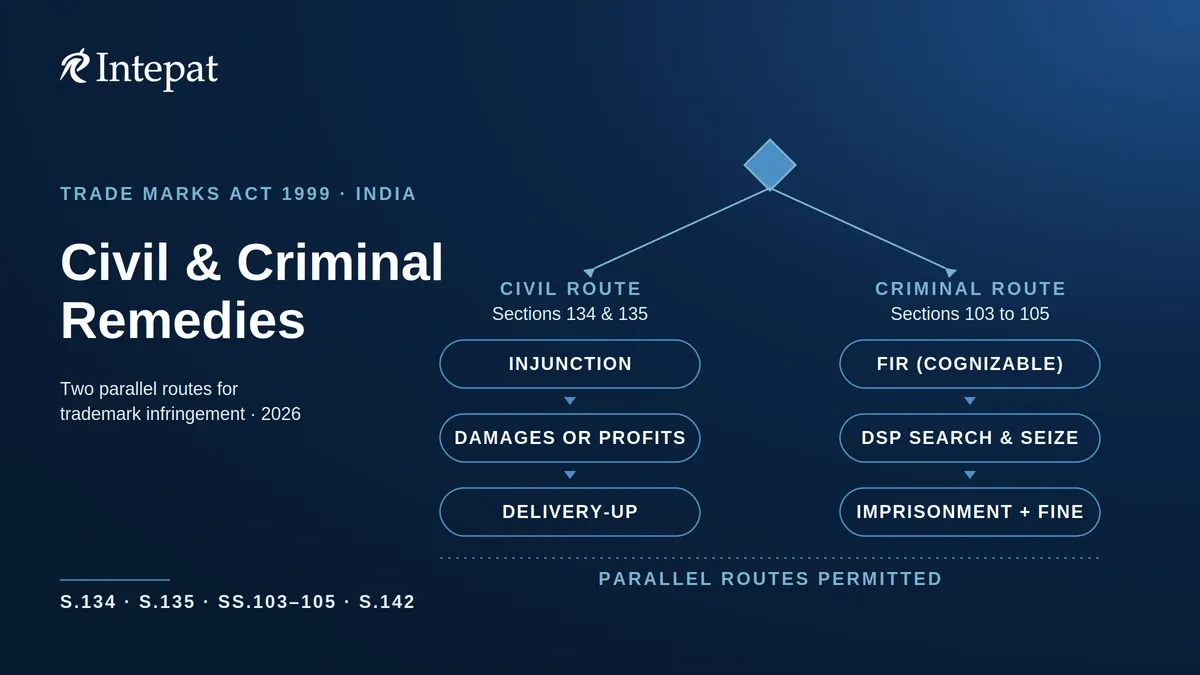
Remedies for trademark infringement: first step by situation
The right first step depends on the form the infringement takes and on what the proprietor already has in hand. The table below maps common situations to a recommended starting point.
| Situation | First step |
| Counterfeit goods (exact copies bearing the proprietor’s mark) | Preserve evidence through test purchases and dated samples; consider a civil suit with interim injunction and a parallel criminal complaint under Sections 103 to 105. |
| A competitor using a deceptively similar brand name | Send a measured legal notice; if urgent, file a civil suit with an application for ex parte interim relief under Order XXXIX Rules 1 and 2 of the Code of Civil Procedure 1908. |
| Counterfeit listing on Amazon, Flipkart, or another marketplace | Capture dated screenshots with the URL before requesting platform takedown; preserve invoices from any test purchase. |
| Counterfeits being imported into India | Record the mark with Indian Customs under the IPR (Imported Goods) Enforcement Rules 2007; pursue civil and criminal remedies in parallel as appropriate. |
| Proprietor’s mark is not registered | An infringement suit is not available under Section 27(1); a passing off action under Section 27(2) is the route, supported by reputation evidence. |
| Limited evidence of the infringer’s use or of the proprietor’s reputation | Strengthen the evidence base (sales figures, advertising spend, market surveys) before any formal action; weak evidence at the interim stage damages the case. |
Trademark infringement under Section 29
Section 29 of the Trade Marks Act 1999 defines the conduct that infringes a registered mark. The proprietor’s right to sue is anchored in Section 28, which gives the registered proprietor the exclusive right to use the mark in respect of the goods or services for which it is registered, and the right to obtain relief for infringement in the manner the Act provides. Section 27(1) closes the door on infringement suits for unregistered marks. The registration certificate matters because Section 31 makes registration prima facie evidence of validity in any legal proceeding.
The Section 29 framework covers several distinct scenarios. The table below maps the operative sub-sections to the conduct each catches.
| Section 29 limb | Conduct caught | Plain-language example |
| 29(1) | Use, in the course of trade, of a mark identical with or deceptively similar to the registered mark, in relation to the registered goods or services, in a manner likely to be taken as use as a trade mark | A competitor markets coffee under a logo deceptively similar to the proprietor’s registered coffee brand |
| 29(2) | Use of an identical or similar mark on identical or similar goods or services where the use is likely to cause confusion on the part of the public, or to suggest an association with the registered mark | Identical product name on closely related goods causing public confusion as to origin |
| 29(4) | Use of an identical or similar mark on goods or services that are not similar to the registered ones, where the registered mark has a reputation in India and the use takes unfair advantage of, or is detrimental to, the mark’s distinctive character or repute | A well-known fashion mark used on unrelated goods to ride on its reputation |
| 29(5) | Use of the registered mark as a trade name, as part of a trade name, or as part of the name of a business concern dealing in the registered goods or services | Incorporating the proprietor’s mark into a company name in the same line of business |
| 29(8) | Advertising that takes unfair advantage of, is contrary to honest practices in industrial or commercial matters, is detrimental to the distinctive character of the registered mark, or is against its reputation | Misleading comparative advertising that disparages the proprietor’s mark |
| 29(9) | Spoken use of the distinctive words of a registered word mark, as well as their visual representation | Voice use of the mark in audio advertising or call-out copy |
Three further sub-sections fill in the scheme. Section 29(3) directs the court to presume confusion where both the marks and the goods or services are identical. Section 29(6) lists what counts as “use” of a mark, including affixing it to goods or packaging, offering goods for sale or services under the mark, importing or exporting goods under the mark, and using it on business papers or in advertising. Section 29(7) reaches a person who applies the registered mark to labels, packaging, business papers, or advertising material, where the person knew or had reason to believe the application was not authorised by the proprietor or a licensee.
For a deeper treatment of how courts assess deceptive similarity, see the note on deceptively similar trademarks with examples. For the wider question of whether a third-party use is direct or indirect under the Act, see indirect trademark infringement in India.
Passing off: when registration is unavailable or under challenge
Section 27(2) of the Act preserves the common law action of passing off for marks that are unregistered, that are registered but whose validity is being contested in the same suit, or where a registered proprietor wishes to plead passing off alongside infringement. The action protects the goodwill associated with a mark rather than the registered right.
The Indian courts apply the classical trinity: the plaintiff must establish goodwill in the mark in the relevant market, a misrepresentation by the defendant likely to deceive the public, and damage or likely damage to that goodwill. The English decision in Erven Warnink often cited in this context laid out five elements (misrepresentation, in the course of trade, to prospective customers, foreseeable injury to business or goodwill, and actual damage), and Indian courts have substantially adopted the framing.
The operative Indian anchors sit in two Supreme Court decisions. In Laxmikant V. Patel v. Chetanbhai Shah & Anr., (2002) 3 SCC 65, the Court confirmed that a reasonable probability of damage to the plaintiff’s goodwill is sufficient to ground a passing off action; proof of actual damage is not required, and goodwill in a trade name is itself a protectable property right. In Cadila Health Care Ltd. v. Cadila Pharmaceuticals Ltd., (2001) 5 SCC 73, the Court laid down a multi-factor test for assessing deceptive similarity that is now applied in both infringement and passing off matters: the nature of the marks (word, label, or composite); the degree of phonetic, visual, and conceptual resemblance; the nature of the goods; the similarity in the nature, character, and performance of the rival goods; the class of purchasers and the degree of care they exercise; the mode of purchase; and other surrounding circumstances. The Court expressly held that phonetic similarity cannot be eclipsed by visual differences, and that the relevant consumer benchmark in India is the average buyer with imperfect recollection.
The practical distinction between infringement and passing off is the burden. Infringement is statutory: registration plus a Section 29 use establishes the cause of action. Passing off requires evidence of reputation, often built through sales figures, advertising spend, market surveys, third-party references, and continuous use. For a domain-name dispute where the plaintiff has no Indian registration, see passing off actions in domain name cases.
Civil remedies under Section 135
Section 135(1) of the Trade Marks Act 1999 lists the reliefs a court may grant in a suit for infringement or for passing off referred to in Section 134:
- Injunction, subject to such terms as the court thinks fit. The injunction restrains the defendant from continuing or repeating the infringing use.
- Damages or account of profits, at the plaintiff’s option. The plaintiff chooses one, not both.
- Delivery-up of infringing labels and marks for destruction or erasure, with or without the monetary relief.
Damages compensate the plaintiff for losses caused by the infringement; an account of profits compels the defendant to disgorge profits earned from the infringing use. In practice, the quantification of damages turns on documentary evidence of lost sales, brand dilution, and corrective advertising costs, and Indian courts have varied in how readily they award compensatory and punitive damages. Recent Delhi High Court practice has tended to scrutinise punitive damages claims more closely than the awards of the mid-2000s, and several decisions now require a clear evidentiary basis before any sum beyond actual damages is granted.
Delivery-up is a practical relief: the order requires the defendant to surrender infringing labels, packaging, and stock for destruction. It is often coupled with an injunction restraining future use.
Section 134(1) requires that the suit be instituted before a District Court (or higher); it cannot be filed in any court inferior to a District Court. Section 134(2) is the procedural pivot most relevant to proprietors based in commercial centres: the plaintiff may file in a District Court within whose jurisdiction the plaintiff actually and voluntarily resides, carries on business, or personally works for gain. The provision overrides the ordinary rule under Section 20 of the Code of Civil Procedure 1908, which would require filing where the defendant resides or the cause of action arose.
Section 134(2) is not, however, an unrestricted forum-shopping provision. In Indian Performing Right Society Ltd. v. Sanjay Dalia & Anr., (2015) 10 SCC 161, decided on 1 July 2015, the Supreme Court read an important limitation into Sections 62(2) of the Copyright Act 1957 and 134(2) of the Trade Marks Act 1999. The Court held that where the plaintiff has its principal place of business or residence at a location where the cause of action has also arisen, the plaintiff must sue there and cannot rely on the additional forum provision to file at a different place merely because it carries on business through a branch office at that other place. The provisions remain available as an additional forum where the principal place and the cause of action lie in different places; they cannot be used to drag a defendant to an inconvenient forum where neither the cause of action nor the plaintiff’s principal place of business connects.
There is a further textual limitation that often goes unnoticed. Section 134(2) expressly applies only “for the purpose of clauses (a) and (b) of sub-section (1)”, that is, suits for infringement of a registered trade mark and suits relating to a right in a registered trade mark. A pure passing off suit, where no registered right is in issue, falls under clause (c) of Section 134(1) and is outside the scope of sub-section (2). A passing off plaintiff cannot, therefore, rely on the additional plaintiff-forum rule; jurisdiction in such a suit must independently satisfy the ordinary territorial rules under Section 20 of the Code of Civil Procedure 1908. For a fuller decision tree on choosing the forum, see steps to find out jurisdiction for a trademark infringement case.
Interim relief: ex parte injunctions and asset-freeze orders
Section 135(2) authorises the court to grant ex parte injunctions and a range of interlocutory orders. Three categories are listed:
- Discovery of documents.
- Preservation of infringing goods, documents, or other evidence related to the subject matter.
- Restraint on the defendant from disposing of assets in a manner that would frustrate the plaintiff’s ability to recover damages, costs, or other pecuniary remedies.
The first two categories cover what Indian courts often describe in shorthand as Anton Piller orders, with a Mareva-style asset-freeze under the third. In Indian civil practice, these orders are implemented through a court-appointed Local Commissioner under Order XXVI Rule 9 of the Code of Civil Procedure 1908. The Local Commissioner, acting under the terms of the court’s order, may be authorised to visit the defendant’s premises, prepare an inventory of infringing goods and materials, take custody of stock for the court, seal items, photograph the premises, and preserve evidence pending trial. The plaintiff does not acquire a free-standing right of search or seizure; the Commissioner is the court’s officer and acts within the four corners of the order.
Temporary injunctions are sought under Order XXXIX Rules 1 and 2 of the Code of Civil Procedure. The court considers the three classical conditions: a prima facie case, balance of convenience, and irreparable injury. A registration certificate helps the proprietor cross the first threshold, but the court still examines the similarity of marks, the relationship between the goods or services, the nature and duration of the alleged use, any delay or acquiescence on the plaintiff’s part, the balance of convenience, and whether the plaintiff’s evidence supports urgent relief. The application is rarely a foregone conclusion even with a clean registration.
Where the infringement appears to involve a network of unidentified infringers (commonly in online piracy, counterfeit distribution chains, and rogue website cases), Indian courts have granted “John Doe” or Ashok Kumar orders that bind defendants whose identities are not yet known, leaving the plaintiff to add specific defendants as they are identified.
Criminal remedies under Sections 103 to 105
Criminal action under the Trade Marks Act is targeted, in practice, at conduct involving the falsification of a mark, the application of a false trade mark or false trade description to goods or services, and the sale or possession for sale of goods bearing such false marks or descriptions. Section 102 defines “falsifying” a mark (including making a deceptively similar mark without the proprietor’s assent) and “false application” of a mark. Sections 103 and 104 then attach criminal liability to those acts, and Section 105 enhances the penalty on a second or subsequent conviction.
| Provision | Conduct caught | Imprisonment | Fine |
| Section 103 | Falsifying a trade mark; applying a false mark to goods or services; possessing dies, plates, machines, or instruments for the purpose of falsification; applying a false trade description; tampering with required indications of origin | Not less than 6 months, may extend to 3 years | Not less than Rs 50,000; may extend to Rs 2,00,000 |
| Section 104 | Selling, letting for hire, exposing for sale, possessing for sale, or providing services bearing a false trade mark or false trade description | Not less than 6 months, may extend to 3 years | Not less than Rs 50,000; may extend to Rs 2,00,000 |
| Section 105 | Second or subsequent conviction under Section 103 or 104 | Not less than 1 year, may extend to 3 years | Not less than Rs 1,00,000; may extend to Rs 2,00,000 |
Penalties verified as of June 2026 against the Trade Marks Act 1999.
Section 103 carries a proviso that the accused escapes liability if they prove they acted without intent to defraud. Section 104 has a similar carve-out for an accused who took reasonable precautions, gave full information about the supplier on demand, or otherwise acted innocently. Each section also has a proviso allowing the court, for adequate and special reasons recorded in the judgment, to impose a lower sentence or fine; this is a discretionary safety valve rather than a default.
Two procedural features matter for enforcement strategy. First, Section 115(3) makes offences under Sections 103, 104, and 105 cognizable, which means the police can register a First Information Report and investigate without the magistrate’s prior order. Second, Section 115(4) empowers a police officer not below the rank of Deputy Superintendent of Police (or equivalent) to search and seize without warrant the goods, dies, plates, and other instruments involved in the offence; but the officer must first obtain the Registrar’s opinion on the facts relating to the trade mark and is bound by that opinion. The Registrar’s opinion is a practical bottleneck that should be factored into any timeline for a criminal raid.
Section 115(2) requires that the case be tried by a court not inferior to a Metropolitan Magistrate or Judicial Magistrate of the first class. Section 118 sets the limitation: no prosecution may be commenced after three years from the offence or two years from the discovery of the offence by the prosecutor, whichever expires first.
It does not follow that every act of trademark infringement under Section 29 will support a criminal prosecution. Criminal liability turns on the statutory definition of falsifying or falsely applying a mark in Section 102, the intent-to-defraud carve-out in Section 103, and the Registrar’s opinion under Section 115(4). In practice, prosecutions are most readily framed around counterfeit goods, knock-off packaging, possession of dies and plates, and trade in goods bearing false marks or descriptions.
Choosing civil, criminal, or both
In plain terms, civil action is used to stop the infringing use, preserve evidence, and claim monetary relief. Criminal action is targeted, in practice, at conduct involving counterfeiting, application of a false trade mark, or trade in goods or services bearing false marks. The decision usually comes down to the proprietor’s primary objective.
| Primary objective | Preferred route | Why |
| Stop the infringer from continuing the use | Civil suit with interim injunction | The civil court can grant urgent interim restraint, including ex parte relief in appropriate cases, where the pleadings and evidence justify immediate intervention. |
| Recover monetary loss from the infringer | Civil suit | Damages or account of profits are civil reliefs; criminal proceedings do not compensate the proprietor directly. |
| Seize counterfeit stock from a warehouse or retail outlet | Criminal complaint plus Section 115(4) seizure, or civil suit with Local Commissioner | Police seizure is faster against an organised counterfeit operation; a Local Commissioner is more controllable for evidence preservation. |
| Deter organised false-mark or counterfeit trade through prosecution | Criminal complaint under Sections 103 to 105 | Criminal proceedings carry deterrent value in cases that satisfy the false-mark or counterfeiting threshold under Sections 102 to 105 of the Act. |
| Combat large-scale counterfeit distribution | Both routes in parallel | Counterfeit cases regularly require simultaneous civil injunction (to bind known parties) and police action (to disrupt unknown operators in the supply chain). |
The routes are not mutually exclusive. Filing a civil suit does not bar a criminal complaint, and vice versa, in a case where the conduct meets both the civil infringement test and the false-mark threshold for criminal action.
Avoid these common mistakes
• Sending an aggressive notice before confirming registration status and assembling evidence.
• Requesting a marketplace takedown before preserving dated screenshots and URLs of the infringing listing.
• Assuming every act of trademark infringement supports a criminal prosecution.
• Filing at a distant branch-office jurisdiction without first checking the position against Sanjay Dalia.
• Opting for damages or account of profits without the documentary basis needed to quantify the claim.
Practical steps before filing
Several steps strengthen any subsequent action and reduce procedural risk:
- Confirm registration status. Pull a copy of the registration certificate from the Registry and verify that the mark is current. A lapsed registration cannot found an infringement claim. See registered trademark certificates and their proof value.
- Collect evidence of the infringer’s use. Sample products, packaging, invoices, online listings, and website screenshots dated and notarised where possible. For online use, archived web pages preserve the evidence past any takedown.
- Document the proprietor’s reputation. Sales figures, advertising spend, distributor lists, and media coverage are central to passing off and to a damages claim.
- Send a measured cease-and-desist where appropriate. A cease-and-desist notice can resolve the matter without litigation, but the threat must be capable of being defended under Section 142. The provision is directed specifically at threats of infringement proceedings against a person, and the threat-maker, if sued, must satisfy the court both that the mark is registered and that the threatened acts constitute, or if done would constitute, infringement of the mark. Section 142(3) exempts legal practitioners and registered trade marks agents from liability under this section, but only for acts done in their professional capacity on behalf of a client.
- Check Commercial Courts Act requirements. A trademark infringement or passing off suit at the specified value of not less than Rs 3 lakh is a “commercial dispute” under Section 2(1)(c)(xvii) of the Commercial Courts Act 2015, triable by a Commercial Court or Commercial Division. Section 12A of that Act ordinarily requires the plaintiff to exhaust pre-institution mediation before filing, unless the suit contemplates urgent interim relief. In Novenco Building and Industry A/S v. Xero Energy Engineering Solutions Pvt. Ltd., 2025 INSC 1256 (decided 27 October 2025), the Supreme Court held that continuing intellectual property infringement creates inherent urgency, and that mere delay between discovery and filing does not negate it; insistence on pre-institution mediation in such cases would leave the plaintiff effectively remediless. Where urgency is real and properly pleaded, the suit may proceed without first exhausting mediation; otherwise, mediation must be completed within the statutory window (three months, extendable by two) before filing, with the mediation period excluded from limitation under Section 12A(7).
- Plan for jurisdiction. Section 134(2) gives the plaintiff an additional forum where the plaintiff resides or carries on business, subject to the Sanjay Dalia limitation discussed above, and subject to the textual restriction that this additional forum is available only for suits under clauses (a) and (b) of Section 134(1), not for a pure passing off suit under clause (c).
Evidence to gather before action
A clean evidence file before filing avoids common dismissals at the interim stage. A practical checklist, ordered to match real case preparation:
- Registration certificate of the mark and its current renewal status.
- Samples or photographs of the infringer’s goods, packaging, and trade dress.
- Purchase invoice or test-purchase proof, where available.
- Dated screenshots with the full URL for every online listing or website complained of.
- Customer correspondence or third-party communications showing actual confusion, where any has surfaced.
- Sales figures, advertising spend, distributor lists, and media references establishing the proprietor’s reputation.
- Prior cease-and-desist correspondence, if any.
- Customs entry papers and bills of lading where imports are involved.
- WHOIS records and registrar details for any domain-name dispute.
Online and cross-border infringement
Counterfeit distribution and online infringement bring distinct enforcement levers in addition to civil and criminal action.
Customs recordal. Under the Intellectual Property Rights (Imported Goods) Enforcement Rules 2007, the proprietor of a registered trade mark can record the mark with Indian Customs. Once recorded, Customs has the authority to detain imports suspected of infringement. The recordal lasts for a notified period and must be renewed; see renewal of customs recordal in India.
Recordal is not a file-and-forget step. The right holder executes an indemnity bond at registration, indemnifying Customs against liabilities and expenses arising from any suspension of clearance. When Customs suspends clearance under a registered notice, the right holder must join the proceedings within ten working days of suspension (extendable by a further ten days at the discretion of the Customs officer); for perishable goods, the timeline is three working days, extendable by four. Failure to join the proceedings within the prescribed timeline causes release of the detained goods. The right holder also bears the costs of detention, storage, destruction, and disposal of confiscated goods, which can be material for high-volume seizures.
E-commerce takedowns. Major marketplaces operate brand-protection programmes that allow proprietors to report counterfeit listings and seek removal. In practice, takedown strategy should be built around the platform’s reporting process, the Trade Marks Act, preserved evidence of infringement, and seller-identification details obtained through the platform. The Information Technology (Intermediary Guidelines and Digital Media Ethics Code) Rules 2021, as amended, provide a broader intermediary due-diligence framework, but they should not be treated as a substitute for trademark-specific enforcement under the Act. For Amazon specifically, see how to report IP infringement on Amazon and Amazon Brand Registry: process and benefits.
Cross-border infringement. Where the infringer is based outside India but distributes into India, the Indian court’s jurisdiction can be invoked on the strength of targeted Indian customers, an interactive website, or actual sales in India. For marks with reputation in India, Section 29(4) supports an infringement claim even on dissimilar goods, and the dilution standard applies. Recognition as a well-known trademark under Section 11(2) strengthens enforcement across classes.
Defences and limits on remedies
Several provisions of the Act limit the reach of the remedies discussed above. A defendant facing an infringement claim will commonly rely on one or more of the following:
- Section 30 honest practices defence. Use of a registered mark to identify the proprietor’s goods or services is not infringement where it is in accordance with honest practices and does not take unfair advantage of the mark’s reputation. Section 30 also exempts descriptive uses (kind, quality, geographical origin), parallel imports of goods first marketed by the proprietor or with the proprietor’s consent, and use by the proprietor of one of two co-existing registered marks.
- Section 31 prima facie evidence rebuttal. Registration is only prima facie evidence of validity; the defendant can challenge validity in a counterclaim or rectification petition.
- Section 33 acquiescence. A registered proprietor who has knowingly tolerated the defendant’s use for five continuous years loses the right to seek invalidation or to oppose the use, save where the defendant’s registration was obtained in bad faith.
- Section 34 vested rights. Use of a mark by a person who has continuously used it from a date earlier than the registered proprietor’s first use, or earlier than the date of registration (whichever is earlier), is preserved.
- Section 135(3) limits on damages. Section 135(3) of the Act bars damages other than nominal damages, and bars an account of profits, in three situations: (a) where the suit is for infringement of a certification trade mark or collective mark, the court cannot award damages beyond nominal damages or an account of profits, regardless of the merits; (b) where the defendant in an infringement suit satisfies the court that, at the time of first use, the defendant was unaware and had no reasonable ground to believe the plaintiff’s mark was on the register, and that the defendant ceased use on becoming aware of the right; and (c) the parallel innocence defence in a passing off suit, where the defendant satisfies the court that at the time of first use it was unaware and had no reasonable ground to believe that the plaintiff’s mark was in use, and ceased use on becoming aware. Injunction and delivery-up remain available in all three cases.
- Section 142 groundless threats. A person aggrieved by a groundless threat of infringement proceedings may sue for a declaration that the threats are unjustifiable, for an injunction against continuance, and for any damages sustained. The person making the threat can defeat the action only by satisfying the court both that the mark is registered and that the threatened acts constitute, or would if done constitute, infringement. The exemption for legal practitioners and registered trade marks agents under Section 142(3) is confined to acts done in their professional capacity on behalf of a client.
These provisions are why a measured pre-litigation strategy generally outperforms aggressive cease-and-desist letters sent in the proprietor’s own name without legal advice.
Frequently asked questions
No. The remedies for trademark infringement under Sections 28 and 29 of the Trade Marks Act 1999 are available only to the proprietor of a registered mark; Section 27(1) bars an infringement suit on an unregistered mark. The proprietor of an unregistered mark may, however, bring a passing off action under Section 27(2), which requires proof of goodwill, misrepresentation by the defendant, and damage or likely damage to that goodwill.
A civil suit for infringement is governed by the three-year limitation under the Limitation Act 1963, running from each act of infringement, since each act gives rise to a fresh cause of action. For criminal prosecution under Sections 103 to 105, Section 118 of the Trade Marks Act 1999 sets the limit at three years from the offence or two years from discovery, whichever expires first.
No. Section 135(1) of the Trade Marks Act 1999 requires the plaintiff to choose between damages and account of profits; the two reliefs are alternative, not cumulative. Delivery-up of infringing material and an injunction can be sought together with either.
Infringement is a statutory right under Sections 28 and 29 and requires a registered mark. Passing off is a common law action preserved by Section 27(2) and is based on goodwill, misrepresentation, and damage, irrespective of registration. The reliefs available are similar; the evidentiary burden is heavier for passing off.
Yes, subject to two conditions. Section 115(4) of the Trade Marks Act 1999 empowers a police officer not below the rank of Deputy Superintendent of Police, or equivalent, to search and seize without warrant, but only after obtaining the Registrar’s opinion on the trade mark facts and abiding by that opinion. The seized articles must be produced before a Magistrate of the first class.
Section 134(1) requires the suit to be filed before a District Court or higher. For suits for infringement of a registered mark or relating to a right in a registered mark, Section 134(2) permits the plaintiff to file in a District Court within whose jurisdiction the plaintiff resides, carries on business, or personally works for gain. This additional forum is not available for a pure passing off suit, which falls under clause (c) of Section 134(1) and must satisfy ordinary territorial jurisdiction under Section 20 CPC. Under the Supreme Court’s decision in IPRS v. Sanjay Dalia (2015), even in infringement suits the plaintiff cannot use the additional forum where its principal place of business and the cause of action are at the same location.
Yes. Section 115(3) of the Trade Marks Act 1999 expressly makes offences under Sections 103, 104, and 105 cognizable, allowing the police to register an FIR and investigate without a magistrate’s prior order. The case is triable by a Metropolitan Magistrate or Judicial Magistrate of the first class under Section 115(2).
Yes, and a measured cease-and-desist notice is often the first step. The proprietor should ensure the threat is one the proprietor can defend, because Section 142 of the Trade Marks Act 1999 makes groundless threats of infringement proceedings actionable. The threat-maker can defeat any subsequent suit under Section 142 only by satisfying the court that the mark is registered and that the threatened acts constitute, or would constitute, infringement.
Section 12A of the Commercial Courts Act 2015 ordinarily requires pre-institution mediation before a commercial suit of the specified value is filed, unless the suit contemplates urgent interim relief. In Novenco Building and Industry A/S v. Xero Energy Engineering Solutions Pvt. Ltd. (2025 INSC 1256, decided 27 October 2025), the Supreme Court held that continuing intellectual property infringement creates inherent urgency, exempting such cases from the mandatory mediation requirement. The urgency must be genuinely pleaded and supported by the facts.
Yes. The proprietor can use the platform’s brand-protection programme to request removal of counterfeit listings, and in parallel preserve dated screenshots, URLs, and test-purchase evidence for any civil or criminal action under the Trade Marks Act. The intermediary due-diligence framework under the Information Technology (Intermediary Guidelines and Digital Media Ethics Code) Rules 2021, as amended, supplements but does not displace the platform’s own takedown process.
Yes. Under the Intellectual Property Rights (Imported Goods) Enforcement Rules 2007, the proprietor of a registered trade mark can record the mark with Indian Customs by executing an indemnity bond. Once recorded, Customs has the power to suspend clearance of imports it has reason to believe are infringing. The right holder must join the proceedings within ten working days of suspension (three working days for perishable goods), failing which the goods are released; the right holder also bears the costs of detention and destruction.
Disclaimer: This article is for general information on Indian trademark law as at June 2026 and does not constitute legal advice. Enforcement strategy turns on the specific facts of each case, the evidence available, the conduct and location of the infringer, and the forum chosen. Before initiating or responding to infringement action, including the dispatch of cease-and-desist communications, readers should obtain advice from a qualified trade mark attorney or advocate.