




Trademark franchising in India means licensing your brand to a franchisee while you retain ownership. No separate franchise law exists; the Trade Marks Act 1999 governs the brand side through a written licence agreement. You may also record the franchisee formally at the Trade Marks Registry. The quality control clause in that agreement is what protects the mark.
This guide covers the licence structure, recordal procedure, and the drafting decisions that determine whether the arrangement strengthens or weakens your trademark rights. For the complete context on what trademark registration gives you and what it does not protect, see the complete guide to trademark registration in India.
Key points
• Register the trademark first; without registration, you cannot sue for trademark infringement, although a passing-off action remains available where goodwill, misrepresentation, and damage can be established.
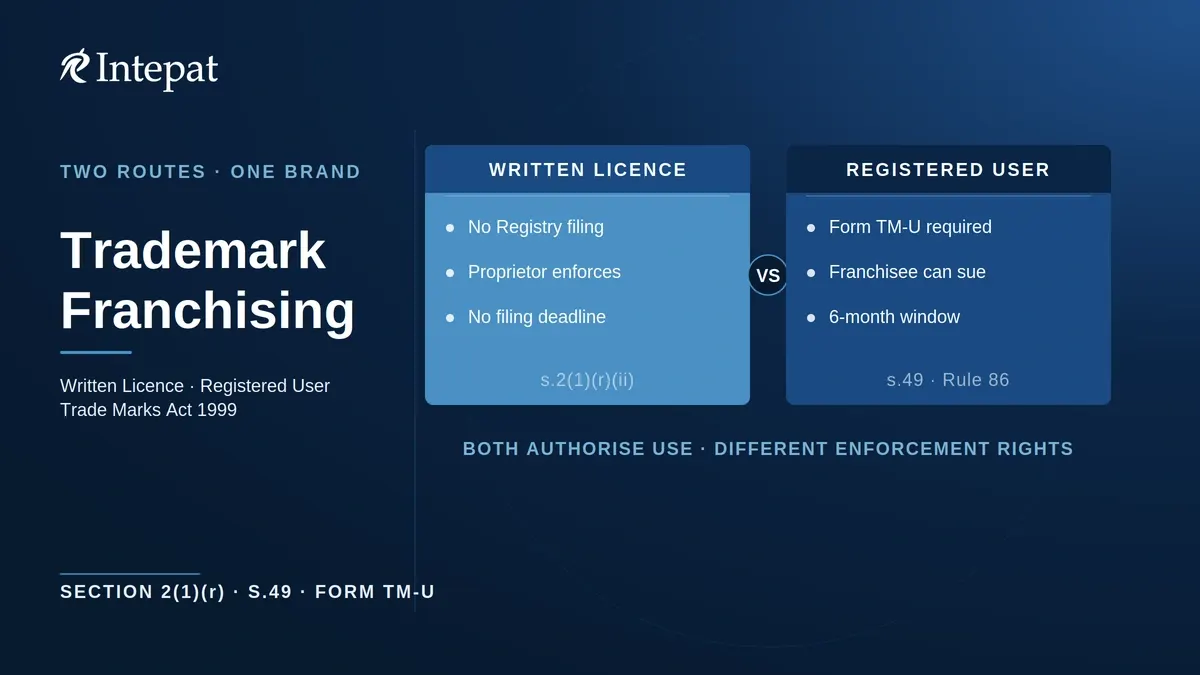
• Authorise a franchisee through a written licence agreement (no Registry filing needed for this route).
• Build quality-control obligations into the agreement; if you formally register your franchisee as a registered user, failing to enforce those standards can result in that registration being cancelled.
• To give the franchisee the right to sue infringers independently, record them as a registered user (a franchisee formally entered in the Trade Marks Register), using Form TM-U; Rs 4,500 e-filing per mark; file within six months of signing.
• A registered-user franchisee cannot assign or transmit its right to use the mark; any onward use by another party requires fresh authorisation from the proprietor.
What trademark franchising actually means in India
Franchising your business means letting a franchisee operate under your brand, systems, and standards in a defined territory. The mark (your word, logo, colour combination, or shape of goods) is what makes the franchisee’s outlet recognisable to your customers. That puts trademark ownership and licensing at the IP foundation of any franchise arrangement in India.
India has no dedicated franchise statute. Territory exclusivity, franchise fees, and disclosure obligations sit in the franchise agreement itself, governed under general contract principles. The Trade Marks Act 1999 addresses a different but equally important question: who may use the mark, under what conditions, and what happens if the arrangement is managed carelessly.
This article covers the trademark dimension of franchising your trademark in India only. For commercial franchise terms, FDI approvals, and the tax treatment of royalties, separate specialist advice is needed.
Why trademark ownership matters before you franchise
The most common blocker in a franchise arrangement is straightforward: you can only license statutory rights you actually hold. If the mark is not registered in your name, there are no statutory trademark rights to pass to a franchisee.
An unregistered mark does carry some legal protection; a proprietor can seek relief through a passing-off action (a common-law claim based on misrepresentation that damages established goodwill) where the mark has acquired goodwill, and that right is preserved by the Trade Marks Act 1999. But it leaves both parties in a weaker position. The franchisee has no clear statutory footing for their use of the mark, and you lack the statutory enforcement tools that a registration provides if a third party starts copying the brand in a different city or state.
The practical starting point is to register the trademark in India before any franchise conversation begins. Registration gives you an exclusive statutory right to the mark, a documented asset you can license, and a public record that the brand belongs to you. From that position, a franchise can be structured on firm ground.
| Protect Your Brand First |
| Register your trademark before you license it to any franchisee; our attorneys can help. |
| Register Your Mark |
The written licence: how most franchisors authorise a franchisee
The Trade Marks Act 1999 provides two ways to authorise a franchisee’s use of your mark. The first, and the route most franchisors use in practice, is a written licence by consent. The Act calls this “permitted use”: the franchisee must be connected in the course of trade with the goods or services your mark covers, the mark must remain registered, and the use must rest on your written consent. The use must also fall within the scope of the trademark’s registration itself: the goods, services, and any conditions stated in the registration certificate. No Registry filing is required for this route.
The trademark licence agreement should define the mark covered, the territory, the approved goods or services, quality standards, the proprietor’s right to inspect compliance, and what happens to mark use after the agreement ends. The franchisee’s use is authorised as long as it falls within those terms. Under the Act, permitted use by a franchisee is deemed to be use by the proprietor, protecting the mark from cancellation for non-use by third parties.
The limitation is equally clear: a franchisee operating on a written licence alone cannot bring an infringement action in their own name if a third party starts copying the brand. That enforcement right stays with you as the registered proprietor.
For a full account of the key provisions, the trademark licensing guide covers what to include.
Quality control: the clause that protects your brand
When your mark appears on a franchisee’s goods or services, customers assume those goods and services meet the standards they associate with your brand. Quality control in franchising is not just an operational matter; it is central to preserving the trademark’s distinctiveness and your standing as proprietor. Under the Trade Marks Act 1999, if a quality-control stipulation in a registered-user arrangement is not enforced or not complied with, the Registrar may cancel the registered-user entry on that ground.
While this Registry cancellation ground is specific to registered-user arrangements, the same quality-control discipline applies to written consent licences. A licence that sets no quality standards and involves no monitoring is sometimes called a naked licence, and it is the most direct route to eroding the mark’s distinctiveness over time. Your franchise agreement must specify what the franchisee may and may not do under the brand, the standards their goods or services must meet, and your right to inspect and verify compliance.
If you choose the formal registered-user route, the affidavit filed with the application must state the degree of control the proprietor will exercise over the franchisee’s permitted use. That affidavit creates a documented basis for the quality relationship and supports your position if the recordal is later challenged. For a detailed treatment of what to include, the quality-control guide for trademark licensing covers the provisions in full.
Registered-user recordal: the optional formal layer
A written licence by consent is lawful but does not appear in the Trade Marks Registry. If you want the franchisee to have formal standing, including the right to bring an infringement suit in their own name, you can record them as a registered user under the Trade Marks Act 1999. That recordal is made by the proprietor and the proposed registered user jointly, in Form TM-U prescribed under the Trade Marks Rules 2017.
The application must be filed within six months of the date of the written agreement between the parties. It must be accompanied by the agreement itself (or a duly authenticated copy) and an affidavit from the registered proprietor. The affidavit must cover the nature of the relationship between the parties, the degree of control you will exercise over the franchisee’s use, the goods or services covered, any restrictions, and whether the arrangement runs for a fixed period or is open-ended. Once the Registrar accepts the application, the franchisee is entered in the register.
Filing deadline: Any registered-user application must reach the Registry within six months of the date of the written agreement. Applications outside that window will not be entertained.
In practice, many franchisors rely on the written-licence route where they want to keep enforcement with the proprietor and avoid filing formalities. Registered-user recordal becomes more useful where the franchisee needs independent enforcement standing, the arrangement is long-term or covers a separate territory, or a foreign proprietor wants a formal Indian record of authorised use. Note that registered-user recordal does not constitute approval for royalty remittance outside India; Rule 90 of the Trade Marks Rules 2017 states this. The trade-off is that recordal adds a six-month filing window and tighter statutory consequences if the quality-control relationship is not maintained.
Written licence only, or registered-user recordal?
| Written licence only | Registered user (Form TM-U) | |
| Registry filing | None | Joint application, proprietor and franchisee |
| Fee | None for this step | Rs 4,500 e-filing / Rs 5,000 physical, per mark (verified June 2026) |
| Application deadline | No Registry deadline | Within six months of the agreement date |
| Franchisee can sue an infringer? | No | Yes, in own name (subject to what the agreement says); proprietor joined as defendant |
| Franchisee can transfer or sub-license? | Subject to contract terms | No; the statute means the franchisee cannot pass or assign the licence to anyone else |
| Appears in Trade Marks Register | No | Yes |
On the enforcement row: when a registered user brings an infringement action, the registered proprietor must be made a defendant. This is a procedural requirement, not a bar to the proceedings; the suit can continue with the proprietor as a named party. A consent-only franchisee has no equivalent right; any infringement action must be brought by you as the proprietor.
For a complete guide to the registered-user procedure, the article on registered users in India covers the full statutory and procedural framework.
Before you sign: licence the brand, do not give it away
A licence and an assignment are legally different, and the distinction matters before any franchise agreement is finalised. Under the Trade Marks Act 1999, the registered proprietor has the power to assign the mark: to transfer ownership in writing to another party. An assignment is permanent; the mark moves to the new owner and the previous proprietor no longer holds it. A franchise licence is the opposite arrangement: it grants permission to use the mark within defined terms while ownership remains with you.
A poorly drafted franchise agreement that reads as a transfer of ownership, rather than an authorisation of use, could affect your standing as the proprietor. The risk is most significant in long-term or exclusive arrangements, where the franchisee’s position might be characterised as more permanent than a licence contemplates.
Review the agreement with trademark counsel before execution. The working question is direct: does this agreement authorise the franchisee to use the mark, or does it hand the mark over? For the statutory basis of the difference between a licence and a trademark assignment in India, the linked article explains both mechanisms in full.
Frequently Asked Questions
A franchise is a broader commercial arrangement that typically includes a trademark licence as its brand component, alongside business-format rights, training, territory, and operational terms. Under the Trade Marks Act 1999, the brand-use component of a franchise is governed by the statutory permitted use framework; the wider commercial terms are matters of contract.
No. The Trade Marks Act 1999 provides two authorisation routes. A written consent licence requires no Registry filing and is a lawful authorisation. Formal registered-user recordal under Section 49 is optional but gives the franchisee the right to bring an infringement claim in their own name. The choice turns on the enforcement access you want the franchisee to have.
The fee for registering a franchisee as a registered user under Section 49 is Rs 4,500 e-filing / Rs 5,000 physical per mark, per the Trade Marks Rules 2017 First Schedule (verified June 2026; subject to change). The joint application in Form TM-U must reach the Registry within six months of the written agreement between the parties.
A franchisee recorded as a registered user under Section 49 of the Trade Marks Act 1999 may bring infringement proceedings in their own name, unless the franchise agreement restricts this, with the registered proprietor named as a required party in the proceedings. A franchisee on a written consent licence has no statutory right to institute an infringement action.
A registered-user arrangement in which the quality-control stipulation is not enforced or not complied with may be cancelled by the Registrar under the Trade Marks Act 1999. More broadly, a licence that sets no standards and involves no monitoring erodes the mark’s distinctiveness over time, weakening both its commercial value and its long-term registrability.
No. Under the Trade Marks Act 1999, a registered user of a trademark has no assignable or transmissible right to use the mark. A registered user cannot assign or transmit its statutory user right. Any onward use by another franchisee, affiliate, or sub-operator should be structured through fresh proprietor consent and, where needed, a separate registered-user filing.
Disclaimer: This article covers the trademark-licensing dimension of business franchising under the Trade Marks Act 1999 and Trade Marks Rules 2017, verified June 2026. Commercial franchise terms, FDI approvals, royalty taxation, and franchise-disclosure obligations fall outside this scope and require separate professional advice. Nothing in this article constitutes legal advice for any specific transaction. Consult a qualified trademark practitioner before structuring or executing any franchise or licence arrangement.