




Originally published 10 April 2026. Republished and updated 9 November 2026.
PCT national phase amendments in India are narrow: the one claim change you can make on the entry form is deletion. Every other change to claims, description or drawings is a separate Form 13 amendment under a strict scope limit. This guide sets out what can change at each stage, what it costs and how to order the decisions.
The rules here are those of the Indian Patent Office under the Patents Act, 1970 and the Patents Rules, 2003, as at November 2026. They apply to an international application that designates India and enters the Indian national phase.
Quick answer: Use claim deletion at entry if you must, take Article 19 and Article 34 amendments in through the application you enter with, and file Form 13 for any other voluntary amendment. Decide before entry whether you will want a divisional, and budget for the claims fee on the higher count until the office’s count is clear.
Which PCT national phase amendments in India are allowed at entry?
You can delete claims on the entry form, and make the dependency changes that follow, without a separate Form 13 request. On the claims, the Manual allows only deletion at entry. Amendments made before the searching or examining authority count as made before the Indian office if you ask. Any other voluntary change is a Form 13 request.
Entry is by Form 1. For the purpose of that rule, the application you enter with is the international application as filed, including its amendments [Rule 20(1)].
That includes any Article 19 amendment communicated to the Indian office and any amendment made under Article 34(2)(b), which can reach the claims, description and drawings. So what you carry in is the text as it stands after those amendments.
The one change permitted on the entry form itself is claim deletion at entry. The Rules allow an applicant to delete a claim while filing, following the formalities for amended pages (retyped pages and a marked copy). The Manual adds that addition, revision or modification of claims is not allowable at entry (for applications filed on or after 16 May 2016), and that changes to the dependency of the remaining claims that follow from a deletion need no separate request.
That is a rule about the claims on the entry form. The Manual also contemplates a separate Form 13 request filed with the application, which the FAQ below takes up. Nothing stops you amending later; it moves every other voluntary change to the Form 13 amendment route described in the fifth section below.
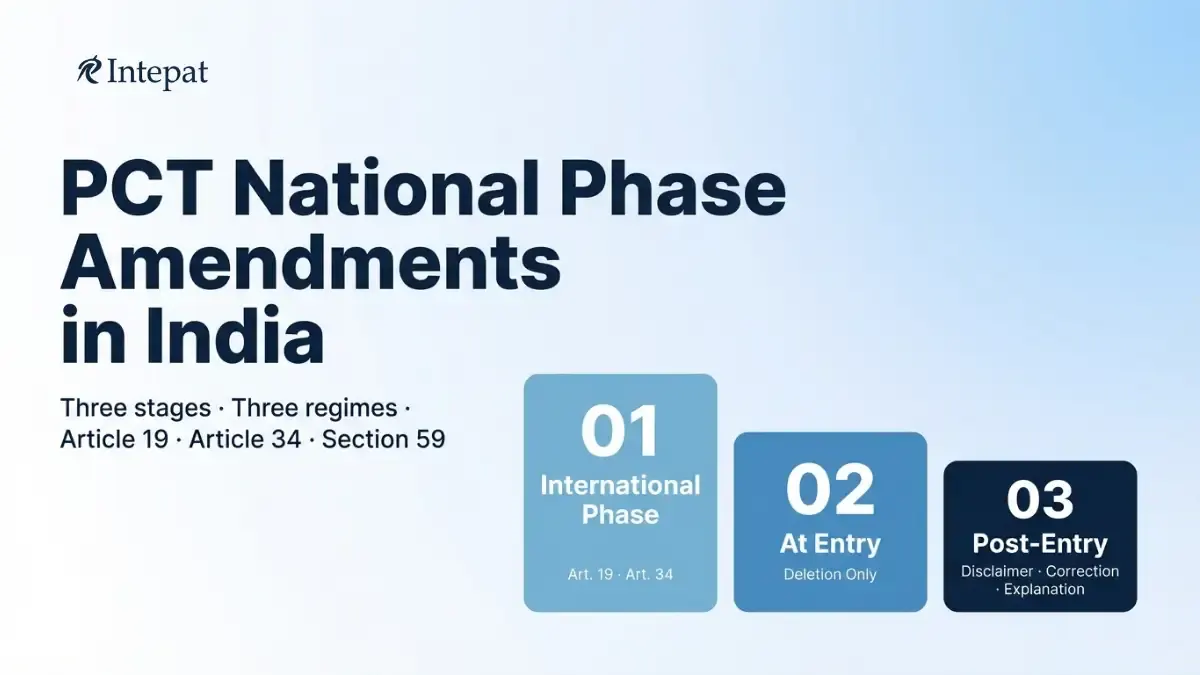
| Stage | What you can change | Route and fee |
|---|---|---|
| International phase | Claims under Article 19; claims, description and drawings under Article 34 if you filed a Chapter II Demand | Article 19 goes to the International Bureau; Article 34 goes to the examining authority |
| At entry in India | Delete claims, with consequent changes in dependency | Form 1; Rs 320 or Rs 1,600 for each claim above 10 |
| After entry, before grant | Disclaimer, correction or explanation within the original disclosure | Form 13; Rs 800 or Rs 4,000 |
| After grant | The same, within the same limits | Form 13; Rs 1,600 or Rs 8,000 |
The lower figure in each row is the e-filing fee for a natural person, startup, small entity or educational institution; the higher figure is the e-filing fee for everyone else (First Schedule, entries 1 and 19). Physical filing costs more. Verified as of November 2026.
Which international-phase amendments carry into India?
Article 19 amendments count as part of the application you enter with if they were communicated to the Indian office, and so do Article 34(2)(b) amendments. The Act treats amendments proposed before the searching or examining authority as made before the Patent Office if you so desire. An amendment left untranslated after the office’s invitation is disregarded.
The Act treats an amendment proposed before the international searching authority or the preliminary examining authority as an amendment made before the Patent Office, if the applicant so desires [Section 138(6)]. The Manual repeats this and describes the effect as applying before entry into the national phase. Article 19 amendments are filed with the International Bureau, not before those authorities, so Section 138(6) does not name them; the definition of the application you enter with does.
Two practical points follow. First, the translation duty can bite. Where the international application was not filed or published in English, the translation must cover Article 19 amended claims (if India was not elected) or the annexes to the preliminary examination report (if India was elected), and amendments still untranslated after the office invites a translation are disregarded [Rule 20(5) and (6)]. Second, the periods for making international-phase amendments are set by the PCT, not by India, and our guide to amending during the international phase covers them.
An Article 19 amendment falls within the definition if it was communicated to the Indian office, so confirm that communication before you instruct Indian counsel; the sources do not say what happens to one that was not. Plan the instructions around the claim set you intend to enter with, and say clearly which amendments you want treated as made before the Indian office.
How do you delete claims at entry, and what does it do to the fee?
Prepare retyped pages and a marked copy, then file them with Form 1. As we understand current e-filing practice, the Form 1 fee follows the claims you file, so deletion would lower the fee; no IP India document we hold says so. The sources do not settle which count applies, so plan for a balance.
Deletion at entry follows the usual amendment formalities: the amended pages are retyped to form a continuous document, and a marked copy identifies each change by page and line with the reason [Rule 14]. The claims fee is Rs 320 for each claim above 10 for a natural person, startup, small entity or educational institution, and Rs 1,600 for everyone else, on e-filing [First Schedule, entry 1].
Here is where the sources part company. In current e-filing practice, the national phase Form 1 computes the claims fee on the number of claims you file, though no IP India document we hold says so. The Manual, however, says the fee is calculated on the pages and claims as they stand in the PCT international application on the date of filing in India. WIPO’s India chapter counts the claims in the international application at entry, including amended claims. Neither passage addresses the fee effect of deletion on Form 1, and the Manual’s item permitting deletion does not mention the fee.
The fee must be paid before the 31 month limit [Rule 20(3)], and the office does not begin processing before then unless Form 18 is filed. The sources do not say the office will notify a shortfall first, so pay on the higher count or keep any balance payable before month 31.
WIPO’s India chapter says an underpaid claims fee leaves the application deemed not filed under Section 142(3).
Rule 22 separately deems an application withdrawn if the applicant does not comply with Rule 20, which includes paying the national fee and filing any required translation before the 31 month limit. The sources do not say which consequence applies to a claims fee shortfall.
Is deleting claims at entry final?
Treat it as a scope decision you may not be able to reverse. The instruments allow deletion at entry and say nothing on restoring a deleted claim. A later amendment must keep every claim wholly within the scope of a claim that stood before it. Decide before entry whether you will want a divisional.
The Act lets an applicant, before grant, file a further application for an invention disclosed in the specification already filed [Section 16(1)]. The Act does not say how deletion at entry affects that right. The Manual adds that divisional claims must be based on the claims of the first application, with no addition of claims outside their scope [Manual 06.01.01(vi)]. The sources do not say whether a claim deleted at entry still counts for that purpose, so do not assume a deleted claim can be revived through a divisional.
A divisional is a further application, so it follows the application you enter with, and the deletion is made while filing that application. The further application cannot include matter not in substance disclosed in the first one [Section 16(2)]. Decide before you file Form 1 which subject matter you may want in a divisional.
Later amendments run into the scope limit. Under the Act, no amendment may be allowed if any amended claim would not fall wholly within the scope of a claim before the amendment [Section 59(1)]. The Act does not state a rule on restoring a claim you have deleted, so do not count on bringing one back.
What can you change after entry, and how?
Ask by Form 13, with a marked copy, reasons, and a declaration that no infringement suit or revocation proceeding is pending. The Act then limits what can be allowed: disclaimer, correction or explanation, incorporation of actual fact, nothing outside the original disclosure, and every claim within the scope of a claim before the amendment.
You ask on Form 13 [Rule 81(1)].
It is an application under Section 57 to amend the application, the complete specification or any related document. It states the reasons for the request and carries the declaration that no suit for infringement or proceeding for revocation is pending. The Controller will not pass an order on the request while such a suit or proceeding is pending.
The fee depends on the stage: before grant, Rs 800 for a natural person, startup, small entity or educational institution and Rs 4,000 for others; after grant, Rs 1,600 and Rs 8,000 [First Schedule, entry 19].
The limit on what can be allowed is the one in the Act [Section 59(1)]:
- only by way of disclaimer, correction or explanation;
- only for the purpose of incorporation of actual fact;
- nothing that makes the specification claim or describe matter not in substance disclosed or shown before;
- no claim that would not fall wholly within the scope of a claim before the amendment.
The right to amend to comply with the Controller’s directions issued before grant is preserved [Section 57(6)]; the sources do not say whether it sits outside the Section 59 limits.
The application for a substantive amendment after grant is published, and an interested person has three months from publication to oppose it on Form 14 [Rule 81(3)].
Because the limit is scope based, the practical lesson is to settle claim architecture before entry. A claim set that lacks a fallback cannot gain one in India. Our guides to FER strategy after a negative written opinion and the PCT entry fee show how the amended claim set interacts with examination and cost.
When do the amendment and response clocks run?
National phase entry and the request for examination share the 31 month date for current filings. After the first statement of objections you have six months to put the application in order, extendable by three on Form 4. Treat 31 months as the last day; do not plan on Rule 138 or IP India’s FAQ for more.
The entry date is 31 months from the priority date, and processing does not begin before it unless you file an express request on Form 18 with its fee. The request for examination also falls due within 31 months [Rule 24B(1)]. Our guide to PCT national phase entry in India covers the date and its consequences.
The period to put an application in order after the first statement of objections is six months, and the Controller may extend it by three months on a Form 4 request with the prescribed fee, made before the period ends [Rule 24B(5) and (6)].
Rule 138 is a separate, general power that lets the Controller extend a time limit set by the Rules, or condone a delay, by up to six months on a Form 4 request made before those six months expire.
Rule 138 itself lists no exclusions; the acts the general correction power cannot reach, including the 31 month entry limit, are listed in a different rule [Rule 137(2)]. The sources do not say whether that list limits Rule 138.
IP India’s Patent FAQ describes extension by up to six months on Form 4 under Rule 138, which is itself discretionary, but the FAQ is guidance with no legal effect, and we know of no decision applying it to a missed entry date. Docket the statutory date; treat Rule 138 as a discretionary fallback, not a plan. Our guide to extending Indian patent deadlines sets out the routes.
FAQ
The sources disagree. The Manual says an applicant may request amendment of the complete specification on Form 13 as a separate request along with the national phase application. WIPO’s India chapter says amendments may be requested only during the national phase, not before or at entry. Treat it as unsettled and file Form 13 right after entry.
It may. In current e-filing practice the Form 1 fee follows the claims you file, though no IP India document we hold says so. The Manual and WIPO count the international application’s claims and do not address deletion. The fee is Rs 320 or Rs 1,600 for each claim above 10. Pay any balance within the 31 months.
No. The Act allows an amendment after entry only by way of disclaimer, correction or explanation, and only for incorporation of actual fact. Every amended claim must fall wholly within the scope of a claim that stood before the amendment. Broadening or adding claims at entry is not allowable under the Manual either.
Yes, within the same limits. A Form 13 request may seek correction or explanation of the description, and the amendment must not make the specification describe matter not in substance disclosed before. Adding new matter is not allowed. The fee is Rs 800 or Rs 4,000 before grant, filed with a marked copy and reasons.
Yes, by Form 13, within the same scope limit. The fee after grant is Rs 1,600 or Rs 8,000. The application for a substantive post-grant amendment is published, and any interested person has three months from publication to oppose it on Form 14. The Controller will not decide while an infringement suit or revocation proceeding is pending.
This article explains the law on PCT national phase amendments in India as at November 2026 and is for general information only. It is not legal advice. Government fees, forms, and procedures change; confirm current figures with the Indian Patent Office before you file. For advice on your specific invention, consult a registered patent agent.
Sources
- The Patents Act, 1970, as amended to 1 August 2024, Office of the Controller General of Patents, Designs and Trade Marks.
- The Patents Rules, 2003, First Schedule fees and forms, Indian Patent Office.
- The Patents (Amendment) Rules, 2024, G.S.R. 211(E), 15 March 2024, Government of India.
- Manual of Patent Office Practice and Procedure, 2019, Indian Patent Office.
- PCT Applicant’s Guide, National Phase, India chapter, World Intellectual Property Organization.