




Originally published 1 June 2026. Republished and updated 9 November 2026.
Many Indian patent deadlines can be extended on Form 4, but not all. Some acts have their own short extension. Others fall under a general extension of up to six months, which must be requested before the six months run out. Treat most Patents Act deadlines, the 31-month PCT entry date and the request for examination as final.
This guide explains extension of time for Indian patent deadlines under the Patents Act 1970 and the Patents Rules 2003, as amended in March 2024. It is for applicants, founders and in-house teams who have missed a date, or are about to. It covers application, prosecution, opposition and maintenance deadlines before the Patent Office; penalty proceedings and appeals have their own procedures. Fees are verified as of November 2026.
Quick answer: First find out whether the missed period is set by the Act or by the Rules. A Rules period usually has a Form 4 route, either its own or the general six-month one, with a fee for each month. Most Act periods have none; the main exception is renewal fees due at a late grant, which the Act lets you extend to nine months from recording. Treat the 31-month national phase date and the request for examination as final, whatever the general rule appears to allow.
First, work out which kind of deadline you missed
Every Indian patent deadline comes from the Patents Act or the Patents Rules. Rule 138 does not extend a period fixed directly by the Patents Act, and most Act periods have no extension of their own. Where the Act gives one, as s.142(4) does for renewal fees due at a late grant, use it. Rules periods can usually be extended on Form 4, but treat a few as final.
The table sorts the common cases.
| Kind of deadline | Examples | Can it be extended? |
|---|---|---|
| Set by the Act | Complete specification 12 months after a provisional (s.9(1)); convention application 12 months from the first filing abroad (s.135(1)); post-grant opposition within one year of publication of grant (s.25(2)) | Generally no. Missing the complete specification date means the application is deemed abandoned. The main exception is renewal fees due at a late grant (s.142(4)), in the next table; narrow powers also apply after a secrecy direction is revoked (s.38) |
| Rules period with its own Form 4 route | Form 3, working statement, response to the first examination report, renewal fee | Yes, for a fixed further period; see the next table |
| Other Rules periods | Proof of right to apply, where an assignee files without it (Rule 10) | Yes, up to six months under Rule 138, at the Controller’s discretion |
| Rules periods to treat as final | PCT national phase entry at 31 months (Rule 20(4)(i)); request for examination (Rule 24B(1)) | Rule 138 does not exclude them, and IP India’s Patent FAQ describes a discretionary six months, but do not rely on it for a late filing |
The Act often leaves the length of a period to the Rules. The request for examination and the time to put an application in order are two examples: the Act states the consequence, and the Rules fix the time. That is why they sit among the Rules periods above, not the Act periods.
Extension of time for Indian patent deadlines: Form 4 routes and costs
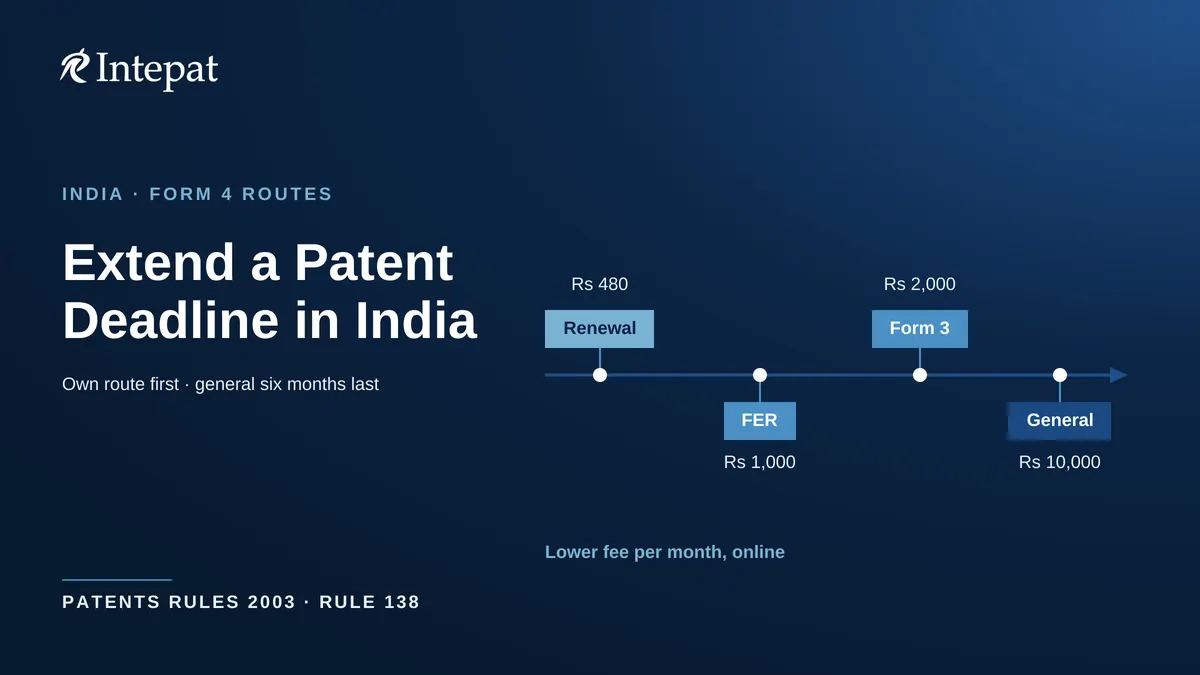
Form 4 is the request for extension of time or condonation of delay. One form serves every route, but each route has its own limit and its own monthly fee. Pick the specific route where one exists: it is far cheaper than the general one.
| Missed act (rule) | Further time available | Fee per month, online: lower / higher |
|---|---|---|
| Renewal fee (Rule 80(1A)) | Up to 6 months | Rs 480 / Rs 2,400 |
| Inventorship declaration on Form 5, other than for an ordinary application (not convention or PCT) filed with a complete specification (Rule 13(6)) | Within 1 month from filing the complete specification; for a PCT application, from the date of filing in India | Rs 480 / Rs 2,400 |
| Review, or setting aside an ex parte order (Rule 130) | Up to 1 further month | Rs 480 / Rs 2,400 |
| Renewal fees due when a principal patent is granted more than two years after filing (s.142(4)) | Up to 6 more months, to 9 months from recording | Rs 480 / Rs 2,400 |
| Form 3 on foreign filings (Rule 12(5)) | Up to 3 months | Rs 2,000 / Rs 10,000 |
| Working statement on Form 27 (Rule 131(2)) | Up to 3 months | Rs 2,000 / Rs 10,000 |
| Putting the application in order (Rule 24B(6)) | 3 months | Rs 1,000 / Rs 4,000 |
| Same, expedited examination (Rule 24C(11)) | 3 months | Rs 2,000 / Rs 10,000 |
| Any other Rules period (Rule 138) | Up to 6 months | Rs 10,000 / Rs 50,000 |
Source: First Schedule, entry 4 (verified as of November 2026). The lower fee applies to individuals, startups, small entities and educational institutions; startups, small entities and educational institutions must file Form 28 to claim it. The higher fee applies to others, including a joint application in which any applicant is outside the lower class. Paper filing costs about ten per cent more. For a PCT application, an inventorship declaration made in the international phase may already meet the Form 5 requirement.
Here is how the put-in-order route works in dates. Suppose the first examination report issued on 16 January 2026. You have six months, to 16 July 2026, to put the application in order. If the Controller allows a Form 4 request, the period runs to 16 October 2026. At the lower fee, three months cost Rs 3,000.
The rule allows the Form 4 request to be made “before expiry of the period specified herein” (Rule 24B(6)). That wording, introduced in March 2024, supports making the request inside the three-month extension, but the office has not confirmed that reading. In our practice we still file it before the first six months end, so the application stays inside a running period.
How the general six-month extension works
Rule 138 is the general power. The Controller may extend the time for any act under the Rules, or condone a delay, by up to six months. You ask on Form 4. The request must be made before the six months expire, and it may be made any number of times within them.
The monthly fee is the highest of all the Form 4 routes. A full six months costs Rs 60,000 at the lower fee and Rs 3,00,000 at the higher fee. For example, where an assignee applies without proof of its right to apply, the proof is due six months after filing (Rule 10). If it is two months late, the extension costs Rs 20,000 or Rs 1,00,000.
The rule does not say when the six months start. IP India’s FAQ on working statements counts them from the deadline as already extended. Where the three-month extension was taken, it adds the six months to the extended date. For other acts, count the six months from the original deadline, which is the safer date.
Can Rule 138 be added on top of a specific route? The office’s FAQ says yes for the working statement: three months under the specific rule, then up to six months more under Rule 138. IP India’s separate Patent FAQ says the same for putting an application in order after an examination report: three months on Form 4, then up to six months under Rule 138. Both FAQs are guidance with no legal effect, and relief is at the Controller’s discretion.
What changed in March 2024
Before 15 March 2024, Rule 138 allowed only one month. It also listed acts it could not reach, including national phase entry, the request for examination and the put-in-order period. The Patents (Amendment) Rules 2024 changed both points.
The new Rule 138 gives up to six months and has no list of excluded acts. The old list moved, almost word for word, into a new Rule 137(2). Two items were added to it: a late statement on foreign filings and a late working statement.
Rule 137(2) now stops the Controller’s general correction power, described below, from reaching those acts. It says nothing about Rule 138. On its words, then, Rule 138 is open to every Rules period. That is the source of the uncertainty in the next section.
When Rule 138 is not a safe answer
Two dates should be treated as final: the 31-month PCT national phase date and the request for examination. Rule 138 does not exclude them, and IP India’s Patent FAQ says both can be extended by up to six months under it, but that FAQ is guidance with no legal effect. Do not rely on a late filing without checking the current law, decisions and Patent Office practice; the cost of being wrong is the application.
For a PCT application, the national phase in India must be entered within 31 months of the priority date (Rule 20(4)(i)). If the requirements are not met, the application is deemed withdrawn (Rule 22). The Indian Patent Office has told WIPO that the PCT’s reinstatement rule for missed entry does not apply in India. In May 2026 the Delhi High Court held that the 31-month entry date and the request for examination period (then 48 months) were mandatory, on an application filed in 2010 under the old one-month rule. Our guide to late PCT national phase entry in India covers that case.
A request for examination not made in time leaves the application treated as withdrawn. For an application filed on or after 15 March 2024, it is due 31 months from the priority or filing date, whichever is earlier; earlier applications keep 48 months. For a PCT application, the filing date is the international filing date. Divisional applications and applications under a secrecy direction have their own dates. Our request for examination guide sets out the dates.
The put-in-order period is the third date to watch. After the three-month Form 4 extension, the application is deemed abandoned if it is still not in order and no further extension is allowed. IP India’s Patent FAQ describes up to six more months under Rule 138, but relief is discretionary; treat nine months as final. Our guide to the first examination report explains how to respond in time.
Correcting a slip under Rule 137
Rule 137(1) is a correction power, not an extension. On terms the Controller directs, a document may be amended where the Act makes no special provision for amending it. A procedural irregularity may also be corrected where, in the Controller’s opinion, it can be put right without harm to anyone’s interests.
It does not apply to the acts listed in Rule 137(2), such as national phase entry, the request for examination, the response to the examination report and the renewal fee extension. For the response and the renewal fee, use their specific Form 4 routes. For national phase entry and the request for examination there is no safe route; treat them as final.
Where no form is prescribed, the petition may be made on Form 30 (Rule 8(2)). The fee for a petition not otherwise provided for is Rs 1,600 at the lower rate and Rs 8,000 at the higher, online. There is no monthly fee: the petition costs a fraction of a single month of the general extension.
Delays you did not cause
Two parts of Rule 6 cover delay caused by events outside your control. They are separate from Form 4. Each needs a petition with a statement of the facts and evidence in support, filed promptly.
The first covers a late office communication. If a document from the Patent Office reaches you late, the Controller may condone your resulting delay. You must petition immediately after receipt. The delay condoned cannot exceed the gap between when the document should have arrived by post or electronic transmission and when it did (Rule 6(5)).
The second covers war, revolution, civil disorder, strike, natural calamity, a general unavailability of electronic communication services and similar events where you live or do business. The situation must have been severe enough to disrupt normal communication in that area. You must act as soon as reasonably possible, and not later than one month after the situation ends. The delay condoned cannot exceed the period of the emergency or six months from the original deadline, whichever is earlier (Rule 6(6)).
If a granted patent has lapsed
A granted patent ceases if a renewal fee is not paid within the period, or the period as extended. The renewal fee can be extended by up to six months on Form 4. After that, restoration is the remaining route, and it has its own deadline.
You may apply to restore the patent within eighteen months from the date it ceased (s.60), on Form 15. Confirm that date before counting. The patent ceases at the end of the period prescribed for the fee if the fee is not paid within that period or any extension, so count the eighteen months from the original due date to be safe, not from the end of the six-month extension; for fees due at a late grant, count from the end of the three months after recording. The Controller must be satisfied, at first sight, that the failure to pay was unintentional and that there was no undue delay in applying (s.61). The application is then published and can be opposed. If restoration is allowed, the unpaid renewal fees and an additional fee are payable within a month of the order. Our guide to restoring a lapsed patent covers the steps, and our patent renewal guide covers the fees.
What to do today if a deadline has passed
Act on the day you find the miss. Delay can increase monthly Form 4 fees, and several windows close for good. Work through these five checks with your patent agent before filing anything.
- Find the original deadline and the event it ran from.
- Find out whether the period is set by the Act or the Rules, and whether it has its own Form 4 route.
- Work out the last day to ask for relief on the applicable route. For Rule 138, count from the original deadline to be safe; IP India’s FAQ counts from the extended date for a working statement after the three-month extension.
- Confirm your fee column: individuals, startups, small entities and educational institutions pay the lower fee (startups, small entities and educational institutions file Form 28 with it), unless a joint applicant is outside that class.
- Check whether the application already shows as abandoned, withdrawn or lapsed.
Some other Rules periods have no specific extension, and the general extension should not be relied on for them; docket them as hard. Two examples are the patentee’s reply in a post-grant opposition (Rule 58) and the priority document after an invitation (Rule 21(3)). The firm’s patent deadline tracker sets out Indian patent deadlines and the extension route for each.
For the foreign filing statement and the working statement, see our guides to the statement and undertaking and working statements.
| Missed a Deadline? |
|---|
| We check your Form 4 route before time runs out. |
| Get Advice |
FAQ
Often, yes, if the period was set by the Patents Rules and the time for a Form 4 request has not run out. Many acts have their own route, such as renewal fees. Others fall under Rule 138, though a few should be docketed as hard. Most Patents Act periods cannot be extended; treat national phase entry and the request for examination as final.
It depends on the route. The general extension under Rule 138 costs Rs 10,000 a month for individuals, startups, small entities and educational institutions, and Rs 50,000 a month for others, online. Specific routes are much cheaper, from Rs 480 a month for a late renewal fee. Paper filing costs about ten per cent more.
No. The Form 4 request must be made before the six months run out. Count them from the original deadline to be safe; IP India’s FAQ counts from the extended date for a working statement where the three-month extension was taken. Other remedies, such as a late office communication (Rule 6(5)) or restoring a lapsed patent, have their own conditions.
Treat 31 months from the priority date as final. Reinstatement under the PCT does not apply in India, and in 2026 the Delhi High Court held the entry date mandatory for an application filed in 2010 under the old rules. The 2024 Rule 138 has no exclusion list and IP India’s Patent FAQ describes a six-month route, but do not plan on it.
You have six months from the report, and a Form 4 under Rule 24B(6) can add three months. After that it is deemed abandoned unless a further extension is allowed. IP India’s Patent FAQ describes up to six more months under Rule 138, but relief is discretionary, so do not rely on it. If time is short, file the Form 4 now.
This article explains extensions of time for Indian patent deadlines as at November 2026 and is for general information only. It is not legal advice. Government fees, forms, and procedures change; confirm current figures with the Indian Patent Office before you file. For advice on your specific invention, consult a registered patent agent.
Sources
- The Patents Act 1970, incorporating all amendments till 1 August 2024, IP India, accessed 4 November 2026.
- The Patents Rules 2003, consolidated, IP India, accessed 4 November 2026.
- Frequently Asked Questions on Form 27, 26 August 2024, Office of the Controller General of Patents, Designs and Trade Marks.
- First Schedule of fees, Patents Rules 2003 (IP India PDF), IP India, accessed 4 November 2026.
- Neurocentria Inc v Deputy Controller of Patents and Designs, C.A.(COMM.IPD-PAT) 5/2025, 18 May 2026, Delhi High Court.