




In most PCT contracting states, missing the national phase entry deadline triggers a further question: is there a remedy? In many jurisdictions, restoration of rights may be available based on standards such as unintentional delay, all due care, or specific statutory provisions. A comparative overview is set out in our global analysis of late national phase entry.
This article examines the Indian position in detail, including the statutory framework, the scope and limits of Rule 138, and the case law that defines the current legal position.
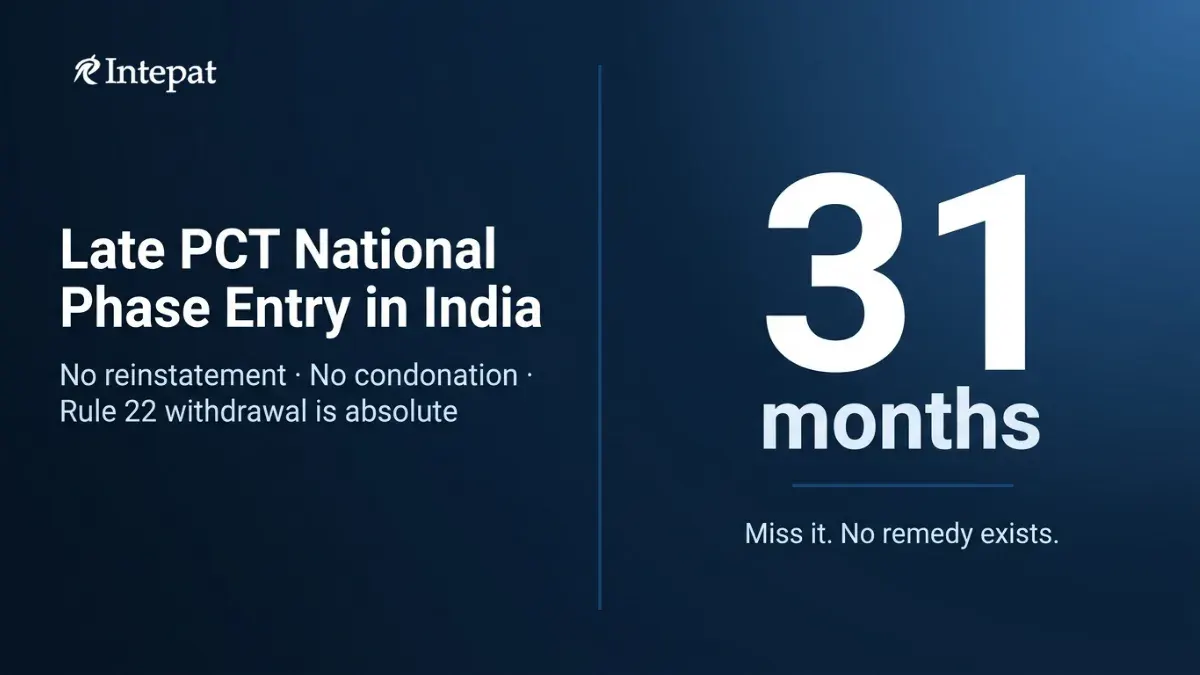
What the 31-Month Deadline Means Under Indian Patent Law
Rule 20(4)(i) of the Patents Rules, 2003 requires that an international application designating India must enter the national phase within 31 months from the priority date, which under PCT Article 2(xi) is the filing date of the earliest application whose priority is claimed, or the international filing date where no priority is claimed. If this requirement is not met, Rule 22 deems the international application withdrawn. The consequence follows by force of the rule; in Diebold the Delhi High Court held that the Office had no occasion to give a hearing before declining a filing made after the deadline.
Entry in time means more than filing Form 1 by month 31. The national fee and other fees must be paid in full within the same period, including the additional fee for each further priority and the fees for excess sheets and claims, and, where the international application was not filed or published in English, a verified English translation must be filed. The deemed withdrawal applies if any of these entry requirements is not met. The priority document, where it was not furnished in the international phase, is also due within 31 months, and the English translation must cover any amended claims; if these are still not filed after the Controller’s invitation, the priority claim or the amendments are disregarded (Rules 20(3), 20(5) and (6), 21 and 22).
What is due by month 31, what happens if it is not, and what room remains:
| Requirement | Deadline | Provision | Consequence if missed |
| National phase application (Form 1), national fee and other fees, verified English translation where needed | 31 months from the priority date | Rule 20(3) and 20(4)(i) | International application deemed withdrawn for India (Rule 22) |
| Priority document, where not furnished in the international phase; translation covering amended claims | 31 months from the priority date, then on the Controller’s invitation | Rule 21 (priority document); Rule 20(5) and (6) (translation of amended claims) | Priority claim or amendments disregarded |
| Request for examination (Form 18) | 31 months from the priority date; 48 months for applications filed before 15 March 2024 | Rule 24B(1) | Application treated as withdrawn (Section 11B(4)) |
| Extension or condonation of the entry deadline | Not available in the ordinary case; two narrow Controller-level grounds (late receipt of an Office communication; war, calamity, communications outage and similar events), and a Form 4 request under the substituted Rule 138 that is untested | Rules 6(5), 6(6), 137(2) and 138 | See the sections below |
Since the Patents (Amendment) Rules, 2024, the request for examination in Form 18 is also due within 31 months from the priority date (48 months for applications filed before 15 March 2024). For a national phase application this is the same day as the entry deadline, so Form 18 should be filed with the national phase application. A missed request means the application is treated as withdrawn. The three-month extension available after the first examination report applies only to the period for putting an application in order for grant, not to the request for examination (Rule 24B(5) and (6)). Under the earlier 48-month rule, a Division Bench of the Delhi High Court (Carlos Alberto, as recited in European Union and Neurocentria) held the period mandatory even where the patent agent was negligent.
The legal effect of the national phase application comes from Section 138(4) and (5) and Section 7(1A) and (1B) of the Patents Act, 1970. An international application designating India has effect as an application under Section 7, 54 or 135, as the case may be, but only if a corresponding application is filed before the Controller in India. Its title, description, claims, abstract and drawings are taken as the complete specification, and the international filing date is the filing date in India. None of these provisions relaxes the 31-month requirement.
The practical starting point for any late entry analysis is the priority date. Check it first. The full procedural requirements for timely national phase entry in India are covered separately.
Does India Permit Reinstatement Under PCT Rule 49.6?
PCT Rule 49.6 provides a mechanism by which a designated Office may reinstate an applicant’s rights where the national phase entry deadline was missed. On a request filed, and the missed acts performed, within two months of removal of the cause and no later than 12 months after the missed time limit, paragraphs (a) to (e) require the designated Office to reinstate rights if it finds the delay unintentional or, at the Office’s option, that the failure occurred in spite of due care required by the circumstances.
Rule 49.6(f) provides that if, on 1 October 2002, paragraphs (a) to (e) were not compatible with the national law applied by a designated Office, they do not apply to that Office for as long as the incompatibility continues, provided the Office informed the International Bureau by 1 January 2003. India has communicated that reservation, as the Delhi High Court recorded in Humanity Life Extension. The WIPO Applicant’s Guide records that the Indian Patent Office does not permit reinstatement under Rule 49.6, and India also does not recognise restoration of the right of priority, whether granted by the receiving Office or requested in India.
In Diebold Self Service Systems v Union of India, the Delhi High Court recorded that India had “initiated the requisite steps” under Rule 49.6(f) (the judgment refers to “Rule 49(f)”) and held that the PCT Regulations permit India’s position. In Humanity Life Extension LLC v Union of India, a Division Bench treated the point as settled by Diebold, which had rejected the argument that India’s reservation was impermissible.
The applicable procedural requirements for India are published in the WIPO PCT Applicant’s Guide (India National Chapter), in the version valid from 1 July 2026.
How Rule 138 Applies, and Where It Does Not
Rule 138 is the Controller’s general power to extend time. Its text has changed more than once, and the judgments do not quote the same pre-2016 wording, so the safest guide is what the Delhi High Court has said about its effect.
Before 16 May 2016, the Controller had power to extend the 31-month entry period by one month, as a Division Bench recorded in Humanity Life Extension, although the Rule 138 text quoted in Humanity begins “Save as otherwise provided in the Chapter III of these rules”, and the IPAB in Tryton recorded a concession that an amendment from 15 October 2013 had already removed extension for Chapter III deadlines. In Nokia (2011) the Madras High Court held that Rule 138 allowed a one-month extension of the entry period on sufficient cause, independently of the PCT’s own excuse-of-delay provisions (PCT Article 48 and Rule 82), and the IPAB followed it in Tryton. The Patent Office had refused the requests in both cases.
The 2016 amendment removed that power by expressly excluding the entry period from Rule 138. From 16 May 2016, the Controller could not extend the national phase entry deadline.
The Patents (Amendment) Rules, 2024, in force from 15 March 2024, substituted Rule 138. The new rule opens “Notwithstanding anything contained in these rules” and allows the Controller to extend the time for doing any act, or condone delay, by up to six months on a request in Form 4 made before that six-month period expires; the request may be made any number of times within that period. The official fee is charged per month: Rs 10,000 for natural persons, startups, small entities and educational institutions, or Rs 50,000 for others, by e-filing. Unlike the 2016 version, the substituted Rule 138 contains no list of excluded deadlines.
The 2024 Rules placed a list of that kind in a new Rule 137(2), which provides that the Controller’s general power to allow amendment of documents and correct procedural irregularities does not apply to the listed matters. The national phase entry period is among them. Rule 137(2) does not, in terms, limit Rule 138.
The question this leaves open is whether the substituted Rule 138, with its non obstante opening, can now reach the 31-month deadline despite Rule 22. No decision we have reviewed has decided it. Neurocentria (2026) concerned a 2010 filing and did not examine the substituted rule. In our view, an applicant should not expect it to succeed: the Delhi High Court continues to treat national phase entry as mandatory and non-extendable, and India’s Rule 49.6(f) notice remains in place. An applicant still within six months of a missed deadline should take advice at once; a Form 4 request is possible but untested.
What Indian Courts Have Said on Late National Phase Entry
Before 2016: a one-month extension, and resistance to it
In Nokia Corporation v Deputy Controller of Patents and Designs (Madras High Court, W.P. 2057/2010, 24 January 2011), the international application claimed priority from 11 January 2007, so the deadline was 11 August 2009. Nokia’s papers, first filed on 18 August 2009, were returned, and the application was filed online on 10 September 2009 with a petition for condonation and extension under Rules 137 and 138; the delay was attributed to a docketing error. The Deputy Controller rejected the request. The court held that Rule 138 allowed a one-month extension of the entry period on sufficient cause, independently of the PCT’s own excuse-of-delay provisions, quashed the order and remanded the request for decision on its merits.
In Tryton Medical Inc, the national phase application was filed eight days late, with a request under Rule 138. The IPAB condoned the delay by its order of 24 March 2015 (OA/10/2014/PT/DEL), relying on Nokia, and issued a further order on 7 March 2016 when the Patent Office did not comply. The Delhi High Court (Tryton Medical Inc v Union of India & Ors, W.P.(C) 195/2017, 10 July 2017, 2017:DHC:3397) allowed Tryton’s writ petition and directed the Patent Office to comply with the IPAB’s orders and examine the application. It decided the petition on judicial discipline, without construing Rule 138, and the delay predated the 2016 amendment.
Since 2022: the Delhi High Court applies a mandatory bar
In Diebold Self Service Systems v Union of India & Ors (Delhi High Court, Division Bench, W.P.(C) 11136/2018, 22 December 2022, 2022/DHC/005743), the national phase application was filed five months and four days after the deadline. The petitioner argued that Rule 22 was ultra vires the Patents Act and inconsistent with India’s PCT obligations, and that “shall” in Rule 22 should be read as directory.
The court rejected those arguments. It held Rule 22 consistent with the Act and the PCT, noted that India had initiated the requisite steps under Rule 49.6(f), and held that “shall” in Rule 22 is mandatory and not directory. Adopting the earlier single-judge decision in Nippon Steel, it accepted that the Act and Rules require time-bound steps and that a writ court cannot read a relaxation of time limits into them without express legislative intent. The petition was dismissed.
In Humanity Life Extension LLC v Union of India & Anr (Delhi High Court, Division Bench, W.P.(C) 12238/2019, 20 July 2023, 2023:DHC:5000-DB), the petitioner said that its Indian attorney, though instructed in time, failed to file within 31 months; a later filing was returned. The petitioner challenged the 2016 amendment to Rule 138 and relied on PCT Rule 49.6. The court noted that the Controller’s power to extend the entry period by one month ceased on 16 May 2016, followed Diebold as having settled that the period is mandatory, treated India’s Rule 49.6(f) reservation as settled by Diebold, and dismissed the petition.
In Neurocentria Inc v Deputy Controller of Patents and Designs (Delhi High Court, C.A.(COMM.IPD-PAT) 5/2025, 18 May 2026), the international application claimed three US priorities, the earliest dated 22 March 2007, so the 31-month period expired on 22 October 2009. The Indian application was filed on 15 February 2010, nearly four months late, and Form 1 listed only the second and third priorities. The application was later refused. When a fresh hearing was granted in 2024, the applicant filed Form 13 under Section 57(5) to disclaim the earliest priority, with a petition under Rule 137, so that both the 31-month entry period and the 48-month examination period would run from the second priority.
The court dismissed the appeal. It held that the national phase and request for examination timelines are mandatory and non-extendable, and that the 31 months run from the earliest priority claimed, because PCT Article 2(xi) defines the priority date that way. A disclaimer sought 14 years after entry, where the earliest priority had not been disclosed at filing, could not bring a missed deadline back within time; what cannot be done directly cannot be done indirectly. Relying on Nippon Steel, the court accepted that a priority amendment cannot be entertained once an application is deemed withdrawn, and that Rule 137 does not supply that power. The applicant’s case that it had followed its first agent’s advice did not help. The court distinguished European Union and Bry-Air as concerning other deadlines, and Nokia and Tryton as involving extensions of up to one month, where Neurocentria’s delay was over four months.
The Writ Jurisdiction Question
A separate line of Delhi High Court decisions has set aside the loss of an application or patent through writ jurisdiction under Articles 226 and 227 of the Constitution, where a patent agent’s failure caused it. These cases are sometimes cited as possible avenues for late national phase entry.
In The European Union Represented by the European Commission v Union of India (Delhi High Court, 31 May 2022, 2022:DHC:2301), the court allowed responses to First Examination Reports to be filed after the deadline. The reports had gone to the applicant’s first patent agent, and it was unclear whether the agent ever told the applicant, which appeared to have been in the dark. The court held that writ courts may, in rare and extraordinary cases, permit a late response after examining whether the applicant in fact intended to abandon the application, weighing circumstances such as agent negligence, docketing error and the applicant’s own diligence; a lack of follow-up by the applicant may support an inference of abandonment. The First Examination Report and its procedural requirements operate under a different statutory mechanism from national phase entry.
In Bry-Air Prokon Sagl & Ors v Union of India & Anr (Delhi High Court, W.P.(C)-IPD 25/2022, 17 October 2022, 2022/DHC/004439), the court restored applications deemed abandoned for missed FER responses and allowed the petitioners to apply for restoration of a patent that had lapsed for non-payment of renewal fees. In Saurav Chaudhary v Union of India & Anr (Delhi High Court, W.P.(C)-IPD 9/2023, 4 July 2024, 2024:DHC:4946), a patent agent’s failure to tell the applicant about the FER led to deemed abandonment, and the court set it aside and directed the reply to be accepted.
These decisions concern deemed abandonment under Section 21(1) for failure to put an application in order for grant and, in Bry-Air, also the lapse of a granted patent for unpaid renewal fees. Missed requests for examination are a different consequence, withdrawal under Section 11B(4), and the Division Bench in Carlos Alberto held that period mandatory even where the agent was negligent. National phase entry has been treated differently from both because the courts place it among the deadlines that cannot be extended: European Union lists it first among them. No decision we have reviewed has granted relief for a national phase deadline missed after the 2016 amendment. In Neurocentria (2026), an appeal rather than a writ petition, the Delhi High Court declined to apply the agent-negligence line to national phase entry.
What to Consider When the Deadline Is Approaching or Has Passed
If the 31-month period has not yet expired, file the national phase application with the national fee, any translation and Form 18 as early as possible; that avoids the late-entry problem altogether. An express request in Form 18 allows the Patent Office to process or examine the application before 31 months. Expedited examination in Form 18A may be available where the Indian Patent Office was the International Searching Authority or International Preliminary Examining Authority, or where the applicant is a startup, a small entity or within another listed category. A Chapter II demand under PCT Article 31 allows amendment and a preliminary report before entry, but only if it is filed by 22 months from priority or three months from the search report, whichever is later.
If the 31-month period has apparently passed, verify the priority date calculation before drawing any conclusion. The period runs from the earliest priority date claimed in the international application, not from the international filing date, unless no priority was claimed. Disclaiming the earliest priority years later does not work: in Neurocentria the Delhi High Court refused a disclaimer sought 14 years after entry, where the earliest priority had not been disclosed when the application was filed. Do not assume the deadline carries to the next working day: the e-filing portal is available around the clock, including holidays.
If the deadline has genuinely passed, two narrow possibilities remain at the Controller level. Rule 6(6) allows the Controller to excuse a delay caused by war, revolution, civil disorder, strike, natural calamity, a general outage of electronic communications or a similar event in the applicant’s or agent’s locality: the event must have been severe enough to disrupt normal communication in that area, the act must be done as soon as reasonably possible and the petition, with supporting evidence, made within one month after the situation ends, and the delay excused cannot exceed six months from the deadline. No decision we have reviewed has tested Rule 6(6) for national phase entry. Rule 6(5) is narrower than it looks: it excuses delay caused by late receipt of a Patent Office communication, and the Manual applies it in practice to failures of the Office’s own servers or payment gateway, but in Nokia the Controller confined it to mail delay, and in Diebold the Division Bench observed that there is no leeway at the initiating stage. An ordinary docketing or agent error does not qualify under either.
A Form 4 request under the substituted Rule 138, within six months, is also untested, as explained above. Outside those, the application designating India is treated as withdrawn (Rule 22). That withdrawal affects India only: national phase entries completed in time in other designated states are unaffected. The common procedural errors in PCT filings targeting India cover the deadline calculation errors that practitioners encounter most frequently.
Frequently Asked Questions
Almost certainly not. Rule 22 deems the application withdrawn, India does not apply PCT Rule 49.6 reinstatement, and the Delhi High Court treats the deadline as non-extendable. Rule 6(6) covers only delays caused by events such as war or natural calamity, and a request under the substituted Rule 138 is untested.
Untested. The substituted Rule 138 allows up to six months and lists no exclusions. Rule 137(2) names Rule 20(4)(i) only to exclude it from the separate Rule 137(1) power. No decision we have reviewed has ruled on such a request, which must be made on Form 4 before the six months expire, and the courts treat entry as non-extendable.
The international application designating India is deemed to have been withdrawn under Rule 22 of the Patents Rules 2003. No examination commences, and no national phase rights arise in India from that application. The loss of rights applies only to India; it does not affect national phase entries that were completed within time in other designated states.
Not since 2016. In Nokia (2011) the Madras High Court held that a one-month extension request must be decided on its merits, and the IPAB condoned an eight-day delay in Tryton (2015), an order the Delhi High Court enforced in 2017. Diebold (2022), Humanity Life Extension (2023) and Neurocentria (2026) confirmed the mandatory bar.
Not necessarily. Many PCT offices offer some remedy after a missed national phase deadline, such as reinstatement for unintentional delay or further processing. India has notified that PCT Rule 49.6 reinstatement does not apply to it, does not recognise restored priority, and applies the 31-month deadline strictly. Check the destination office’s own rules in the WIPO Applicant’s Guide.
Probably not. Agent negligence is not a Rule 6(6) ground. Courts have set aside deemed abandonment for missed FER responses where the agent failed and the applicant was diligent, but in Neurocentria (2026) the Delhi High Court refused to extend that line to national phase entry. Take advice on the facts at once.
This article explains the law on late PCT national phase entry in India as at October 2026 and is for general information only. It is not legal advice. Government fees, forms, and procedures change; confirm current figures with the Indian Patent Office before you file. For advice on your specific invention, consult a registered patent agent.
Sources
- Patents Act 1970, as amended to 1 August 2024 (Sections 7, 11B and 138): IP India, Act e-version
- Patents Rules 2003, Rules 6, 20, 22, 137 and 138, as amended by the Patents (Amendment) Rules 2024, G.S.R. 211(E), 15 March 2024: IP India, Rule 138
- WIPO PCT Applicant’s Guide, India, national phase chapter, valid from 1 July 2026: pctlegal.wipo.int
- Neurocentria Inc v Deputy Controller of Patents and Designs, C.A.(COMM.IPD-PAT) 5/2025, 2026:DHC:4418, Delhi High Court, 18 May 2026: court copy
- Diebold Self Service Systems v Union of India, W.P.(C) 11136/2018, 2022/DHC/005743, Delhi High Court, 22 December 2022: court copy