




Cybersquatting is the bad-faith registration of a domain name that copies or mimics someone else’s trademark. India has no dedicated anti-cybersquatting statute. Trademark owners enforce through the Trade Marks Act 1999, the common-law action of passing off, and two arbitration mechanisms: INDRP for .in and .bharat domains and UDRP for .com, .net, .org and other generic top-level domains.
Quick answer: Cybersquatting is registering a lookalike domain to profit from another party’s trademark. In India, brand owners enforce through (i) NIXI’s INDRP arbitration for .in and .bharat domains, (ii) ICANN’s UDRP arbitration for .com and other gTLDs, and (iii) civil suits under the Trade Marks Act 1999. INDRP and UDRP can result in cancellation or transfer of the domain. A civil suit may additionally seek injunctions, damages, an account of profits, delivery-up, and costs.
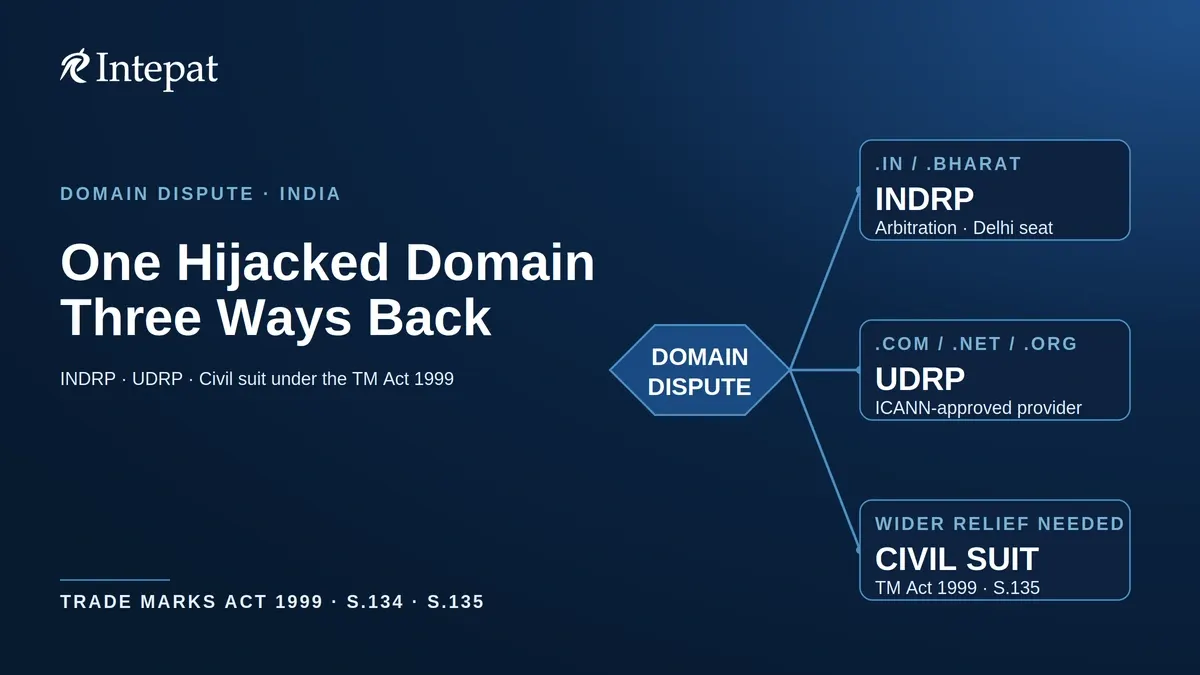
Which route should you choose?
| You want… | The right route |
| Recover a .in or .bharat domain | INDRP arbitration (NIXI) |
| Recover a .com, .net, .org or other gTLD | UDRP arbitration (WIPO or other ICANN-approved provider) |
| Damages, account of profits, or wider injunctions | Civil suit under the Trade Marks Act 1999 |
| Urgent ex parte relief before the squatter moves the domain | Civil suit (Delhi or other commercial High Court) |
| Action against multiple infringing domains or related conduct | Civil suit, optionally with parallel arbitration |
Arbitration is fast and inexpensive but is limited to the disputed domain itself. A civil suit is slower but offers the full suite of trademark remedies, including monetary relief.
Evidence to preserve before you do anything else
Once you suspect cybersquatting, capture this material immediately. Once a domain changes hands or a website is taken down, the evidentiary trail can disappear within hours.
- WHOIS or RDDS records for the disputed domain: registrant details where disclosed, registrar, registration date, and expiry date
- Dated screenshots of the offending website, including parked pages, redirects, and any “for sale” notice
- An archived capture (Wayback Machine or equivalent) of the page on the date you discovered it
- Any email or message from the registrant offering to sell, lease, or transfer the domain, and any payment demand
- Evidence of customer confusion: misdirected emails, social-media reports, support-ticket complaints
- Your trademark registration certificate and renewal records, or, for unregistered marks, proof of prior use through invoices, advertising spend, and press coverage
- Web analytics showing traffic diverted from your domain or queries that landed on the infringing one
What cybersquatting is, and what it isn’t
The word combines “cyber” with “squatting”: occupying digital space that, in commercial terms, belongs to someone else. The familiar patterns are a third party registering a domain like brandname-india.com or a typo variant such as brandnname.com, then parking the page with advertising, redirecting traffic to a competitor, demanding payment from the trademark owner, or staging a phishing front.
Two related practices are often grouped under the same heading but treated as distinct by tribunals. Typosquatting exploits common misspellings of well-known marks. Reverse domain hijacking is the opposite problem: a trademark owner uses arbitration in bad faith to seize a domain from a legitimate registrant who happens to share the name. The UDRP Rules expressly recognise reverse domain hijacking and direct panels to declare it where the complaint was brought in bad faith. INDRP has no equivalent express provision, though an abusive INDRP complaint may still attract adverse findings or costs.
What cybersquatting is not: a parallel business genuinely operating under a similar name registered before the complainant’s trademark rights arose. Priority of rights, demonstrable use, and the registrant’s purpose remain the substantive tests.
Why Indian law treats domain disputes through trademark law
India never enacted a domain-name statute equivalent to the United States Anticybersquatting Consumer Protection Act (15 U.S.C. § 1125(d), 1999). The Supreme Court resolved the gap in Satyam Infoway Ltd v. Sifynet Solutions (P) Ltd, (2004) 6 SCC 145, holding that domain names function as business identifiers in the digital marketplace and are therefore amenable to protection under passing off and, for registered marks, under the Trade Marks Act 1999. The Court reasoned that a domain name’s role in identifying source, distinguishing goods and services, and carrying goodwill makes it comparable in commercial substance to a trademark, even though its technical function is to route Internet traffic. The same logic underpins a passing-off action over a domain name where the mark is unregistered but has acquired goodwill in trade.
The doctrinal building blocks are familiar. Section 29(1) treats use of a mark identical or deceptively similar to a registered trademark, in the course of trade and for similar goods or services, as infringement. Section 29(4) extends infringement to use on dissimilar goods or services where the registered mark has a reputation in India and the use takes unfair advantage of, or is detrimental to, the mark’s distinctive character or repute. Section 29(8) treats advertising itself as infringing where the advertising takes unfair advantage, harms distinctive character, or runs against the mark’s reputation. These last two matter for cybersquatting because parked pages, ad-revenue redirects, and phishing fronts often involve dissimilar goods or pure advertising rather than a directly competing sale. Section 27(2) preserves passing-off rights for unregistered marks.
Indian courts had moved in this direction even before Satyam Infoway. The Delhi High Court in Yahoo!, Inc. v. Akash Arora, 1999 IIAD Delhi 229; 78 (1999) DLT 285, the first reported cybersquatting decision in India, granted an ad interim injunction against the defendant’s use of “yahooindia.com” on a passing-off footing. The Bombay High Court in Rediff Communication Ltd v. Cyberbooth, AIR 2000 Bom 27, took the same approach to “radiff.com”.
INDRP: recovering a .in or .bharat domain
The .IN Domain Name Dispute Resolution Policy (INDRP) has been adopted by NIXI and applies to any dispute over an .IN or .Bharat (available in all Indian languages) domain name. Under Clause 5, the .IN Registry appoints an arbitrator from its empanelled list, and the arbitration is conducted under the Arbitration and Conciliation Act 1996 (as amended in 2019) read with the INDRP Policy and Rules. Under Clause 9, NIXI and the .IN Registry do not participate in or administer the arbitration itself; they remain neutral.
Clause 4 sets out the three elements a complainant must establish, joined by “and” and therefore cumulative:
- The registrant’s domain is identical or confusingly similar to a name, trademark, or service mark in which the complainant has rights;
- The registrant has no rights or legitimate interests in respect of the domain; and
- The registrant’s domain has been registered or is being used either in bad faith or for an illegal or unlawful purpose.
Clause 7 lists four bad-faith circumstances, each with a recognisable real-world pattern. Registration primarily to sell, rent, or transfer the domain to the brand owner or a competitor for more than out-of-pocket costs (the ransom-the-domain pattern). Registration of the domain to prevent the trademark owner from reflecting the mark in a corresponding domain, provided the registrant has engaged in a pattern of such conduct (the serial squatter; an isolated registration is not enough). Intentional attempts to attract Internet users by creating a likelihood of confusion with the mark (the look-alike storefront or phishing page). Registration primarily to disrupt a competitor’s business (the redirect-to-competitor pattern). Clause 6 sets out three circumstances on the other side that demonstrate legitimate interests, including bona fide prior use and being commonly known by the domain.
Under Clause 8, all fees and proceeding expenses charged by the .IN Registry are paid by the complainant. Under Clause 11, the remedies available are limited to cancellation of the domain or transfer to the complainant; costs may be awarded at the arbitrator’s discretion, but the .IN Registry does not supervise their implementation. Clause 14 freezes any transfer for ninety days after the award to allow for a court challenge. Under Clause 17, Indian law applies and the seat of arbitration is Delhi.
UDRP: recovering a .com or other gTLD
The Uniform Domain-Name Dispute-Resolution Policy (UDRP) was adopted by ICANN in 1999 and applies to all generic top-level domains, including .com, .net, .org, and the newer gTLDs. Every accredited registrar incorporates the UDRP into its registration agreement, so every registrant has contractually agreed to it.
Paragraph 4(a) requires the complainant to prove three cumulative elements:
- The domain name is identical or confusingly similar to a trademark or service mark in which the complainant has rights;
- The registrant has no rights or legitimate interests in respect of the domain; and
- The domain has been registered and is being used in bad faith.
Paragraph 4(b) lists four non-exhaustive bad-faith circumstances. They closely mirror INDRP’s Clause 7, with one decision-relevant difference: UDRP’s attract-by-confusion limb at 4(b)(iv) expressly requires that the registrant act for commercial gain, while INDRP’s Clause 7(c) does not. The prevent-owner-reflecting limb in both frameworks requires a pattern of conduct. Leading UDRP providers include the WIPO Arbitration and Mediation Center and the Forum (formerly the National Arbitration Forum); the Asian Domain Name Dispute Resolution Centre also accepts cases, including from Indian complainants.
Remedies under Paragraph 4(i) are confined to cancellation or transfer of the domain. Money damages and costs are not available; for those, a parallel civil action remains the only route. Two timing rules also matter at the back end. Under Paragraph 4(k), the registrar waits ten business days after the decision before implementing a transfer or cancellation; if the registrant files a lawsuit in a “Mutual Jurisdiction” within that window, implementation is stayed. Under Paragraph 8(a), the registrant may not transfer the domain to a new holder during a pending proceeding and for fifteen business days after.
INDRP vs UDRP: the differences that change a filing decision
For a brand operating in India with both .in and .com exposure, the choice between INDRP and UDRP is driven by the domain extension, but the two frameworks are not identical. Three differences matter to a filing decision.
| Feature | INDRP (.in / .bharat) | UDRP (.com, .net, .org, other gTLDs) |
| Administering body | NIXI / .IN Registry adopts the policy; arbitrator appointed by .IN Registry; NIXI remains neutral | ICANN-approved providers (WIPO, the Forum, ADNDRC, others) |
| Statutory basis | Arbitration and Conciliation Act 1996 (as amended 2019) | Contractual, via each registrar’s accreditation agreement |
| Bad-faith threshold | Registration or use in bad faith, or for an illegal or unlawful purpose (Clause 4(c)) | Registration and use in bad faith (Paragraph 4(a)(iii); conjunctive) |
| Attract-by-confusion limb | Clause 7(c): no “commercial gain” requirement | Paragraph 4(b)(iv): “for commercial gain” required |
| Remedies | Cancellation, transfer, costs at arbitrator’s discretion | Cancellation, transfer; no damages, no costs |
| Implementation freeze post-award | Ninety days (Clause 14) | Ten business days for registrant court action; fifteen business days transfer freeze |
| Seat and governing law | Delhi; Indian law (Clause 17) | Determined by the chosen provider’s rules and the registrar’s accreditation |
The disjunctive standard under INDRP makes the Indian framework, in this narrow respect, more complainant-friendly than UDRP. A registrant who acquired a .in domain innocently but later began using it to mislead customers can fall within Clause 4(c). Under UDRP, both registration and use must be in bad faith.
When a civil suit is the right route
Arbitration is fast and inexpensive, but it cannot award damages and cannot reach beyond the disputed domain. A civil action under the Trade Marks Act is the right route when the complainant needs damages or an account of profits, available under Section 135 alongside the full suite of remedies for trademark infringement; an injunction extending to offline use, advertising, or related domains the cybersquatter holds; urgent ex parte relief, which Section 135(2) expressly permits along with interlocutory orders for discovery, preservation of evidence, and restraining the defendant’s asset dealings; or a finding with precedential value, which an arbitral award typically does not carry.
A note on jurisdiction. Section 134(1) of the Trade Marks Act covers suits for infringement, suits relating to rights in a registered mark, and suits for passing off, and requires all three to be filed before a District Court or higher. Section 134(2) adds a plaintiff-friendly forum, where the plaintiff resides, carries on business, or personally works for gain. But by its own opening words, that additional forum is available only “for the purpose of clauses (a) and (b) of sub-section (1)”, that is, infringement and rights in a registered mark. A pure passing-off action, which is clause (c), does not get the benefit of Section 134(2) and must be filed under ordinary civil-procedure principles. An unregistered-mark cybersquatting claim therefore has a narrower choice of forum than a registered-mark one.
Parallel proceedings in arbitration and court are permissible. Under UDRP Paragraph 4(k), a UDRP-losing registrant in fact has a ten-business-day window to file a court action in the Mutual Jurisdiction to prevent transfer of the domain.
What founders should do before a cybersquatter surfaces
Cybersquatting is far cheaper to prevent than to litigate. Three steps, taken at the right time, displace most of the risk.
Register the trademark early. A registered mark in the relevant classes opens up Section 29’s infringement remedies in addition to passing off, gives the plaintiff the Section 134(2) plaintiff-friendly forum, and meaningfully strengthens any INDRP or UDRP complaint. Before filing, a structured trademark search prevents wasted filings on marks that are unavailable or weak.
Buy the obvious domain variants at registration. The exact-match .com and .in are baseline. Common misspellings, hyphenated variants, and the .co.in and .net.in country-code variants are inexpensive and remove easy targets. Defensive registration is not paranoia; it is a one-time cost that closes the most common attack surface.
Set up a watch. A domain-watch service can flag newly registered domains that resemble your mark. Early detection allows a measured cease-and-desist to resolve matters before arbitration or litigation is needed.
A practical caveat. If the disputed domain was registered before your trademark rights arose, an arbitration complaint may struggle on the bad-faith element, especially under UDRP’s conjunctive standard. Settled UDRP panel practice treats registration that pre-dates the complainant’s rights as ordinarily inconsistent with bad-faith registration, absent later targeting, a change of registrant, or a re-registration. Filing reflexively in such cases also raises the risk of a reverse-domain-hijacking finding under UDRP Rule 15(e). A short merits review before filing is worth the time.
If a cybersquatter does surface, the sequence is straightforward: preserve evidence using the checklist above, send a measured cease-and-desist, and file the appropriate proceeding (INDRP, UDRP, or a civil suit) depending on the extension and the relief required. Our trademark services team handles all three workflows.
Frequently Asked Questions
No. India has no equivalent of the United States Anticybersquatting Consumer Protection Act (15 U.S.C. § 1125(d)). Cybersquatting is addressed through the Trade Marks Act 1999 (infringement under Section 29 and passing off preserved by Section 27), the common law of passing off as confirmed by the Supreme Court in Satyam Infoway v. Sifynet Solutions, and arbitration under INDRP for .in and .bharat domains.
INDRP applies to .in and .bharat domains (including Indian-language IDNs) and is conducted under Indian arbitration law. UDRP applies to .com, .net, .org and other generic top-level domains and is administered by ICANN-approved providers such as WIPO. The most decision-relevant difference is that INDRP requires bad-faith registration or use, while UDRP requires both. UDRP also requires “commercial gain” in its attract-by-confusion limb, while INDRP does not.
No. Both frameworks limit relief to cancellation or transfer of the domain. INDRP additionally permits costs at the arbitrator’s discretion under Clause 11. For damages or an account of profits, a civil suit under Section 135 of the Trade Marks Act 1999 is required.
A registered mark is the strongest basis, but it is not strictly required. Both INDRP Clause 4(a) and UDRP Paragraph 4(a)(i) accept “rights” in a trademark or service mark, which panels have construed to include unregistered marks with established goodwill, particularly where there is evidence of use, advertising spend, and consumer recognition.
In practice, many INDRP matters are resolved within a few months. The actual timeline depends on arbitrator appointment, the pleadings, complexity, and any subsequent challenge. Under Clause 14, the .IN Registry holds any transfer for ninety days after the award to allow for a court challenge.
For .in and .bharat domains, INDRP applies regardless of the registrant’s location because every registrant accepted INDRP terms at registration. For .com or other gTLDs, UDRP applies for the same reason. Service is effected through the registrar, and decisions are enforced by the registrar against the domain itself, not against the registrant personally.
Disclaimer: This article provides a general overview of cybersquatting and domain-name dispute resolution in India and under the UDRP. It is not legal advice. Statutory references, case law, and policy texts are current as of the date of publication; readers should verify them and consult a qualified trademark attorney before acting on any specific matter.