




Initially Published: July 2017 | Updated in June 2026
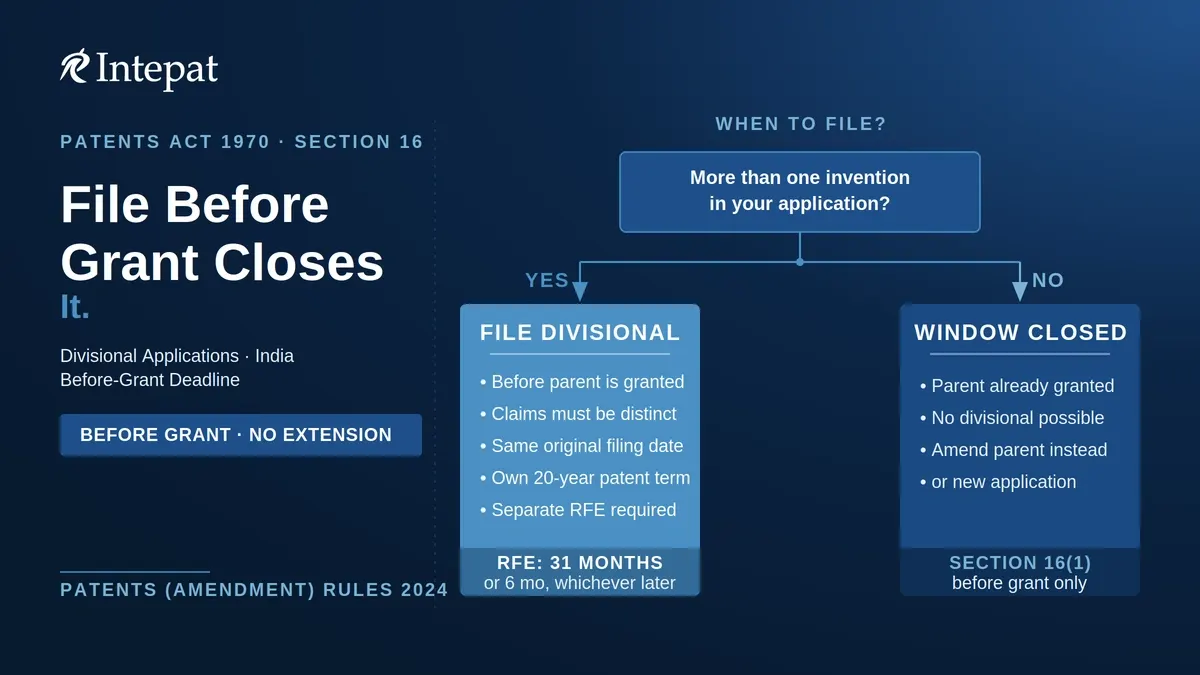
A divisional patent application is a second application carved out of one you have already filed, covering a distinct invention disclosed in the original. In India, you can file one at any time before the parent application is granted, either on your own initiative or to answer an objection that your application claims more than one invention.
This guide covers the position in India only, under the Patents Act 1970 and the Patents Rules 2003 as amended. One thing to clear up at the outset: a divisional is not a second attempt to protect the same invention after the parent has run into difficulty. It works only when the original application disclosed more than one distinct invention.
Quick answer
- Deadline: file while the parent application is pending and before it is granted. Do not wait for grant, refusal, or abandonment.
- Basis: the second invention must already be disclosed in the parent’s provisional or complete specification. It need not have been claimed in the parent.
- Cost: a divisional is a fresh application, so the standard filing fee applies (Rs 1,600 for individuals, startups, small entities and educational institutions; Rs 8,000 for others), plus a separate examination request.
- No overlap: the divisional and the parent cannot claim the same subject matter.
- Same clock: the divisional is deemed filed on the parent’s filing date, so its 20-year term is not freshly extended by filing later.
What a divisional patent application is
A divisional patent application is a fresh application that carves a second, distinct invention out of one you have already filed. The earlier application is the parent; the new one is the divisional. The divisional stands on its own. It gets its own number, its own examination, and, if it succeeds, its own patent. What it cannot do is introduce anything new: everything in the divisional must already have been described in the parent’s specification when the parent was filed.
The reason the route exists is straightforward. Sometimes a single application describes more than one invention. You may have meant to protect only one of them, or the patent office may tell you that your application in fact covers several. A divisional lets you pull the extra invention into its own application and protect it separately, without losing the original filing date. It is one of several types of patent application available under India’s patent system, and it sits apart from the others because it always grows out of an earlier filing.
Here is the idea in concrete terms. Suppose your application describes both a new battery chemistry and a new charging circuit you developed alongside it, but your claims cover only the chemistry. The charging circuit is described in your application, yet nothing in your claims protects it. A divisional lets you file a second application for the charging circuit, drawing on the same original description, so that the invention you described but did not claim does not simply fall away when the parent is granted.
When you can file a divisional application in India
Timing is the rule that catches people out. You can file a divisional at any time before the parent application is granted. Once the parent is granted, the window closes, and there is no separate route to reopen it.
Watch the grant date. The before-grant window is the hard deadline for a divisional. It is not one of the patent deadlines that can be extended, so if grant happens first, the option is simply gone. Some other patent deadlines can be extended; this one cannot.
This makes grant the date you have to watch. If you are even considering a divisional, file it while the parent is still pending, ideally well before you expect a grant decision. Because the divisional is deemed filed on the parent’s original filing date, waiting does not usually affect that filing-date benefit. Waiting is still risky, though, because the option disappears once the parent is no longer safely pending. In practical terms, the safest rule is to file while the parent is genuinely live and before any final grant, refusal, or abandonment.
There are two situations in which a divisional is filed: on your own initiative, because you spotted a second invention worth protecting separately, or in response to an objection from the patent office that your application claims more than one invention. Both are allowed. After a 2024 change to the rules, you can also file more than one divisional, and even a divisional out of an earlier divisional.
While the divisional is pending, the parent carries on through its own examination on its own timeline, and the two applications then live separate lives. The choice between filing voluntarily and waiting for an objection is partly tactical, but the safer habit is to spot a second invention early, because you control a voluntary filing whereas an objection arrives on the patent office’s schedule.
Must the second invention appear in the parent’s claims?
No. For years this was the hardest question in this area, and the answer was genuinely uncertain. A 2023 Delhi High Court Division Bench ruling, the Syngenta case, clarified the position: the second invention has to be disclosed somewhere in the parent’s provisional or complete specification, but it does not have to appear in the parent’s claims.
That distinction matters in practice. The specification is the full written description of your invention. The claims are the shorter, numbered statements at the end that define exactly what you are protecting. Inventions are often described in the body of an application but never claimed. Earlier, the patent office frequently refused divisionals unless the second invention had been claimed in the parent. The court rejected that approach, and a 2024 amendment to the Patents Rules now puts the same position in the rule book: a divisional can be based on an invention disclosed in the parent’s specification.
One limit survives. There still has to be more than one invention. You cannot file a divisional to re-run the same invention the examiner refused, or to chase broader claims on the single invention you already have. The divisional has to cover something genuinely distinct that the parent disclosed.
For applicants, the practical effect of the 2023 ruling is reassuring. If your original application genuinely described more than one invention, you are no longer at the mercy of how narrowly your claims happened to be drafted. What you wrote into the description is enough to support a divisional, as long as a real second invention is there to be found.
How to file a divisional: forms, fees, and the examination deadline
A divisional is treated as a full, fresh application, so it follows the normal filing process rather than a shortcut. You file the application form with a complete specification that refers back to the parent’s application number, and you pay the standard application fee. There is no provisional specification for a divisional, and there is no discount for filing one.
In plain terms, what you file is a fresh application form together with a complete specification that names the parent application it was divided from. A divisional cannot start life as a rough provisional; it goes in complete from day one. Some supporting paperwork from the parent may not need to be repeated: where the same applicant files the divisional and the parent record already holds adequate proof of the right to apply and an authorisation that covered divisionals, those documents are usually not filed again. If that authorisation did not extend to divisionals, a fresh one is needed. The proof of right, inventor details, and applicant status are all worth checking before you file, rather than assumed.
| Step | Individual / startup / small entity / educational institution | Other applicants |
| Filing the divisional (application + complete specification) | Rs 1,600 | Rs 8,000 |
| Each claim over 10 | Rs 320 | Rs 1,600 |
| Each page over 30 | Rs 160 | Rs 800 |
| Request for examination | Rs 4,000 | Rs 20,000 |
Online filing rates; physical filing is slightly higher. Verified as of June 2026.
Two cost points are worth flagging, because applicants often miss them. First, a divisional carries its own request for examination, with its own fee. It is not examined just because the parent was. Second, there is no 50% fee reduction for a divisional. (That reduction is real, but it applies only to a different route called a patent of addition, covered below.) So the realistic cost of a divisional is close to the cost of a normal application, not a small add-on to the parent.
The examination clock has its own rule. The request for examination on a divisional is due by the later of two dates: 31 months from the parent’s filing or priority date, or 6 months from the date you file the divisional. The second limb matters when you file the divisional late in the parent’s life, because it gives you a short, separate window to get the examination request in. If you want the divisional examined sooner, expedited examination is available to eligible applicants.
Divisional application vs patent of addition
A divisional application is easy to confuse with a patent of addition, but the two solve different problems. A divisional is for the situation where your original application disclosed more than one distinct invention and you want to protect the extra one separately. A patent of addition is for an improvement or a modification of an invention you have already applied to protect; it stays tied to that main invention rather than standing on its own as a separate invention.
The practical differences matter. A patent of addition runs with the main patent and qualifies for a 50% reduction in filing fee. A divisional gets no such reduction and is treated as a full, fresh application. So if what you actually have is a refinement of one invention, a patent of addition is usually the cheaper and more natural route. If you have two genuinely different inventions, the divisional is the right tool.
The claim-overlap trap and double patenting
The one substantive restriction on a divisional is that it cannot claim the same subject matter as the parent. The patent office examines the divisional against the parent specifically to check that the two sets of claims do not cover the same invention, because granting two patents for the same invention, known as double patenting, is not allowed.
This does not mean every technical feature has to be unique to one application. The parent and the divisional can share background features, common components, or the same working environment; that is normal. The real question is whether the invention claimed in the divisional is distinct from the invention claimed in the parent. If the two claim sets reach the same matter, the examiner can require the parent, the divisional, or both to be amended before either proceeds. This is why a divisional works best when the two inventions were always genuinely different, and why it is a poor fit when you are really trying to get a second attempt at the same invention.
Is filing a divisional worth it?
A divisional is worth filing when you have a real second invention sitting in your parent application that you want to protect on its own, and the parent has not yet been granted. It is the right tool for a genuine case of more than one invention, and the wrong tool for almost everything else.
| Your situation | Is a divisional the right move? |
| The patent office objected that your application covers more than one invention | Yes, if you want to keep the extra invention. File before the parent is decided. |
| You have a second invention described in the parent but never claimed | Yes. File before the parent is granted. |
| You want to re-claim the same invention the examiner refused | No. A divisional cannot claim the same matter as the parent. |
| The parent has already been granted | No. The window has closed. |
| You want broader claims on the same single invention | No. Consider amending the parent, not a divisional. |
Before you commit, weigh the cost against the value. The upside is real when it fits: a divisional keeps a distinct, already-disclosed invention alive as its own protectable asset instead of letting it lapse with the parent, and it does so without sacrificing the original filing date. That can matter most for a startup whose single application quietly described two things worth owning.
Set against that, each divisional is a separate application with its own filing fee, its own examination fee, and its own prosecution, so two applications cost roughly twice as much to see through as one. If the second invention is commercially important and clearly distinct, that cost is usually justified. If it is marginal, it may not be. The way divisionals are handled also varies between countries, so a strategy that works abroad does not always map onto India. Because the deadline is grant of the parent, this is a decision to make early, not at the last minute.
Frequently asked questions
A divisional patent application is a separate application filed out of an earlier “parent” application, covering a distinct invention already disclosed in the parent. It is governed by Section 16 of the Patents Act 1970. The divisional keeps the parent’s filing date but is examined and granted on its own.
You can file a divisional at any time before the parent application is granted. Grant is the deadline: once the parent is granted, you can no longer file a divisional from it. The before-grant window cannot be extended, so a divisional is best filed well ahead of any expected grant decision.
No. A divisional cannot include anything that was not already disclosed in the parent’s specification when the parent was filed. It carves out an invention that the parent described; it does not introduce new subject matter. Adding new matter is a ground on which the patent office can object to the divisional.
Yes. A divisional is treated as having the same filing date as the parent application it was divided from, and its 20-year term runs from that date. This is why filing a divisional does not cost you any priority, even though it is filed later than the parent.
The filing fee is Rs 1,600 for individuals, startups, small entities and educational institutions, and Rs 8,000 for other applicants, for online filing. A separate examination request fee applies (Rs 4,000 or Rs 20,000). Extra fees apply for claims over 10 and pages over 30. Verified as of June 2026.
Yes. Since the 2024 amendment to the Patents Rules, an applicant may file one or more divisional applications from the same parent, and may even file a divisional out of an earlier divisional, provided each is based on an invention disclosed in the parent and is filed before the relevant parent is granted.
No. A divisional must be filed while the parent application is still pending and before it is granted. Once the parent is granted, the route closes. For the same reason, you should not rely on filing a divisional after the parent has been refused, abandoned, or withdrawn.
No. A divisional is for a distinct second invention that the parent disclosed. A patent of addition is for an improvement or modification of the main invention you already applied to protect. They are filed differently and priced differently: a patent of addition gets a 50% fee reduction, a divisional does not.
Yes. A divisional is examined on its own and needs its own request for examination. The deadline is the later of 31 months from the parent’s filing or priority date, or 6 months from the date the divisional is filed. Miss it and the divisional can be treated as withdrawn.
This article is general information on Indian patent law as at June 2026, not legal advice. Divisional filing turns on the specific disclosures in your application and on the grant timeline, both of which are time-sensitive. For advice on a particular application, consult a registered patent agent.