




A patentability search checks whether an invention is genuinely new, inventive, and useful enough to justify filing a patent application. It has no government form, fee, or deadline in India, so what it actually covers depends entirely on how the search is briefed and run, not on any fixed procedure.
This article draws on the Patents Act 1970, the Patents Rules 2003 as amended, and the Manual of Patent Office Practice and Procedure, current to August 2026. It’s written for anyone deciding whether to commission a search, not only for patent professionals.
Quick answer
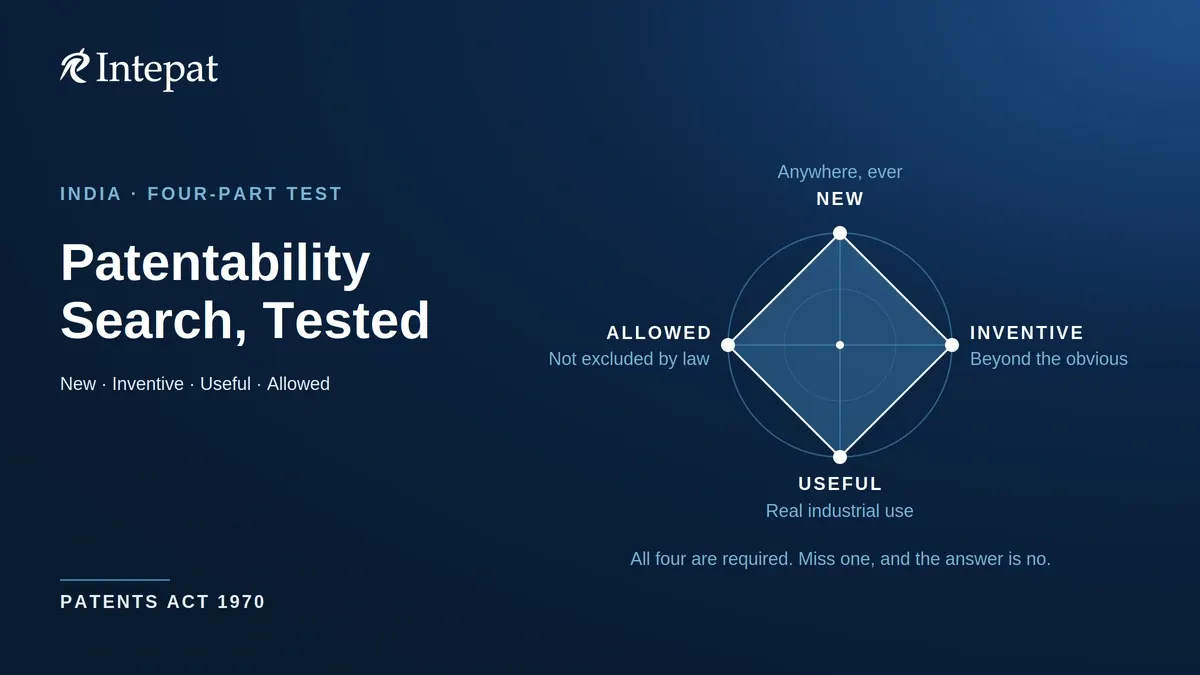
- A patentability search asks four things in plain terms: has anyone done this before, anywhere in the world; is it a real inventive step and not just an obvious tweak; does it have a practical industrial use; and is it the kind of subject matter Indian law allows to be patented at all.
- Some categories, such as abstract algorithms, pure business methods, or a new form of an already-known substance that doesn’t work any better, are excluded outright, no matter how novel they are.
- India has no general grace period. Publishing, demoing, or pitching an invention before filing can count as a disclosure that defeats the application later, with only narrow, easy-to-miss exceptions.
- There’s no government fee for the search itself, but that isn’t the same as free. Pricing depends on the firm and the invention’s complexity, so ask for a scoped estimate before committing.
- A clean result supports a filing decision. It is not a guarantee that a patent will be granted or survive a later challenge.
What a patentability search actually checks
Indian law defines a patentable invention as a new product or process that involves an inventive step and is capable of industrial application. A patentability search exists to test one defined invention against that standard before money is spent on drafting and filing, not to explore a rough idea.
Two parts of that test look at what counts as prior art: whether the invention has been publicly disclosed anywhere in the world before, in any document or through public use, and whether the gap between the invention and what’s already known would have been obvious to someone ordinarily skilled in that field. A third part, industrial applicability, is judged differently: it looks at whether the specification itself describes a real, workable use, not at what else exists in the world.
The fourth part is not a search question at all. Indian law rules out certain categories of subject matter from being patented, regardless of how novel or clever they are: abstract ideas and algorithms, pure business methods, mere discoveries of natural phenomena, and a new form of an already-known substance that doesn’t perform any better than what came before, among others. No amount of prior art searching changes that answer, which is why a search that only checks novelty and inventive step has covered at most half the ground that actually matters to a filing decision.
What’s included in a typical search
A commissioned search generally follows the same shape as the Patent Office’s own examination, run earlier and over a smaller slice of the literature:
- Disclosure review. The searcher reviews the invention disclosure and pins down the actual inventive concept, since a search built around the wrong concept searches the wrong thing entirely.
- Search strategy. A strategy is built around classification codes and keywords.
- Database search. The strategy runs across patent and non-patent literature, using databases such as India’s own InPASS, WIPO’s PatentScope, and Espacenet.
- Claim mapping. Results are mapped against each element of the likely claims, not just skimmed for similar-sounding inventions.
- Exclusion check. The search separately checks whether the invention falls into any of the excluded categories described above.
The output that matters is a written opinion, not a folder of documents. A useful report states what was searched, where, and with what limitations, and gives a reasoned view on risk, so that whoever reads it later, an inventor, in-house counsel, or an investor, can actually act on it rather than take it on faith.
What it can’t tell you
However well it’s run, a private search has real limits. Indian law is explicit that even the Patent Office’s own examination does not warrant the validity of a patent, and a private search carries no more assurance than that. A clean result is evidence supporting a filing decision. It is not a certificate that the claim will survive examination or a later challenge.
Coverage has gaps too. No single database has complete coverage of every patent ever published, and even widely used tools like Google Patents don’t index Indian specifications in full text. A patentability search narrows risk. It does not remove it.
Your own disclosure can work against you
India has no general grace period. An inventor who posts a demo video, gives a conference talk, or pitches investors before filing has, in most cases, disclosed the invention exactly as a stranger’s publication would, and can end up anticipating their own application.
Narrow exceptions exist, for display at a government-notified exhibition or a paper read before a learned society, for example, but they have to be formally claimed within twelve months and are easy to miss if nobody is tracking the clock. A patentability search that turns up the applicant’s own earlier disclosure is not automatically fatal news, but it is a signal that this paperwork needs attention fast.
When to run one
A provisional filing secures a priority date (the date the invention’s timing is measured from) without yet setting out full legal claims. That begins a separate twelve-month clock from the grace-period exceptions described above: the complete specification, the full application with detailed claims, is generally due within twelve months of the provisional filing, and only the material already in the provisional is protected from the applicant’s own later disclosures. A search run once, at the idea stage, and never repeated, can miss anything added to the invention in that window.
For a first-time applicant, the decision a search actually serves is whether to spend on filing at all, and which claims are worth drafting broadly versus narrowing. For in-house counsel or a repeat filer, it’s closer to quality control: whether the brief matched the invention as finally claimed, and whether the opinion is specific enough to act on. Either way, the result feeds a filing decision. It doesn’t replace one, and it sits alongside, not instead of, the other searches a freedom-to-operate or landscape question calls for later.
Frequently asked questions
It checks whether an invention is new anywhere in the world, involves a real inventive step, has a genuine industrial use, and doesn’t fall into a category Indian law excludes outright, such as abstract algorithms or pure business methods. The first three depend on what a search finds; the fourth is a legal question no amount of searching can resolve.
No. Indian law only regulates the Patent Office’s own examination, which happens after filing. Commissioning a private, pre-filing search is a professional judgment call, not a legal obligation, and there’s no prescribed form, fee, or deadline for it.
You can search free databases yourself, including India’s own InPASS, WIPO’s PatentScope, and Espacenet, as a reasonable first screen. What that search won’t give you is the legal assessment on top: whether what you found meets the inventive-step test and clears the categories Indian law excludes outright. That judgment, and the written opinion built on it, is what a professional search adds.
A prior art search gathers documents. A patentability search applies the legal test on top of what that search finds, novelty, inventive step, industrial use, and the categories the law excludes, and ends in a reasoned written opinion rather than a document list.
Yes. India has no general grace period, and an inventor’s own public disclosure before filing can defeat the application just as a stranger’s would. A handful of narrow exceptions exist, but they generally have to be formally claimed within twelve months of the disclosure, and are easy to miss.
No. Even the Patent Office’s own examination carries no warranty of validity, and a private search carries no more assurance than that. A clean result supports a filing decision; it doesn’t remove the risk of a later objection or challenge.
Pricing isn’t fixed and depends on the firm, the invention’s complexity, and how many databases and jurisdictions the brief covers, so no single figure applies generally. Ask for a scoped estimate against your specific invention rather than assume a standard rate. Turnaround is more predictable: Intepat’s own published turnaround for a standard report is seven to ten working days from a complete disclosure.
A patentability search asks whether your own invention is new and inventive enough to file. A freedom-to-operate search asks whether selling your product would infringe someone else’s existing rights. A clean patentability result says nothing about freedom-to-operate risk.
This article explains the law on patentability searches in India as at August 2026 and is for general information only. It is not legal advice. Government fees, forms, and procedures change; confirm current figures with the Indian Patent Office before you file. For advice on your specific invention, consult a registered patent agent.
Grace-period exceptions and specification deadlines both run on strict clocks, and missing either can seriously damage an application. The figures and timelines here are indicative and change; do not rely on them for a specific filing without confirming the current position and, where the stakes warrant it, taking professional advice.