




Claim mapping in patents is the element-by-element comparison of a granted patent claim against a specific target: an accused product, a prior-art reference, or a technical standard. Each word of the claim is matched to a corresponding feature and recorded in a claim chart, the working method behind an infringement, freedom-to-operate, or validity opinion.
This guide covers claim mapping as it works in Indian patent practice, drawing on the Patents Act, the Patent Office’s own guidance, and two recent Delhi High Court rulings on the subject.
Quick answer: Claim mapping means testing every element of a claim, one at a time, against a defined target: product to claim, never product to product. Delhi High Court has twice in the last two years denied relief where no such mapping was attempted. Build or refresh the chart before you rely on it, not after.
How Claim Mapping in Patents Works
Claim mapping tests a patent’s claims, not its title, abstract, or product description, against a specific target, one element at a time. A patent specification must end with claims that define the scope of protection being sought, and mapping is how that defined scope gets applied in practice.
The law describes an invention in general terms: a new product or process involving an inventive step and capable of industrial use. But that general definition is not what a specific patent actually covers. The claims are the operative statement of scope, and a patent ordinarily holds several of them, each mapped and assessed on its own. The Patent Office’s own manual puts it plainly: claims define the contours of the rights a granted patent confers, making them the most critical part of the application. Mapping assumes the claim’s wording is already settled; where the words themselves are disputed, that earlier step is claim construction, not mapping (see the FAQ below).
A specification’s claims must relate to one invention, or a linked group forming a single inventive concept, and must be written clearly and concisely, grounded in what the rest of the specification discloses. Mapping starts from this fixed, examined text, never from the shorter summary a marketing page gives the same invention.
Why the Claim Is the Target, Not the Product Description
A claim chart tests the granted claim against the target, because the claim, not the product brochure, is what the Patents Act, 1970 protects. The Patent Office describes granted claims as forming a protective fence around the invention, drawn by the words and phrases in the claims themselves, and nothing outside that fence is protected.
This cuts both ways for a drafter and for whoever checks the drafting later. Matter that appears in the description but was never claimed is treated as disclaimed and open to public use, even though it was disclosed. A detailed specification paired with a narrow claim protects only the narrow claim; a chart built from the specification’s broader description, rather than the claim’s actual words, overstates what the patent covers and misleads whoever relies on it.
Building a Claim Chart Element by Element
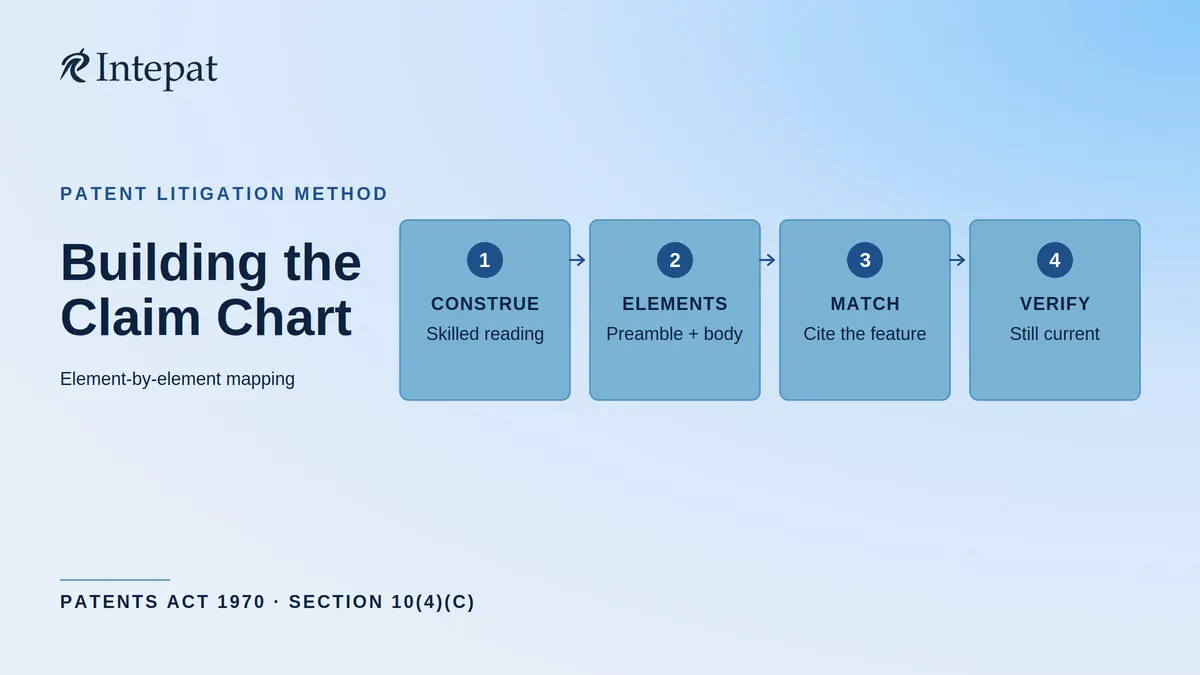
A claim chart breaks a single claim into its constituent elements and places each beside the corresponding feature of the target, with a citation for every match. A claim itself usually has three parts, a preamble, a transitional phrase, and a body, and the chart should follow that same structure element by element.
The preamble names the category of invention and sometimes its purpose. The transitional phrase, typically “comprising,” “including,” “consisting of,” or “consisting essentially of,” is what fixes how open or closed the claim is to additional, unclaimed features. The body lists the elements themselves. A chart worth relying on quotes the exact claim language in one column and cites the exact source, a datasheet page or teardown photograph, in the column beside it, rather than summarising the target in the drafter’s own words. A short illustration, using a hypothetical claim rather than a real one:
| Claim element | Target feature and citation |
| “A chair comprising:” | Product is marketed and sold as a chair (product listing, page 1). |
| “a seat;” | Moulded polymer seat pan (teardown photograph 2; datasheet, p.1). |
| “a backrest attached to the seat; and” | Backrest fixed to the seat pan by two bolts (teardown photograph 4). |
| “four legs supporting the seat.” | Four legs, each bolted to the seat pan (teardown photograph 3). |
Every claim element gets a matching, cited row; a chart with an empty or unsupported row for even one element is not yet ready to support a conclusion either way.
Every term in the claim must itself be traceable to the description, whether stated outright or fairly inferred; a chart that maps a claim term the specification never actually supports may not survive scrutiny. India does not recognise catch-all claiming: a claim that fails to define the scope of the invention it seeks to protect will not be allowed at all, so every row in a chart must trace to specific claim language, never to a general reference to the specification or drawings.
Mapping for Infringement and Freedom to Operate
Mapping for patent infringement India asks whether a target product or process falls inside the fence a granted or published claim draws; mapping for freedom to operate India (FTO) asks the same question earlier, before launch. The exclusive rights a patent confers run to the acts its claim covers, so both exercises map the same way, timing aside.
Those rights carry their own carve-outs, including for government use and for experiment or research. The burden of proof can also shift mid-suit: where a patent covers a process for making a new product, and the patentee can show the products are identical but could not identify the defendant’s actual process despite reasonable efforts, a court may direct the defendant to prove its process is different. A party unsure whether its own process or product infringes can apply for a declaration of non-infringement, but only after writing to the patentee for an acknowledgment, giving full particulars of the process or article, and being refused or ignored.
The defences available in an infringement suit mirror the grounds on which a patent could be revoked, which is why an FTO chart should record not only whether an element maps, but which revocation ground would apply if the underlying claim itself is weak. A clean element match is not the end of the analysis either: regulatory-development activity aimed at a law governing the product’s manufacture, sale, or import falls outside infringement regardless of how cleanly the claim maps, and so does genuine use for experiment or research. Where mapping and infringement are both made out, the reliefs available are an injunction and, at the patentee’s election, damages or an account of profits, with infringing goods and the equipment used to make them liable to seizure, forfeiture, or destruction.
Mapping Against Prior Art for Patentability and Validity
Mapping against prior art runs the same element-by-element test in reverse: the target is a prior publication or an earlier claim, tested against that claim’s own priority date, not one fixed date for the whole patent. The examiner runs a publication-based search as a statutory duty before grant.
A revocation petition repeats and broadens that test afterward, and can also reach what the examiner’s publication-only search never investigates: prior public knowledge or use in India. The law is explicit that examination is investigative, not a guarantee of validity, which is exactly why an independent mapping exercise still matters after grant, in litigation or diligence. This is also where a prior-art search differs from an invalidation or FTO search in what it maps against, though the method is the same.
Two of the recognised revocation grounds turn directly on this mapping: a claim is invalid for lack of novelty if, mapped against the prior art, it was already publicly known, publicly used, or published before its priority date; and it is invalid for obviousness if the same prior art shows the claimed feature was already obvious to a person skilled in the art, lacking the technical advance or economic significance a genuine inventive step requires. Both grounds are also available as defences in an infringement suit, which is why a defendant maps prior art onto the claim just as carefully as onto its own product.
What Recent Delhi High Court Rulings Say About Claim Mapping
Delhi High Court has twice in the last two years refused relief where a patentee skipped product-to-claim mapping, and the Supreme Court has now sent a related dispute back for exactly that exercise. Registration of a patent, without more, does not establish that a specific product falls inside a specific claim.
In F. Hoffmann-La Roche AG v. Zydus Lifesciences Limited, the court held that an ad interim injunction is not possible without claim mapping, finding that because there was no mapping of the plaintiffs’ patents against the defendant’s product, it could not rule in the plaintiffs’ favour. Granting an injunction merely on the basis of a registered patent, without putting it to the test of claim mapping, could not have been the legislature’s intention.
The Division Bench reached a related conclusion the other way around, about fifteen months later. Reviewing a Single Judge’s order that had granted an injunction against a biosimilar product without any product-to-claim mapping, the Division Bench vacated the injunction, holding that while mapping may not be an iron rule in every case, its absence demands overwhelming circumstantial material showing the defendant’s product maps onto the suit patent. Where no mapping is attempted, any substitute evidence has to be conclusive enough, even at the prima facie stage, to show the defendant’s product is the very product the plaintiff holds the patent for. In place of an injunction, the Division Bench ordered audited accounts of the product’s sales revenue until the suit patent’s own expiry.
That dispute is still moving. The Supreme Court has since allowed the patentee to carry out product-to-claim mapping against the defendant’s marketed product and remanded the matter back to the Division Bench, per reported coverage. Treat this as reported, not as primary-record fact, until the order itself is confirmed. No further Division Bench order has been reported as of this article’s verification date.
Claim Mapping When Amending a Specification
An amendment redraws the fence a chart maps against, so any chart built before an amendment must be rebuilt, not patched, afterward. The law allows amendment only by way of disclaimer, correction, or explanation, and only to incorporate an actual fact.
The same rule fixes the outer limit that matters most for mapping: an amended specification may not claim or describe matter not already disclosed in substance before the amendment, and no amended claim may fall outside the scope of a claim that existed before the amendment. In practice, this means a post-amendment claim chart can only narrow or hold steady the set of target features that map inside the fence, never widen it beyond what the pre-amendment claim already reached. A chart that finds new matching features an earlier, narrower chart could not have found is a signal to re-check the amendment’s scope, not a legitimate result. A chart still keyed to the pre-amendment claim is mapping the wrong instrument entirely, and any opinion built on it should be treated as stale until re-run against the current text.
Where Claim Charts Fail in Practice
Unreliable claim charts tend to fail for one of three reasons: they compare product to product instead of product to claim, they treat the specification’s broad description as the claim itself, or they go stale once the claim is amended or the target product changes.
The first of these has already cost a party relief in reported Delhi High Court practice; the other two are common even without a reported ruling attached to each. Product-to-product comparison is the most common shortcut: a defendant’s product looks like a competitor’s earlier licensed product, so a party assumes the mapping is already done. It is not; only a claim-to-product test matters, never product-to-product. Treating the description as the claim is the second failure: a chart built from the specification’s fuller narrative will find more matching features than one built from the claim’s narrower words, overstating its actual reach.
The third failure is a timing failure rather than a method failure: a chart is a snapshot, and it goes stale the moment the claim is amended, the target product’s formulation or design changes, or a new prior-art reference surfaces that the original search missed.
Practical Rule: Build the Chart Before You Act
The practical rule is to build or refresh the claim chart before filing a suit, clearing a launch, or relying on a competitor’s patent grant, never after. A chart is cheap to build and to update; an injunction lost, or wrongly obtained, for want of one is not.
The exposure runs both ways: a patentee who sends an infringement threat without a chart to back it risks a groundless-threats action of its own, so mapping protects whoever sends a demand letter just as much as whoever receives one. Four checks cover most of what Delhi High Court has actually tested:
- Every claim element is mapped to a specific, cited feature of the actual target, not to a product-to-product resemblance.
- The claim text being mapped is the current, granted, possibly amended text, not an earlier draft.
- The chart names its evidence, a page, a photograph, a datasheet, well enough that someone else could rebuild it independently.
- The patent itself is confirmed still in force against the Register; a lapsed or expired patent has nothing left to map against.
A chart that fails any of these checks is not yet ready to support a launch decision, a demand letter, or a court filing, whatever the underlying commercial pressure to move quickly.
Frequently Asked Questions About Claim Mapping
Claim mapping is the element-by-element comparison of a patent claim against a defined target: an accused product, a prior-art reference, or a technical standard. Every specification must end with claims defining the scope of protection sought, and mapping tests that scope against something real, not the patent’s title or description.
Delhi High Court has treated it as required. In F. Hoffmann-La Roche v. Zydus, the court held that an ad interim injunction is not possible without claim mapping. The Division Bench in the later Zydus dispute over a biosimilar allowed conclusive circumstantial material to substitute instead.
A claim chart lists a claim’s elements, from its preamble, transitional phrase, and body, in one column, with the target’s corresponding feature in the next, each cited to a specific, checkable source. A chart that only summarises the target in general terms is not built to a standard anyone could independently verify.
Construction comes first: settling what a claim’s words actually mean and how far they reach, often the contested issue in litigation itself. Mapping comes second: once meaning is settled, mapping tests a specific target against it, element by element. A chart built on a contested construction should say so, since a different construction can change the result entirely.
Yes, but narrowly: amendment is allowed only by disclaimer, correction, or explanation, to incorporate an actual fact, and an amended claim can never fall outside the scope it had before the amendment. A chart mapped against the pre-amendment text should be treated as stale and rebuilt, not patched to match the new wording.
A chart missing even one mapped element usually cannot support a literal infringement or anticipation (novelty) finding on that claim; each element is treated as material. Whether the doctrine of equivalents, which can sometimes reach a non-identical element, closes the gap, or a narrower claim maps completely instead, is the next question.
This article explains claim mapping as a working method in Indian patent practice, current as of August 2026, and is for general information only. It is not legal advice. The two Delhi High Court rulings discussed are drawn from reported law-report coverage, not from the primary court record, and the related Supreme Court development is current only as of the date reported; confirm the present procedural status before relying on it. For an opinion on a specific patent, product or dispute, consult a registered patent agent or patent attorney.