




Patent infringement in India happens when a third party, without consent, does what your patent’s claims reserve for you. For a product patent that means making, using, selling, or importing the product; for a process patent it means using the process or dealing in its direct output. It is a civil wrong, enforced by a suit, not a crime.
Quick answer
• Infringement is civil, not criminal. You sue; the infringer is not prosecuted or jailed for infringing.
• You can sue only after your patent is granted, though your rights run from the date your application was published.
• Infringement is judged against your claims, read literally and by their substance, not against your product as a whole.
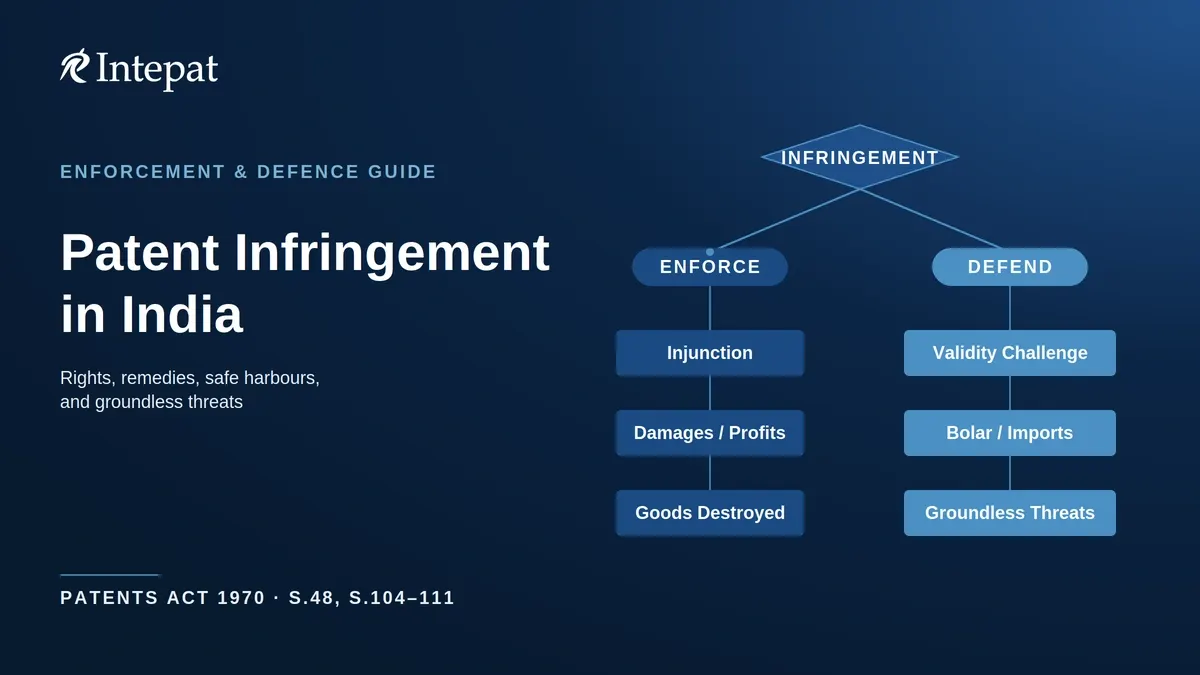
• A court can grant an injunction plus, at your choice, either damages or an account of profits, and can order infringing goods destroyed.
• Common defences: challenge the patent’s validity, or rely on the research, Bolar, parallel-import, or consent safe harbours.
This guide covers patent infringement under the Indian Patents Act 1970. It is written for founders and businesses on both sides of the problem: the patent holder deciding how to enforce, and the company that has received a notice and needs to know where it stands. The doctrine of equivalents is noted here and compared across countries in a separate guide.
Patent infringement is a civil wrong, not a crime
A patent dispute in India is fought in a civil court, not a police station. There is no criminal offence of “infringing a patent.” The Patents Act does deal separately with other conduct, such as falsely marking an unpatented article as patented, which carries its own monetary penalty, but that is a distinct wrong, not infringement. Copying a patented invention is handled by a civil suit, where the remedy is to stop the conduct and recover the loss, not to imprison anyone.
What counts as patent infringement in India
A granted patent gives the patentee the exclusive right to prevent others, who do not have consent, from dealing in the invention. For a product patent, that means making, using, offering for sale, selling, or importing that product in India. For a process patent, it means using the patented process, and dealing in the product obtained directly by that process. These rights sit in Section 48 of the Patents Act, the section that defines what a patent actually protects.
So infringement is doing any of those acts, in India, without permission, where what you do falls inside the patent’s claims. Two points decide most disputes. First, the test is territorial: the act must take place in India. Second, the test runs against the claims, the numbered statements at the end of the specification that mark the legal boundary of the monopoly, not against the product or the marketing around it.
The Act does not list “types” of infringement. Phrases practitioners use, such as colourable imitation, mechanical equivalents, or immaterial variation, are not statutory categories. They are the language courts use when they construe claims and ask whether a near-copy still takes the substance of the invention.
How courts decide infringement: reading the claims
Infringement turns on claim construction, the court’s reading of what each claim covers. The starting point is literal infringement: does the accused product or process contain every element of at least one claim, read in light of the patent’s description? If it does, infringement is usually made out.
A copyist who makes a small, unimportant change to dodge the exact words of a claim is not automatically safe. Indian courts recognise non-literal infringement through principles such as pith and marrow and an essential-elements analysis: the question is whether the accused product or process takes the substance of the claimed invention, while still giving proper weight to the claim language and the essential elements of the claim. These ideas overlap with the doctrine of equivalents, which is judge-made rather than written into the Act, and which different countries handle differently, as set out in our comparative analysis of the doctrine of equivalents. In practice, the work of proving a match is done through claim mapping, an element-by-element comparison of your claims against the suspected product. For example, if a claim requires elements A, B, and C, you generally have to show that the accused product or process contains each of those elements, or a close equivalent of an element where non-literal infringement is argued.
Who can sue, and when
More than one person can bring an infringement suit, but the routes differ.
| Who | Can they sue? | Condition |
| Patentee | Yes | Holds the granted patent |
| Registered assignee | Yes | Assignment recorded on the register; stands in the patentee’s place |
| Exclusive licensee | Yes | A like right to the patentee’s, for infringement after the licence date; the patentee is added as a defendant if not joined |
| Compulsory licensee | Conditionally | Must first call on the patentee; only if the patentee refuses or neglects to act within two months can the licensee sue |
The exclusive-licensee right comes from Section 109, and the compulsory-licensee route from Section 110; both are explained further in our guides on patent licensing and compulsory licensing.
Timing is a hard gate. You can institute infringement proceedings only after the patent is granted. Your rights do run from the earlier date your application was published, so once the patent is granted you can claim for infringement during the publication-to-grant period. What you cannot do is file the suit before grant, and no claim reaches back to acts committed before publication. In practice, any claim for the publication-to-grant period is tested against the patent as finally granted, since the granted claims, which may be narrower than those first published, set what you can actually enforce. This is the modern position under the grant regime; older terms such as a patent being “sealed” or “accepted” belong to a system that no longer operates.
| Facing a copy of your patented product? |
| Our patent team can map your claims and lay out your enforcement options. |
| Get Patent Help |
Where to file a patent infringement suit, and who proves it
An infringement suit is filed in a court no lower than a district court. If the person you sue strikes back with a counterclaim asking the court to cancel your patent, the suit and the counterclaim move up to the High Court. Patent infringement suits also count as commercial disputes, so above a threshold value they are heard by a commercial court or the commercial division of a High Court, forums built to resolve them faster. A validity attack is the most common form of defence, so a revocation counterclaim, covered in our guide to patent revocation, should be expected and planned for before you sue.
The clock matters. The limitation period is generally three years, and patent infringement is treated as a continuing wrong: each fresh act of infringement starts its own three-year period. Acts older than three years may be time-barred while recent ones remain actionable, which is why prompt action protects the most ground. (Verified as of June 2026 against the Limitation Act 1963.)
Who proves infringement? As a rule, the patentee does. There is an important exception for process patents. Where the patented process makes a new product, or where there is a substantial likelihood that an identical product was made by the patented process and the patentee could not work out the actual process despite reasonable efforts, a court may direct the defendant to prove that their process is different. The patentee must first show the product is identical, and the court will not force disclosure of genuine manufacturing secrets where that would be unfair.
Patent infringement remedies in India
| Relief | What it does |
| Interim injunction | Stops the conduct during the case, on the settled three-part test of a prima facie case, balance of convenience, and irreparable harm |
| Permanent injunction | Stops the conduct for good after trial |
| Damages or account of profits | Compensates your loss, or strips the infringer’s profit; you choose one, not both |
| Seizure, forfeiture, or destruction | The court can order infringing goods, and the implements mainly used to make them, seized, forfeited, or destroyed without compensation |
The headline relief is the injunction, often the interim injunction that holds the position while the suit runs. On the money side, you elect either damages or an account of the infringer’s profits. The court can also order the infringing stock and the tooling behind it destroyed.
One limit is worth knowing before you act. A defendant who proves that, at the time of the infringement, they were not aware and had no reasonable grounds to believe the patent existed can escape damages and an account of profits, though not the injunction. Marking your product “patent” or “patented” does not by itself count as notice; the patent number must accompany the word. The practical lesson is direct: mark your products with the patent number, so an infringer cannot later claim innocence.
Border recordal is no longer available for patents. Since a 2018 change to the customs rules, patents have been outside the customs recordal and seizure system that still covers trademarks, copyright, designs, and geographical indications. To stop infringing imports of a patented product, you generally proceed through court relief, such as an injunction, rather than a customs recordal. (Verified as of June 2026.)
Patent infringement defences and safe harbours
If you are on the receiving end of an infringement claim, several defences and statutory safe harbours may apply. Some defeat the claim outright; others place the conduct outside infringement altogether.
| Defence or safe harbour | What it covers |
| Validity challenge | Any ground on which the patent could be revoked is a defence, and is often raised as a counterclaim for revocation |
| Consent or licence | Acts done with the patentee’s permission are not infringement |
| Research and government use | Use merely for experiment or research, including teaching, and certain government uses, are protected |
| Bolar exemption | Acts reasonably related to developing and submitting information for regulatory approval, in India or abroad, are not infringement |
| Parallel imports | Importing a patented product from someone duly authorised under the law to produce and sell it is not infringement |
| Foreign vessels | Use on a foreign vessel, aircraft, or land vehicle that is only temporarily or accidentally in India is not infringement |
The research, Bolar, and parallel-import safe harbours sit in the Act itself and are not discretionary. The Bolar exemption lets a generic maker prepare a regulatory dossier before a patent expires, and the parallel-import safe harbour lets authorised goods cross the border. That last one is narrower than it looks: the importer should be able to show that the seller abroad was duly authorised under the applicable law to produce and sell the product, and it is not a blanket permission to import any patented product from any source. Two further tools protect a business that has been wrongly accused. If someone threatens you with infringement proceedings by circulars, advertisements, or communications without justification, you can sue them for a declaration that the threats are unjustifiable, an injunction to stop the threats, and damages; a bare notice that a patent exists is not, by itself, such a threat. And if you are unsure whether a planned product infringes, you can ask the court for a declaration of non-infringement, after first asking the patentee in writing to acknowledge the position and being refused.
If you hold a patent, or receive a notice: what to do next
If you suspect someone is infringing, confirm the patent is granted and renewal fees are paid, map your claims against the suspected product, and preserve evidence before anyone is alerted. Send a measured notice if at all, because an unjustified threat can itself be actioned, and move within the limitation period. Because a validity counterclaim is likely, treat the strength of your patent as part of the enforcement decision, not an afterthought.
If you receive an infringement notice, do not ignore it and do not panic. Check whether your product genuinely falls within the claims, weigh whether the patent could be revoked, and test the safe harbours: research, Bolar, parallel import, or consent. A non-infringement declaration or a groundless-threats action may be the right answer to a baseless demand. On either side, the decision turns on claim construction and validity, so take advice before you send a notice or reply to one.
| What not to do if you receive a notice |
| Do not ignore it; deadlines pass and evidence gets lost.Do not admit infringement casually in an email or call.Do not alter or destroy the product before the technical position is preserved.Do not fire off a flat denial before checking the claims and the patent’s validity. |
Frequently asked questions
No. Patent infringement is a civil wrong, enforced by filing a suit. The Patents Act’s criminal penalties punish different conduct, such as falsely marking an article as patented or making false entries in the patent register, not the act of copying a patented invention.
No. Infringement proceedings can be instituted only after the patent is granted. Your rights run from the date your application was published, so once granted you can claim for the publication-to-grant period, but the suit itself cannot be filed before grant.
A court can grant an injunction to stop the infringement and, at your option, either damages or an account of the infringer’s profits. It can also order infringing goods and the implements used to make them seized, forfeited, or destroyed without compensation.
The civil court decides, by construing the patent’s claims and comparing them to the accused product or process. Infringement can be literal or, under the judge-made doctrine of equivalents, can cover a version that takes the substance of the invention through an immaterial change.
It is generally three years under the Limitation Act 1963. Patent infringement is treated as a continuing wrong, so each fresh act of infringement starts its own three-year period. Older acts may be time-barred while more recent acts remain actionable.
Several defences exist. Common ones include challenging the patent’s validity (often as a counterclaim for revocation) and relying on consent, the research or government-use exceptions, the Bolar exemption for regulatory work, or the parallel-import safe harbour for goods bought from an authorised seller.
Not for patents. Since a 2018 amendment to the customs rules, patents are outside the recordal and seizure system, which still covers trademarks, copyright, designs, and geographical indications. To stop infringing imports of a patented product, you now need a court injunction rather than a customs complaint.
You usually prove it by mapping each element of at least one granted claim against the accused product or process. For process patents, the burden can shift to the defendant in limited situations, where the product is identical and you could not reasonably work out the actual process used, once you first show the products are the same.
Yes. Every ground on which a patent could be revoked can be raised as a defence in an infringement suit, and the defendant can also file a revocation counterclaim. When that counterclaim is filed, the suit and the counterclaim are heard together by the High Court, so validity becomes part of the same case.
It can be, if the allegation is not properly supported. A baseless or excessive threat can expose the sender to a groundless-threats action, in which a court can declare the threats unjustified and award damages. A sound notice is usually preceded by claim mapping, a validity check, and evidence preservation.
This article explains the general position on patent infringement under the Indian Patents Act 1970 and is not legal advice. Infringement and validity turn on claim construction and the specific facts, limitation periods are strict, and an unjustified threat can itself be actioned. Before sending a notice, filing a suit, or responding to one, consult a registered patent agent or patent attorney about your situation.