




Initial Publication 2021 and Updated in August 2026
Prior art, invalidation, and FTO searches serve three different purposes at different stages of a product’s journey in India. The key questions are simple: Can this invention be patented? Can an existing patent be challenged? Could launching this product infringe someone else’s patent?
Choosing the wrong type of search can waste both time and money.
Quick answer: A prior art search checks whether your invention is new and patentable, so it is usually done before filing a patent application. An invalidation or invalidity search looks for earlier material that can be used to challenge an already-granted patent, often during a patent dispute or infringement defence. An FTO search checks whether commercialising your product could infringe patents owned by others, and is typically carried out before launch or market entry.
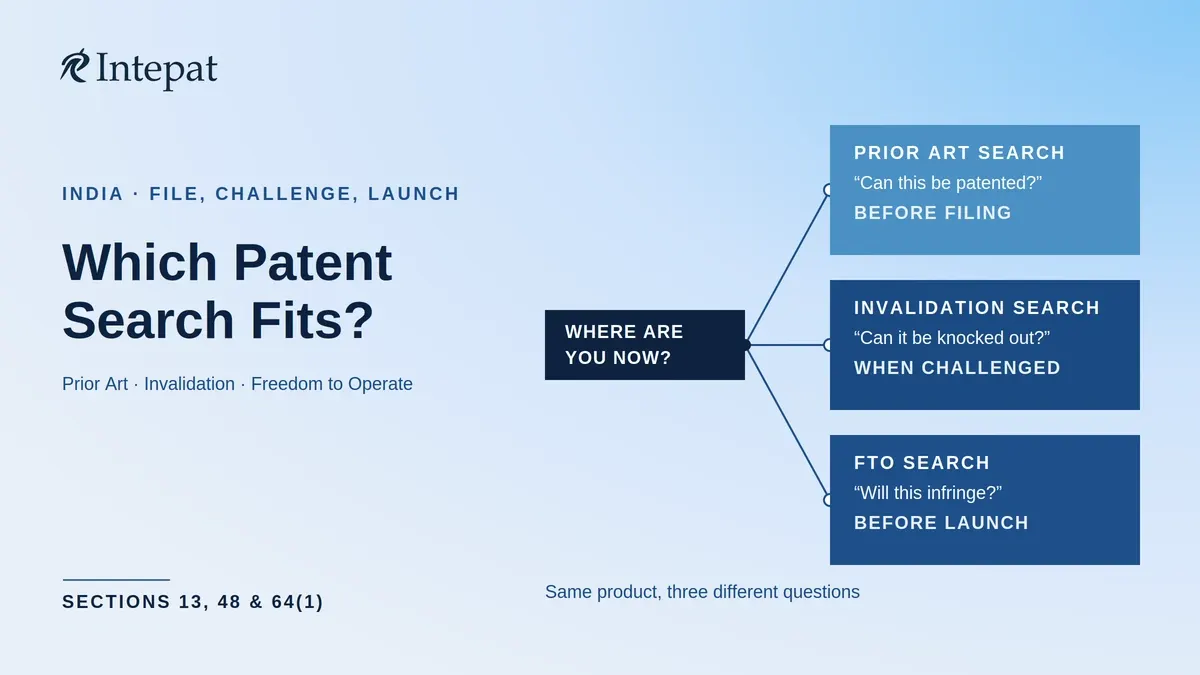
Prior Art Vs Invalidation Vs FTO Search: What Each One Answers
Each search answers a different question, and mixing them up can lead to the wrong search being commissioned.
A prior art search asks: Can this invention be patented?
An invalidation search asks: Can this granted patent be challenged or knocked out?
An FTO search asks: Do any third-party patents create a risk if this product or process is launched?
They also come into play at different stages. A prior art search is usually carried out before filing a patent application. An invalidation search becomes relevant when a granted patent is being challenged or enforced. An FTO search is typically conducted before commercialising a product or process.
Using the wrong search at the wrong stage can mean paying for work that does not answer the question you actually need resolved. For example, commissioning an FTO search when you really need to assess patentability before filing would involve a different scope and purpose.
Prior Art Search: Before You File
A prior art search helps assess whether an invention is new before a complete specification is filed. Under Indian patent law, a “new invention” is one that has not already been disclosed through publication or use anywhere in the world before the relevant filing date.
Novelty, however, is only part of the analysis. The invention must also involve an inventive step. This means it must provide a technical advance, or have economic significance, and must not be obvious to a person skilled in the art. Novelty and inventive step are separate legal requirements, so a useful prior art search should assess both.
The Patent Office will conduct its own search during examination. The examiner is required to look for earlier Indian patent specifications with an earlier priority date, as well as publications from India and other countries that may anticipate the claimed invention.
Doing this search before filing gives the applicant an important advantage: potentially damaging prior art can be identified while the specification and claims can still be drafted around it.
A prior art search commonly uses:
- Keyword searches focused on the important technical features of the invention.
- Public patent databases, including Google Patents, Espacenet, WIPO Patentscope, and the Lens.
- Patent classification codes, such as CPC and IPC, to find documents within the relevant technical field even when different terminology is used.
- Non-patent literature, including journal articles, conference papers, research publications, and other publicly available technical material. Prior art is not limited to patent documents.
A patentability search is essentially this exercise carried out from the applicant’s perspective before filing, rather than by the examiner during prosecution. For the practical distinction between the terms, see the difference between a prior art search and a patentability search.
Invalidation (Invalidity) Search: After a Patent Is Granted
An invalidation search, also called an invalidity search, looks for evidence that can be used to challenge a patent that has already been granted.
Under Indian patent law, a granted patent can be challenged through revocation proceedings before the High Court. A revocation petition may be filed by a person interested or by the Central Government, and revocation may also be sought by way of a counter-claim in a patent infringement suit.
There is also a separate post-grant opposition route. Within one year from the date of publication of the grant, any person interested may oppose the patent before the Controller on statutory grounds that are similar to, though not identical with, the grounds for revocation.
The possible grounds include, among others, that:
- the claimed invention was already claimed in an earlier Indian patent with an earlier priority date;
- the invention was not new because it had already been publicly known, publicly used in India, or published in India or elsewhere before the relevant priority date;
- the invention was obvious or lacked an inventive step;
- the claimed subject matter was not patentable under the Patents Act; or
- the complete specification did not sufficiently and fairly describe the invention.
An invalidity search is therefore more targeted than a general prior art search. The objective is not simply to find similar earlier documents, but to build evidence that supports one or more specific grounds on which the patent can be challenged.
This becomes particularly important in patent disputes. A party facing, or expecting, an infringement claim may commission an invalidity search to assess whether the patent being asserted against it can itself be attacked.
Read more about running an invalidity search and the broader range of patent search types in India.
Freedom to Operate (FTO) Search: Before You Launch
A freedom to operate search, or FTO search, identifies patents and relevant published patent applications that could affect the commercial launch of a planned product or process.
WIPO guidance treats the search and the legal opinion as two separate steps. The search identifies potentially relevant issued and pending patent rights. The infringement analysis then determines whether the proposed product or process may fall within the scope of those rights.
Under Indian patent law, a patentee has the exclusive right to prevent others, without consent, from making, using, offering for sale, selling, or importing a patented product in India. For a patented process, the patentee can also prevent unauthorised use of the process and certain dealings in products obtained directly from it.
Published pending applications also matter. Once an Indian patent application is published, the applicant receives rights broadly corresponding to those of a patentee from the date of publication, although infringement proceedings cannot be started until the patent is actually granted. A pending application may therefore create future commercial risk and should not automatically be ignored merely because it has not yet matured into a patent.
An FTO search differs from a prior art search in two important ways.
First, it is more focused. A prior art search can extend to patents, expired rights, academic papers, technical publications, public use, and other disclosures. An FTO search concentrates on patent rights and pending applications that could affect commercial activity.
Second, FTO is territorial. A product may be clear to operate in India but face relevant patent rights in the United States, Europe, or another market. The search must therefore cover each country where the product will be manufactured, used, sold, offered for sale, or imported.
FTO analysis is also best started early. If a potentially blocking patent is identified while the product is still being developed, the design may be changed before substantial investment is made. The search can then be updated as the product specification becomes final, with a fuller legal opinion completed before commercial launch.
If an FTO search identifies a potentially blocking patent, the available options may include obtaining a licence, designing around the relevant claims, assessing the actual infringement position, or challenging the patent where appropriate. In some cases, an invalidity search is therefore carried out alongside the FTO analysis.
Current Indian patent filing and status information can be checked through the Indian Patent Office portal.
Read more about FTO searches and opinions.
How the Three Searches Compare
The easiest way to distinguish the three searches is to look at the question being asked, when the search is carried out, and what it covers.
| Prior Art Search | Invalidation Search | FTO Search | |
|---|---|---|---|
| Main question | Can this invention be patented? | Can this granted patent be challenged? | Could this product or process infringe third-party patent rights? |
| When it is used | Before filing | After grant, usually when a patent is challenged or asserted | During product development and again before launch |
| What it searches | Earlier patents, publications, and other prior art relevant to novelty and inventive step | Evidence relevant to one or more grounds for challenging the patent | Granted patents and relevant published pending applications in each target country |
| Who usually needs it | Patent applicants | Parties challenging a patent or defending an infringement claim | Businesses planning to manufacture, use, sell, offer for sale, or import a product |
Which Search Do You Need? A Decision Framework
The right search depends on what stage you are at and what decision you need to make.
- Planning to file a patent application? Start with a prior art search. It helps assess novelty and inventive step before significant filing costs are incurred and can guide claim drafting around the closest earlier disclosures.
- Facing an infringement claim or challenging a competitor’s patent? An invalidation search is usually the right choice. The search is built around the specific grounds available for attacking the patent, such as lack of novelty, obviousness, insufficient disclosure, or other statutory grounds.
- Preparing to launch a product or process? Start an FTO search early. The aim is to identify granted patents and relevant published pending applications that could affect commercialisation. If potential risks are found early, the product can often be redesigned before launch.
- Dealing with more than one issue at the same time? You may need more than one search. For example, a company defending an infringement suit while developing a redesigned product may need both an invalidation search and an FTO search. They serve different purposes and should be carried out separately.
Frequently Asked Questions
Can one search cover both prior art and FTO purposes?
No. The two searches serve different purposes.
A prior art search looks broadly at earlier public disclosures, regardless of whether any patent right is still in force. An FTO search focuses on granted patents and relevant published pending applications that may create commercial risk in a particular country.
There may be some overlap in the documents found, but one search cannot reliably replace the other.
When should I commission an FTO search?
Start once the product or process is sufficiently defined to search meaningfully against existing patent rights.
Doing it early gives you more room to change the design if a potential conflict is found. The search can then be updated as the product develops, with a fuller legal opinion completed before commercial launch.
Does a clean prior art search guarantee that my patent will be granted?
No.
A prior art search mainly helps assess novelty and inventive step. During examination, the application may still face objections on other grounds, including insufficient disclosure, lack of clarity, or exclusions from patentability under the Patents Act.
A favourable search result therefore improves your understanding of the prior art, but it does not guarantee grant.
Who typically commissions an invalidation search?
Most often, it is commissioned by a party facing a patent infringement claim and wanting to assess whether the asserted patent can itself be challenged.
It may also be used by a business that wants to challenge a competitor’s patent because that patent is affecting its commercial plans.
What happens if an FTO search finds a blocking patent?
The next step depends on the claims of the patent and the commercial context.
Possible options include obtaining a licence, designing around the relevant claims, reassessing whether the product actually falls within the patent’s scope, or challenging the patent where valid grounds exist.
In some cases, an invalidation search is carried out alongside the FTO analysis to determine whether the blocking patent can be attacked.
This article explains the law on patent search types in India as at August 2026 and is for general information only. It is not legal advice. Government fees, forms, and procedures change; confirm current figures with the Indian Patent Office before you file. For advice on your specific invention, consult a registered patent agent.