




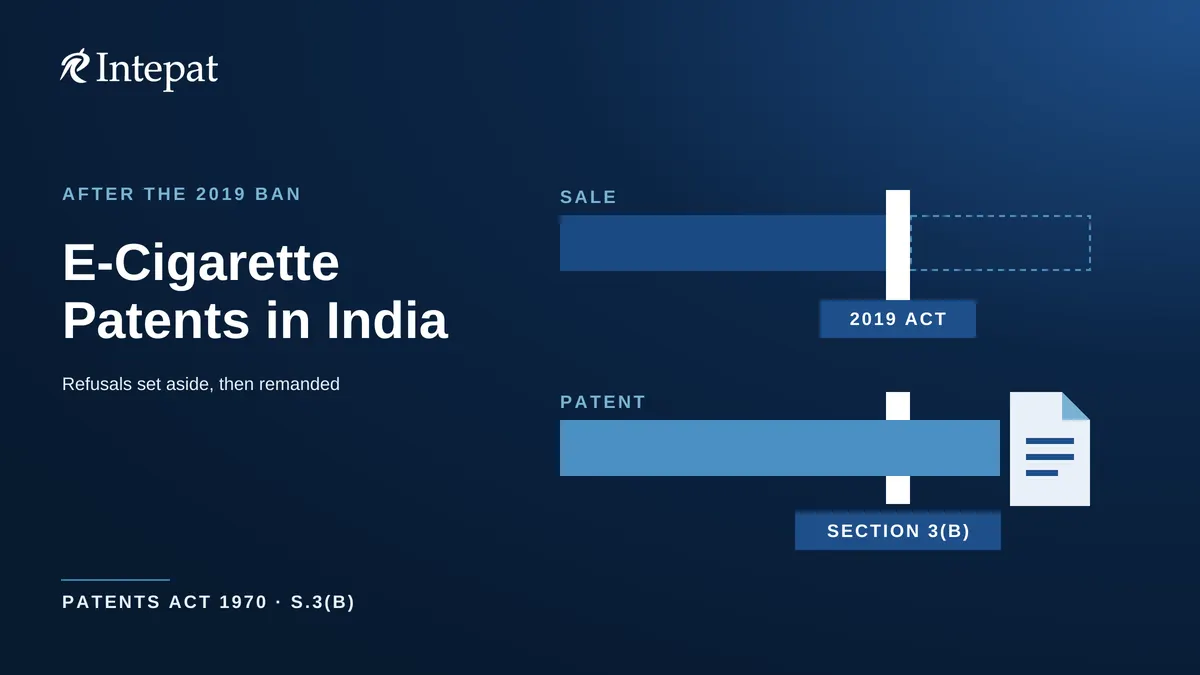
The 2019 e-cigarette ban does not, by its terms, block e-cigarette patents in India. It prohibits making, importing, selling and advertising the products and says nothing about patents. Refusals turn on Section 3(b) of the Patents Act, 1970, and since 2025 the Delhi and Calcutta High Courts have set aside several refusals that leaned on the ban.
This guide covers Indian law only: the Prohibition of Electronic Cigarettes (Production, Manufacture, Import, Export, Transport, Sale, Distribution, Storage and Advertisement) Act, 2019 (the 2019 Act), the Section 3(b) exclusion as the Indian Patent Office has applied it, and the High Court decisions from April 2025 to September 2026. It replaces our April 2020 article, written before any of those decisions, and is meant for applicants and agents facing a Section 3(b) objection on a tobacco, nicotine or aerosol-generating invention. Updated 19 October 2026.
Quick answer: Under High Court decisions of 2025 and 2026, relating to e-cigarettes, heat-not-burn devices, tobacco or nicotine is not by itself a ground to refuse a patent, and refusals on that basis have been set aside. A Controller (the Patent Office officer who decides the application) who relies on serious prejudice to health must identify the primary or intended use of the claimed invention and show, on scientific material put to the applicant, that it causes that prejudice. The refusal appeals discussed below each ended in a remand (a return for fresh decision), not a grant, so expect the objection and build the record.
Does the 2019 ban stop e-cigarette patents in India?
No provision of either Act says so. The 2019 Act regulates the product: it prohibits producing, manufacturing, importing, exporting, transporting, selling, distributing and advertising electronic cigarettes, and knowingly allowing premises to be used to store them. It does not mention patents, and the courts have held that a refusal must rest on the Patents Act itself.
The Calcutta High Court put it directly: the 2019 Act “deals with the sale, manufacture, import export and not with the grant or non-grant of patent for an invention” (ITC Limited, IPDPTA/13/2024, para 12). The Delhi High Court faulted eight refusal orders for proceeding “under the influence of a singular fact”, namely that the inventions related to aerosol devices, tobacco or nicotine and so fell within the ban (Philip Morris, 17 April 2026, para 65).
A patent also does not authorise sale. Section 48 gives the patentee the exclusive right to prevent third parties from making, using, offering for sale, selling or importing the invention without consent, and the courts have treated it as a negative right that confers no affirmative right to sell or commercialise the product (IPDPTA/13/2024, para 13; 9 September 2026, para 49). The Calcutta High Court called the contrary assumption “an inherent fallacy” (para 13). A granted patent therefore sits alongside the ban rather than overriding it: the 2019 Act still prohibits making and trading in the product and its parts in India.
What does the 2019 Act prohibit, and what falls outside it?
The 2019 Act defines an electronic cigarette as an electronic device that heats a substance, with or without nicotine and flavours, to create an aerosol for inhalation. The definition expressly includes electronic nicotine delivery systems, heat-not-burn products and e-hookah, and excludes any product licensed under the Drugs and Cosmetics Act, 1940.
The Act was published on 5 December 2019 and is deemed to have come into force on 18 September 2019. Section 4 prohibits producing, manufacturing, importing, exporting, transporting, selling and distributing electronic cigarettes “whether as a complete product or any part thereof”, and advertising them; Section 5 prohibits knowingly allowing premises to be used to store them. A first contravention of Section 4 is punishable with imprisonment of up to one year, a fine of up to one lakh rupees, or both; a second or subsequent offence with imprisonment of up to three years and a fine of up to five lakh rupees. Contravening Section 5 carries imprisonment of up to six months, a fine of up to fifty thousand rupees, or both.
Because Section 4 reaches any part of a device, a claim to a component does not take the product outside the ban. That does not decide patentability. Section 3(b) looks at the primary or intended use of what is claimed, and many claims are to a part or a method: a heating susceptor (the element that absorbs induced energy and heats), a temperature control, a tobacco-free substrate. In the April 2026 appeals the applicant framed that use around the technical contribution rather than the device as a whole (17 April 2026, paras 14 and 32).
The medicinal carve-out applies only to a product actually licensed under the Drugs and Cosmetics Act, 1940. Separately, on Section 3(b), the Delhi High Court faulted a refusal that overlooked approved nicotine replacement therapies in which nicotine is an active ingredient (9 September 2026, para 50), so evidence of medicinal use can help answer the health objection. Approval of other nicotine products does not show that a particular applicant’s product is licensed or acceptable.
How does Section 3(b) work, and why did the Patent Office use it?
Section 3(b) excludes from the meaning of invention one whose primary or intended use or commercial exploitation could be contrary to public order or morality, or which causes serious prejudice to human, animal or plant life or health or to the environment. Refusals of nicotine and aerosol applications relied mainly on the health limb.
The Patent Office’s own Manual (version 3.0, 2019) illustrates the clause with examples such as devices for theft or house-breaking, counterfeiting currency, gambling, food adulteration and human cloning, and notes that a pesticide not causing serious prejudice may be patentable. None of the examples mentions tobacco, smoking or nicotine, as the Calcutta High Court itself observed (ITC Limited, IPDPTA No. 121 of 2023, para 37). The Manual calls its examples mere illustrations that may not be conclusive, so absence from the list does not by itself show that an invention is patentable.
The refusal orders that reached the courts followed a recognisable pattern. They relied on the 2019 Act and on World Health Organization and Indian Council of Medical Research reports on nicotine, and in several cases those documents appeared for the first time in the refusal order (17 April 2026, paras 8 and 60; 9 September 2026, para 32). Before the Delhi High Court, the Patent Office argued that the legislative ban was itself evidence that the inventions harm health (17 April 2026, para 18). The court accepted that Section 3(b) is meant to raise the threshold for granting a patent on an invention that may be intended to injure health, but held that this analysis “must be real with scientific basis and must come forth from the impugned order” (para 64).
What have the High Courts decided since 2025?
These decisions are a selection, not a census: seven rulings, five from the Calcutta High Court and two from the Delhi High Court (covering nine appeals), that set aside fourteen Section 3(b) refusals. Each refusal appeal was remanded for a fresh decision; none held the invention patentable. A separate September 2026 ruling on an existing patent follows the table.
| Date | Court and case | Invention | Outcome |
| 16 April 2025 | Calcutta HC, R J Reynolds Tobacco Company, IPDPTA/31/2023 | Method of making a sugar syrup from tobacco stalk (a flavorant) | Refusal held unreasoned; remanded, decision within four months of communication |
| 30 April 2025 | Calcutta HC, ITC Limited, IPDPTA No. 121 of 2023 | Device and method for delivering a nicotine aerosol | Remanded to a different officer, decision within six months of the order |
| 20 May 2025 | Calcutta HC, ITC Limited, IPDPTA/13/2024 | Heater assembly to generate aerosol | Remanded; decision after a hearing within three months of communication |
| 25 June 2025 | Calcutta HC, ITC Limited, IPDPTA/124/2023 | Electronic aerosol-generating device | Refusal set aside after the Controller accepted that scientific material had not been put to the applicant; remanded, three months from communication |
| 24 July 2025 | Calcutta HC, ITC Limited, IPDPTA/6/2024 | Method of producing an aerosol-generating substrate | Refusal on Section 3(b) and two other grounds set aside; remanded, three months from communication |
| 17 April 2026 | Delhi HC, Philip Morris Products S.A., C.A.(COMM.IPD-PAT) 6/2024 and seven connected appeals | Eight inventions, from a nicotine powder inhaler to a tobacco cut filler method | All eight refusals set aside; remanded to the respective Controllers, reasoned decisions within five months |
| 9 September 2026 | Delhi HC, Phillip Morris Products S.A., C.A.(COMM.IPD-PAT) 29/2025 | Tobacco-free aerosol-forming substrate with a formaldehyde scavenger | Remanded, decision within five months after a hearing |
In the heater assembly case, Justice Ravi Krishan Kapur set out a two-step test: identify the primary or intended use of the invention, then ask whether that use is contrary to public order or morality or causes serious prejudice (paras 8 and 9). The Controller had assumed the device would be used only with tobacco when the invention was not limited to any substrate, and the court added that “tobacco products are not per se unpatentable in India” (paras 8 and 11). In the nicotine aerosol case, Justice Krishna Rao held that “Section 3(b) is the intent principle and not the effect or harm principle” (para 37).
In April 2026 Justice Jyoti Singh heard eight Philip Morris appeals together. On all of them, the court held that relating to an aerosol device, tobacco or nicotine “cannot per se be a ground to deny grant of patent” (para 64), and directed reasoned decisions after fresh hearings, expressing no view on the merits (para 71). Two of the orders were also faulted because nine documents first appeared in the refusal itself (para 60). The September 2026 decision applied the same reasoning to a tobacco-free substrate refused on inventive step, Section 3(b) and Section 3(e) (the mere-admixture exclusion). It set aside all three grounds, holding that the inventive step and Section 3(e) conclusions “cannot sustain” without the analysis the order lacked, and directed a fresh decision uninfluenced by the observations in either its own order or the refusal (paras 41, 45 and 52).
A different kind of case followed on 10 September 2026, when Justice Jyoti Singh dismissed ITC’s challenge to Philip Morris’s granted patent IN 384250 for a heated aerosol-generating article (C.A.(COMM.IPD-PAT) 24/2025 and a connected writ petition). That was a post-grant challenge argued on novelty and inventive step over earlier documents, not on Section 3(b) (paras 60 and 64 to 73). It shows that a patent in this field can survive a validity challenge. It does not decide whether Section 3(b) can bar a patent.
What must a Section 3(b) refusal now show?
Where a Controller relies on serious prejudice to health, the decisions require an assessment of the invention as claimed and its primary or intended use, backed by scientific material and reasons, with the applicant able to answer the adverse material. The public order and morality limbs are separate and assessed on their own terms.
The Controller must also engage with the applicant’s evidence, foreign grants and India’s treaty obligations. The use is that of the claimed invention, not of the product category it belongs to. The Calcutta High Court set aside a refusal that treated a substrate-neutral heater as if it would only ever heat tobacco (IPDPTA/13/2024, para 8), and the Delhi High Court faulted refusals that classified each invention as an e-cigarette and stopped there (17 April 2026, para 65).
The Controller should give adequate notice of the proposed grounds and the material relied on, with a meaningful chance to respond. In both Delhi decisions, documents and reports cited for the first time in the order breached natural justice, and in September 2026 the court called this fatal (17 April 2026, para 60; 9 September 2026, para 33). The Calcutta High Court set refusals aside on the same footing (30 April 2025, paras 24 to 29). For how the hearing stage works, see our guide to responding to a First Examination Report.
Foreign grants now carry weight. The Delhi High Court held that if an invention has been patented in another jurisdiction, “it has crossed the threshold of being an invention which cannot primarily intend to cause harm to human health”, though foreign decisions do not bind the Controller (17 April 2026, para 65). It also held that the Controller “was obliged to consider the Paris Convention and TRIPS Agreement instead of being solely influenced by the ENDS Act” (9 September 2026, para 49), the ENDS Act being the court’s name for the 2019 Act.
A foreign grant is material for the Controller to consider. It is a patent decision, not a regulatory approval of the product, so it supports an application without replacing evidence that answers the specific health objection.
Both treaties address restrictions of this kind. Article 4quater of the Paris Convention provides that the grant of a patent “shall not be refused” on the ground that sale of the patented product “is subject to restrictions or limitations resulting from the domestic law”. Article 27(2) of the Agreement on Trade-Related Aspects of Intellectual Property Rights (TRIPS) allows members to exclude inventions where preventing their commercial exploitation is necessary to protect health, “provided that such exclusion is not made merely because the exploitation is prohibited by their law”.
How should you answer a Section 3(b) objection on a nicotine or aerosol invention?
Answer it on the claims. State the technical problem and the contribution the claims make, explain why that contribution is the primary or intended use, and put on record the evidence the courts have treated as relevant, so that any refusal has to deal with it in a reasoned order.
In practice, applicants have built the response around these points:
- Tie the primary or intended use to the claims and specification, identifying the technical contribution (such as temperature control, aldehyde reduction or a heater that works with any substrate), and say expressly where the claims are not limited to tobacco or are tobacco-free. Address the alleged health prejudice directly, and keep any amendment within what the application as filed discloses.
- Address the 2019 Act directly: it governs making and trading in the product, and a patent is a right to exclude, not a licence to sell.
- Where the order relies on Section 83, answer that grant does not commercialise the product, as the Calcutta High Court held, and that Section 83(e) itself provides that patents do not prevent the government from taking measures to protect public health.
- File the grants of the same family in other jurisdictions, with a short comparison of the claims.
- Put any harm-reduction or medicinal-use evidence on record with its source. Approval of other nicotine products, such as nicotine replacement therapies, does not show that your product is licensed or meets Section 3(b), but it can help answer the health objection.
- Cite Article 4quater of the Paris Convention and Article 27(2) of TRIPS.
- If a new ground or document first appears at the hearing, object in writing and ask for proper notice, time to answer and a further hearing where needed.
If the application is still refused, the appeal lies to the High Court under Section 117A, ordinarily within three months of the decision. The Intellectual Property Appellate Board, to which our 2020 article referred, was abolished by the Tribunals Reforms Act, 2021. Where a refusal also rests on obviousness, as in September 2026, our guide to inventive step in Indian patents sets out what the Controller must show.
What do the decisions leave open?
Each of the refusal appeals discussed above ended in a remand. None holds that an e-cigarette, heat-not-burn or nicotine invention is patentable, and none holds that Section 3(b) cannot apply to them. The Controller may still refuse on cogent material disclosed to the applicant and reasoned in the order.
The Delhi High Court said so expressly: the Controller may make an independent analysis and, “if there is substantial cogent material to hold otherwise”, refuse the application, but only after that material is put to the applicant and a reasoned order is passed (17 April 2026, para 65). This article does not establish the present status of the remanded applications or the outcome of any further challenge. Those should be checked in the Patent Office and court records before advising on a particular application.
Section 3(b) itself is unchanged. The Parliamentary Standing Committee on Commerce, in its 161st Report, recommended amending it to add a safeguard against arbitrary refusals and to limit the exclusion to inventions barred under a law in force, as quoted by the Calcutta High Court and repeated by the Delhi High Court (9 September 2026, paras 46 and 48). Until any amendment, the practical question in each application is the one the courts have framed: what the claimed invention is for, and what evidence shows about it. For the place of Section 3 among the other exclusions, see our practitioner’s guide to the Patents Act, and for a parallel Section 3 decision, our analysis of Syngenta on Section 3(d).
Frequently Asked Questions
Yes. The 2019 Act defines an electronic cigarette to include heat-not-burn products, electronic nicotine delivery systems and e-hookah, whatever their shape or name. The only exclusion is a product licensed under the Drugs and Cosmetics Act, 1940. The definition decides what may be sold in India; it does not decide whether an invention is patentable.
Yes. Nothing in the Patents Act or the 2019 Act prevents filing. Expect a Section 3(b) objection. Draft the claims and description around the technical contribution and, where true, state that they are not limited to tobacco. At examination, show why the primary or intended use does not cause serious prejudice to health, with evidence and any foreign grants.
No. Under Section 48 a patent gives the right to stop others making, using, selling or importing the invention without consent. The courts treat it as a negative right, not an automatic right to use or sell, so a granted patent sits alongside the 2019 Act rather than overriding it.
Not in the refusal appeals discussed above, which ended in remands, not grants. Separately, on 10 September 2026 the Delhi High Court dismissed ITC’s post-grant challenge to Philip Morris’s patent IN 384250 for a heated aerosol-generating article, leaving it standing. That decision concerns validity and sets no general exemption from Section 3(b).
The Controller decides the application afresh, usually after a hearing. The Controller can refuse again, but only on material disclosed to the applicant and explained in a reasoned order. A further refusal would carry the usual right of appeal to the High Court.
To the High Court, under Section 117A of the Patents Act, ordinarily within three months of the Controller’s decision. Appeals no longer go to the Intellectual Property Appellate Board, which was abolished in 2021. All the decisions discussed here were appeals heard by the commercial or intellectual property benches of the Delhi and Calcutta High Courts.
They can. In April 2026 the Delhi High Court said the Controller should not be oblivious of foreign grants where the objection is harm to health, though they do not bind it. Filing the family’s grants elsewhere, with a short claim comparison, puts that material on record for the hearing and any appeal.
This article explains Indian law on patents for e-cigarette, heat-not-burn and related inventions as at October 2026 and is for general information only. It is not legal advice. The refusal appeals discussed are remands, and the outcome of any application depends on its claims and evidence. For advice on a specific application, consult a registered patent agent.