




A patent of addition protects an improvement to an invention you have already filed, and it carries no separate renewal fee. A divisional application splits one application that covers more than one invention into two or more. They solve different problems, and this guide shows which one fits your situation and when each is allowed.
The patent of addition vs divisional question trips people up because both routes produce a “second” application linked to a first one. Both sit inside the Indian Patents Act 1970, alongside the other types of patent application available in India, so everything below is India-specific. What differs is the trigger, the eligibility test, the cost, and what you end up protecting.
Quick answer
- Use a patent of addition when you have improved or modified an invention you have already filed or patented, and the improvement is an incremental change that might be rejected as obvious if filed as its own patent. It pays no separate renewal fee.
- Use a divisional application when a single application covers more than one distinct invention and you want to protect each separately. It must be filed before the parent is granted, and each application keeps the parent’s original filing date.
- You cannot freely switch between them later. The choice follows the facts: an improvement points to a patent of addition; two distinct inventions in one filing point to a divisional.
Ask one question first: did the second filing arise because you improved the original invention, or because the first application already disclosed more than one invention? The answer usually settles the route.
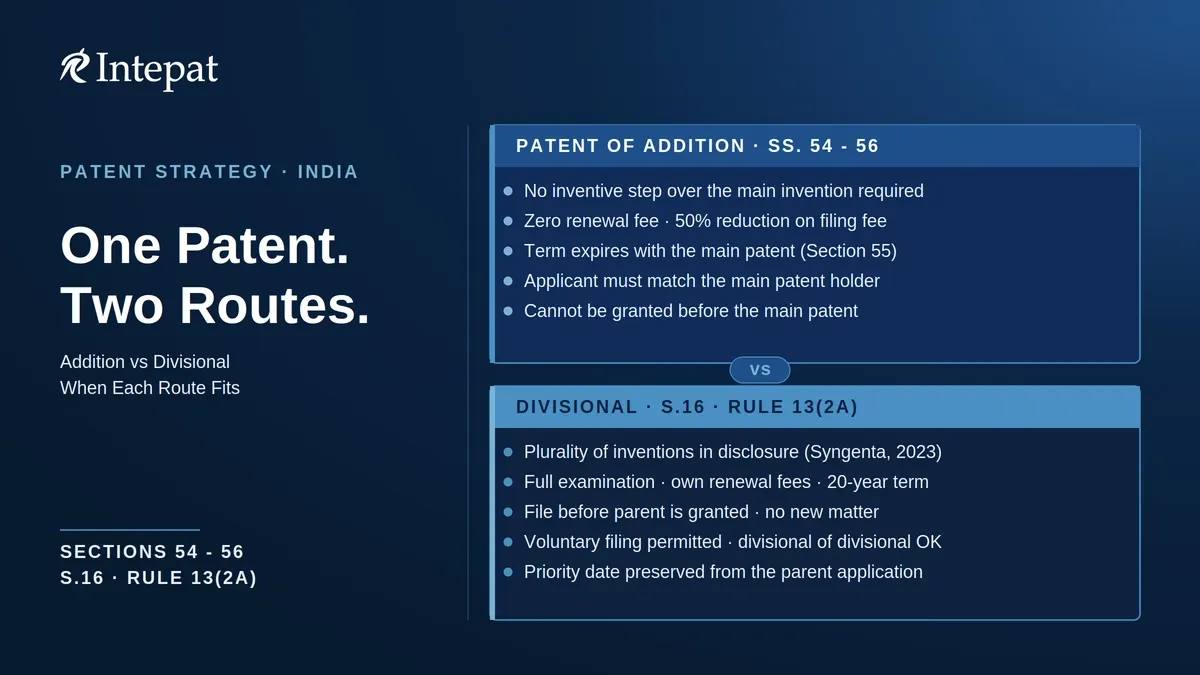
What a patent of addition is, and when it helps
A patent of addition lets you protect an improvement or modification of an invention you have already applied for, or already hold a patent on (Section 54). It is built for the common situation where, months or years into the process, you refine the original idea and the refinement is real but probably too small to clear the “inventive step” bar as a fresh, standalone patent.
The applicant for the addition must be the same as the applicant or patentee for the main invention. If the improvement would bring in a new co-owner, a patent of addition is not the right route. The improvement is filed as its own application that refers back to the main patent and states that it is an improvement or modification of it.
Two features make it attractive. First, it does not need to involve an inventive step over the main invention, so an incremental tweak that a normal patent examiner would reject for obviousness can still be protected. Second, no separate renewal fee is payable for as long as it stays a patent of addition (Section 55), so you are not maintaining two fee streams. The trade-off is timing: it cannot be granted before the main patent is granted, and it expires when the main patent expires, however many years are left.
A simple example shows the fit. You filed a patent for a device, and a year later you redesigned one component so it performs better. That redesign may be too obvious to stand as its own patent, but it can be protected as a patent of addition tied to the original filing. One caution: no renewal fee does not mean no cost. You still pay a filing fee to lodge the patent of addition application, so the saving is on the yearly renewals, not on the act of filing. That filing fee is itself reduced: a patent of addition application is eligible for a 50 percent reduction on the official application and specification fees compared with an ordinary application, though examination and later prosecution costs are charged at normal rates.
One point is often misunderstood. The relief from inventive step does not extend to novelty. The improvement must still be genuinely new; in checking that, the examiner is allowed to read it against the main invention’s own specification. So a patent of addition forgives obviousness over the parent, but not a lack of newness.
What a divisional application is, and when you can file one
A divisional application is used when one application carries more than one invention. Instead of forcing everything through a single filing, you “divide” it, carving out an invention into a further application that keeps the original filing date of the parent (Section 16). The classic trigger is a “unity of invention” objection, where the examiner says your claims cover more than one invention and asks you to split.
The two conditions that decide whether you can file are timing and plurality. On timing, a divisional must be filed before the parent is granted; once the parent is granted, the window closes. On plurality, there has to be more than one invention in the parent, and the further application cannot introduce any new matter that was not already disclosed in the parent. Each application must also claim different subject matter, a guardrail that stops a divisional from creating a double patenting problem.
For years it was unclear whether that “more than one invention” had to appear in the parent’s claims, or whether it was enough for it to be disclosed anywhere in the specification. The Delhi High Court settled this in Syngenta Ltd v Controller of Patents and Designs (October 2023): the plurality of inventions can be drawn from the disclosure in the provisional or complete specification and need not sit only in the parent’s claims. That decision moved past an earlier, stricter reading in the Boehringer Ingelheim case.
The 2024 rules then reinforced this position. Section 16 already let an applicant divide voluntarily, and from the Patents (Amendment) Rules 2024 (effective 15 March 2024) the rules now expressly permit one or more further applications, including for an invention disclosed in the provisional or complete specification, or based on an earlier divisional. So you no longer have to wait for an objection, and you can file a divisional of a divisional where the disclosure supports it.
A common example helps. Suppose one application claims both a new product and a separate method of making it, and the examiner treats those as two inventions. You file a divisional so the product stays in the parent and the method moves into the divisional, with each keeping the original filing date. The divisional is then prosecuted on its own, which means a separate request for examination and its own set of fees. That is the practical cost of the route: a divisional is a full second application to take through to grant, not a minor add-on.
Patent of addition vs divisional: the differences that decide it
The two routes answer different questions. A patent of addition answers: how do I protect an improvement to my earlier invention without paying a second stream of renewal fees. A divisional answers: I have more than one invention in a single filing, how do I protect each of them. The table below sets the differences side by side. The statutory references are there for your patent agent; you do not need them to make the decision.
| Question | Patent of addition | Divisional application |
| What triggers it | You improve or modify an invention you already filed or hold | One application covers more than one distinct invention |
| Governing provision | Sections 54 to 56 | Section 16 (with Rule 13(2A)) |
| Inventive step needed | No inventive step over the main invention is needed; the improvement must still be novel | Yes, each invention is judged on normal patentability standards |
| Must it be new | Yes, novelty is still tested against the main invention | Yes, on normal standards |
| Filing date | Same as or later than the main application | Same as the parent (priority date is preserved) |
| Renewal fees | None, while it remains a patent of addition | Its own renewal fees, like any application |
| Examination | Examined as a separate application, but it cannot be granted before the main patent | Needs its own request for examination, then full examination |
| Term | Ends when the main patent ends | Twenty years from the parent’s filing date |
| When you can file | Cannot be granted before the main patent is granted | Before the parent is granted |
There is also a useful escape hatch built into a patent of addition. If the main patent is later revoked, you can ask the Controller, the patent office’s deciding officer, to convert the patent of addition into an independent patent for the remaining term, after which normal renewal fees start to apply (Section 55). The reverse conversion also exists: an improvement you originally patented independently can, on request, be converted into a patent of addition to the main patent (Section 54).
Choosing between a patent of addition and a divisional
In practice the decision is rarely a free choice between two options; the facts usually point one way.
If you have a granted or pending patent and have since refined the same invention, a patent of addition is normally the better fit, especially when the refinement is incremental and you want to avoid the obviousness risk and the extra renewal cost of a fresh patent. It keeps your protection cheap to maintain and removes the inventive-step hurdle for the improvement. The cost is that it lives and dies with the main patent.
If your single application actually contains two or more distinct inventions, whether you spotted that yourself or the examiner raised it, a divisional is the route. Filing it preserves the parent’s priority date for the carved-out invention and lets each invention be prosecuted, granted, and enforced on its own. Because the divisional window shuts on grant of the parent, the practical advice is not to wait: if you know your filing covers more than one invention, consider filing the divisional before examination rather than risk the parent being granted first.
The two are not interchangeable, and you generally cannot convert one into the other after the fact. A divisional does not help you protect a later improvement, and a patent of addition does not help you separate inventions that were bundled into one filing. Where the situation is genuinely on the line, the safer step is to have a registered patent agent assess the claims and the specification before you commit, because the eligibility tests turn on exactly what was disclosed and claimed in the original filing.
A few missteps are worth avoiding. For a divisional, do not add subject matter beyond what the parent application disclosed. For a patent of addition the rule is different: its whole purpose is to cover new material, so the caution is not to use the route for an unrelated invention, because the new disclosure must remain an improvement or modification of the main invention. Do not assume the divisional window stays open, because once the parent is granted the chance to file is gone for good. And do not file a patent of addition with mismatched ownership; the applicant has to match the holder of the main invention. Each of these is a common reason an otherwise useful filing route becomes difficult.
| Talk it through first |
| Get a patent agent to check your claims before you choose a route or file. |
| Book a consultation |
Frequently asked questions
A patent of addition is usually cheaper to maintain because no separate renewal fee is payable for as long as it stays a patent of addition (Section 55). A divisional is a full separate application with its own filing and examination fees and its own renewal fees, so it costs more to prosecute and keep alive.
Yes. Under Rule 13(2A) of the Patents Rules, in force since 15 March 2024, an applicant can voluntarily file one or more divisional applications for an invention disclosed in the provisional or complete specification, or even based on an earlier divisional, provided the parent has not yet been granted.
No. A patent of addition cannot be refused or revoked only because the improvement lacks an inventive step over the main invention (Section 56). The improvement must still be new, however, and its novelty is tested against the main invention’s specification, so obviousness is forgiven but a lack of newness is not.
If the main patent is revoked, the patent of addition does not automatically fall away. The patentee can ask the Controller to make it an independent patent for the remaining term (Section 55). From that point, normal renewal fees become payable, as they would for any standalone patent.
Yes. A divisional application is treated as filed on the same date as the parent, so the priority date is preserved (Section 16). It cannot, however, contain any matter that was not already disclosed in the parent application, and neither application may claim what the other claims.
Yes. You can file a patent of addition once you have applied for, or already hold, the main patent, as long as the new filing is an improvement or modification of the main invention. It simply cannot be granted before the main patent itself is granted.
No. A divisional must be filed before the parent application is granted (Section 16). Once the parent is granted the window closes, so if your filing covers more than one invention, the safe practice is to file the divisional before examination concludes.
Yes. Since 15 March 2024, Rule 13(2A) allows a further application based on an earlier application filed under Section 16, so a divisional of a divisional is possible, provided the disclosure supports it and the relevant parent has not yet been granted.
This article is general information on Indian patent law, not legal advice. Whether a patent of addition or a divisional application is right for you depends on the specific claims and disclosure in your filing and on current Patent Office practice. For advice on your matter, consult a registered patent agent.