




Originally published 3 January 2020. Republished and updated 3 November 2026.
In the Bajaj Auto v TVS Motor patent case, the Madras High Court first stopped TVS from selling its Flame motorcycle. On an interim view, its Division Bench lifted that injunction in 2009, citing the TVS engine’s different design, a licensed patent and a pending revocation application. The Supreme Court ordered a fast trial; the companies settled in 2019.
The dispute concerned Indian Patent No. 195904. This page sets out what each court decided in the Bajaj vs TVS patent dispute, and what none of them decided.
Quick answer: None of the three orders finally decided infringement or validity. The Division Bench found the patent prima facie valid (on a first view, before trial) but said Bajaj had not made out a strong prima facie case of infringement. The companies settled on 31 October 2019, and their exchange filings say neither side must pay compensation or a penalty.
What the Bajaj Auto v TVS Motor Patent Case Was About
Bajaj Auto held Indian Patent No. 195904 for a four stroke engine that uses twin spark plugs to burn a lean air fuel mixture in a small bore. TVS launched its Flame 125 cc motorcycle in December 2007, and the parties disputed whether the Flame engine fell within the Bajaj patent. TVS said its engine rested on a different technology.
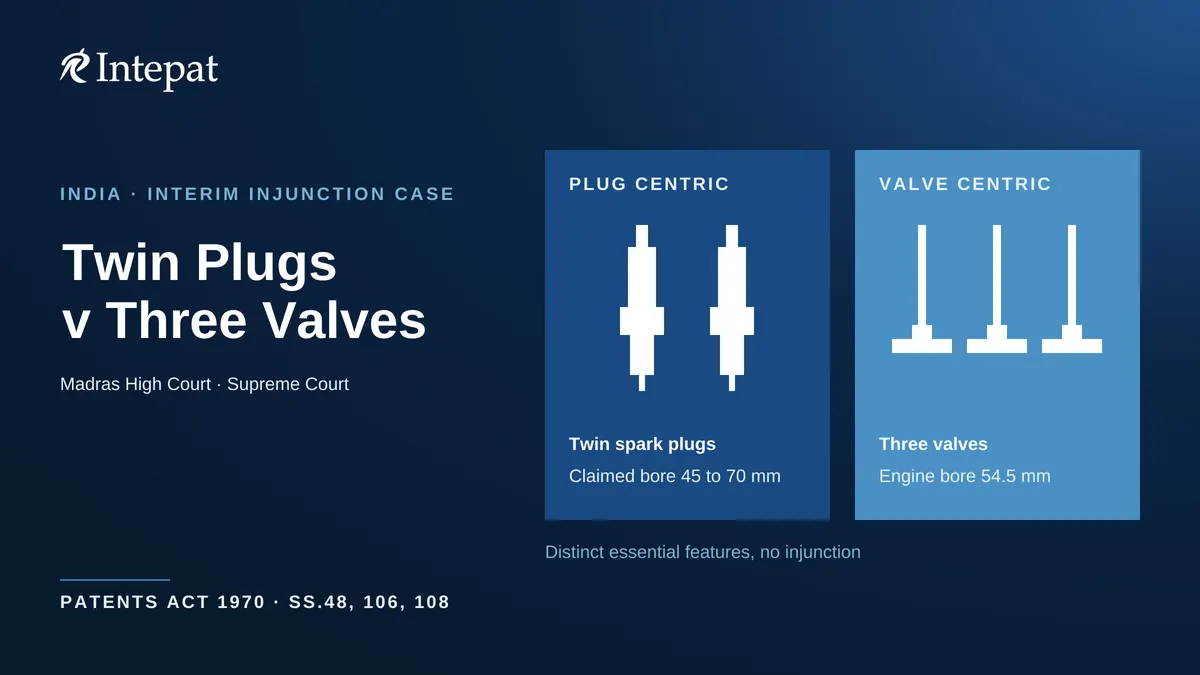
Bajaj described its twin spark plug patent as covering engines with a bore (cylinder diameter) of 45 mm to 70 mm, and said the Flame engine has a bore of 54.5 mm. TVS described the Flame engine as using two spark plugs and three valves. TVS brought C.S. No. 979 of 2007 in October 2007 over what it called groundless threats, citing statements it said Bajaj made on 1 and 3 September 2007. After the December launch, Bajaj brought C.S. No. 1111 of 2007 in the Madras High Court for patent infringement.
The judgments record the application date as 16 July 2002 (a provisional specification, with the complete specification following in 2003). A patent lasts twenty years from the date of filing, unless it lapses earlier for unpaid renewal fees, so counting from that date this one would have expired by July 2022 at the latest.
Key Dates in the Dispute
The dispute ran from 2007 to 2019 across the Madras High Court, the Supreme Court, the Intellectual Property Appellate Board and other forums. The table gives selected key dates. The orders themselves record what each court decided.
| Date | Forum | What happened |
| 16 July 2002 | Patent Office | Date from which the courts counted Patent No. 195904 (provisional specification; priority date) |
| 7 July 2005 | Patent Office | Patent No. 195904 sealed (granted) |
| 1 and 3 September 2007 | Between the parties | Threats of infringement action, as alleged by TVS |
| October 2007 | Madras High Court | TVS files C.S. No. 979 of 2007 over alleged groundless threats |
| December 2007 | Market | TVS launches the Flame 125 cc motorcycle |
| 16 February 2008 | Madras High Court, Single Judge | Injunction granted to Bajaj; TVS application dismissed |
| 18 May 2009 | Madras High Court, Division Bench | TVS appeals allowed; injunction set aside; TVS application allowed |
| 16 September 2009 | Supreme Court | Trial ordered to finish by 30 November 2009; sales accounts to a Receiver (a court-appointed officer) |
| 31 October 2019 | Out of court | Settlement; parties agree to withdraw pending proceedings |
TVS had also applied to the Appellate Board to revoke the patent. That application was still pending when the Division Bench heard the appeals, and the Division Bench relied on the fact.
Why the Single Judge Granted the Injunction
On 16 February 2008, Justice P. Jyothimani, sitting alone as the Single Judge, granted Bajaj an interim injunction (an order made before trial) and dismissed the TVS application. He found a prima facie case of novelty and treated Bajaj’s marketing of its product as showing that the invention worked. He left the question of obviousness for a full trial.
The order says the test of obviousness, which forms part of inventive step must be decided in a full-fledged trial. The judge recorded that Bajaj had marketed its product on a large scale without objection for about five years, and treated that as showing, on the face of it, that the invention is enabled (works as described). Patent rights themselves come from the grant, not from marketing. He held that the prima facie case, the balance of convenience (which side the order hurts more) and the inadequacy of damages all leaned towards Bajaj.
Why the Division Bench Set the Injunction Aside
On 18 May 2009 the Division Bench, two judges sitting on appeal, allowed the TVS appeals. It accepted that the Bajaj patent was prima facie valid, yet held that Bajaj had not made out a strong prima facie case of infringement.
The court also allowed the TVS application in the threats suit (paragraph 86). The judges were S.J. Mukhopadhaya and F.M. Ibrahim Kalifulla.
The decision rested on three main prima facie grounds, plus a related finding on essential features. First, the court treated the TVS engine as valve centric (its combustion turns on the three valve arrangement) and the Bajaj invention as plug centric (it turns on twin spark plugs), and approved the TVS stand that the third valve is not merely cosmetic. Second, TVS held a registered licence under Indian Patent No. 196636, owned by AVL List GmbH, for a three valve engine; the court treated that patent as prima facie valid too and said it supported the TVS product. Third, with a TVS application to revoke the Bajaj patent pending on prior art and obviousness, the court held that on the special facts an injunction could not be sustained. The court also found that the novel feature claimed by each side differs, and said that where the essential features are distinct there is no scope for an injunction.
The court’s assessment was provisional and case-specific. As a matter of general patent law (our commentary, not a holding), a separate patent or licence does not itself establish freedom to operate against another patent, because a patent gives a right to exclude others, not a right to practise.
On prior art, TVS pleaded US Patent No. 4534322, published in 1985, which it said Bajaj mentioned only after an International Search Report of 13 August 2004 and described as relating to a large bore. The court said the TVS allegation that Bajaj secured its patent through a deceptive statement about that bore size could not be rejected as baseless, and that the point needed detailed consideration. That was an allegation and a judicial concern at the interim stage, not a finding of fraud.
The Division Bench did not decide validity finally. It left the parties to work out validity in the patent revocation proceedings and at trial, where the Act’s revocation and defence provisions apply independently.
What the Supreme Court Ordered
On 16 September 2009 the Supreme Court did not decide who was right. It directed final disposal of the infringement suit (C.S. No. 1111 of 2007) by 30 November 2009, and allowed TVS to keep selling the Flame while accounting for every sale to a court-appointed Receiver.
Justices Markandey Katju and Asok Kumar Ganguly noted that the suit had been filed in December 2007 and that no written statement had yet been filed. TVS was directed to file its written statement, if not already filed, before the Madras High Court’s Dussehra closure, and the Single Judge was asked to start hearing on reopening and continue day to day, with no adjournments in the ordinary course. TVS had to keep accurate records of its all India and export sales and give them, signed by a responsible officer, to a Receiver nominated by the Chief Justice every fortnight, with a copy to Bajaj; the arrangement was to continue while the suit remained pending.
The Court made no observation on the merits and told the trial judge to decide the suit without being influenced by its own order, the Division Bench order or the Single Judge order. It also repeated that patent, trade mark and copyright suits should normally reach final judgment within four months of filing, and directed all courts to follow that. The order therefore concerns how such suits are managed, not the scope of Patent No. 195904.
How the Dispute Ended and What It Teaches
The companies settled on 31 October 2019. According to Bajaj Auto’s exchange filing, they agreed to withdraw the pending proceedings before the Madras and Bombay High Courts, the Intellectual Property Appellate Board at Chennai, and courts in Sri Lanka and Mexico, and to release each other from claims in respect of those proceedings.
TVS’s own stock exchange disclosure is to the same effect. The filing states that neither side is required to pay any compensation or penalty to the other under the settlement. It records an agreement to withdraw, not proof that every court had already passed a withdrawal order. The sources reviewed for this page include no final judgment on whether Patent No. 195904 was valid or infringed. The Appellate Board has since been abolished by the Tribunals Reforms Act, 2021 (deemed in force from 4 April 2021), and a revocation petition is now heard by the High Court.
Four practical points follow:
- The Division Bench compared the essential features of the two engines, not their appearance. As general commentary, validity and infringement need separate analysis, and infringement turns on the claims of the patent rather than on whether a product looks or is built differently.
- The Division Bench treated the AVL licence as relevant at the interim stage in this case; that is not a general rule. Holding or licensing another patent does not by itself establish freedom to operate.
- The Division Bench gave weight to the revocation application because it rested on specific prior art and obviousness grounds that it considered formidable. The order does not say what a bare application would achieve.
- Patentability analysis and freedom to operate analysis answer different questions. Before launch, identify relevant in-force patent claims and assess the proposed product against those claims.
Frequently Asked Questions
No. The Single Judge granted an interim injunction on a prima facie view, and the Division Bench set it aside in 2009 on a prima facie view that the TVS engine differed from the claimed invention. The Supreme Court made no observation on the merits, and in 2019 the parties agreed to withdraw the proceedings.
No. The Division Bench described the patent as prima facie valid. It noted that the TVS prior art and obviousness grounds needed detailed examination in the revocation application and at trial. The sources reviewed for this page contain no order revoking Patent No. 195904 and do not show how the revocation petition ended.
In this case the Single Judge granted an injunction while a revocation petition was pending, but the Division Bench reversed. It held that, on the special facts, a pending application resting on prior art, obviousness and other formidable grounds made an injunction unsustainable. Whether an injunction issues depends on the strength of the challenge and the facts of each case.
No. Counting from 16 July 2002, the date the courts used, the patent’s maximum twenty year term ended by July 2022. The Patent Office register may show that the patent ceased earlier, but the outer limit alone means no term can remain today.
A product launch requires an assessment of the proposed product against relevant in-force patent claims. Technical differences and licences under other patents must be evaluated in that analysis; neither provides automatic clearance.
The Intepat IP patents team carries out freedom to operate searches that test a planned product against the claims of Indian patents before launch.
This article explains the law on the Bajaj Auto v TVS Motor patent case in India as at November 2026 and is for general information only. It is not legal advice. For advice on your specific invention, consult a registered patent agent. This analysis is based on the full text of the decisions cited; it is a summary for general information and not a substitute for reading the order in your own matter.
Sources
- The Patents Act, 1970, as amended to August 2024 (IP India), and The Tribunals Reforms Act, 2021, IP India.
- Bajaj Auto Ltd v TVS Motor Co Ltd, O.A. Nos. 1357 and 1272 of 2007, Madras High Court, 16 February 2008.
- TVS Motor Co Ltd v Bajaj Auto Ltd, O.S.A. Nos. 91 and 92 of 2008, Madras High Court, 18 May 2009.
- Bajaj Auto Ltd v TVS Motor Co Ltd, Civil Appeal Nos. 6309 and 6310 of 2009, (2009) 9 SCC 797, Supreme Court, 16 September 2009.
- Settlement disclosures of 31 October 2019: Bajaj Auto Limited, exchange filing and press release (NSE), and TVS Motor Company Limited, Regulation 30 disclosure.