




Initially Published in 2019; Updated in August 2026
A freedom to operate (FTO) search checks whether existing patent rights could affect your ability to launch a product in a particular market. It is a pre-launch clearance exercise, not a test of whether your own invention is patentable.
Skipping an FTO search does not remove the risk. It only increases the chance of discovering a blocking patent after money has already been committed to development, tooling, marketing, or launch.
FTO is also territorial. The relevant question is not limited to where you plan to sell the product. Patent rights may matter in every country where you intend to make, use, offer for sale, sell, or import it.
For example, an Indian patent does not create patent rights in the United States, and a US patent does not create rights in India. A company expanding into a new country therefore needs an FTO analysis for that territory. There is no single worldwide FTO clearance.
Quick answer: An FTO search checks your product against granted, in-force patent claims and also identifies relevant published pending applications that could create future risk. It should be carried out in each country where you plan to manufacture, use, sell, offer for sale, or import the product.
Ideally, the search should be completed before major commercial commitments are made. Once the relevant patents and applications have been identified, an FTO opinion can assess the actual infringement risk and help decide whether to proceed, redesign the product, seek a licence, or consider other options.
What a Freedom to Operate Search Actually Checks
A freedom to operate search compares the features of your product or process against patent claims held by others in each country where you plan to operate. The core question is simple: could an existing patent create a legal barrier to launching this product in this market?
The search focuses on granted, in-force patents that may be enforceable against the proposed product. Relevant published pending applications are also reviewed, but they are treated differently. They are not an immediate enforcement risk before grant, but they may become important later if they proceed to grant with claims that cover the product.
This is why WIPO’s freedom to operate toolkit recommends considering both granted patents and published pending applications.
An FTO search is also very different from a patentability search. A patentability search asks whether your invention is new and inventive enough to be patented. An FTO search asks whether someone else’s patent rights could affect your ability to commercialise the product.
The distinction matters because owning a patent does not automatically give you freedom to operate. A company may obtain a patent on an improvement and still infringe an earlier, broader patent owned by someone else when it makes or sells the product.
A related but narrower exercise is an invalidity search. This focuses on one particular patent and looks for prior art or other evidence that may be used to challenge its validity. It may become relevant if an FTO search identifies a potentially blocking patent, or if that patent is already being asserted in a dispute.
Patentability, FTO, and invalidity searches therefore answer different questions. Choosing the right one depends on the commercial decision you are trying to make.
Why It Has to Happen Before Launch, Not After
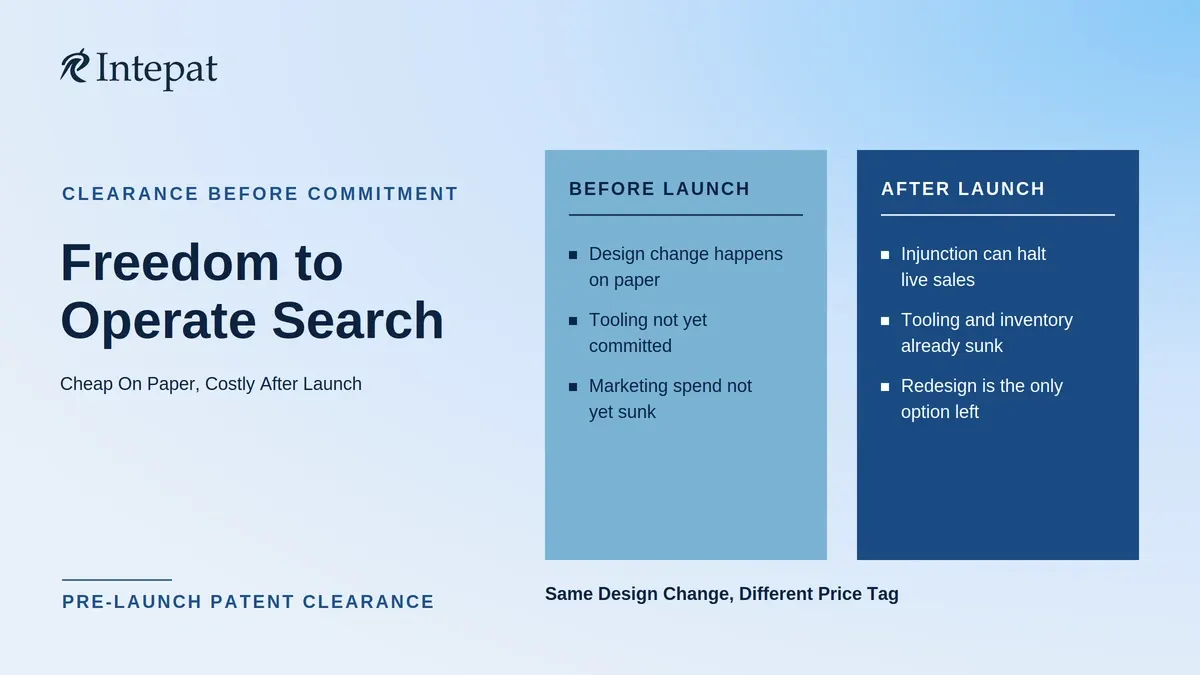
The value of a freedom to operate search depends heavily on timing. If it is done before tooling, manufacturing commitments, or major marketing spend, the result can still influence what you build, how you build it, or where you launch it. If it is done after launch, many of those decisions have already become expensive to change.
The features of the product, the manufacturing process, and the components used are exactly the kinds of details an FTO search examines. If a potentially blocking patent is identified early, the product may be redesigned before significant costs are incurred. In many cases, the cheapest design-around is the one made while the product is still on the drawing board.
There is another timing issue built into the patent system itself. Patent applications are generally not published immediately after filing. This means an FTO search carried out today may not reveal a recently filed application that has not yet become public.
That is an unavoidable limitation of any search based on public patent databases. A later-granted patent may therefore emerge from an application that could not have been identified when the earlier search was conducted. The legal effect of such a patent on activities that took place before grant can vary by jurisdiction, which is addressed separately in the jurisdiction-specific guidance.
Starting the search early does not remove this blind spot, but waiting until the last minute creates an additional risk that could have been avoided.
This is also why FTO should not always be treated as a one-time exercise. The product that reaches the market may be materially different from the first prototype. Features may be added, removed, or redesigned, and those changes can affect the patent analysis.
An FTO search carried out against an early version of the product does not automatically clear the final version. If the design has changed materially, the earlier search may need to be updated or, in some cases, repeated. The right approach depends on how much the product has changed and whether those changes affect the features that were compared against the relevant patent claims.
What Skipping It Can Cost You
Skipping an FTO search does not remove the patent risk. It only means you may discover the problem after launch, when the available options are fewer and more expensive.
If a patent holder succeeds in an infringement action, the consequences can go beyond paying damages. The court may also grant an injunction that stops further manufacture, sale, or other infringing activity.
That matters because the cost of changing course rises sharply after launch. By then, tooling may be complete, inventory produced, distributors appointed, listings created, and marketing budgets already spent. A design-around identified before launch may require only a change to the product plan. The same change after launch can disrupt an operating business.
The risk also has to be considered separately for each country. Clearance in India does not automatically clear the same product in the United States, Europe, or another market. A company expanding internationally therefore cannot assume that an earlier FTO search continues to protect it when entering a new territory.
An FTO search also does not mean assuming that every patent found is a problem. The initial search may identify a shortlist of patents and published applications for closer review. Some may fall away once the claims, legal status, and actual product features are analysed in detail.
The purpose of doing the search before launch is simply to know where you stand while changes are still relatively easy and inexpensive to make.
What You Get From an FTO Opinion
A freedom to operate search identifies patents and published applications that may be relevant to your product. An FTO opinion goes further. It analyses the actual patent claims and assesses whether they are likely to cover the product as designed.
That distinction is important because a list of potentially relevant patents does not, by itself, tell a business what to do next. An FTO opinion separates the results into practical categories: patents that appear to present a meaningful risk, patents that can likely be ruled out after claim-level analysis, and cases where the position remains uncertain and may require a design change, further investigation, or monitoring.
This makes the opinion much more useful for commercial decision-making. A board, investor, manufacturing partner, or product team can act on a reasoned conclusion in a way they cannot act on a list of search results alone.
A simple example shows the difference. Suppose an FTO search for a connected device identifies three patents describing a similar sensor arrangement.
The first patent requires a particular wiring configuration that your device does not use, so its claims may not cover your product. The second contains broader claims that appear to cover the sensor arrangement as designed, creating a more serious risk. The third is still a pending application, and its claims may change before grant, so it may need to be monitored rather than treated as a present enforcement risk.
The search identifies all three documents. The FTO opinion explains what each one actually means for the product and the launch decision.
What You Can Do Once You Have One
An FTO opinion does not simply give a “go” or “no-go” answer. It helps you decide what to do about each patent identified as relevant.
The usual options are:
- Proceed as planned. The opinion finds that the relevant claims do not cover the product as designed, so no change is needed.
- Design around. A particular claim feature creates the risk, and the product can be modified so that it falls outside the claim scope.
- Take a licence. The claims appear to cover the product, and redesigning it is not commercially practical, so a licence may be the better option.
- Delay or redirect the launch. The patent risk is significant and neither a design-around nor a licence is workable on acceptable terms. The business may then delay the launch or focus on a market where the patent does not apply.
The right response depends on the wording of the claims, how closely they match the product, how important the affected feature is, and whether licensing is commercially realistic.
The options are also not mutually exclusive. A single product may require different responses to different patents. A company might design around one patent, take a licence under another, and proceed without changes in relation to a third.
That is the practical value of an FTO opinion: it turns patent search results into a clear set of commercial choices.
Taking a Product Outside India
Freedom to operate is a country-specific exercise. The basic question stays the same wherever you launch, but the patent rights, remedies, defences, and timing rules differ from one jurisdiction to another. For a detailed comparison, see our guide to freedom to operate searches and FTO opinions in India, the US and Europe.
For Indian companies expanding overseas, one of the easiest mistakes is to assume that a product cleared in India is also clear for export. It is not.
A product may be sold without difficulty in India and still face a blocking patent in the United States, Europe, or another target market. Patent rights are territorial, so clearance in one country does not travel with the product.
The practical rule is simple: treat every new country as a new launch from an FTO perspective. This applies whether the business is an Indian multinational entering a new market, a startup accepting its first export order, or an MSME supplying an overseas distributor.
It is also important to separate FTO from your own international patent strategy. A PCT or foreign filing strategy helps protect your invention in other countries. It does not tell you whether someone else’s patent in those countries could block your product. Patent protection and freedom to operate are separate exercises, and both may form part of an international launch strategy.
FTO can also become important during fundraising, investment, licensing, or distribution discussions. As part of IP due diligence, an investor or commercial partner may ask what patent clearance has been carried out for the target markets. Having a completed FTO analysis makes that question much easier to answer than trying to reconstruct the position under transaction pressure.
For the earlier-stage question of what a startup should review before filing its own patent, see our separate guide on what startups should know before filing a patent.
Frequently Asked Questions
Yes. Patent rights are territorial, so clearance is assessed for the territory or region each patent has effect in, which can be a group of states in one instrument (a European unitary patent, for example) rather than a single country. A clearance result for India tells you nothing about the United States or Europe, so expanding into a new market needs a fresh search.
A patentability search asks whether your invention is new enough to be granted a patent of its own. A freedom to operate search asks whether selling your product would infringe someone else’s existing patent. You can hold a valid patent on your product and still infringe a different patent by selling it; the two questions use different document sets and different tests.
Before tooling, manufacturing commitments, and marketing spend are locked in, ideally once the product design is stable enough to compare against patent claims feature by feature. Running it earlier keeps a design-around cheap; running it after launch limits you to remedies rather than choices.
The search produces a list of potentially relevant patents. The opinion assesses whether each one’s claims, as written, actually cover your product, and states what that means for your launch: proceed, design around, license, or hold. It is the document a decision gets made from.
The specific claim language and how central the affected feature is to your product determine the options. A narrow claim element is often designed around without touching the rest of the product. A broad claim covering a core feature may call for a licence, a delay, or redirecting the launch to a market the patent does not reach.
No. A clearance result is specific to the country it was run for, because patents themselves only have effect within their granting country. A product cleared for India can still infringe a granted patent in the United States or Europe, so each new country of sale needs its own freedom to operate search, not a carry-over of an earlier result.
This article explains the position on freedom to operate searches as at August 2026 and is for general information only. It is not legal advice. Patent law and remedies vary by country and change over time; for country-specific detail see our full guide to freedom to operate in India, the US and Europe. For advice on your specific product and target markets, consult a registered patent agent.