




A passing off action is a civil court remedy that lets a business stop another party from using a confusingly similar domain name that trades on its goodwill. Indian courts treat a domain name as a business identifier, so the owner can sue even when the mark behind it is unregistered, by proving goodwill, misrepresentation and damage.
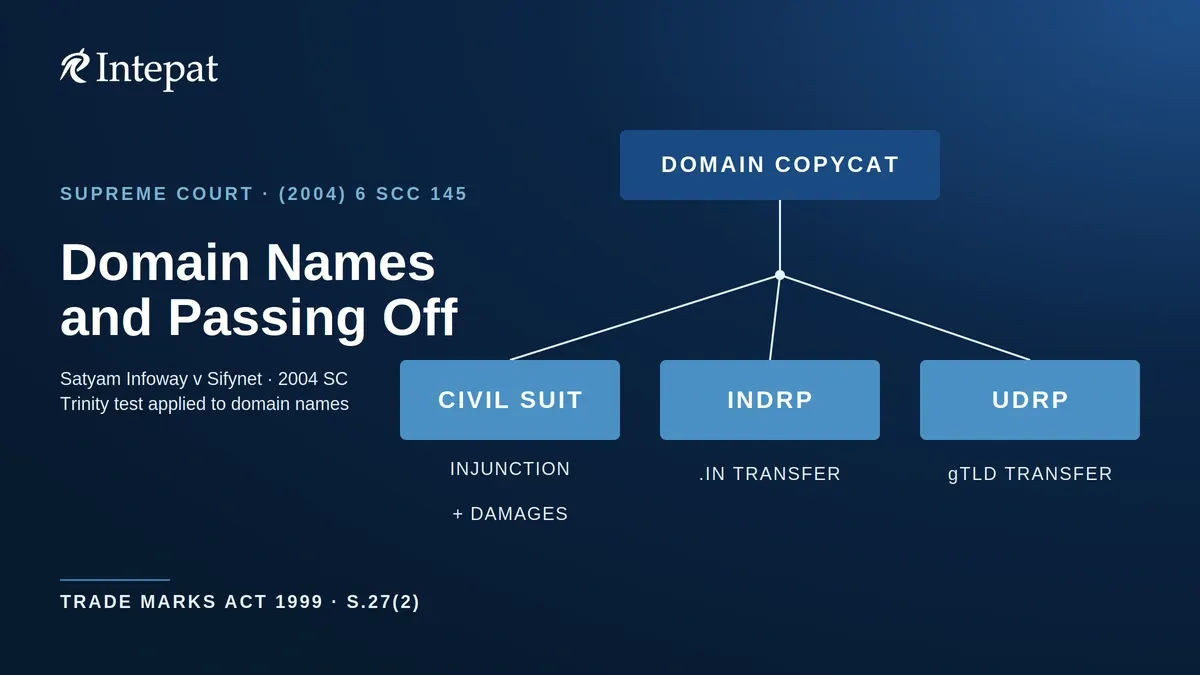
This guide focuses on the civil court route in India. The two complaint processes that take the domain back directly, INDRP (for .in names) and the UDRP (for .com and other global names), are covered in our separate guides.
| What you need to know first |
| You do not need a registered trademark. Section 27(2) of the Trade Marks Act 1999 keeps the right to sue in passing off intact for an unregistered mark. |
| You must prove three things: goodwill or reputation in India, misrepresentation that is likely to confuse, and damage (or its likelihood). |
| The court can grant an injunction and, at your option, either damages or an account of profits (the money the rival made by infringing, paid over to you), plus delivery-up of the infringing material (an order to hand it over to be destroyed) under Section 135. |
| You file in a District Court or High Court. The convenient “sue where you reside” rule in Section 134(2) is not available for a pure passing-off claim, so ordinary jurisdiction rules apply. |
A descriptive or dictionary-word domain (a common word for the service) is hard to protect unless you can prove it has acquired a secondary meaning.
What a Passing Off Action for Domain Names Protects
Suppose your business trades as brandname.in and a stranger registers brandnameindia.com to catch your customers. Even with no trademark registration, you may have a passing off claim if Indian users associate that name with you. That is the gap this action fills.
Passing off is a common-law wrong: misrepresenting your goods or services as someone else’s. It protects the goodwill attached to a name, not a piece of paper. That is why a business with no trademark registration can still act. The Trade Marks Act expressly keeps this right intact for unregistered marks (Section 27(2)).
A domain name began life as a technical address, but it now also identifies a business. The Supreme Court recognised this in Satyam Infoway Ltd v Sifynet Solutions (P) Ltd (2004), holding that a domain name can carry all the features of a trademark and can be the basis of a passing-off claim. The Court read the definitions of “trade mark”, “mark” and “service” in the Act and concluded that a domain name distinguishes and identifies a business to internet users, not merely its location on the network.
Two points follow. First, the domain is protected because of the goodwill behind it, so an unregistered name with reputation in India can be sued over. Second, registering the mark still helps: it opens a second route to sue (for trademark infringement) and is strong evidence of your rights. Our note on the relationship between trademarks and domain names sets out how the two interact.
The Three Things You Must Prove
Indian courts apply the classical three-element test for passing off, the same test the Supreme Court applied to the domain dispute in Satyam Infoway. Older textbooks list five elements, but in practice the case turns on these three, and the table below shows what each one means for a domain dispute.
| Element | What it means | What you show for a domain |
| Goodwill or reputation | The public associates the name with you | Prior use in India, traffic and users, press coverage, advertising spend, sales |
| Misrepresentation | The rival use is likely to deceive or confuse | The rival domain is identical or deceptively similar and likely to be taken as yours or connected to you |
| Damage | Injury to your goodwill, actual or likely | Diverted traffic, lost control of reputation, or dilution; likely damage can be enough |
The make-or-break element is usually goodwill. A coined or distinctive name (the kind that means nothing until you give it meaning) is far easier to protect than a name that simply describes the service. Where your reputation is cross-border, the principles around well-known trademarks can support a claim even without local registration, provided the reputation reaches Indian consumers.
Evidence That Proves Goodwill in India
Goodwill is proved with a record, not assertion. Gather, and date, as much of the following as applies:
- date of first use of the name and the domain;
- invoices, customer records and sales figures for India;
- website traffic from India, with analytics or search-console data;
- advertising spend and social-media reach;
- screenshots of your site and the rival site, placed side by side;
- WHOIS or registrar details for the disputed domain;
- emails, reviews or complaints showing actual confusion;
- press coverage, awards or industry recognition;
- any trademark applications or registrations you already hold.
How Indian Courts Apply Passing Off to Domain Names
Indian courts moved early here, well before any statute addressed domains. The first reported dispute, Yahoo! Inc v Akash Arora (1999), was decided by the Delhi High Court under the predecessor Trade and Merchandise Marks Act 1958. Running “yahooindia.com” against “yahoo.com”, the Court granted an interim injunction: a domain name deserves the same protection against passing off as a trademark, and adding “India” did not distinguish a deceptively similar name.
The Bombay High Court followed in Rediff Communication Ltd v Cyberbooth (2000), where “radiff.com” shadowed Rediff’s “rediff.com”. The Court restrained the defendant and said that a domain name carries real commercial value as a corporate asset, so an imitation that invites confusion can be sued over.
Satyam Infoway settled the law on this in 2004. The Supreme Court found Satyam’s coined word “Sify” had acquired goodwill through prior use, that Sifynet’s “Siffynet” was visually and phonetically similar, and that the parties’ somewhat different lines of business did not defeat the likelihood of confusion. It restored the injunction in Satyam’s favour. As a Supreme Court ruling, it remains the leading judgment for domain-name passing off in India.
These cases share a pattern: a distinctive name, prior use that built goodwill, and a later domain close enough to confuse. That is the typical pattern behind cybersquatting, where a name similar to an established brand is registered to trade on its reputation.
Where Passing Off Falls Short: Descriptive and Generic Domains
Passing off is not a monopoly over a word. If the name simply describes the service in ordinary language, exclusivity is difficult, because competitors are entitled to describe their own services too.
The Bombay High Court drew this line in People Interactive (India) Pvt Ltd v Vivek Pahwa (2016), on a motion for an interim injunction in the dispute between “shaadi.com” and “secondshaadi.com”. “Shaadi” is the Hindi word for marriage, so it is descriptive of a matrimonial service. The Court held that to claim exclusive rights in such a word, the owner must show that the public now hears it as the owner’s brand first and the dictionary sense second. At the interim stage Shaadi.com had not established that, so the Court declined to restrain “secondshaadi.com” while the suit proceeds.
The practical lesson: assess the name honestly before relying on passing off. A coined name travels well; a descriptive one needs years of investment and proof before a court will fence it off.
Practitioner note The honest-adoption defence in Section 135(3) can relieve a defendant of damages or an account of profits, but only where every condition is met: that it did not know, and had no reasonable ground to believe, your mark was in use when it began, and that it stopped as soon as it learned of your mark. It does not bar an injunction. Gather and date your evidence of reputation early; the strength of that record often decides interim relief (an early order from the court, before the full trial).
Remedies You Can Ask the Court For
Section 135 lists what the court can order in a passing-off suit. The judge can grant an injunction and, at your option, either damages or an account of profits, with or without delivery-up of the infringing material.
In a domain dispute the injunction is the heart of the remedy. Courts routinely grant interim orders, and even ex parte ones (made without first hearing the other side). Section 135 also allows interlocutory orders (orders during the case) for discovery (forcing disclosure of documents), preservation of evidence, and freezing the rival’s assets. These often protect the brand while the suit runs.
Recovering the domain name itself is a separate question. Section 135 covers delivery-up of infringing material; it does not, in so many words, cover transfer of a domain registration. That specific outcome, transfer or cancellation, is what the INDRP and UDRP policies deliver. Courts have also directed parties and registrars to give effect to their orders. For the wider list of remedies that also applies to trademark infringement, see our note on remedies for trademark infringement.
Where to File, and When a Domain Dispute Policy Is Faster
A passing-off suit over a domain is filed in at least a District Court (Section 134(1)(c)), which in practice means a District Court or, in the metros, the commercial division of a High Court. One catch: the rule in Section 134(2) that lets a plaintiff sue where it resides or carries on business applies only to suits about a registered mark (its infringement, or a right in it), not to a pure passing-off claim. For passing off, the ordinary rules apply: you sue where the defendant is, or where the harm happened. If a registered-mark infringement claim is also set out properly in the same suit, the Section 134(2) benefit can attach to that claim, although the passing-off claim still rests on the ordinary rules.
Whether you call it passing off, cybersquatting or a domain dispute, the practical question is the outcome you need. A civil court is the better route when you need an injunction, damages, disclosure or restraint reaching beyond the domain. A domain-dispute policy is cleaner, and often faster, when your only goal is to take the name back, though a UDRP or INDRP panel can only transfer or cancel the domain, not award damages.
| Your situation | Better first route | Who decides |
| You only need the domain transferred or cancelled | INDRP or UDRP complaint | Arbitrator (NIXI) or panel (an ICANN provider such as WIPO) |
| You need urgent restraint on the rival’s use | Passing-off suit with an interim injunction | Civil court (District Court or High Court) |
| You want damages or an account of profits | Passing-off suit | Civil court |
| The domain is .in or .भारत | INDRP complaint | Arbitrator appointed by NIXI |
| The domain is .com, .net, .org or another gTLD | UDRP complaint | Panel under an ICANN-approved provider |
| The rival is also copying your site content, branding, ads or emails | Passing-off suit, possibly with intermediary or takedown directions | Civil court |
The two policies do not replace the court route; you can still sue in passing off afterwards if you need an injunction or damages. A policy complaint turns on three things: that the domain is identical or confusingly similar to a name or mark in which you have rights, that the registrant has no legitimate interest in it, and that it was registered or used in bad faith. One difference matters in practice: the UDRP requires bad faith in both the registration and the use, while the INDRP applies if there is bad faith in either the registration or the use. The UDRP process is explained in our guide to the UDRP and WIPO’s role in domain name disputes.
What to Do If Someone Registers a Domain Like Yours
If a copycat domain appears, the order of work is consistent across cases.
- Assemble proof of goodwill: dates of first use, traffic and user numbers, press, advertising and sales for India. This record is what convinces a court to grant an early injunction.
- Check the name’s strength. A coined or distinctive name is straightforward; a descriptive one needs evidence of secondary meaning before you rely on passing off.
- Send a cease-and-desist notice, recording the date the other side became aware of your rights, which affects whether you can recover damages later under Section 135(3).
- Choose the route. For a .in or global domain where you only need the name back, a policy complaint (INDRP or UDRP) is often quicker. Where you need a court order that does more than transfer the domain, file a passing-off suit and seek an early injunction.
- Secure the trademark behind the brand. Registration adds a second way to sue (for trademark infringement) and strengthens every future dispute.
Frequently Asked Questions
No. Passing off is a civil action based on common law, kept intact by Section 27(2) of the Trade Marks Act 1999. The same conduct can also lead to criminal charges under Sections 103 and 104 where it amounts to falsifying or falsely applying a trade mark, but that is a separate offence, not a remedy for passing off.
No. Section 27(2) of the Trade Marks Act 1999 keeps the right to sue in passing off intact for an unregistered mark. You succeed by proving goodwill, misrepresentation and damage, not by producing a registration. Registration is still valuable: it opens a second route to sue, for trademark infringement.
A court can restrain the rival from using the domain and can direct steps to give effect to its order. The specific transfer or cancellation of the registration is the defined outcome of the INDRP and UDRP policies. Many brand owners use a policy complaint to recover the name and a court suit for the injunction or damages.
A passing-off action is a civil court remedy giving injunctions, damages or an account of profits under Indian law. A UDRP or INDRP complaint is an administrative process whose only outcomes are transfer or cancellation of the domain. The court route is broader and slower; the policy route is narrower and often faster.
Only with difficulty. Passing off can only protect a descriptive word if it has acquired a secondary meaning, so the public hears it as your brand first. In People Interactive v Vivek Pahwa, the Bombay High Court declined an interim order against secondshaadi.com, finding “shaadi” descriptive and proof of secondary meaning insufficient at that stage.
In at least a District Court (Section 134(1)(c)), which usually means a District Court or a High Court commercial division. Note that the “sue where the plaintiff resides” convenience in Section 134(2) applies to registered-mark infringement, not to a pure passing-off claim, so ordinary jurisdiction rules apply.
This article is for general information on Indian law and reflects the position as of June 2026. Case law on domain names and passing off is fact-specific, and the right forum, evidence and route depend on your circumstances. It is not legal advice. For advice on a specific dispute, consult a qualified trademark attorney. Statutory text is available from the official source, the Trade Marks Act 1999 on India Code.