




The 2024 patent filing figures are now published. Innovators filed a record 3.7 million patent applications worldwide, filings by Indian applicants grew 19.1%, and digital communication overtook computer technology as the largest field in international filings under the Patent Cooperation Treaty (PCT). This guide sets out the patent trends 2024 data shows and what each means for a filing programme.
The figures come from the World Intellectual Property Organization (WIPO), which publishes calendar-year data in the year after the year closes. The legal points that follow each trend are stated under Indian law: the Patents Act 1970, the Patents Rules 2003 as amended in March 2024, and the Patent Office’s 2025 guidelines for computer-related inventions. Figures are verified as of October 2026.
Quick answer: In 2024, worldwide patent filings reached a record 3.7 million (up 4.9%), filings by Indian applicants grew 19.1% for a sixth straight double-digit year, digital communication became the largest PCT field, and pharmaceutical and semiconductor PCT filings fell. Earlier WIPO series show generative AI inventions growing through 2023, with India fastest among the top five, and energy-related applications up 3.2% in 2023. India also cut the examination-request deadline from 48 to 31 months for applications filed on or after 15 March 2024.
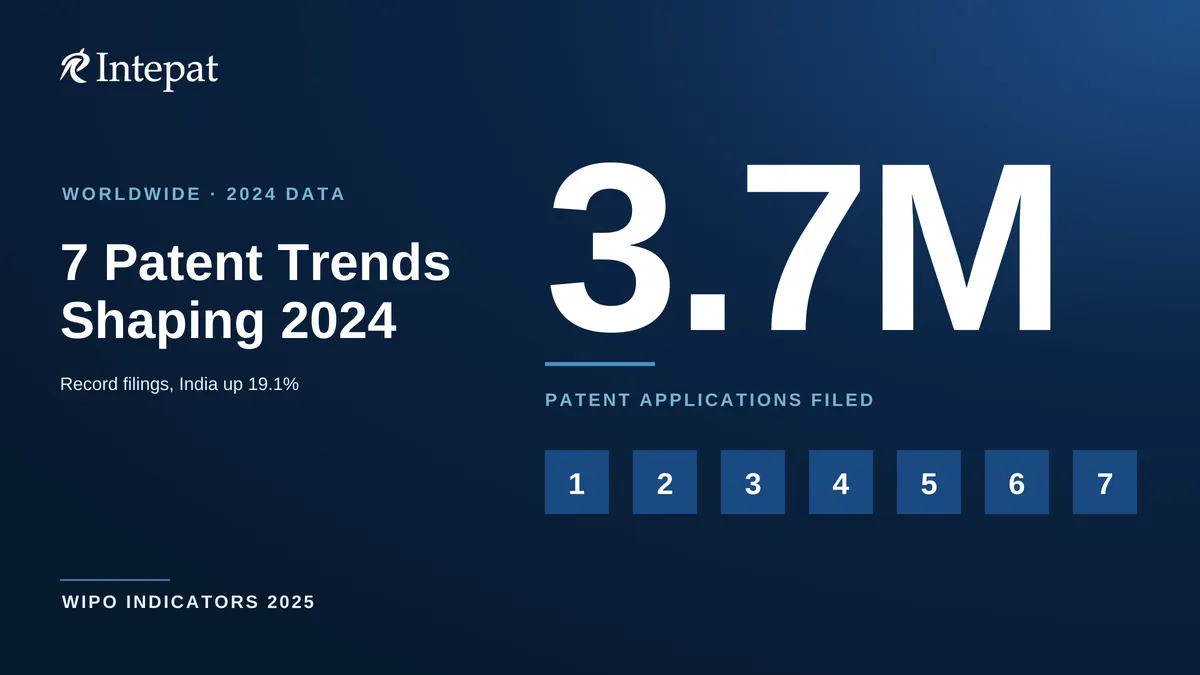
Patent Trends 2024 at a Glance
Seven trends stand out: record worldwide volume, India’s growth, a change at the top of PCT technology fields, generative AI, energy technology, a fall in pharmaceutical and semiconductor PCT filings, and a set of Indian procedural changes. The table gives each trend’s headline figure and the year its data covers.
| Trend | Headline figure | Data year |
| 1. Record worldwide filings | 3.7 million applications, up 4.9% | 2024 |
| 2. India’s growth | Up 19.1%, sixth straight double-digit year | 2024 |
| 3. Digital communication leads PCT | 10.5% of PCT filings, ahead of computer technology at 9.7% | 2024 |
| 4. Generative AI | 54,000 inventions; India’s growth 56% a year | 2014 to 2023 |
| 5. Energy technology | 47,200 published applications, up 3.2% | 2023 |
| 6. Pharma and semiconductors fall in PCT | Down 5.6% and 4.7% | 2024 |
| 7. Indian procedure changes | Examination request within 31 months, not 48, for applications filed from 15 March 2024 | In force 2024 |
The data years differ because WIPO’s energy series counts published applications and its generative AI study covers inventions filed from 2014 to 2023, and applications are published only some time after filing. The PCT field figures are 2024 filing data. Read each figure against its own year rather than treating the table as one snapshot.
Trend 1: Worldwide Patent Filings Reached a Record 3.7 Million
Worldwide patent filings reached a record 3.7 million in 2024, up 4.9% on 2023 and the fifth consecutive year of growth. Offices in Asia received about 2.6 million of these, or 70.1% of the world total, and an estimated 2.1 million patents were granted worldwide, up 5.2%.
China’s patent office received 1.8 million applications, up 9%, and the United States Patent and Trademark Office ranked second with 603,194. WIPO also estimates 19.7 million patents in force in 2024, up 6% on 2023. For an Indian applicant, the practical consequence is volume: more published prior art (earlier documents that can defeat novelty) each year. A patent landscape analysis or a novelty search run shortly before filing can cover what has been published up to that date. It cannot cover recent applications that are not yet published; in India an application is ordinarily kept unpublished for 18 months from its priority date or filing date, whichever is earlier.
Trend 2: Filings by Indian Applicants Grew 19.1%
Patent filings by applicants based in India grew 19.1% in 2024, one of three origins among the top 20 with double-digit growth, alongside Finland and Turkiye. WIPO reports that 2024 was India’s sixth consecutive year of double-digit growth, driven mainly by resident filings, meaning applications Indian residents filed at home.
The stock of granted rights moved with it. Patents in force in India rose from 76,556 in 2019 to 228,402 in 2024, roughly a threefold increase in five years. For a business launching a product in India, that changes freedom-to-operate risk (the risk that a product infringes someone else’s live patent): there is a much larger pool of live Indian patents that a clearance review may need to consider. It also adds to the body of Indian documents that a prior art search must cover.
Trend 3: Digital Communication Overtook Computer Technology in PCT Filings
Digital communication became the largest technology field in PCT filings in 2024, at 10.5% of the total and up 9.9%. It overtook computer technology, which had held the top position since 2019; computer technology filings fell 6%, leaving it with 9.7% of the total. Electrical machinery, at 8.6%, grew 8%.
Medical technology (6.5%) and measurement (4.4%) completed the top five fields. Total PCT filings were nearly flat at about 273,900, up 0.5%, so the change at the top reflects a shift in mix rather than overall growth. A growing field means a growing body of published applications for a search to cover. If your invention sits in communication technology, plan the search scope accordingly before you commit to the PCT route from India.
Trend 4: Generative AI Inventions Grew, With India Fastest Among the Top Five
WIPO counted 54,000 generative AI inventions (patent families) filed between 2014 and 2023, with over a quarter of them published in 2023 alone. India ranked fifth by inventor location with 1,350 inventions and recorded the highest average annual growth among the top five, at 56%.
In India, the patentability question for AI and blockchain inventions turns on the Patents Act’s exclusion of mathematical methods, business methods, algorithms, and computer programmes “per se” (a qualifier that applies to computer programmes alone). The Patent Office’s 2025 guidelines frame the test for AI, blockchain and quantum computing directly: “The core question for patentability is whether the claimed invention leverages the theoretical constructs to provide an implementable technical solution or it remains in the realm of abstract theory.” An AI claim that recites a trained model and its output, without the technical problem it solves and how, is exposed to that exclusion. Our guide on whether AI and machine learning inventions are patentable in India works through claim examples.
The guidelines also separate AI-generated inventions, made by an AI system autonomously or with very limited human input, which they treat as unpatentable because AI cannot be the inventor, from AI-assisted inventions, made using AI as a tool, which are not excluded outright and can be patented if they meet the patentability criteria and show a technical effect through a tangible application. A record of the human contribution therefore matters at filing. The guidelines are explicit that overcoming the computer programme exclusion does not require novel hardware; a technical solution to a technical problem through technical means, producing a technical effect beyond a merely incidental one, may take the invention outside it.
For blockchain, the guidelines state that blockchain as a theoretical concept is not patentable, and that “The key lies in demonstrating a concrete technical effect or improvement in a technological process.” They require blockchain applications to describe the cryptographic techniques, data structures, consensus mechanisms and any interactions with hardware or network systems. The same drafting point serves Internet of Things (IoT) inventions, which fall within the guidelines’ definition of computer-related inventions and appear in their examples of features that can take an invention outside the exclusion: describe the technical implementation and the technical improvement, not only the business outcome. Sector filing patterns are covered in our blockchain patent trends analysis.
Trend 5: Energy-Related Patent Filings Rose
Energy-related patent filings rose 3.2% in 2023 to reach 47,200 published applications, the figure WIPO reports in its 2025 indicators. Because the series counts published applications, it reflects research effort from earlier years rather than 2024 filings, and it is not directly comparable with the 2024 PCT totals.
Indian law has no separate patentability standard for green technology: a clean-energy invention meets the same novelty, inventive step and industrial application tests as any other. What differs is the commercial case, since energy inventions are often licensed or co-developed, which makes early clarity on ownership and inventorship worth the effort. Our renewable energy patent trends piece covers the sector in more detail.
Trend 6: Pharmaceutical and Semiconductor PCT Filings Fell
Pharmaceutical PCT filings fell 5.6% in 2024 and semiconductor filings fell 4.7%. With computer technology down 6%, these were the three fields WIPO names as having the steepest declines in 2024.
WIPO reports the declines without assigning a cause, and this article does not supply one. A fall in one route also does not show a fall in total filings in that field, since applicants can file directly in each country instead of using the PCT.
For pharmaceutical applicants in India the legal position is unchanged by the filing figures: the Patents Act treats the mere discovery of a new form of a known substance as not an invention unless it enhances the known efficacy, and treats salts, polymorphs, isomers and similar derivatives as the same substance unless they differ significantly in properties with regard to efficacy. In practice, a filing plan for a pharmaceutical variant therefore needs comparative efficacy data before the claim set is fixed. The same provision also excludes the mere discovery of a new property or new use for a known substance, a limb that efficacy data does not answer, so a repurposing strategy needs a different claim approach. See our note on protecting pharmaceutical inventions for the drafting choices.
Trend 7: India Changed Its Patent Procedure in 2024
India amended the Patents Rules with effect from 15 March 2024. The examination-request deadline fell from 48 to 31 months, counted from the priority or filing date, whichever is earlier; ordinary requests on earlier applications keep the old period. Foreign-filing disclosures, divisionals, working statements and advance renewal also changed.
The changes that matter most for a filing calendar are set out below.
- Examination request: due within 31 months of the priority or filing date, whichever is earlier, for applications filed on or after 15 March 2024; an ordinary request on an earlier application keeps the old period. If no request is made in time, the application is treated as withdrawn. A PCT application must also enter the Indian national phase within 31 months from priority, the same period as the examination request, so the request should be ready at entry. Our request for examination guide gives the deadline rules in full.
- Foreign-filing updates: details of corresponding applications filed outside India are due within three months of the first examination report, not six months from each foreign filing. The Controller can direct the applicant to file a fresh statement within two months of the direction, and can extend or condone delay in filing it by up to three months on request.
- Divisional applications: the Rules now confirm that one or more further applications may be filed for an invention disclosed in the provisional or complete specification or in an earlier divisional; the Act still requires a further application to be filed before grant and to add nothing beyond what the parent’s complete specification disclosed in substance.
- Working statement (the periodic statement on whether a patent is worked in India): due once for every block of three financial years, counted from the financial year after the year of grant, within six months of each block’s end; the Controller can extend or condone delay by up to three months on request. See the statement of working guide.
- Renewal fees: a 10% reduction applies where renewal fees for at least four years are paid in advance electronically.
As a related data point, the Indian Patent Office, acting as an International Searching Authority for PCT applications, issued 43.3% more international search reports in 2024 than in 2023, while WIPO notes that Indian applicants mainly file abroad directly through the Paris Convention route rather than the PCT. Our explainer on choosing India as the searching authority covers when that option suits an applicant.
What These Trends Mean for Your Next Filing
The 2024 data points to more prior art, faster growth in India, and a technical-effect test for software-led inventions in the 2025 guidelines. For a filing decision, that means three actions: search shortly before filing, draft AI, blockchain and IoT claims around the technical effect, and diarise the 31-month examination deadline at filing.
A business planning its next filing can test its position with three questions. Has a search been run shortly before filing in the specific field, given the growth in published documents? Does the draft specification state the technical problem and the technical means, as the 2025 guidelines expect? Is the examination request diarised against the 31-month deadline for applications filed on or after 15 March 2024? If you have an idea but nothing filed yet, the first step is a novelty search, followed by a discussion with a registered patent agent on whether to file a provisional application.
Frequently Asked Questions
WIPO reports a record 3.7 million patent applications worldwide in 2024, up 4.9% on 2023 and the fifth consecutive year of growth. Offices in Asia received about 2.6 million of them, or 70.1% of the total. An estimated 2.1 million patents were granted worldwide in the same year, an increase of 5.2%.
Filings by applicants based in India grew 19.1% in 2024, the sixth consecutive year of double-digit growth, according to WIPO, driven mainly by resident filings. Patents in force in India rose from 76,556 in 2019 to 228,402 in 2024, so a freedom-to-operate review now has a much larger pool of live Indian patents to consider.
Digital communication had the most PCT filings in 2024, at 10.5% of the total and up 9.9% on 2023. It displaced computer technology, which had led since 2019; computer technology filings fell 6%, leaving it at 9.7%. Electrical machinery followed at 8.6%, and total PCT filings were close to flat at about 273,900.
They can be, where the claimed invention provides an implementable technical solution rather than an abstract method. The Patents Act excludes algorithms and computer programmes per se; the Patent Office’s 2025 guidelines say AI and blockchain inventions may become patentable where they show a concrete technical effect, without needing novel hardware. Novelty and inventive step still apply.
From 15 March 2024, the examination request is due within 31 months of the priority or filing date, whichever is earlier. Foreign-filing updates run from the first examination report, divisionals may be filed from an earlier divisional, working statements fall due every three financial years, and paying renewal electronically for at least four years ahead earns 10% off.
This article explains the position in India as at October 2026 and is for general information only. It is not legal advice. Laws, fees, and procedures change; verify the current position before you act. For advice on your specific matter, consult a qualified IP professional. Worldwide figures are WIPO’s as published in November 2025 for the 2024 calendar year, and in July 2024 for the generative AI data.
Sources
- WIPO, World Intellectual Property Indicators 2025: Patents highlights, published 12 November 2025: worldwide filings, grants, patents in force, India growth and patents in force, energy-related applications.
- WIPO, press release PR/2025/943 on World Intellectual Property Indicators 2025, 12 November 2025: India’s 19.1% growth and sixth double-digit year.
- WIPO, PCT Yearly Review 2025: Executive Summary, 28 November 2025: PCT totals, field shares and changes, India as International Searching Authority, Paris route filing.
- WIPO, press release on the Generative AI patent landscape report, 3 July 2024: 54,000 inventions, India’s 1,350 inventions and 56% growth.
- Office of the CGPDTM, Guidelines for Examination of Computer Related Inventions (CRIs), 2025: paragraph 1.2 (definition of computer-related inventions), paragraph 3.4 (four limbs of section 3(k)), paragraph 3.5.3 (per se qualifies computer programmes only), paragraph 4.5.4 and Table 1 (novel hardware not required; IoT examples), paragraph 5.1 (implementable technical solution test), paragraph 5.2.1 (AI-generated and AI-assisted inventions), paragraphs 5.4 and 5.4.1 (blockchain).
- The Patents Act, 1970, as amended up to 1 August 2024: section 3(k) (computer programme per se and algorithms), section 3(d) (new forms, new properties and new uses of known substances), section 11B(4) (application treated as withdrawn), section 16 (further applications).
- Patents (Amendment) Rules, 2024, G.S.R. 211(E), in force 15 March 2024: rule 12(2), (4) and (5) (Form 3 timing), rule 13(2A) (further applications), rule 24B(1)(i) and (vi) (31-month examination request and saving clause), rule 80(3) (10% advance renewal reduction), rule 131(2) (working statement every three financial years).
- Patents Rules, 2003: rule 20(4)(i) (PCT national phase at 31 months from priority), rule 24 (18-month publication period).