




A patent landscape analysis in India is built from published applications and granted patents held by the Indian Patent Office, and that data behaves in ways that will mislead an analyst working from general assumptions. The method is the same anywhere; what changes is what the records can and cannot show.
This guide covers the seven characteristics of Indian patent data that most often produce a confident chart pointing at the wrong conclusion. For what a landscape is, why organisations commission one and how one is built, start with the guide to patent landscape analysis.
Quick answer
- Indian applications stay confidential for eighteen months, so the most recent filings in any field are invisible and a recent dip is usually a timing artefact.
- Filing volume, examination throughput and grant volume move independently in India, so none of the three can stand in for the others.
- A ceased patent may be restorable, a pending one already carries rights, and a database status label is not the legal record.
The Indian Patent Office Is a Usable Source Here
For a landscape spanning several countries, national patent office websites are generally not used to build the dataset, because each covers only its own publications and most will not export individual data fields.
WIPO’s guidelines for preparing patent landscape reports record the exception directly: a national collection is appropriate where the geographic scope of the report is that one jurisdiction, or where legal status needs verifying.
An India-only landscape falls squarely inside that exception. The Patent Office search environment covers published applications, granted patents and associated status information, and running a search on the Indian Patent Office databases is a legitimate primary route rather than a compromise. Published applications carry the bibliographic and technical detail a landscape needs: application number, filing and publication dates, title, classification, applicant, abstract, claims, priority and inventor details. The specification and drawings are available on payment of the prescribed fee, so the work can reach claim level rather than stopping at abstracts.
What the interface will not do is normalise anything for you. Applicant names, family relationships and technology categories all have to be resolved before a count means anything, and that work sits with the analyst.
Indian applicant data carries a particular version of the name problem. The Patent Office’s own annual report lists Indian Institute of Technology collectively at 1,740 applications for 2024-25, aggregating separate institutions under one label, while Lovely Professional University at 2,241 and Saveetha Institute of Medical and Technical Sciences at 2,038 appear in their own right. Whether the IITs are one applicant or several changes the top of any ranking, and the answer is a choice the analyst makes rather than one the data supplies. Transliteration adds more variants, and Indian subsidiaries of foreign groups often file under names that look unrelated to the parent.
The composition of Indian filings is also shifting in a way that affects who a competitor scan should cover. Domestic applicants filed 68,201 applications in 2024-25, around 62% of the total, so a landscape scoped only to familiar multinational names will now miss most of the field.
The Eighteen-Month Blind Spot
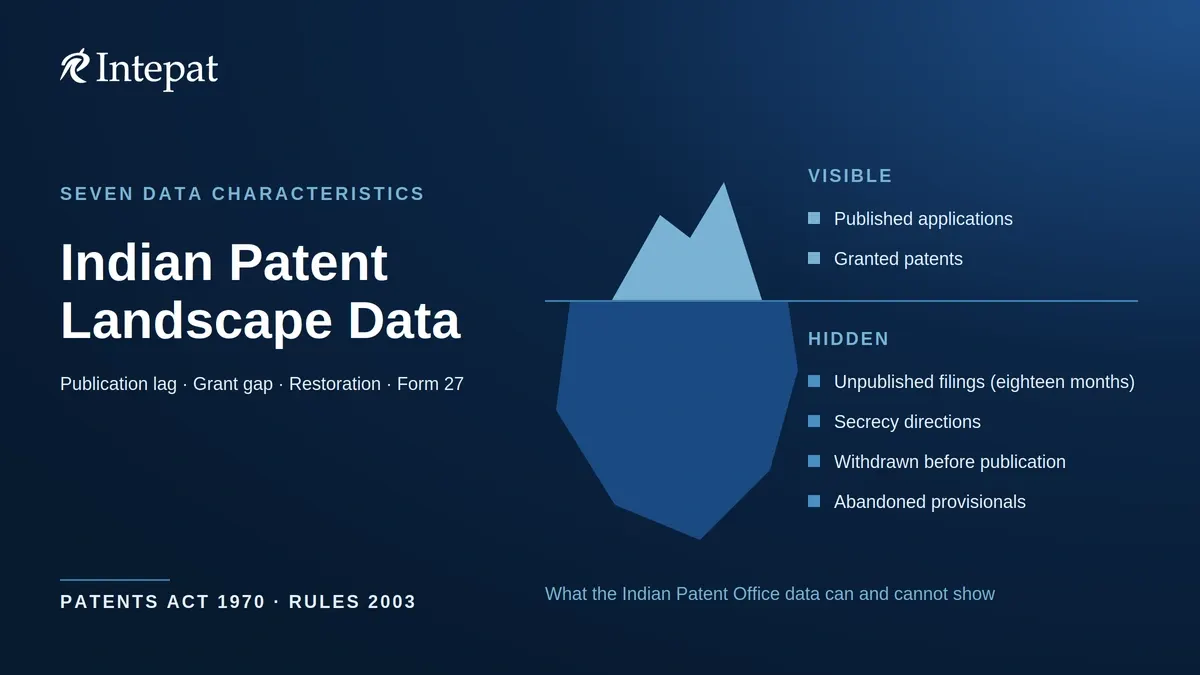
An Indian application stays closed to the public for eighteen months from its filing or priority date, whichever is earlier, with journal publication ordinarily following within a month of that period ending. A competitor may already hold a filing covering your project that no database can show.
The gap is widest for a first filing in India claiming no earlier priority. Some applications never appear on that timetable at all. Three categories are exempt from ordinary publication: applications under a secrecy direction, which publish later once the direction ceases; applications deemed abandoned because a complete specification did not follow a provisional within twelve months; and applications withdrawn three months before the eighteen-month point, in practice before the end of the fifteenth month. Secrecy directions are not negligible in volume, with 276 applications referred to the Defence Research and Development Organisation during 2024-25.
Early publication pulls in the opposite direction and is now a large share of the data. Of 159,419 applications published in 2024-25, 46,969 followed an early publication request, close to three in ten. Two applications filed the same week can therefore surface months apart, which distorts any fine-grained filing curve built without adjustment.
The practical consequence is a rule about wording. “No one has filed in this field” is not a defensible finding. “No relevant published applications were identified within the defined search scope and cut-off date” is.
Filing Volume and Grant Volume Diverge Sharply
| Year | Applications filed | Applications examined | Patents granted |
| 2020-21 | 58,503 | 73,165 | 28,385 |
| 2021-22 | 66,440 | 66,571 | 30,073 |
| 2022-23 | 82,811 | 49,961 | 34,134 |
| 2023-24 | 92,168 | 18,438 | 103,057 |
| 2024-25 | 110,375 | 15,726 | 33,504 |
Filings climb steadily across the period. Examination output falls by nearly four-fifths. Grants sit flat, spike once, then collapse. These are three separate series describing different cohorts moving through the office on different timetables, and no approval rate can be derived by dividing one by another.
The spike has a documented cause. A 2023 internal reorganisation promoted nearly 370 examiners to controller, producing record disposal of 1.26 lakh applications in 2023-24 including over one lakh grants. Recruitment of replacement examiners was then delayed, and pendency at the first examination stage rose. The gap between the 90,971 examination requests filed in 2024-25 and the 15,726 applications actually examined is the most useful pendency signal in the dataset: a large population of published applications is sitting unexamined, and a status label of “pending” says little about how close any of them is to grant.
Statutory exclusions widen the gap further in some fields. Indian law excludes mathematical and business methods, computer programmes as such and algorithms from the definition of an invention, among the other categories covered in what cannot be patented in India. Applications in those fields are filed and published regardless, because patentability is resolved during prosecution rather than at filing. Computer Science and Electronics drew 29,494 filings in 2024-25 while 10,058 grants issued in that field the same year, figures from different cohorts that cannot be divided into a success rate.
A Published Application Already Carries Rights
This is the provision most often missing from landscape commentary, and it changes how a pending record should be treated. From publication until grant, an Indian applicant has the like privileges and rights as if the patent had been granted on the publication date, though no infringement proceedings can be brought until grant.
A published application is therefore not a neutral data point for product planning. It is a right in waiting, with exposure that crystallises on grant.
Timing is what makes that actionable. No patent can be granted until six months after the application is published, and a pre-grant representation is considered only once a request for examination is on file. Before grant, any person may oppose; after grant, the window narrows to a person interested and closes one year from publication of the grant. The office received 239 pre-grant representations and 101 post-grant oppositions in 2024-25, so these are narrow and lightly used routes.
A landscape that flags a published application without noting where it sits against those dates has recorded a fact rather than surfaced a decision point.
Ceased Does Not Mean Free to Use
Indian patents run twenty years from the filing date, and from the international filing date where the application entered the national phase through the PCT. A patent ceases when a renewal fee goes unpaid, but cessation is reversible.
A restoration application can be made within eighteen months of the date the patent ceased to have effect. Where the Controller is prima facie satisfied the failure was unintentional, the application is published, and any person interested then has two months to oppose it.
This is not a theoretical route. During 2024-25, 558 restoration applications were received and 435 patents were restored.
So a record showing “ceased” needs four checks before it is written off: the date and reason for cessation, whether the eighteen-month window remains open, whether a restoration application has been published, and whether restoration has been entered on the Register. Restoration does not reach every inactive patent, and a surrendered or revoked patent raises a different question, which is why a report should not collapse lapsed, abandoned, withdrawn and revoked records under a single “inactive” label.
Status Belongs to the Register or the File Wrapper
Patent databases are discovery tools. A search result and a statutory record are not the same thing, and the difference becomes load-bearing the moment a record starts affecting a commercial decision.
For granted patents, the Register records grantees, assignments, transmissions, licences, amendments, extensions and revocations, and Indian law gives those entries the status of prima facie evidence. A bibliographic index displaying “active” or “expired” carries none of that standing. Pending applications have no equivalent Register entry, so verification runs through prosecution status and the file wrapper instead: the examination request, examination reports, responses, amendments, hearing records and any pre-grant proceedings.
Both are open to inspection, and certified copies of Register entries are available on payment of the prescribed fee. That cost is modest for a single record and disproportionate across a whole dataset, so obtain them when a record moves from interesting result to evidence in opposition, revocation or litigation, and not before. A report stating “status verified” should say where it was verified and on what date, per record rather than once for the whole study, because status decays continuously while the report sits on a desk.
Form 27 Adds an India-Specific Working Signal
Indian records carry a commercial disclosure that many jurisdictions do not require. Every patentee and licensee must state the extent to which the invention has been worked on a commercial scale in India, and the Controller may publish those statements.
The obligation runs on a three-financial-year cycle beginning with the year after grant, with each statement due within six months of the period ending.
The cycle is what makes the raw numbers treacherous. During 2024-25 the office received 11,056 statements of working and 3,663 patents were reported as working, against 230,480 patents in force as at 1 April 2025. Statements received in any single year therefore cover a fraction of the live portfolio, and the annual totals swing hard: 94,097 arrived in 2023-24 and 4,781 in 2022-23.
Absence of a statement in a given year accordingly establishes none of the following: that the patent was not worked, that the patentee failed to comply, or that the technology has no commercial presence in India. What a filed statement does provide is a dated record of what the patentee or licensee declared about commercial working. Treat it as a supplement to market research rather than a replacement for it.
A Foreign Family May Still Have an Indian Member
Patent rights are territorial, and an Indian patent has effect only in India. A family filed heavily in the United States, Europe, China or Japan tells you about an applicant’s strategy rather than about an Indian right.
The reverse holds too: no visible Indian family member cannot rule out future Indian risk, because a recent filing may simply be unpublished.
Substantial foreign filing does reach India. Foreign applicants filed 42,174 Indian applications in 2024-25, most through the international routes, with 31,940 national phase entries under the PCT and 4,627 convention applications claiming Paris priority. The United States alone accounted for 10,620 national phase entries.
Those are aggregate volumes and they do not establish how likely any particular family is to include an Indian member. The practical instruction is therefore to check rather than to assume: where a foreign family matters commercially, search expressly for an Indian member instead of inferring its absence from foreign-only results.
Reading a Patent Landscape Analysis in India
The test of an Indian landscape is not how many records it returned. It is whether the count has been resolved into legal states a reader can act on. Six checks separate a record count from a decision, and each maps to one of the characteristics above.
- Is the recent period genuinely quiet, or has the eighteen-month lag not yet cleared it?
- Are applications and grants counted separately rather than merged into one number?
- Does each ceased record carry a restoration check, or only a status label?
- For decision-relevant records, does the status come from the Register or the file wrapper, and on what date?
- Does a pending record show where it sits against the six-month and one-year opposition windows?
- Has a foreign family been checked for an Indian member rather than assumed to lack one?
Each of those checks should be visible in the report rather than merely performed. A reader who cannot see which records were status-verified, when, and against what source has no way to judge which conclusions are still safe to act on and which need re-running before a decision is taken.
A report that answers those six has done the analytical work. One that returns four hundred records and a chart has moved the problem rather than solved it. Where the answer turns on whether a specific product would infringe a specific claim, that is a freedom-to-operate question rather than a landscape one, and the guide to the types of patent search sets out which exercise fits which decision.
Frequently asked questions
Applications stay closed to the public for eighteen months from the filing or priority date, whichever is earlier. The most recent filings in any field are therefore not yet visible, subject to the publication exceptions and to early publication requests. An apparent fall-off in the latest period is usually a timing artefact rather than a real decline.
Grants fell from 103,057 to 33,504, but the earlier figure was the outlier. A 2023 reorganisation promoted nearly 370 examiners to controller and produced record disposal in 2023-24. Replacement examiner recruitment was then delayed, examination output dropped, and grants fell back accordingly.
No. Applications filed in a year and patents granted in the same year belong to different cohorts separated by several years of prosecution, and Indian examination throughput has varied widely across that period. Dividing one by the other produces a number that describes neither filing appetite nor examination outcomes.
No. Applications withdrawn three months before the eighteen-month point, and those deemed abandoned when a complete specification did not follow a provisional, leave no published record to retrieve. Secrecy-direction cases differ, because publication is deferred until the direction ceases rather than prevented altogether.
Yes. From publication until grant the applicant has the like privileges and rights as if the patent had been granted on the publication date, though infringement proceedings cannot be brought until grant occurs. A published application is a live commercial consideration for product planning rather than a neutral record.
Any person may oppose a published application before grant, so there is no fixed deadline. The practical floor is that no patent can be granted until six months after publication, and a representation is considered only once an examination request is on file. After grant the window narrows to one year and to a person interested.
Not automatically. Establish why the patent ceased and whether restoration remains open, since an application can be made within eighteen months of cessation for non-payment and 435 patents were restored during 2024-25. Check for a published restoration application and the Register entry before treating a record as clear.
No. The statement runs on a three-financial-year cycle, so most patents in force are not due to report in any given year. In 2024-25 the office received 11,056 statements against 230,480 patents in force. Absence in one year proves nothing about working, compliance or commercial presence.
No, and nor should you assume it has one. Foreign applicants filed 42,174 Indian applications in 2024-25, mostly through the PCT national phase and convention routes, but aggregate volume says nothing about any particular family. Where a family matters commercially, search expressly for an Indian member.
This article explains how Indian patent data behaves for the purposes of landscape analysis, as at August 2026, and is for general information only. It is not legal advice. Fees, forms, deadlines and procedures under the Patents Act, 1970 and the Patents Rules, 2003 change over time; confirm the current position with the Indian Patent Office before relying on it. A landscape report does not assess whether a specific product infringes any patent, and should not be relied on for that purpose. For advice on a specific invention, filing or clearance question, consult a registered patent agent.