




A trademark in India is registered through five structured stages: clearance search, filing of Form TM-A, examination by the Registry, publication in the Trademark Journal, and registration. The overall duration varies depending on examination outcomes and whether opposition is filed. Registration is granted only after statutory scrutiny and completion of all procedural stages. Each stage, along with fees, timelines, and documentation, is set out in the complete guide to trademark registration in India.
Trademark registration in India is governed by the Trade Marks Act, 1999 and the Trade Marks Rules, 2017. Although the filing system is fully digitised, registration is not automatic. Each application is examined for distinctiveness, potential conflict with earlier marks, and procedural compliance. Accepted applications are published to allow third parties an opportunity to oppose before registration is granted.
This guide is intended for startup founders, MSMEs, brand owners, in-house legal teams, and foreign counsel coordinating India filings. For businesses seeking structured brand protection, the process should be approached as a compliance-driven legal pathway rather than a filing formality. Class selection, documentation accuracy, and procedural discipline materially influence the enforceability and commercial strength of the resulting rights.
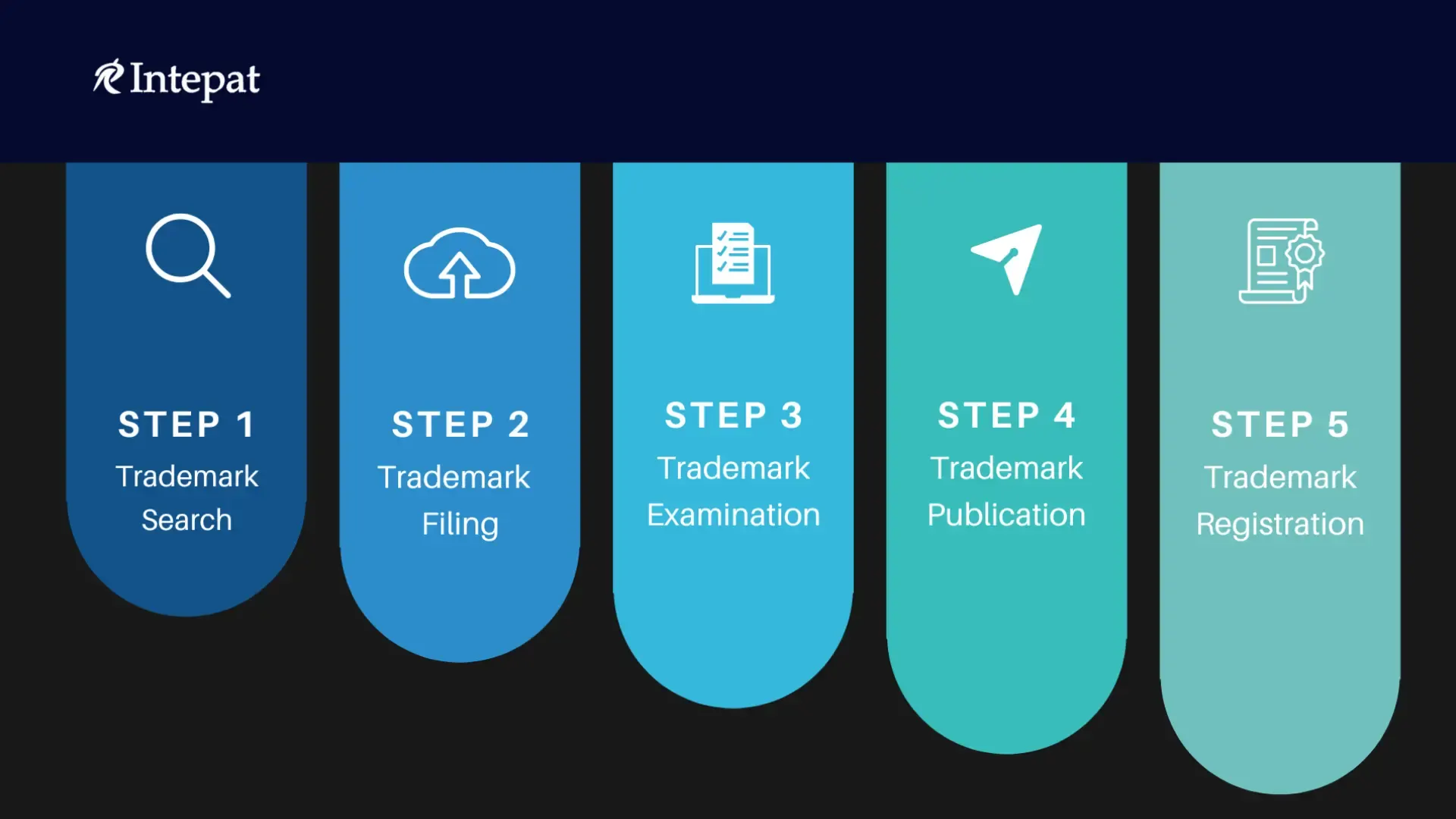
Trademark Registration in India: Process Overview
Trademark registration in India follows a defined statutory pathway. While each application may vary depending on examination findings or third-party opposition action, the process progresses through five structured stages.
Before examining each step in detail, the overall framework can be summarised as follows:
| Stage | What Happens | Statutory Position | Outcome |
|---|---|---|---|
| 1. Search | Review of existing registered and pending marks | Pre-filing risk assessment | Clearance strategy determined |
| 2. Filing | Submission of Form TM-A with prescribed details and fee | Application formally recorded | Filing date and application number generated |
| 3. Examination | Registry evaluates distinctiveness and potential conflicts | Examination Report issued where applicable | Acceptance or objection |
| 4. Publication | Accepted application published in the Trademark Journal | Open to third-party opposition | Opposition filed or proceeds forward |
| 5. Registration | Entry into the Register of Trademarks | Registration certificate issued | Exclusive statutory rights granted |
Each stage carries procedural requirements and legal consequences. The sections that follow examine how each step operates in practice, beginning with trademark search and clearance.
Trademark Registration Process in India: Overview Of Steps
Step 1: Trademark Search and Clearance
Purpose of a Trademark Search
A trademark search evaluates whether a proposed mark conflicts with earlier registered or pending trademarks. Although not legally mandatory, a structured clearance search significantly reduces the risk of objection during examination or opposition after publication. The objective at this stage is risk assessment rather than simple availability confirmation.
Scope of Review
A proper search examines identical and similar word marks, phonetically comparable expressions, and visually similar device or logo marks. The analysis should extend beyond identical spelling and consider pronunciation, conceptual meaning, and overall commercial impression.
India follows the Nice Classification system comprising 45 classes. While trademark rights are class-specific, similarity assessment is not always confined strictly to identical classes where goods or services are commercially related.
Applicants conducting their own review may refer to this practical guide on how to conduct a trademark public search in India before proceeding with trademark filing steps.
Risk Considerations
Filing without prior clearance increases the likelihood of examination objections on relative grounds and may invite opposition from earlier rights holders. Minor spelling changes or stylisation adjustments do not necessarily eliminate conflict if the dominant portion of the mark remains similar.
A structured search at this stage enables informed decision-making, reduces procedural uncertainty, and strengthens the enforceability of rights after registration.
Step 2: Trademark Filing Procedure
Once clearance is completed and the mark is considered commercially viable, the next stage is formal filing before the Trade Marks Registry. Filing establishes the official record of the application and secures the filing date from which statutory rights are assessed.
Trademark applications in India are filed electronically using Form TM-A under the Trade Marks Act, 1999 and the Trade Marks Rules, 2017.
At the filing stage, a government fee is payable for each class: currently ₹4,500 online for individuals, recognised startups and small enterprises, and ₹9,000 online for all other applicants, while a detailed and updated breakdown is available in our trademark registration fee guide.
Information Required at Filing
At the time of filing, the applicant must provide accurate identification details, including legal status and address. The mark must be represented exactly as intended for commercial use. Protection is granted only in the class or classes applied for under the Nice Classification system, making correct classification central to the scope of rights.
Where prior use is claimed, the stated date of first use must be accurate and consistent with supporting records. If the application is filed through an authorised representative, a Power of Attorney must be executed in the prescribed manner.
Errors at this stage, particularly in class selection or mark representation, may narrow the scope of protection or complicate examination.
Class Selection and Filing Strategy
Trademark protection in India is class-specific. Applicants must determine whether filing is appropriate in a single class or across multiple classes based on actual and intended commercial activity. Multi-class applications centralise prosecution under one filing, but statutory fees remain payable per class.
Class strategy should reflect present business operations and foreseeable expansion while maintaining defensible alignment with the goods or services claimed.
Filing Outcome
Upon successful submission of Form TM-A, the Registry issues an acknowledgement and generates a unique application number. From this stage, the applicant may use the ™ symbol in relation to the mark, indicating that registration is pending.
Given the importance of correct classification and documentation, filings are often coordinated through professional trademark registration services to ensure procedural compliance and structured prosecution.
Step 3: Examination and Objections
After filing, the application is examined by the Trade Marks Registry to determine whether it satisfies statutory requirements under the Trade Marks Act, 1999. Examination is not a mere formality. The Registry independently evaluates whether the mark is legally registrable and whether it conflicts with earlier rights.
Statutory Grounds of Examination
The Registry primarily assesses the application under Section 9 and Section 11 of the Act. Section 9 addresses absolute grounds for refusal, including lack of distinctiveness, descriptiveness, or marks that are customary in trade. Section 11 addresses relative grounds for refusal, focusing on the likelihood of confusion with earlier registered or pending marks.
A detailed explanation of these statutory standards is discussed in the context of Section 9 and Section 11 grounds of refusal in India.
In addition to substantive review, the Registry may examine procedural compliance, including classification accuracy and clarity of representation. If goods or services listed in the application are in the wrong class, this can often be corrected by an amendment on Form TM-M without losing the filing date. Many refusals arise from avoidable drafting or classification issues, which is why structured handling at the filing stage often reduces examination risk.
Examination Report
After examination, the Registrar either accepts the application outright and sends it for advertisement, or issues an examination report. The examination report may:
- Accept the application subject to conditions or disclaimers
- Raise objections requiring a written response
Where objections are raised, the applicant must file a structured reply addressing each ground cited. The response typically includes legal reasoning, distinction from cited marks, and evidence of use where relevant.
Show Cause Hearing
If the written reply does not resolve the objections, the application may be listed for a hearing before the Registrar. At this stage, oral submissions may be presented and additional documents relied upon. The Registrar may then accept the mark for publication or refuse the application with reasons.
Examination outcomes significantly influence the speed and certainty of registration. Careful handling of statutory objections at this stage strengthens the defensibility of the mark before it proceeds to public scrutiny.
Step 4: Publication and Opposition
Once the application is accepted after examination, it is published in the Trademark Journal. Publication operates as formal public notice that exclusive rights are being claimed over the mark.
Publication does not confer registration. Instead, it opens a statutory window during which third parties may oppose the application if they believe the mark conflicts with earlier rights or does not meet registrability standards.
Nature of Opposition
Opposition proceedings are quasi-judicial in nature, involving pleadings, evidence, and hearings before the Registrar. If a notice of opposition is filed, the applicant must file a counter-statement within two months of receiving a copy of it. This period is fixed by the Act. The matter then proceeds through evidentiary stages before being decided by the Registrar after hearing both parties.
A detailed procedural explanation of this stage is discussed in the context of trademark opposition proceedings in India.
Failure to file a counter-statement within the prescribed period results in the application being treated as abandoned. Where opposition proceeds to hearing and the Registrar rules against the applicant on merits, the application is refused.
Outcomes at This Stage
Where no opposition is filed within the statutory period, the application proceeds toward registration. In cases where opposition is filed and successfully defended, registration follows. If the opposition succeeds, registration is denied.
The opposition stage introduces external scrutiny into the registration procedure and often determines whether a mark ultimately secures enforceable statutory protection.
Step 5: Registration and Post-Registration Rights
If no opposition is filed within the statutory period, or if opposition is successfully defended, the application proceeds to registration. Upon registration, the mark is entered into the Register of Trademarks and a digitally signed registration certificate is issued by the Registry.
Registration confers statutory rights under the Trade Marks Act, 1999. The registered proprietor acquires the exclusive right to use the mark in relation to the goods or services for which it is registered and may initiate infringement proceedings against unauthorised use. Once the mark has been entered on the register, the ® symbol may be used with it. Using ® before then is falsely representing the mark as registered, and since 1 August 2024 can attract a penalty of half a per cent of turnover or ₹5 lakh, whichever is less.
Validity and Renewal
A registered trademark remains valid for ten years from the date of filing. Protection may be renewed indefinitely for successive ten-year periods upon payment of the prescribed fee. Procedural compliance at this stage is essential, as failure to renew can lead to removal of the mark from the Register.
The statutory process and timelines for renewal of a trademark in India should be monitored carefully to ensure continuity of rights. If renewal is missed, a late renewal with surcharge is possible for six months after expiry. After that, restoration can be applied for only up to one year from the expiry date, and it is at the Registrar’s discretion.
Registration therefore marks the beginning of enforceable statutory rights, but long-term commercial value depends on disciplined renewal management and portfolio oversight.
Trademark Registration Timeline in India
While the procedural stages remain consistent, the actual duration of registration varies depending on examination backlog and whether opposition is filed.
| Stage | What Happens | Indicative Timing (2026) | Key Trigger |
|---|---|---|---|
| Filing | Application submitted using Form TM-A | Day 0 | Filing date secured |
| Examination | Registry reviews distinctiveness and conflicts | Approximately 12 to 14 months from filing | Examination Report issued, if objections arise |
| Reply to Examination | Applicant responds to objections | Within prescribed period | Objection addressed or hearing scheduled |
| Publication | Accepted application published in Journal | After acceptance | Opposition window opens |
| Opposition Period | Third parties may oppose | 4 months from publication | Counter-statement required if opposed |
| Registration | Entry into Register and certificate issued | After opposition clearance | Exclusive rights conferred |
| Renewal | Protection extended for further term | Every 10 years from filing date | Renewal application required |
Understanding the trademark registration procedure timeline assists in planning compliance milestones.
The current examination queue position and pendency data may be verified through the official Trademark Application Status and queue listing published by the Registry.
Applications that proceed without objection or opposition typically move faster than contested filings. Opposition proceedings or hearings may materially extend the overall timeline.
Common Mistakes in Trademark Registration
Even where the statutory process is followed, applications are frequently delayed or weakened due to avoidable strategic and procedural errors. The following issues arise regularly in practice.
1. Selecting a Weak or Descriptive Mark
Marks that describe the quality, purpose, or characteristics of goods or services often face objection under statutory grounds relating to distinctiveness. The legal distinction between distinctive and descriptive marks plays a central role in examination outcomes. A mark that is commercially attractive is not automatically legally registrable. Choosing inherently distinctive branding at the outset reduces examination risk and strengthens enforceability.
2. Incorrect Class Selection
Trademark rights in India are class-specific. Filing in an incorrect class may leave core business activities unprotected. Conversely, filing in unrelated classes without commercial basis may invite challenge. Class strategy should align with present commercial use and foreseeable expansion.
3. Filing Without Proper Clearance
Proceeding without evaluating earlier marks increases the likelihood of objection or opposition. Minor spelling variations or cosmetic stylisation do not eliminate conflict where the dominant portion of the mark remains similar. Clearance analysis is a risk management step, not a procedural formality.
4. Inconsistent User Claims
Where prior use is claimed, inconsistencies between the stated date of use and supporting documentation can undermine credibility during examination or opposition. User details should be supported by dated commercial records where relevant.
5. Ignoring Registry Communications
If you do not reply to an examination report within one month, the Registrar may treat the application as abandoned. If you do not file a counter-statement within two months of receiving a notice of opposition, the application is treated as abandoned. Many applications lapse not due to substantive refusal, but due to procedural non-compliance.
6. Treating Registration as the End of the Process
Registration confers statutory rights, but portfolio management continues thereafter. Renewal monitoring, consistent use, and enforcement strategy determine long-term commercial value. Neglecting post-registration compliance can weaken or extinguish rights.
Avoiding these common mistakes improves the probability of smooth prosecution and strengthens the defensibility of the mark once registered.
Trademark Registration in India: Structured Compliance for Long-Term Brand Protection
Trademark registration in India follows a defined statutory pathway. From clearance and filing to examination, publication, and registration, each stage involves independent scrutiny and procedural compliance. While the framework is structured, outcomes depend significantly on mark selection, classification accuracy, timely responses, and strategic handling of objections or opposition.
Registration should therefore be approached as a legal compliance exercise rather than a filing formality. Businesses that treat trademark protection as a structured process, supported by proper documentation and disciplined portfolio management, are better positioned to secure enforceable and commercially valuable rights.
For startups, growing enterprises, in-house teams, and foreign counsel coordinating India filings, early strategic planning reduces procedural risk and strengthens long-term brand defensibility. For most businesses, the first practical step is a structured clearance review to assess registrability risk and class alignment before filing.
Structured Trademark Filing and Prosecution Support
Registration procedure involves statutory scrutiny at multiple stages, and early strategic review reduces the risk of objection, opposition, and procedural delay.
If you are planning to file, responding to an examination report, or defending an opposition, a structured legal assessment can clarify registrability risk and procedural strategy before the next Registry milestone.
A structured trademark assessment helps evaluate filing position and compliance strategy before proceeding with the next step.
Frequently Asked Questions on Trademark Registration in India
An application that meets no objection or opposition usually takes about 12 to 18 months. Objections, a hearing or an opposition can stretch this to 30 months or more.
The process for trademark registration in India includes search, filing, examination, publication, and registration. Each stage involves statutory review and procedural compliance.
Trademark registration is not mandatory to use a brand name. However, registration confers statutory rights, including exclusive use and the ability to initiate infringement proceedings under the Trade Marks Act, 1999.
Yes. The ™ symbol may be used once an application is filed. The ® symbol may be used only after registration is granted.
If you do not reply within one month of receiving the report, the Registrar may treat the application as abandoned. An extension of up to one more month can be requested on Form TM-M, at the Registrar’s discretion.
Section 9 objections relate to absolute grounds such as lack of distinctiveness or descriptiveness. Section 11 objections relate to relative grounds, primarily the likelihood of confusion with earlier registered or pending marks.
Yes. After publication in the Trademark Journal, any person may file an opposition within the statutory opposition window if they believe the mark conflicts with their rights or does not meet registrability requirements.
A registered trademark remains valid for ten years from the date of filing and may be renewed indefinitely for successive ten-year periods upon payment of the prescribed fee.
Yes. Foreign applicants are permitted to file trademark applications in India. However, an address for service within India is required for Registry correspondence. In practice, filings are commonly coordinated through a registered Indian trademark agent to ensure procedural compliance and communication with the Trade Marks Registry.