




Originally published 1 June 2026. Republished and updated 12 November 2026.
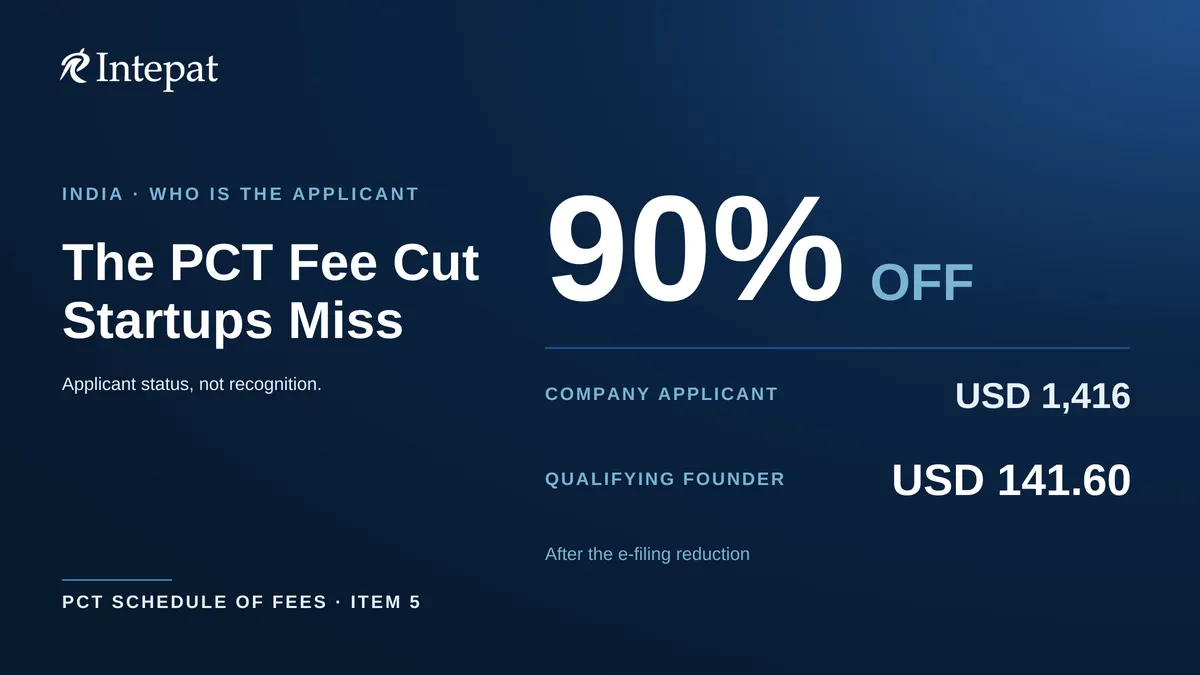
The PCT for Indian startups buys time, not a patent. One filing keeps 159 countries open while you raise money and test the market. The international filing fee from India comes to about USD 1,416 for a company, with the Indian search fee on top, and a founder who files in their own name and qualifies pays a tenth.
Quick answer: The PCT is worth it when you want more than two or three countries, or when you need another 18 months before spending real money. The 90 per cent fee cut goes to a natural person who is both a national of and resident in a listed State, owns the application outright and is under no obligation to assign or license it to anyone ineligible, not to a startup company, and the big bill lands at 30 or 31 months from your priority date.
What the PCT for Indian startups actually buys
Time, and a search result. One application filed from India keeps your right to enter the national phase in any of the 159 PCT Contracting States alive. In most of them that right runs to 30 months from your earliest priority date, and in India and at the European Patent Office to 31. No patent comes out of it.
Two offices have not taken on the longer period and run to shorter dates than either, so the list is worth checking rather than assuming. There is no international patent waiting at the end. Each country examines under its own law and grants or refuses on its own terms, and the PCT only defers the day you choose which of them to pay for. For a startup that deferral is the product, because the honest answer to which markets will matter is usually not available in year one.
It is worth knowing what you are not buying. The international phase gives you no patent to enforce against a competitor, only a filing date you have kept. What publication itself gives you depends on the country, because the Treaty hands that question to each national law rather than answering it. The application is also published promptly after 18 months have run from the priority date, subject to the exceptions the Treaty sets out, which turns your disclosure into something anyone can read and, depending on the country, something that can be cited against a later and better version of your own idea.
The search report is the part that earns its keep, and the part easiest to overlook. The searching authority draws it up and sends it to you and to WIPO, and in practice it reaches you well before you have to commit to countries. A bad report is useful, because it buys you the option to stop. If you want the Indian office to run that search, naming India as the searching authority is also a ground for expedited examination in India later, and that ground is open to any applicant, a founder filing in their own name included. A startup has a second and separate ground on its status alone, and where every applicant is a natural person there is a third, available if at least one of them is female.
When the PCT pays off for a startup, and when it does not
It pays off when you want more than two or three countries, when you need another 18 months to raise money or prove the market, or when you want a search result before you commit. It does not when you already know your one or two markets, or when the entry money will not be there as the dates arrive.
The test is cheap to run. Count the countries you would file in tomorrow if money were no object, then ask whether you could fund that list within a year of your Indian filing. If you could, and the list is short, direct and Paris route filings are cheaper and faster. If you could not, the PCT is buying you the gap.
Take a seed-stage company in Bengaluru that wants India, the United States and Europe eventually, has the budget for one filing this year, and expects a Series A in about 18 months. Filing directly in three countries inside the priority year is out of reach, and picking one of them means giving up the priority claim in the other two. The PCT holds all three open until after the raise, and the search report lands in time to drop whichever market it makes look unwinnable.
Against that, two cases where it is the wrong tool. One is a product with a short commercial life, where a patent granted four years out protects something nobody is buying any more. The other is the company that files, gets busy, and arrives at its entry dates with nothing in the bank: the Indian date falls at 31 months and each other country has its own, and once a date passes the filing stops having effect there, as though it had been withdrawn, unless that office allows late entry. All the money bought was a published disclosure.
What a PCT filing from India costs, and the one thing that cuts it by 90 per cent
Filed through ePCT at the Indian receiving office with India as searching authority, the main government costs are the international filing fee less the electronic-filing reduction, plus the search fee. The Indian office charges no transmittal fee on an ePCT filing. A company pays the filing fee in full, and a qualifying founder pays a tenth of it.
| Government fee on one PCT filing from India | Startup company as applicant | Qualifying founder as applicant |
|---|---|---|
| Transmittal fee at the Indian office, ePCT filing | No fee | No fee |
| International filing fee, after the electronic-filing reduction | USD 1,416 | USD 141.60 |
| Each sheet beyond 30 | USD 19 | USD 1.90 |
| Search fee, India as searching authority | Rs 2,500 | Rs 2,500 |
Verified as of November 2026. The USD 1,416 assumes the request goes in character coded format and the rest of the application as PDF, which is how every ePCT filing in our own files has gone in; put the description, claims and abstract in character coded format too and the reduction deepens, bringing a 30 sheet filing to USD 1,291. The Rs 2,500 search fee is the reduced rate, which startups, small entities, educational institutions and natural persons all pay alike, against Rs 10,000 for everyone else. File through the International Bureau instead of the Indian office and a transmittal fee is payable there, though applicants who qualify for the 90 per cent reduction are exempt from it.
Now the part reported wrongly almost everywhere. The 90 per cent cut is not a startup concession. India sits in the part of the WIPO list that covers natural persons, so the reduction follows the applicant and ignores the recognition certificate: a company recognised as a startup under the Startup India initiative pays the full fee, while a founder filing personally pays USD 141.60. It takes nine tenths off the filing fee, the per-sheet fee, the handling fee and the supplementary search handling fee, and it is worked out after the electronic-filing reduction, not before it.
The conditions are where this comes apart. The founder has to be a natural person who is both a national of a State on the list and resident in one, not either on its own. Where two founders file together, each of them has to qualify. And the applicants must be the sole and true owners of the application, under no obligation to assign or license it to anyone who would not qualify, which is the condition that catches funded startups: if the company is already entitled to the invention, the founder’s name on the form changes nothing.
The Indian concession is a different animal, and it does survive incorporation. The Rules group natural persons, startups, small entities and educational institutions into the reduced fee column, and a startup claiming it files Form 28 with every document that carries a fee. That column is what cuts the Indian bill at national phase entry; at the filing stage an ePCT filing costs nothing in transmittal fee for anybody, and the reduced search fee comes from WIPO’s search fee table. Patent filing for startups in India sets out the concessions, the evidence and the licence paperwork together.
One filing we handled in October 2026 shows the order of operations. On a 54-sheet application where only the request went in character coded format, the fee letter took the USD 251 reduction off USD 2,123 first, then applied the 90 per cent cut to the USD 1,872 left, leaving USD 187.20 to pay. Had all four parts gone in character coded format, the same filing would have come to USD 174.70.
The second bill, and when it lands
The PCT bill is the small one. The national phase bill falls due in the countries you picked, at 30 months from the priority date in most of them and 31 in India, and it arrives in the same few weeks: official fees, local agents, translations where the language changes. Budget for it from the day you file.
India’s extra month is not a favour. The Treaty sets 30 months and lets national law go later, and the Indian rules take the extra one. Europe does the same. On the markets most startups pick it makes little practical difference to the planning, because those dates sit within a month or so of each other, and the work has to be finished before the earliest of them.
Work backwards from that month rather than towards it. Quotes from foreign associates take weeks to collect, translations take longer than anyone budgets, and powers of attorney need signatures from people who travel. Translation is the cost that is easiest to underestimate: on a Japanese or Chinese entry it can be a large part of the bill, and it scales with the length of a specification somebody drafted two years earlier. Keeping that specification tight is a discount you collect when the entry bills land.
This is why the search report matters to the bank balance rather than to anybody’s pride. It arrives in time to cut the country list, and cutting the list is the strongest lever you have. For the Indian side of the bill, the Indian national phase fees are set out separately, the cost and deadline calculator will run your own dates, and what falls due at Indian entry covers the forms and the examination request.
Three traps that cost startups the money or the date
Three traps are worth your attention before you file. A founder files personally without checking what the company already owns, and loses the reduction. A resident files abroad before clearing the Indian requirement to do that. And someone reads about a general power to extend time and assumes the 31-month date can move.
The first is a document problem rather than a patent problem. Read the subscription agreement and the employment terms before deciding whose name goes on the application, because an obligation to assign is enough on its own, even where nothing has been signed across yet.
The second is section 39. An Indian resident needs the foreign filing licence before filing abroad, and that applies to anyone resident here whatever their nationality, unless the same invention has been on file in India for at least six weeks and either no secrecy direction has been given over it or every such direction has been revoked. The section does not reach an invention first filed abroad by somebody resident abroad. Filing at the Indian receiving office is not a way round the question, because in practice the office checks compliance as part of the filing pathway.
The third is worth getting exactly right, because the half-version of it circulates widely. Rule 138 lets the Controller extend a time limit set by the Rules, or condone a delay, by up to six months running from the expiry of the period you missed, on a Form 4 request made inside those six months. The schedule prices a request for extension by the month: Rs 10,000 for a natural person, startup, small entity or educational institution, Rs 50,000 for others, and ten per cent more on a paper filing. The rule lists no excluded steps.
What people are thinking of sits in Rule 137(2), which excludes national phase entry from something else entirely, the Controller’s separate power to amend documents and correct procedural irregularities. The two get run together and reported as one. Whether the six-month power reaches the 31-month entry date has not been settled, so do not plan on it. Treat the date as final, and if the priority year rather than the entry date is your problem, the 12-month priority year has its own narrow remedy. For the mechanics of getting on file, see how a PCT application is filed from India.
FAQ
No. India sits in the natural persons part of the WIPO list, so the reduction follows the applicant, not the certificate: the company pays in full. A founder qualifies only if they are both a national of and resident in a listed State, the sole and true owner, and under no obligation to assign or license to anyone ineligible.
Only where no obligation to assign or license exists at the time. The condition looks at obligations and not only at signed documents, so an employment term or a subscription agreement promising the company its IP defeats it. Where two founders file jointly, each has to qualify separately. Take advice before building a filing around this.
No transmittal fee at the Indian office on an ePCT filing, and the search fee is Rs 2,500 where India is the searching authority, against Rs 10,000 outside the reduced category. A startup files Form 28 with every document that carries a fee. The national phase fees are a separate bill, due at the 31-month date.
Thirty months from the earliest priority date in most countries, 31 in India. It runs from the priority date, not the international filing date, the mistake that costs applicants weeks. Where nothing is claimed as priority, the two are the same date. Against the priority year’s 12 months, the PCT adds about 18 more to decide and fund.
Usually. An Indian filing fixes the priority date cheaply, leaves 12 months to decide, and clears the foreign filing requirement once it has six weeks on file in India and either no secrecy direction has been given over it or every such direction has been revoked. Anyone resident here who files abroad first needs the written permit in hand.
Plan on no. A general power allows extension or condonation of up to six months on a request made in time and paid for by the month, but whether it reaches the national phase entry date has not been settled, and the date is treated as final in practice. Treat a missed date as fatal to the Indian application.
—
This article explains the law on PCT costs and fee reductions for Indian startups as at November 2026 and is for general information only. It is not legal advice. Government fees, forms, and procedures change; confirm current figures with the Indian Patent Office before you file. For advice on your specific invention, consult a registered patent agent.
Sources
- The Patents Rules, 2003, as amended, rule by rule text, Office of the Controller General of Patents, Designs and Trade Marks, read November 2026. https://ipindia.gov.in/acts/patent-rules-2003
- First Schedule of fees, Office of the Controller General of Patents, Designs and Trade Marks, schedule published 31 July 2026. https://ipindia.gov.in/patents-before-you-apply-forms-official-fees
- Patent Cooperation Treaty, Articles 8, 18, 21 and 22, World Intellectual Property Organization. https://www.wipo.int/en/web/pct-system/texts/articles/a22
- Schedule of Fees and PCT fee tables, World Intellectual Property Organization, amounts applying 1 October 2026. https://www.wipo.int/documents/d/pct-system/docs-en-fees.pdf
- List of States whose nationals and residents qualify for a 90 per cent reduction of certain PCT fees, World Intellectual Property Organization, applying to fees payable on or after 7 January 2025. https://www.wipo.int/documents/d/pct-system/docs-en-fee-reduction.pdf