




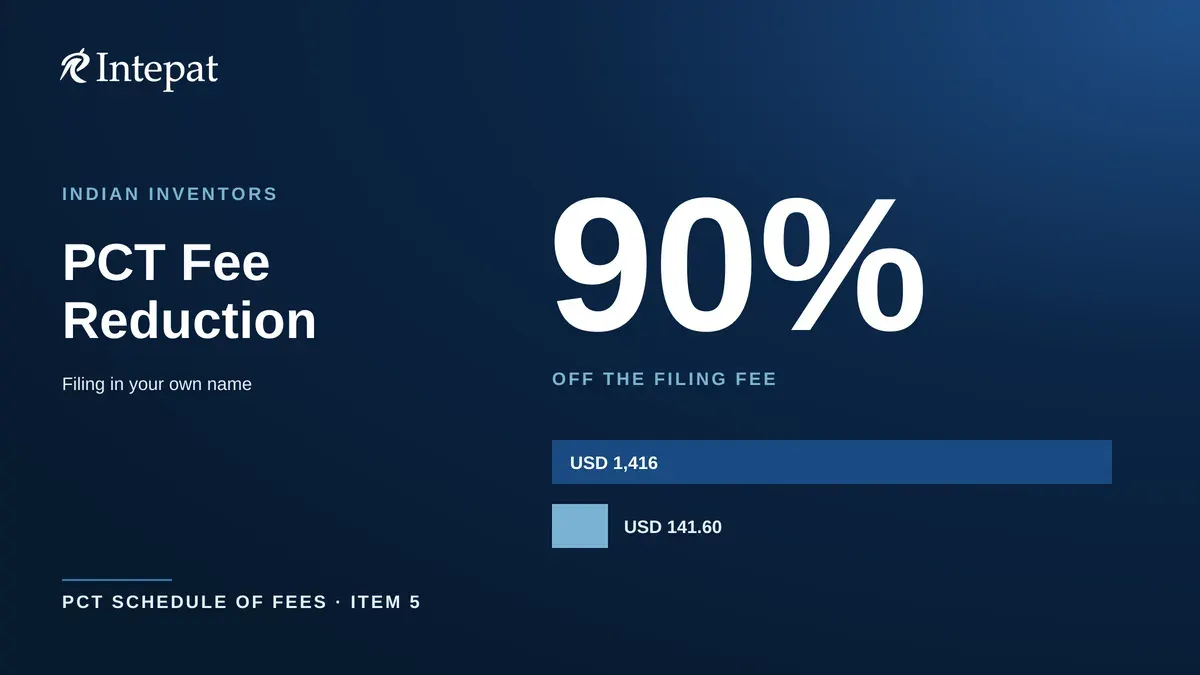
For applicants who qualify, the PCT fee reduction cuts the international filing fee by 90 per cent. If you are an Indian inventor filing in your own name, you may pay about a tenth of what a company pays. If a company or anyone else who would not qualify owns or is owed the invention, you probably do not qualify.
This guide is for founders, independent inventors and employees filing a Patent Cooperation Treaty (PCT) application from India. It explains who qualifies under WIPO’s current list, which fees the cut reaches, and the ownership condition founders need to check.
Quick answer: The 90 per cent PCT fee reduction is open to an applicant who is a natural person and both a national of and resident in a State on WIPO’s list. India is on that list. Every applicant named in the request must qualify. The applicants must be the sole and true owners, under no obligation to assign or license the invention to anyone who would not qualify. Indian companies, including recognised startups, do not qualify.
Who qualifies for the PCT fee reduction
The first part of the test is that you are a natural person who is a national of and resides in a State on WIPO’s list. India is on the list, so an Indian citizen living in India meets this part of the test.
The current list covers applications received on or after 7 January 2025 (for the later fees, fees paid on or after that date).
Both parts matter. Nationality alone is not enough, and neither is residence alone. If you live outside India, your country of residence must at least be on the list. If you are a foreign national living in India, your own country must at least be on it. In either case take advice, because the list’s wording leaves open whether a different listed State is enough.
The nationality and residence test applies to each person named as an applicant. A person named only as an inventor need not meet it, provided that person keeps no ownership of, or rights in, the application.
A company or other organisation can qualify only if it is a national of, and resides in, a country the United Nations classes as a least developed country. India is not on that part of the list. So an Indian private limited company, an LLP, a university or a research institute pays the full international filing fee, whatever its size or startup status.
Every applicant must qualify, and must own the invention outright
Where there are several applicants, each one must meet the test. Two Indian co-founders filing together can both qualify. Add the company as a co-applicant, or a co-founder who does not meet the test, and the reduction is gone for the whole application.
Ownership is the second test. A 2017 understanding of the PCT Assembly says the cut is meant only for applicants who are the sole and true owners of the application and are under no obligation to assign, grant, convey or license the rights in the invention to someone who would not qualify. The PCT Schedule of Fees adds that, when the application is filed, there must be no beneficial owner who would not qualify.
So the question is not only whose name goes on the form. It is also whether anyone who would not qualify owns, or is owed, the invention when you file. An obligation to assign or license to someone who would not qualify rules out the cut on its own, even before any assignment is signed.
The common situations look like this:
| Situation when you file | Does the 90 per cent cut apply? |
|---|---|
| Indian inventor, living in India, files alone and owns the invention outright | Yes |
| Two Indian co-founders, both living in India, file together with no duty to assign | Yes, if each meets the test |
| Founder files together with the company as co-applicant | No: the company does not qualify (Schedule of Fees, item 5 proviso) |
| Founder files alone but has agreed to assign the invention to the company, for example in a shareholders’ or subscription agreement | No: an obligation to assign to an ineligible party (2017 Assembly Understanding) |
| Employee files alone, but the employment contract assigns inventions to the employer | No, if the clause binds you and covers this invention |
| Inventor at a university or institute whose IP policy gives the institution the rights | No, if the policy binds you and covers this invention |
| Indian citizen living abroad | Only if the country of residence is also on WIPO’s list, and even then take advice |
| Foreign national living in India | Only if the country of nationality is also on WIPO’s list, and even then take advice |
If the invention was made at work, read the employment terms before deciding whose name to use. Our guide to employee invention ownership in India explains how an employer gets the right to apply.
What the 90 per cent cut reduces, and what it does not
The cut reaches three WIPO fees: the international filing fee, including the fee for each sheet over 30; the supplementary search handling fee; and the handling fee for a Chapter II demand. It is worked out after the e-filing reduction.
For the two later fees, the list that counts is the one in force when you pay them, so check the list again at that point. If ownership of the application has changed since you filed, take advice before claiming the cut.
If you file with WIPO’s International Bureau as receiving office, a qualifying applicant also pays no transmittal fee there.
It does not reduce the search fee. That fee belongs to the searching authority. If India is your searching authority, the Indian Patent Office has its own lower rate for natural persons, startups, small entities and educational institutions, which depends on your own category, not on WIPO’s cut. Nor does it reduce national phase fees in each country later on.
Here is what that means for an application filed electronically at the Indian Patent Office, of up to 30 sheets, with the request in character-coded format, the description, claims and abstract as PDF, and India as searching authority:
| Fee | Indian company, full fees | Qualifying individual |
|---|---|---|
| International filing fee, up to 30 sheets | USD 1,667 | USD 1,667 |
| Less e-filing reduction (request in character-coded format) | USD 251 | USD 251 |
| Filing fee payable | USD 1,416 | USD 141.60 |
| Each sheet over 30 | USD 19 | USD 1.90 |
| Search fee, India as searching authority | Rs 10,000 | Rs 2,500 |
| Chapter II handling fee, India as examining authority, only if you file a demand | USD 251 | USD 25.10 |
Verified as of November 2026: these are WIPO’s published amounts on 1 October 2026, and no change for India is printed up to 1 January 2027. At the Indian office the filing fee is stated in US dollars and the search fee in rupees. There is no Indian transmittal fee on an ePCT filing. If you file a demand, you also pay the examining authority its own preliminary examination fee. The 90 per cent cut does not reduce it, though India as examining authority charges natural persons, startups, small entities and educational institutions a lower rate (Rs 2,500 where India did the search, against Rs 10,000).
In filings we have handled at the Indian office, the fee letter took the USD 251 reduction off first and then applied the 90 per cent cut to what was left. For the rest of the bill, including the other searching authorities, see our guide to filing a PCT application from India.
Should a founder file in their own name?
Filing personally can save more than USD 1,200 on the filing fee alone. But the saving only holds if the conditions are true when you file. If the company already owns the invention, or you have promised it to the company or to another party who would not qualify, filing in your own name does not make you eligible.
Founders who plan to move the patent into their company later should take advice before filing, not after. The reduction looks at who owns the application and who is owed it. A later transfer also needs its own paperwork; for a granted Indian patent, our guide to patent assignment registration in India covers the Form 16 recordal.
Fees are one factor among several. Our guide to the PCT for Indian startups covers when the PCT is worth it at all, and what the company pays if it files.
FAQ
No. A company, including a recognised startup, qualifies only if it is a national of and resides in a listed least developed country (Schedule of Fees, item 5(b)). A recognised startup or small entity still pays the Indian office’s lower search fee of Rs 2,500 with India as searching authority.
Yes, if each of them is a natural person who meets the nationality and residence test and neither is under a duty to assign or license the invention to someone who does not qualify. If the company or any non-qualifying person is also an applicant, the whole application pays the full fee (fee reduction list, footnote 3).
Not necessarily. Your country of residence must at least be on WIPO’s list, and the list’s wording leaves open whether nationality and residence must be in the same State. Indian citizenship alone is not enough, so take advice before you rely on the cut.
No. The 90 per cent cut covers the international filing fee and sheet fee, the supplementary search handling fee and the handling fee (Schedule of Fees, item 5). The search fee is set by each searching authority. India as searching authority charges Rs 2,500 to natural persons, startups, small entities and educational institutions, against Rs 10,000 for others.
Then you are probably under an obligation to assign to a party that does not qualify, and the reduction is not available to you on that invention. The 2017 Assembly Understanding limits the cut to sole and true owners under no such obligation. Read the contract with your adviser before choosing whose name goes on the application.
This article explains the 90 per cent PCT fee reduction for applicants filing from India as at November 2026 and is for general information only. It is not legal advice. Government fees, forms, and procedures change; confirm current figures with WIPO and the Indian Patent Office before you file. For advice on your specific invention, consult a registered patent agent.
Sources
- Applicability of 90% Reduction in Certain PCT Fees, World Intellectual Property Organization, applicable on or after 7 January 2025, read 14 November 2026.
- PCT Fee Tables, World Intellectual Property Organization, amounts on 1 October 2026, read 14 November 2026.
- Regulations under the Patent Cooperation Treaty, Schedule of Fees, World Intellectual Property Organization, Schedule of Fees, read 14 November 2026.