




Indian rights holders pursuing online infringement have three interlocking mechanisms available: a statutory notice-and-takedown route under the Copyright Act 1957, a conditional safe-harbour and notice-and-removal regime under the Information Technology Act 2000, and judicial remedies including injunctions against identified and unknown defendants. Each mechanism carries distinct notice requirements, trigger conditions, and timelines. This article maps each mechanism and clarifies the practical limits of each.
Quick Reference:
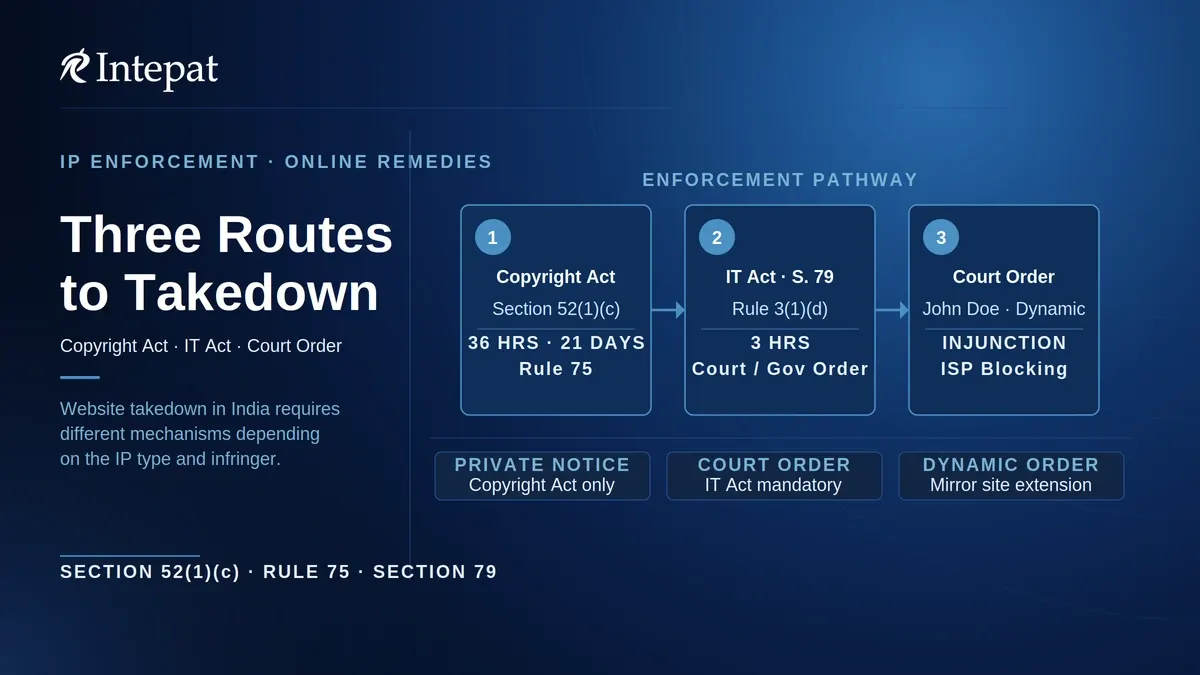
Copyright Act route: Section 52(1)(c) proviso and Rule 75, Copyright Rules 2013. A copyright owner may send a written complaint for transient or incidental storage involving electronic links, access, or integration. If the Rule 75 requirements are met, the intermediary must restrict access within 36 hours, for 21 days or until a court order is produced, whichever is earlier.
IT Act route: Section 79 and Rule 3(1)(d), IT Rules 2021 (as amended). Safe-harbour immunity is conditional on due diligence. After the February 2026 amendment, court orders or reasoned government intimations under Rule 3(1)(d) require removal or disabling of access within 3 hours (verified as of May 2026). A private rights-holder email alone does not trigger mandatory action under Section 79.
Court route: Rights holders may seek injunctions, John Doe (Ashok Kumar) orders, and dynamic injunctions for rogue or mirror websites, particularly where private notices are ineffective or the infringing operation is persistent.
Which Takedown Route Applies?
The table below gives a route-selection overview. Sections below explain each route in detail.
| Route | Trigger | Notice recipient | Court order? | Timeline |
| Copyright Act: Section 52(1)(c) / Rule 75 | Written complaint by copyright owner | Intermediary responsible for storage | Undertaking to obtain within 21 days | Intermediary acts within 36 hours; access restricted for 21 days |
| IT Act: Section 79 / Rule 3(1)(d) | Court order or reasoned government intimation | Platform or ISP | Yes (or government intimation) | 3 hours from receipt (as of Feb 2026 amendment) |
| Trademark: Section 135, TMA 1999 | Filed suit with prima facie evidence | Court issues order against defendant / ISP | Yes | Interlocutory order on application; timeline set by court |
| Judicial: John Doe / dynamic injunction | Filed suit; prima facie evidence of infringement class | ISPs; identified and unidentified defendants | Yes | Ex parte ad interim on application; extensions via Joint Registrar |
Why Online IP Infringement Requires Specialised Enforcement Tools
The standard civil enforcement model for IP infringement assumes an identifiable defendant and a domestic jurisdiction. Online infringement breaks both assumptions. Infringing content can be uploaded by anonymous users, hosted on servers outside India, mirrored across dozens of domains, and redistributed through social media and peer-to-peer networks faster than a conventional writ can be served.
This is not a minor procedural inconvenience. Counterfeit goods sold through unauthorised e-commerce platforms use registered trademarks without authorisation, deceiving consumers and eroding brand goodwill. Copyrighted films, software, and literary works circulate on streaming and file-sharing platforms without a licence. Design specifications and product images are reproduced and sold as counterfeit goods. Each category of infringement calls for a different statutory footing, and practitioners need to identify the correct mechanism before sending any notice.
The Copyright Act Route: Section 52(1)(c) and Rule 75
The Copyright Act 1957 provides the most structured statutory takedown mechanism for copyright owners. It is important to understand both clauses of Section 52(1) that deal with transient storage, because they carry different consequences.
Section 52(1)(b) covers transient or incidental storage of a work or performance purely in the technical process of electronic transmission or communication to the public. This clause provides a safe harbour for ISPs and transmission intermediaries but carries no written-complaint mechanism: a rights holder cannot invoke Section 52(1)(b) to demand a takedown.
Section 52(1)(c) is different. It covers transient or incidental storage for the purpose of providing electronic links, access or integration, where such links, access or integration has not been expressly prohibited by the right holder, unless the person responsible is aware or has reasonable grounds for believing that the storage is of an infringing copy. This is the clause that carries the complaint mechanism, and it is the statutory footing for the Rule 75 takedown procedure.
The Proviso to Section 52(1)(c)
Under the proviso to Section 52(1)(c), if the person responsible for the storage receives a written complaint from the copyright owner alleging that the transient or incidental storage constitutes infringement, that person must refrain from facilitating access for a period of twenty-one days, or until receipt of a court order restraining facilitation of access, whichever is earlier. If no court order is received within that twenty-one-day period, the person responsible for the storage may resume providing access.
What Rule 75 Requires
Rule 75 of the Copyright Rules 2013, made under Chapter XIV (Storage of Transient or Incidental Copies of Works), sets out the mandatory contents of a written complaint under clause (c) of sub-section (1) of Section 52 (verified as of May 2026):
- a description of the work with adequate information to identify it;
- details establishing that the complainant is the owner or exclusive licensee of copyright in the work;
- details establishing that the stored copy is an infringing copy and that the allegedly infringing act is not covered by Section 52 or any other permitted act under the Act;
- details of the location where the transient or incidental storage is taking place;
- details of the person responsible for uploading the infringing copy, if known; and
- an undertaking that the complainant will file an infringement suit in a competent court and produce the court’s orders within twenty-one days of the notice.
On receipt of a complaint satisfying these requirements, Rule 75(3) provides that the person responsible for the storage, if satisfied that the copy is infringing, must within thirty-six hours take measures to refrain from facilitating access for a period of twenty-one days or until a court order is received, whichever is earlier.
| Practitioner caution: |
| Do not send a Rule 75 notice unless you are prepared to file suit and produce a court order within 21 days. Rule 75(6) provides that if the complainant fails to produce those orders within the stipulated period, the intermediary is not obliged to respond to any further notice from the same complainant on the same work at the same location. The undertaking at Rule 75(1)(f) is not a procedural formality: a complainant who gives it and then fails to act loses the ability to re-serve notice on that intermediary for the same content. |
Rule 75(4) requires the person responsible for storage to display a notice giving reasons for restricting access to anyone who requests access. Rule 75(5) permits restoration of access if the complainant fails to produce court orders within the twenty-one-day period.
The IT Act Route: Section 79 and Rule 3(1)(d)
The Information Technology Act 2000 operates on a different logic from the Copyright Act route. Rather than creating a positive obligation triggered by a private complaint, Section 79 creates a conditional safe-harbour for intermediaries and withdraws that immunity upon failure to comply with specified conditions.
Section 79 and Safe-Harbour Conditions
Under Section 79(1) of the IT Act, an intermediary is not liable for any third-party information, data, or communication link made available or hosted by it. This immunity is conditional. Section 79(3)(b) withdraws it if the intermediary, upon receiving actual knowledge through a court order, or being notified by an appropriate government or its agency that any information residing in or connected to a computer resource controlled by it is being used to commit an unlawful act, fails to expeditiously remove or disable access to that material.
A critical qualification flows from the Supreme Court’s decision in Shreya Singhal v. Union of India [(2015) 5 SCC 1]: an intermediary is not required to take down content solely on the basis of a private complaint in order to retain safe-harbour protection under Section 79. The mandatory obligation under Section 79(3)(b) is triggered by a court order or a reasoned government intimation, not by a private notice from a rights holder.
This distinction matters for enforcement strategy. The Rule 75 Copyright Act mechanism provides a private-complaint path, but it operates on its own statutory footing: a copyright owner’s written complaint may trigger the Rule 75 procedure within the Section 52(1)(c) framework, subject to the 21-day court-order undertaking. The Section 79 mandatory obligation is a separate track, triggered only by a court order or government action.
IT Rules 2021 and the November 2025 and February 2026 Amendments
The Information Technology (Intermediary Guidelines and Digital Media Ethics Code) Rules 2021 superseded the 2011 Intermediary Guidelines and set out the due-diligence framework intermediaries must observe to retain safe-harbour status. Rule 3(1)(d) governs the mandatory removal timeline on receiving actual knowledge.
The November 2025 amendment introduced “reasoned intimation” as the required form for government-issued takedown directions: these must now be issued only by a senior officer not below the rank of Joint Secretary, specify the legal basis and statutory provision, identify the nature of the unlawful act, and name the specific URL or electronic location of the content to be removed.
The February 2026 amendment (effective 20 February 2026) further compressed the mandatory response window. Under Rule 3(1)(d) as currently in force, an intermediary must remove or disable access to unlawful information within three hours of receiving actual knowledge through (i) a court order of competent jurisdiction or (ii) a reasoned intimation in writing from an authorised officer of the appropriate government or its agency (verified as of May 2026).
A separate two-hour action window applies under Rule 3(2)(b), but this window is specific to personal-harm categories: complaints involving private visual information exposed without consent, nudity, sexual-act content, artificially morphed images, and electronic impersonation. This is not a general IP enforcement or counterfeiting timeline and should not be treated as such in infringement enforcement planning.
In appropriate cases, Indian courts have examined whether an intermediary remained passive and neutral or crossed into an active role, including by promoting, selecting, controlling, or commercially exploiting infringing activity. This issue is fact-sensitive and must be analysed against Section 79 safe-harbour conditions, the platform’s specific conduct, and evidence of actual knowledge of the infringing material. For a fuller account of how secondary and contributory copyright liability operates in India, see the linked article.
Judicial Remedies: Injunctions, John Doe Orders, and Dynamic Website Blocking
Where statutory takedown mechanisms produce inadequate results, or where the defendant is unidentifiable or the infringing operation too organised to be addressed by individual notices, rights holders may seek judicial intervention.
Injunctions Under the Trade Marks Act and Copyright Act
Under Section 135(1) of the Trade Marks Act 1999, a court may grant an injunction in a suit for infringement or passing off, at the option of the plaintiff together with either damages or an account of profits. Section 135(2) permits interlocutory orders, including ex parte injunctions, pending the final determination of a suit. Courts routinely grant such ex parte orders in online trademark infringement matters where evidence of ongoing infringement is placed on record and delay would cause irreparable harm.
The Copyright Act similarly permits civil remedies including injunctions, damages, and delivery up of infringing copies under Section 55. Courts apply the standard three-part test for interlocutory injunctions: prima facie case, balance of convenience, and irreparable harm.
John Doe Orders (Ashok Kumar Orders)
Where the defendant is unknown or the class of infringers too large to identify individually, Indian courts issue what are commonly called John Doe orders, or in Indian practice, Ashok Kumar orders. These orders are directed against unnamed defendants, binding anyone who falls within a described class of conduct. In the online IP enforcement context, such orders have been used to restrain unknown persons from distributing unauthorised copies of films, broadcasting sporting events without a licence, and selling counterfeit goods under registered trademarks.
The order takes the form of an ex parte ad interim injunction and is typically served on ISPs and content hosting platforms, directing them to block access to identified URLs. Cybersquatting and online brand abuse by unidentified operators are also a context in which such orders have been sought.
Dynamic Injunctions
An important procedural development in Indian courts is the dynamic injunction, introduced through UTV Software Communication Ltd. v. 1337x.to (CS(COMM) 724/2017, Delhi High Court, 10 April 2019). This mechanism allows a rights holder to extend an existing blocking order to mirror websites, redirect URLs, and alphanumeric variants of the originally blocked domain, without filing a fresh suit.
The procedure requires the plaintiff to file an application with a supporting affidavit and evidence establishing that the new domain is a mirror, redirect, or alphanumeric variant of the injuncted website. The Joint Registrar of the Delhi High Court, upon being satisfied by that evidence, issues blocking directions to ISPs in respect of the new domain. The dynamic injunction mechanism does not eliminate the need for evidence at each extension; it eliminates the need for fresh plaint proceedings each time a new mirror site is identified.
This directly addresses the practical problem of infringing content migrating rapidly across domains after a blocking order is served. A static injunction becomes ineffective almost immediately when the operator registers a new domain and redirects traffic. The dynamic procedure substantially reduces the litigation cost of enforcing website blocks against persistent operators who cycle through new domains.
Practical Challenges in Website Takedown Enforcement
Jurisdictional constraints. Where the infringing website is hosted on servers outside India, a takedown notice served on the foreign hosting provider must comply with that jurisdiction’s own legal requirements. Indian courts can grant injunctions effective against Indian ISPs for blocking access within India, but cannot compel a foreign host to remove content from its servers. Rights holders often pursue parallel enforcement in the relevant foreign jurisdiction or rely on the policies of major international platforms, which operate their own IP complaint procedures.
Identification of the correct intermediary. Determining which entity is responsible for a given piece of infringing content requires tracing the provider that controls its hosting or transmission. Where a site operates across multiple content delivery networks and hosting providers in different countries, this is not straightforward. The intermediary on which a Rule 75 notice is served must be the party that controls the storage or transmission of the specific infringing content.
The re-posting problem. Infringing content removed following a takedown commonly reappears on new URLs or alternative platforms within a short period. Rights holders address this through continuous monitoring, automated detection tools that scan for visual and textual matches, and, where a persistent operation is identified, through dynamic injunction proceedings.
Bad-faith notices. The notice-and-takedown mechanism can be misused by submitting notices against content that does not infringe any right, or that is covered by a permitted act under Section 52. Rule 75(6) provides some protection to intermediaries against serial bad-faith complainants by eliminating the intermediary’s obligation to respond to further notices from the same complainant on the same work at the same location following a failure to produce court orders.
Building an Effective Online Enforcement Strategy
An enforcement strategy that relies on a single mechanism is likely to be insufficient for any rights holder with significant online exposure. An effective approach typically combines several tools calibrated to the specific infringement type.
For copyright-dependent businesses, the foundation is copyright registration in key works and maintenance of records adequate to satisfy the Rule 75 complaint requirements before any infringement arises. This avoids delay at the point when speed matters most. The six-element Rule 75 notice is not complex, but the undertaking to produce court orders within 21 days means the institutional capacity to file quickly must be confirmed before sending the notice, not after.
For trademark-dependent businesses, registration in the relevant classes is the prerequisite for both the Section 135 injunction route and for using platform IP complaint systems. Where cybersquatting and online brand abuse are a risk, domain monitoring and rapid registration of defensive domains are part of the enforcement posture.
Where a persistent or large-scale infringing operation is identified, the most resource-efficient path is usually to obtain a court order. Once a court order is in place, the mandatory three-hour response window under Rule 3(1)(d) of the IT Rules (as amended February 2026) applies, rather than depending on voluntary cooperation with private notices. Where mirror sites are expected, seeking a dynamic injunction order from the outset avoids repeated fresh proceedings each time a new domain appears.
Whether a website itself benefits from copyright protection as a compilation or original work is a related question for businesses developing original digital content, and affects how ownership evidence is framed in any takedown notice.
Frequently Asked Questions
Three routes are available. For copyright infringement, send a written complaint under Rule 75 of the Copyright Rules 2013 to the intermediary responsible for the infringing storage; you must undertake to file suit and produce a court order within 21 days. For trademark or other IP infringement, apply to a competent court for an injunction, including an ex parte order where urgency is established. For persistent operations with mirror sites, seek a dynamic injunction from the Delhi High Court under the UTV Software procedure.
Under the Copyright Act route (Section 52(1)(c) and Rule 75), a valid written complaint from a copyright owner can require an intermediary to restrict access within 36 hours for 21 days, provided the Rule 75 requirements are satisfied and the complainant undertakes to produce a court order. Under the IT Act route (Section 79), a private rights-holder complaint alone does not trigger mandatory action: the Supreme Court held in Shreya Singhal v. Union of India (2015) that the mandatory obligation under Section 79(3)(b) is triggered only by a court order or government reasoned intimation.
A Rule 75 notice is a copyright-owner complaint invoking the proviso to Section 52(1)(c) of the Copyright Act 1957. It is a private-complaint mechanism addressed to the specific intermediary responsible for the storage; the intermediary acts on the basis of the complaint, subject to the 36-hour and 21-day timelines in Rule 75(3). An IT Act takedown under Rule 3(1)(d) of the IT Rules 2021 is mandatory, but is triggered only by a court order or a reasoned government intimation, not by a private notice.
A dynamic injunction, introduced in India by the Delhi High Court in UTV Software Communication Ltd. v. 1337x.to (CS(COMM) 724/2017, 2019), allows a rights holder to extend an existing website blocking order to mirror, redirect, and alphanumeric-variant domains without filing a fresh suit. The plaintiff files an application with an affidavit evidencing that the new domain is a variant of the injuncted site; the Joint Registrar, on being satisfied, directs ISPs to block it.
A John Doe order (Ashok Kumar order) is an ex parte interlocutory injunction directed against unnamed defendants, binding anyone who falls within a described class of conduct. In online IP enforcement, such orders are served on ISPs and content platforms, directing them to block identified URLs. Indian courts have granted these orders in copyright, trademark, and design infringement matters involving unidentified infringers operating at scale.
A court order is required to compel ISPs to block a website under the IT Act route (Rule 3(1)(d) of the IT Rules 2021), as the mandatory three-hour takedown window is triggered only by a court order or reasoned government intimation. Under the Copyright Act route (Rule 75), a private notice may be sent without a prior court order, but the complainant must obtain a court order within 21 days to prevent the intermediary from restoring access and losing the right to serve further notices on the same work.
This article is for general information only and does not constitute legal advice. IP enforcement strategy in specific cases, particularly those involving foreign intermediaries or complex multi-regime infringement, requires advice from a qualified legal practitioner. Statutory provisions and regulatory timelines referred to are current as at May 2026 and are subject to amendment.