




A trademark attorney in India can do almost every act your brand needs before the Trade Marks Registry, from filing to hearings, once you authorise them on Form TM-M. Two things they cannot do: swear your affidavit, and stop a deadline running while a Registry email sits in their inbox.
Indian law recognises three kinds of person who may act for you at the Registry, and trademark attorney is not one of the three names it uses. What you are able to hand over is the same in all three cases. Who you may appoint, and what protection that person carries if a dispute follows, is not.
| Quick answer: |
| You are not obliged to appoint anyone. Every file does need an Indian postal address and e-mail that the Registry can write to, which is why an owner with no place of business in India appoints a representative in practice. The Registry fee to e-file one mark in one class is Rs 4,500 for an individual, startup or small enterprise and Rs 9,000 for everyone else, verified as of August 2026, with the professional fee on top. |
Who may act for you before the Trade Marks Registry
Only three kinds of person may act for you before the Registrar, for any act other than making an affidavit: a legal practitioner, a person registered as a trade marks agent, or someone in your sole and regular employment, so long as you have duly authorised them.
Trademark attorney is a market description rather than a statutory one. A registered trademark agent, by definition, is a person whose name is on the register of trade marks agents. A practitioner may answer to that description, to the legal practitioner category, or to both at once.
The three categories are not interchangeable in every respect. The employee route has a ceiling: the Registrar may refuse to recognise any person, not registered as a trade marks agent, who in the Registrar’s opinion is engaged wholly or mainly in acting as agent in applying for trademarks in the name or for the benefit of the person employing him. A company that makes filings one employee’s main job has built the person that limit describes.
The second limit reaches all three. The Registrar shall refuse to recognise as agent any person who neither resides nor has a place of business in India, so a foreign brand owner is not able to put home-country counsel in front of the Registry directly.
You can check who you have appointed, though not by matching the form to the law’s own words. Form TM-A asks the agent to choose a “Nature of the Agent” from Registered Trade Marks Agent, Advocate or Constituted Attorney, and to give a registration number where one applies. That is the form’s own labelling, not a restatement of the three categories the law recognises: Advocate is close to legal practitioner, but Constituted Attorney is not one of the three, and the employee route does not appear on the form as a separate label. Treat the form’s answer as a starting point, not as confirmation of the statutory category.
The Registrar also maintains a register of trade marks agents and ordinarily publishes that list from time to time, and at least once in two years.
A register entry is a snapshot rather than a standing credential. Registration subsists to the end of the financial year in which it is granted, and continues while the continuance fee is paid. The Registrar shall remove an agent whose fee is three months overdue. Ask for a current entry, not an old certificate.
How a person qualifies for the agent category is set out in how a trade marks agent is registered. Acting personally also remains open, and filing without a representative sets out what that involves.
What only you can do, even with an attorney
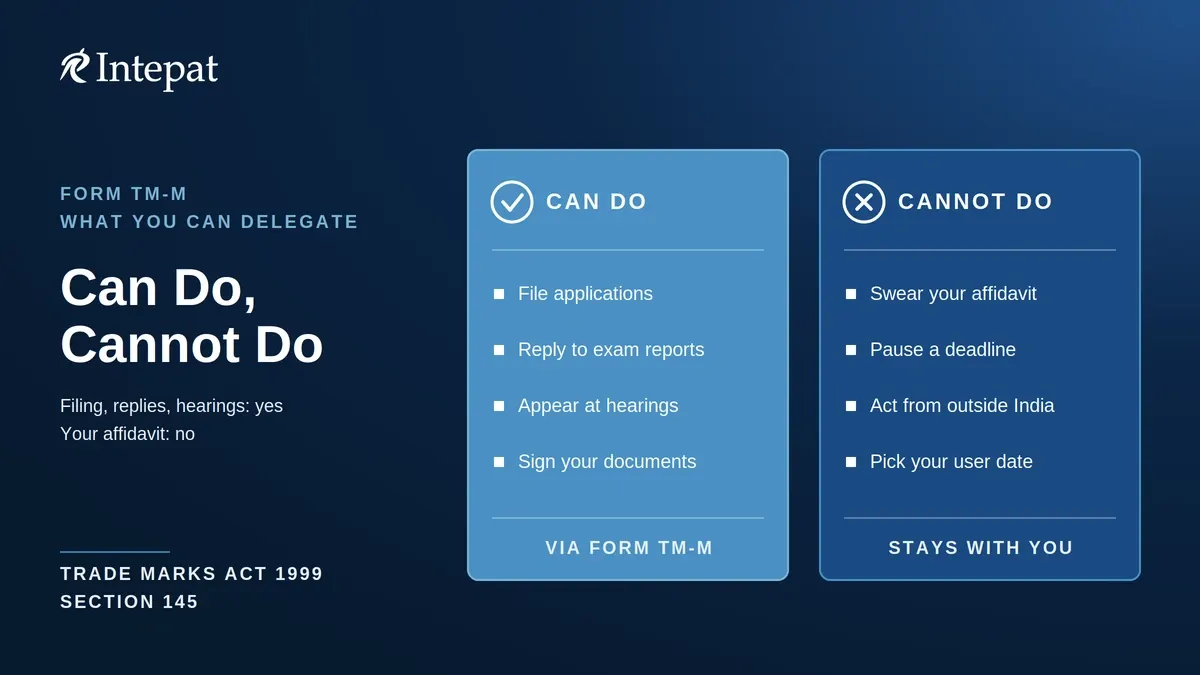
The law carves out one act by name: the making of an affidavit. An authorised representative can file, correspond, argue and appear, but the sworn statement stays yours. The Registrar may also require the personal signature or presence of an applicant, opponent, proprietor, registered user or other person in any particular case.
This matters most on the user date, meaning the date of first use of the mark that the application claims. Where an application claims use before the filing date, the applicant shall file an affidavit testifying to that use, together with supporting documents. Your attorney can draft the affidavit and assemble the exhibits, but the statement of fact inside it is yours.
Where the oath is taken depends on where you are. In India it is sworn before a court, an officer empowered to administer oaths or take affidavits, the Registrar or a Notary Public; outside India, before a diplomatic or consular officer, a notary public, or a Judge or Magistrate of that country or place. A foreign applicant does not have to travel to India to swear a user affidavit.
A user date should therefore not be chosen for filing convenience. Where the earliest date you are able to evidence is later than the date that would flatter, the later date belongs in the affidavit.
Signature of other documents is delegable. Any document required to be signed under the Act and the Rules shall be signed by the applicant or opponent, or by a person duly authorised for the purpose, so the signature itself may come from your representative. That does not reach the affidavit, which the law has already taken out of the delegable set.
Signing Form TM-M makes service on your attorney service on you
Authorisation of an agent is executed on Form TM-M. Once it is on the file, service of any document on the agent counts as service on you, communications may be addressed to the agent, and appearances before the Registrar may be made through the agent. What that changes is when your deadlines start.
The deeming provision is express: service upon the agent of any document relating to the proceeding or matter is deemed to be service upon the person so authorising him. The Registrar may serve by leaving communications at the address for service, by post, or by email, and a communication so sent is deemed served when the letter would be delivered in the ordinary course of post, or at the time of sending the email. For email there is no delivery allowance at all.
An examination report, which is the Registry’s written statement of its objections, is emailed to your attorney on the first of the month. One month runs from receipt of that report before the Registrar may treat the application as abandoned, meaning the file stops without any decision on the mark. If the report reaches you three weeks later, you have a week rather than a month.
One earlier clock is harder still. Where an application does not satisfy a requirement of the Act or the Rules, the Registrar sends a notice to remedy the deficiency, and if the applicant fails to remedy it within one month of the date of the notice the application is treated as abandoned. That period runs from the notice rather than from receipt, and it leaves the Registrar no discretion at the end of it. Ask your representative for same-day forwarding, not for a monthly summary.
Confirm that the address for service on the file is one you also monitor, since it has to comprise a postal address in India and a valid e-mail address. Where no such address is given, the Registrar is under no obligation to send any notice, and no order may be called in question for lack of service.
A period that has already run is not necessarily lost. The Registrar may extend time by up to one month on an application in Form TM-M, and the extension may be granted although the time for doing the act has already expired. The power is discretionary. It does not reach a time the Act itself fixes; the separate time limits for a newly formed company to complete its own registration as proprietor, or for applying to register a registered user; or a time the Rules already provide their own way to extend.
A missed examination reply is therefore worth an application. A missed counterstatement is not, because its two months sit in the Act.
Changing attorneys can abandon your application
If your agent withdraws, or you revoke the authorisation, and the application or opposition mentions no principal place of business in India, you have two months to provide an address for service in India. Fail to do so and you are deemed to have abandoned the application or opposition.
Whether that applies to you turns on a defined term. Principal place of business in India means where you carry on the business concerned, or any other business, in India, and where you carry on no business in India but have a place of residence here, that place of residence. An address for service is a different thing: it is the postal address and e-mail the Registry writes to.
This bites hardest on applicants with no Indian trading presence, whose file carries an address for service in place of a place of business. That same address fixes which office of the Trade Marks Registry holds the file, so losing the representative removes the address the Registry has been writing to.
Sequence the handover accordingly. Put the incoming representative’s authorisation on the file before the outgoing one comes off it, and confirm in writing which address for service now sits on the record. Changing it later does not move the file to a different Registry office, so the handover is about correspondence reaching you, not venue.
The same address governs renewal. Registration runs for ten years and may be renewed from time to time, and where no renewal application with the specified fee has been received, the Registrar sends notice of the approaching expiry to the address for service, not more than six months before it.
A proprietor whose address for service changes shall forthwith request the alteration on Form TM-P. Where the renewal notice goes to a representative you parted with in year four, the first you may hear of the lapse is the advertisement of removal. What renewal costs, and the window in which a lapsed mark can still be restored, is set out in renewing a registered trademark.
Where an attorney’s judgment changes the outcome
Four points in an Indian trademark file reward judgment rather than form-filling: the specification of goods and services, the reply to the examination report, the opposition timetable, and the step that fixes the date from which an appeal runs. Two of them can end an application without any decision on its merits.
The other two shape the decision you get, and how long you have to challenge it. Specification comes first. Where an application covers all the goods or services in a class, or a large variety of them, the Registrar may refuse to accept it unless satisfied that the specification is justified by the use made or intended. If the Registrar then determines that the goods or services fall in classes you did not apply for, you restrict the specification to the classes already applied for or add classes with the appropriate fee, and where all of them fall in a different class the Registrar may instead permit a correction of class. How goods and services are classified sets out the class structure behind that decision.
The examination reply is a timed argument rather than a form. An unsatisfactory reply, or a request from the applicant, leads to a hearing, and failure to appear with no reply on file lets the Registrar treat the application as abandoned. Hearings may be held by video conference and are then deemed to have taken place at the appropriate office, so your representative does not have to sit in the city that holds your file, though the residence requirement above still applies. Replying to a trademark examination report sets out what a reply has to answer.
In the opposition timetable, two of the four deadlines are fixed by the Act and take no extension. Whether the other two can be extended is disputed, and this article will not settle it for you.
| Step | Period and trigger | Extendable | Provision |
| Notice of opposition | Four months from publication of the Trade Marks Journal advertising or re-advertising the application | No, the period is in the Act | Section 21(1), Rule 42(1) |
| Counterstatement, the applicant’s written answer | Two months from the applicant receiving the copy of the notice; otherwise the application is deemed abandoned | No, the period is in the Act | Section 21(2), Rule 44(1) |
| Opponent’s evidence | Two months from service of the counterstatement; otherwise the opposition is deemed abandoned | Disputed, see below | Rule 45 |
| Applicant’s evidence | Two months from receipt of the opponent’s evidence or intimation; otherwise the application is deemed abandoned | Disputed, see below | Rule 46 |
Courts have not settled whether the Registrar’s general power to extend time reaches these two periods. More than one High Court has looked at the question in the last few years and reached different answers. Applying for the extension on Form TM-M costs little next to a lapsed opposition, so apply if you need one, but do not plan a filing on the assumption it will be granted, and take current advice on this specific point before you rely on it.
One more risk falls on a party who neither resides nor carries on business in India. In an opposition, the Registrar may require such a party to give security for costs, and in default may treat the opposition or the application as abandoned. The amount is whatever the Registrar considers proper. The opposition timetable sets out the evidence rounds in full.
The fourth point is procedural and easy to lose. Within thirty days of a Registry decision being communicated, an applicant who intends to appeal may require the Registrar to state in writing the grounds of the decision and the materials used in reaching it, once any requirements the applicant has not objected to have been complied with.
Asking for those grounds does not add a second appeal clock; it moves the one that matters. An appeal to the High Court lies within three months from the date the decision is communicated, but where the grounds are requested in time, the date they are received is deemed to be the date of the Registrar’s decision for that purpose instead. Skip the request and the three months run from the bare order.
A third route is shorter than the appeal itself. The Registrar may review his own decision on an application made within one month of it, extendable by one month on request. Review therefore lapses while the appeal window is still open, so it is weighed against appealing on the day the decision arrives, not sequenced after it.
What a trademark attorney in India costs, and what the Registry charges
Two invoices, not one. The Registry fee is fixed by the First Schedule to the Trade Marks Rules 2017, and the unit varies by entry rather than running per class and per mark throughout. The professional fee is not prescribed anywhere in the Act or the Rules, so it is a matter of contract between you and your adviser.
These are the entries a first filing usually touches, taken from the First Schedule to the Trade Marks Rules 2017 and verified as of August 2026.
| What you are filing | Individual, startup or small enterprise, e-filing | All other applicants, e-filing | Unit | Form |
| Application for registration | Rs 4,500 | Rs 9,000 | Each class, each mark | TM-A |
| Expedited processing | Rs 20,000 | Rs 40,000 | Each class, each mark | TM-M |
| Notice of opposition or counterstatement | Rs 2,700, no concession | Rs 2,700 | Each class opposed | TM-O |
| Renewal | Rs 9,000, no concession | Rs 9,000 | Each class | TM-R |
| Extension of time, amendment, certified copy, grounds of decision | Rs 900, no concession | Rs 900 | Flat | TM-M |
| Change of address for service on the register | Rs 900, no concession | Rs 900 | Each trademark | TM-P |
Physical filing costs more in each row that permits it, and expedited processing is e-filing only. Only the first two rows carry a concessional column, so an opposition, a renewal and a request for grounds of decision cost a recognised startup what they cost anyone else. A handover across a portfolio is priced per mark on the last row.
The expedited row buys a timetable rather than an outcome. It is requested on Form TM-M after the official application number has come back, and the application is then examined ordinarily within three months, with later stages also dealt with expeditiously. The Registrar may limit how many applications are accepted for it.
Who qualifies for the left-hand column is defined by law, not by self-description. A startup is an entity in India recognised as a startup by the competent authority under the Startup India initiative, or a foreign entity meeting that initiative’s turnover and incorporation criteria and filing a declaration to that effect. A small enterprise is defined by reference to the investment limit for a medium enterprise under the Micro, Small and Medium Enterprises Development Act 2006, and that limit sits in that Act rather than in the Trade Marks Rules.
Claiming the wrong column is not a billing correction. Where a document is filed without fee or with insufficient fee, it is deemed not to have been filed at all for the purposes of any proceedings under the Rules, so the filing date it appeared to secure is not secure. Form TM-A requires the certificate for a startup or small enterprise to be provided, so hold that document before the fee is paid rather than after.
One filing in this article is not priced in the Schedule. The authorisation of an agent goes on Form TM-M, and the First Schedule entries for that form do not name authorisation of an agent among the requests they price, so confirm what is charged on it before you sign. The full Trade Marks Registry fee schedule sets out the remaining entries.
Two risks that land on you, not your adviser
A registered trade marks agent or legal practitioner is protected from the groundless-threats action for acts done in a professional capacity on behalf of a client. The client is not. Separately, an agent who registers your registered mark in his own name creates a problem with a three-year clock on it.
Where a person threatens another with infringement proceedings, by circular, advertisement or otherwise, the person aggrieved may sue for a declaration that the threats are unjustifiable, an injunction, and such damages as have been sustained, unless the threatener satisfies the court that the mark is registered and that the acts complained of would infringe it. That exposure attaches to the client in whose name the letter went out, not to the practitioner who drafted it.
The shield is drawn by category. The law names a legal practitioner and a registered trade marks agent and nobody else, so a person in your sole and regular employment sits outside it. That is a reason to send a demand over a practitioner’s signature rather than an employee’s.
There is a way out of the threats action, and the way out has a cost. It does not apply where the registered proprietor, with due diligence, commences and prosecutes an action for infringement against the person threatened, and an infringement suit cannot be instituted in any court inferior to a District Court. The decision rule is to treat a cease-and-desist letter as the first step of a suit you are prepared to file, rather than as a cheaper alternative to one.
The second risk concerns agents and representatives generally, not professional advisers alone. If an agent or representative of the proprietor of a registered trade mark, without authority, uses or registers the mark in his own name, the proprietor may oppose the registration, or secure its cancellation or rectification bringing the mark back by assignment. Action has to be taken within three years of the proprietor becoming aware, which is reason enough to know what has been filed in your name.
Frequently Asked Questions
No. The law lets you do any act before the Registrar yourself, so appointing a representative is an option rather than a requirement. What an appointment buys is judgment at the points where an application can be treated as abandoned without a decision on its merits, such as the one-month examination reply period.
Trade marks agent is the statutory category, meaning a person on the register the Registrar keeps. Trademark attorney is a market description not defined in the Act or the Rules. The law admits three categories: a legal practitioner, a registered trade marks agent, and a person in sole and regular employment. All three may do the same acts.
Not before the Registry. The Registrar shall refuse to recognise as agent any person who neither resides nor has a place of business in India. An applicant with no principal place of business here also gives a home-country address alongside the Indian address for service, which fixes the Registry office.
Professional fees are not prescribed by the Act or the Rules, so ask for a quote in the Registry’s own units and for its scope. A filing quote should say how many marks and classes it covers. The examination reply and any hearing carry no Registry fee of their own; an opposition adds Rs 2,700 per class.
Where the file mentions no principal place of business in India, withdrawal by the agent or revocation of the authorisation starts a two-month period in which to provide an address for service in India, and missing it means the application or opposition is deemed abandoned. Put the new authorisation on file first.
No. The law permits an authorised person to do any act before the Registrar other than the making of an affidavit. Where use is claimed before the filing date, the applicant shall file an affidavit testifying to that use with supporting documents. Your representative can draft and file it, but the oath is yours.
Sometimes, though not predictably. The Registrar may extend time by up to one month on Form TM-M, even after the period has expired, but not for a time expressly provided in the Act; whether that reaches the opposition evidence periods is disputed. A late appeal to the High Court may also be admitted for sufficient cause.
Where an application has been accepted, and either was not opposed within the opposition period or the opposition was decided in the applicant’s favour, the Registrar shall, unless the Central Government otherwise directs, register the mark within eighteen months of filing. Objections and oppositions sit outside that period. The registration process in India sets out the stages.
This article explains the law on engaging a trademark attorney in India as at September 2026 and is for general information only. It is not legal advice. Government fees, forms, and procedures change; confirm current figures with the Trade Marks Registry before you file. For advice on your specific mark, consult a trademark attorney.
Sources
- The Trade Marks Act, 1999 (Act 47 of 1999), Sections 18(3), 21, 23(1), 25(1), 91, 127(c), 131, 134(1), 142, 145 and 146, as amended by the Tribunals Reforms Act 2021 (33 of 2021), which abolished the Intellectual Property Appellate Board and left Section 91 as the operative route of appeal to the High Court. Some online copies of the Act still display sections in their pre-2021 form; this article was checked against a consolidated text showing that amendment, not against any single webpage. Government of India, Office of the Controller General of Patents, Designs and Trade Marks.
- The Trade Marks Rules, 2017 (G.S.R. 199(E), 6 March 2017), Rules 2(1)(r), 2(1)(v), 2(1)(x), 3, 4(B), 5, 10(5), 13(1), 15(3), 17, 18, 19, 23(5), 23(6), 25(2), 31, 33, 34, 36, 42(1), 44(1), 45, 46, 51, 58(1), 59, 101(1), 109, 115, 119, 120(3), 142, 144(iii), 149, 150, 151(1), 152, 155, the First Schedule and the Second Schedule. Government of India, Office of the Controller General of Patents, Designs and Trade Marks.
- Form TM-A, application for registration of a trademark, the “Nature of the Agent” field (Registered Trade Marks Agent, Advocate, Constituted Attorney). Government of India, Office of the Controller General of Patents, Designs and Trade Marks, live source opened 2 September 2026. https://ipindia.gov.in/frontend/pdf/trade-mark/Form-and-Fees/FORM-TM-A.pdf