




Store layout trademark India filings are handled under Section 2(1)(zb) of the Trade Marks Act 1999, asking whether a mark is graphically representable and capable of distinguishing one trader from another. Whether a shop layout can be trademarked comes down to that distinctiveness test: five of six applications reviewed here drew a Section 9(1)(a) objection, and the survivors did not all rely on the same evidence.
That is the position in India today. It is narrower and more procedural than most coverage of this topic suggests, and worth understanding before a filing fee is spent on a mark likely to be objected.
| Quick answer: |
| In the six Indian applications reviewed for this article, all were ultimately processed as device marks, five were registered, and one was refused. The Registry’s standard objection was Section 9(1)(a), lack of distinctive character; prior use of the mark helped overcome it in some cases but was not the deciding factor in every case. |
What the Act Actually Requires
Two provisions work together to decide whether a store interior can be a trade mark. Section 2(1)(m) defines “mark” inclusively: a device, brand, heading, label, ticket, name, signature, word, letter, numeral, shape of goods, packaging, or a combination of these. Section 2(1)(zb) then defines “trade mark” as a mark, in that sense, capable of being represented graphically and capable of distinguishing one person’s goods or services from another’s.
The first provision tells you what kinds of signs the Act recognises; the second imposes the actual test a sign has to pass. Store interiors are not named in the Section 2(1)(m) list, and several commentaries on this topic treat that list as the source of registrability, as though anything inclusive is automatically eligible. That overstates what an inclusive definition does: it explains the category of thing a mark can be, while Section 2(1)(zb) decides whether a particular representation qualifies. A representation of a store interior is captured because it is graphically representable and, where it functions as a source identifier, capable of distinguishing.
Anchoring the analysis on Section 2(1)(m) alone invites the idea that anything not expressly excluded from the list is fair game. Reading it together with Section 2(1)(zb) puts the operative test front and centre: can this drawing tell a customer which business they are looking at.
Store Layout Trademark India on the Register
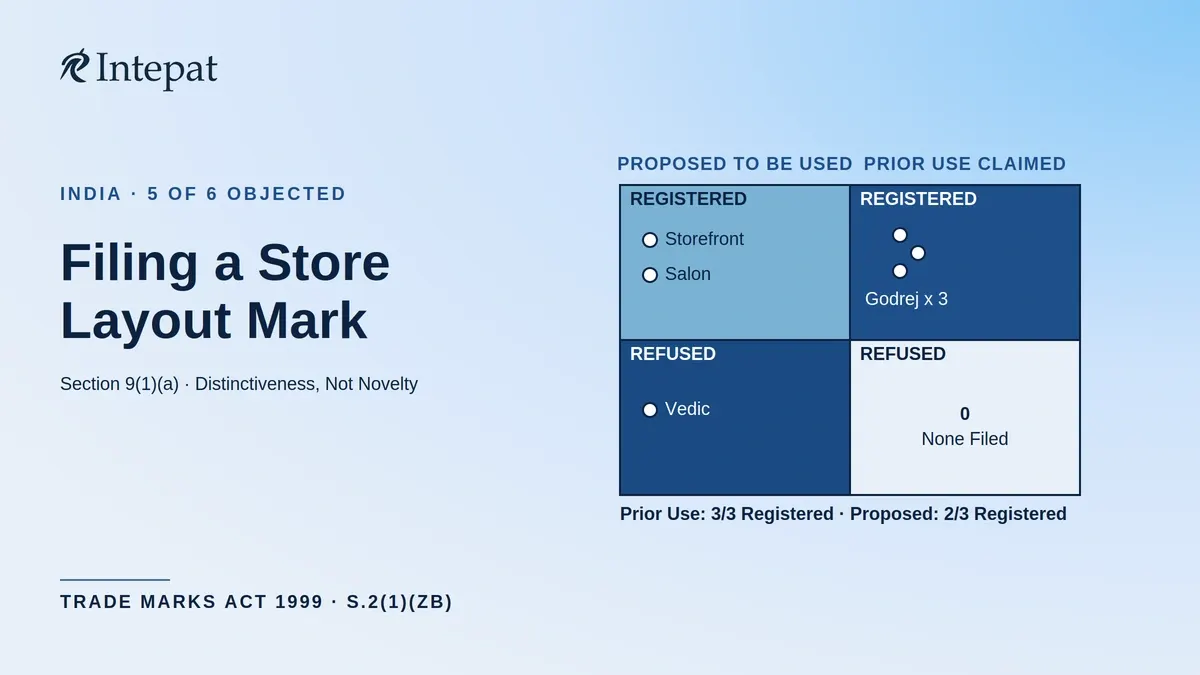
Six Indian store-layout or store-zone applications were reviewed directly against the Trade Marks Registry record for this article, all filed in 2019. Five registered and one was refused.
| Application | Mark | Owner | Class | Filed | Outcome |
| 4073262 | MARY COHR store layout (storefront) | Mary Cohr | 44 | 31 Jan 2019 | Registered |
| 4134918 | MARY COHR salon interior | Mary Cohr | 44 | 02 Apr 2019 | Registered |
| 4100482 | Layout of ‘The Vedic’ restaurant | Divita Kanoria | 43 | 26 Feb 2019 | Refused |
| 4169441 | U&Us Material Library Zone | Godrej & Boyce | 35, 42 | 07 May 2019 | Registered |
| 4169442 | U&Us Color Visualizer Zone | Godrej & Boyce | 35, 42 | 07 May 2019 | Registered |
| 4169443 | U&Us Discussion Area Zone | Godrej & Boyce | 35, 42 | 07 May 2019 | Registered |
The scope claimed varies more than a title suggests. Godrej & Boyce filed three separate applications on the same day for three named zones inside one furniture showroom, each claiming use since 25 June 2014. Mary Cohr split its storefront from its salon interior into two applications filed 61 days apart, and the salon interior mark depicts a full treatment room, not a narrow fixture or corner. The refused Vedic application, by contrast, was a single drawing of an entire restaurant interior, refused for reasons unrelated to how much space it claimed. This is a six-application sample, not the full register, and the scope an applicant chooses to claim looks like a strategic choice made case by case rather than a fixed convention.
Device Mark, Not 3D: How the Registry Actually Takes These
All six applications in this set were ultimately processed and categorised on the register as device marks, even though a store interior is a three-dimensional space. Whether a mark is treated as three-dimensional is a choice made at filing: Rule 23(2)(c) treats a mark as three-dimensional only where the application contains a statement to that effect, and a 3D statement then carries its own representation burden under Rule 26(3), three views as standard, up to five further views if the Registrar is not satisfied, and ultimately a specimen.
Filing as a device mark instead means the mark is fixed as the single image submitted, without that multi-view mechanism. Every representation in this set is a single elevation or perspective drawing. The 8 cm by 8 cm size cap in Rule 26(1) applies to every trademark application regardless of type, so it does not by itself indicate which route an application took; what determines the route is the 3D statement under Rule 23(2)(c). The register status pages record the final categorisation, device mark in all six cases, but not what each applicant originally elected at filing, so this article does not claim to know whether any of the six started life as a 3D application and was later converted.
The Objection You Will Get, and Why It Is Not a Novelty Test
Five of the six applications audited drew an identical objection: Section 9(1)(a), that the mark is devoid of distinctive character and incapable of distinguishing one trader’s goods or services from another’s. The wording was near-verbatim across two different Registry offices and three different examiners.
This is a distinctiveness test, not a novelty test. Section 9(1)(a) asks whether the mark can function as a source identifier, not whether the layout is new or has never been seen before. That distinction is easy to lose, because store layouts genuinely do compete on originality of design; the Act simply does not ask that question at the registration stage. A layout can be entirely unoriginal in design terms and still register, if it has come to signal one trader to consumers, and a striking, original layout can still be refused if it has not.
The one refusal in this set, discussed in full further below, illustrates the stakes of getting the response wrong, not the stakes of the test itself.
Answering It: Evidence of Distinctiveness and the One-Month Clock
An examination report gives the applicant one month from receipt to reply or request a hearing, under Rule 33(4); missing that window risks the application being treated as abandoned under Section 132. That deadline is not absolute: Section 131 and Rule 109 let the Registrar extend it by up to one month on a satisfactory application, so a missed window is a problem to raise promptly, not necessarily a dead end.
The reply is where the Section 9(1)(a) objection is actually won or lost. The proviso to Section 9(1) is one tool for winning it: a mark otherwise objectionable is not refused if it had acquired distinctive character through use before the filing date, or is a well-known trade mark.
Godrej’s three U&Us applications used it cleanly. Each claimed use from 25 June 2014, filed 07 May 2019, nearly five years of prior trading history to point to. The examination report was dispatched 08 July 2019 and the reply was filed seven days later, on 15 July 2019, a turnaround that suggests the evidence was assembled before the objection arrived. All three registered.
But prior use is not the only route through this objection, and the dataset makes that point on its own. Mary Cohr’s second application, 4134918 for the salon interior, was also filed on a proposed-to-be-used basis with no prior trading history to invoke, drew the same Section 9(1)(a) objection as the others, and still registered, roughly 23 months after filing against the storefront application’s 5 months. What persuaded the Registrar in that case is not established by the documents this article holds; the register shows the objection, the reply, and the eventual registration, not the substance of the argument made. What the comparison rules out is any claim that acquired distinctiveness through use is a precondition for overcoming Section 9(1)(a) here. A mark can also succeed on inherent distinctiveness, argued without reference to trading history at all, and 4134918 is consistent with that having happened, even though this article cannot confirm it from the record it holds.
The refused application, by contrast, had neither a use history to invoke under the proviso nor, on the reasoning the refusal order actually gives, a successful inherent-distinctiveness argument. Section 32 gives the same proviso-style protection after registration: a mark registered in apparent breach of Section 9(1) is not invalidated if it has since acquired distinctiveness through use.
For replying to a Section 9 objection generally, the same evidentiary discipline applies regardless of what the mark covers.
Preliminary Advice: The Pre-Filing Move Worth Making
Section 133(1) lets anyone who proposes to file ask the Registrar for prima facie advice, meaning a first-look opinion rather than a binding decision, on whether a mark is distinctive, before a full application is committed.
It is filed on Form TM-M under Rule 21, at a fee of INR 1,800 e-filed against a standard Class 44 filing fee of roughly INR 9,000, or INR 4,500 for an individual, startup, or small enterprise. Section 133(2) adds a conditional financial protection, not a guarantee: if the Registrar’s advice is affirmative and the application is filed within three months of it, and the Registrar later objects on distinctiveness anyway, the applicant may withdraw and recover the filing fee, but Rule 35 requires that withdrawal notice within one month of the examination report’s communication under Rule 33(2), the same clock as an ordinary reply. The advice itself is expressly prima facie only and does not bind the Registrar at the examination stage; five of six applications in this set drew a Section 9(1)(a) objection regardless of what a preliminary check might have shown, so the mechanism is better understood as an optional pre-filing risk screen with a fee-refund backstop than as a predictor of the eventual outcome.
Why Design Registration Is Rarely the Answer Here
A store interior is very rarely registrable as a design, and once the store has opened to the public without falling within a narrow statutory exception, design registration becomes very difficult. The Designs Act 2000, Section 2(d), defines a design as features applied to an article by an industrial process; a bespoke, site-built interior generally is not manufactured that way. Section 4(b) separately bars registration of a design already disclosed to the public, by use as much as by publication, before the filing date.
Two statutory exceptions narrow that bar without removing it: Section 21 protects disclosure at a notified industrial or international exhibition, provided notice is given and the application follows within six months, and Section 44(2) protects a convention-country applicant from invalidation for Indian use during the priority window that section defines. Neither exception is likely to help a retail store simply open and trading outside those windows. For the broader trade dress framing alongside this device-mark route, see trade dress protection in India.
Section 2(a) defines “article” as any article of manufacture and any substance, artificial or partly artificial, and separately includes any part of an article capable of being made and sold separately; that “made and sold separately” phrase qualifies a component part, not the primary definition. Even so, a leased space fitted out on site sits awkwardly within “article of manufacture” on its primary meaning, since it is built in place rather than manufactured and supplied as a thing. Where Section 4(b)’s use-based disclosure bar applies and a registration nonetheless issues, Section 19(1)(d), the general “not registrable under this Act” ground, is the more precise cancellation route than Section 19(1)(b), which is worded around publication specifically.
The route opens more comfortably for specific, manufactured elements: a prefabricated retail kiosk or modular pod, or standalone fittings such as display units and signage housings, each classified under the Locarno Classification (Class 25 covers building units and construction elements, with subclass 25-03 for houses, garages and other buildings). Section 5(3) limits a single application to one class, though Section 6(1) allows one application within that class to cover more than one article, so the number of applications a fit-out programme needs depends on how many distinct designs and classes are involved, not on a fixed one-application-per-element rule. Each application must in any case be filed before the relevant unit is first used or disclosed publicly, not after.
The Right You Already Have and Probably Do Not Own
Copyright can arise in the drawings and, where the built work has sufficient artistic character, in the interior itself, with no filing and no distinctiveness test. It is not a substitute for trademark rights in a store that has already opened, since those rights are built through use after opening, and Section 27(2) preserves a passing-off action regardless of registration outcome; opening a store primarily affects the design-registration route above, not copyright or trademark.
The Copyright Act 1957 protects a work of architecture, and the drawings behind it, as artistic works, but architectural copyright is confined to artistic character and design, so not every commercial fit-out automatically clears that bar. Ownership is more particular than a single default rule: work made in the course of employment under a contract of service ordinarily vests in the employer from the outset, while an independent architect or consultant ordinarily retains authorship and needs a written assignment for the brand to hold the right outright. This article has not verified the Copyright Act’s ownership provisions against a held original text, so check the engagement terms and the statute directly rather than assume either position.
There is a narrower point worth flagging for a franchise rollout specifically, and it applies to the manufactured elements discussed above, not to a site-built interior generally: copyright in a design capable of design registration but never registered ceases once the article has been reproduced more than fifty times by an industrial process. A prefabricated kiosk design replicated across fifty or more outlets could reach that threshold; a bespoke, one-off interior, not manufactured as an article in the first place, does not fit the provision’s terms.
For the distinctiveness threshold generally, the same acquired-use evidence discussed above is what closes the gap between a descriptive layout and a registrable one.
Registration Is Not Enforcement
Registration answers whether the Registry will grant a certificate. It does not answer whether a court will stop a competitor from copying the layout, and the one refusal in this audited set shows how differently those two questions can be reasoned.
The order refusing application 4100482 was issued on 8 December 2021, after a virtual hearing held under Rule 115 on 26 October 2021. Its lead reasoning assesses the mark phonetically and applies the invented-word doctrine, the test for whether a coined term is distinctive because it has no ordinary dictionary meaning, treating the application’s title as if the words themselves were the mark under examination. That is reasoning built for a word mark, not the pictorial device that was actually filed. A line drawing of a restaurant interior is not usefully assessed as an invented word.
Within that same reasoning, the order also makes a separate and better-founded point: the application was proposed-to-be-used, with no prior trading history to invoke under the Section 9(1) proviso and no acquired secondary meaning to fall back on. That second point is a correct application of the test discussed above; it sits alongside, rather than replaces, the more questionable word-mark analysis that leads the order. The order also leaves one objection-ground field incomplete, trailing into an unfinished description, and is internally inconsistent about whether the applicant’s advocate appeared at the hearing.
The lesson for an applicant is not that the refusal was wrong on every point; the absence of any use evidence or successful inherent-distinctiveness argument was a real weakness in that application, whatever the merits of the order’s own reasoning about it. The lesson is that a device mark depicting a space needs to be argued and evidenced as a device mark, not left to be assessed by whatever framework the examiner defaults to. Godrej’s seven-day, use-backed reply and Mary Cohr’s two very differently timed applications both worked through the objection; the refused application did not have a comparable argument to make.
Frequently Asked Questions
Yes, filed under Section 2(1)(zb) of the Trade Marks Act 1999. In the six Indian applications reviewed for this article, all were categorised as device marks, five registered and one was refused, and the scope claimed varied from a storefront to a full interior rather than following one fixed pattern.
Trademark, in almost every real case. Design registration needs the interior to qualify as a manufactured article, filed before the store opens; once trading begins, prior disclosure by use bars it, subject to narrow exhibition and convention-priority exceptions. A passing-off action remains available regardless of registration outcome, though goodwill and misrepresentation still have to be proved.
Section 9(1)(a): the mark is treated as devoid of distinctive character. This is a distinctiveness test, not a novelty test, and it was raised against five of the six applications reviewed here, regardless of how original each layout was.
No. The Section 9(1) proviso lets acquired distinctive character through use, or well-known status, overcome the objection, but it is not the only route: one application in this set registered on a proposed-to-be-used basis with the same objection raised against it, so inherent distinctiveness can also succeed without a use history behind it.
It depends on how the architect or designer was engaged. Work created in the course of employment under a contract of service generally vests in the employer by default; an independent consultant generally retains authorship and needs to make a written assignment for the brand to hold the right. Check the engagement terms rather than assume either position.
The government filing fee is INR 9,000 per class e-filed, or INR 4,500 for an individual, startup, or small enterprise, under the First Schedule to the Trade Marks Rules 2017. A preliminary distinctiveness check under Section 133 costs INR 1,800 e-filed and can be worth taking first.
This article explains the law on store layout trademarks in India as at August 2026 and is for general information only. It is not legal advice. Government fees, forms, and procedures change; confirm current figures with the Trade Marks Registry before you file. For advice on your specific mark, consult a trademark attorney.
Sources
- The Trade Marks Act, 1999 (Act 47 of 1999), Sections 2(1)(m), 2(1)(zb), 9, 18(2), 20(1), 25, 27(2), 31, 32, 131, 132 and 133. Government of India.
- The Trade Marks Rules, 2017, Rules 2(1)(k), 21, 23(2), 25, 26, 33, 35, 37, 109 and 115, and the First Schedule (Entries 1 and 14). Government of India.
- The Designs Act, 2000 (Act 16 of 2000), Sections 2(a), 2(d), 4(b), 5(3), 6(1), 11, 19(1), 21, 22(2) and 44(2). Government of India.
- The Copyright Act, 1957. Sections on authorship, ownership and assignment of architectural and artistic works are discussed in general terms in this article and have not been verified against a held original text; treated as provisional pending that verification.
- International Classification for Industrial Designs (Locarno Classification), Class 25, World Intellectual Property Organization.
- Trade Marks Registry records, internal analysis by Intepat IP: Application Nos. 4073262, 4134918, 4100482, 4169441, 4169442 and 4169443, examination reports and the refusal order in Application No. 4100482 dated 8 December 2021, status as verified August 2026.