




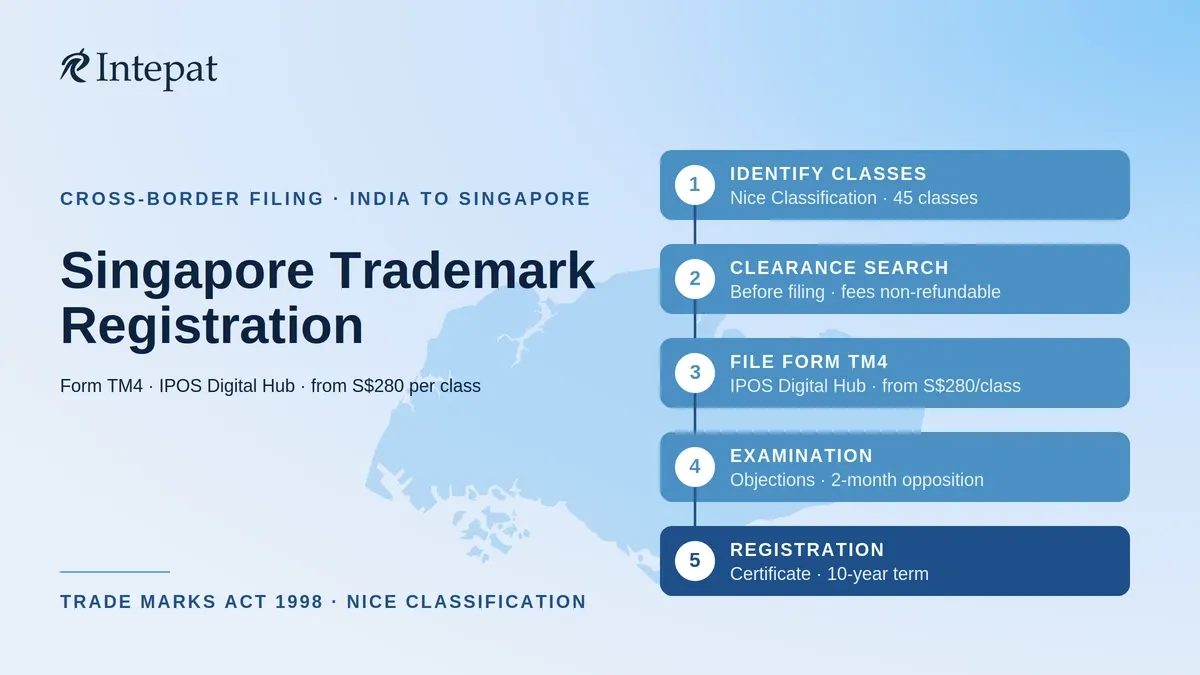
To register a trademark in Singapore, file Form TM4 with the Intellectual Property Office of Singapore (IPOS) through the IPOS Digital Hub, pay from S$280 per class, clear examination and a two-month opposition window, then hold protection for ten years. From India, you can file directly with IPOS or designate Singapore through the Madrid Protocol.
This Singapore trademark registration guide is written for Indian businesses and reflects IPOS practice and fees as at May 2026. It covers Singapore law and procedure, administered by IPOS under the Trade Marks Act 1998, alongside the two filing routes that an applicant based in India actually chooses between.
| The short version for India-based filers |
| First, the blocker: you need a Singapore address for service. Without a Singapore login (Singpass or Corppass), you file through a Singapore agent or an Indian IP firm coordinating with a Singapore associate. Two routes in: file a national application directly at IPOS, or designate Singapore through a Madrid application built on your Indian trademark. Official application fee: S$280 per class (descriptions from the IPOS pre-approved database) or S$410 per class (non-standard descriptions), as at May 2026. This is the official fee only; agent and coordination charges are separate.Protection runs for ten years from the filing date and is renewable.A smooth application reaches registration in roughly nine months; objections or opposition extend that. |
Can an Indian company file in Singapore by itself?
Yes, but only if it has IPOS Digital Hub access (a Singpass or Corppass login) and a Singapore address for service. Most Indian businesses without a Singapore presence file through a Singapore agent, or through an Indian IP firm that coordinates with a Singapore associate. Appointing the agent carries no IPOS fee; the agent’s professional charges are separate.
Why Indian businesses register a trademark in Singapore
Singapore is a common first overseas filing for Indian brands because it is a regional trading hub, a frequent base for holding companies, and a jurisdiction with an established system for enforcing trademark rights. A trademark registered at IPOS gives the owner exclusive rights in Singapore only; it does not extend to Malaysia, Indonesia, or anywhere else in the region, so each market needs its own protection. That territorial limit is the reason filing strategy, not just the filing itself, matters.
Registration is also what makes enforcement possible. Without it, an Indian business relies on the common-law action of passing off, which requires proving goodwill, misrepresentation, and damage, and is harder and slower than suing on a registered right. Registration converts brand reputation into a property right that can be licensed, assigned, or used as the basis for a border-enforcement recordal.
For Indian brands selling through Singapore distributors, regional e-commerce platforms, or marketplace channels, a registered Singapore mark also gives a concrete basis for takedown requests, distributor negotiations, and brand-control discussions, though each platform applies its own internal rules. The registration may also support later international strategy where the applicant has the entitlement to use Singapore as a Madrid office of origin, through nationality, domicile, or a real and effective business establishment there. For most India-based applicants, the Madrid route is instead filed through the Indian Trade Marks Registry on the Indian base mark, which is covered next.
| Singapore is not ASEAN-wide protection. A Singapore trademark protects the mark only in Singapore. It does not cover Malaysia, Indonesia, Thailand, Vietnam, the Philippines, or other ASEAN markets. Each country needs its own national filing or a Madrid designation. |
There is one timing point worth holding onto. If you have already filed the same mark in India, you can claim that earlier Indian filing date in Singapore by filing within six months of it, using the priority mechanism in the Paris Convention to which both countries belong. Do not treat Singapore as a later housekeeping task: the six-month window is strict, and once it closes you can still file in Singapore but you lose the ability to claim the Indian filing date.
Direct IPOS filing or Madrid from India: which route
An Indian applicant reaches Singapore by one of two routes, and the choice is worth making deliberately. The first is a national application filed directly with IPOS. The second is an international application under the Madrid Protocol, filed through the Indian Trade Marks Registry as your office of origin and designating Singapore as a destination. India and Singapore are both members of the Madrid system, so the designation route is available.
The Madrid route is built on a home mark. Under Section 36D of the Trade Marks Act 1999, an Indian basic application or registration is used as the basis for the international application, and you can add other countries in the same filing. The trade-off is dependency: the same provision means that if the Indian base mark is withdrawn, cancelled, or finally refused within five years, the international registration tied to it ceases to that extent. After five years, the international registration becomes independent of the Indian base mark.
What “central attack” looks like in practice. If your Indian base application is finally refused for Class 35 within the five-year dependency period, the Singapore Madrid designation can also fall away for the corresponding Class 35 goods or services. This is why a direct IPOS filing is usually safer where the Indian mark is still under objection or opposition.
A direct IPOS filing carries no such dependency. It stands on its own from day one. The table below maps common situations to the route that usually fits; it is general guidance, not a fixed rule, and a borderline case is worth discussing with an agent.
| Your situation | Route that usually fits |
| Only Singapore is required | Direct IPOS filing |
| The Indian mark is under objection or opposition | Usually direct IPOS filing |
| The same mark is being filed in several countries | Madrid may be more efficient |
| Priority from the Indian filing is still within six months | Either route, but decide quickly |
| You need a Singapore right not linked to the Indian base mark | Direct IPOS filing |
| The Indian base mark is clean and stable | Madrid can be considered |
Our Madrid Protocol guide sets out the international route in full, and if a designation later draws an objection in Singapore, responding to a provisional refusal follows its own procedure.
Filing the Madrid route from India: a quick checklist An Indian basic application or registration, with its number. The same applicant name as the Indian base mark.The same mark representation as the Indian base mark.Goods and services no broader than the Indian base specification.Singapore selected as a designated contracting party.WIPO fees in Swiss francs, plus the Indian handling and certification charges.Awareness that the Singapore designation depends on the Indian base mark for five years.
What qualifies for registration in Singapore
A Singapore trademark must be a sign capable of being represented and capable of distinguishing your goods or services from those of others. Words, logos, shapes, colours, and sounds can all qualify, provided the mark does the work of telling buyers where the product comes from. The registrability questions IPOS asks track the absolute grounds familiar to any trademark system.
A mark is likely to be refused if it is not distinctive, if it consists only of signs that describe the goods or services (for example “best” or “cheap”), or if it uses terms that are customary in the trade or in everyday language. It may also be refused on relative grounds if it is identical or confusingly similar to an earlier mark already on the register for related goods or services. Descriptive and generic choices are the most common cause of avoidable objections, which is why the clearance step below earns its place.
The Singapore trademark registration process, step by step
The path from filing to certificate runs through the same stages for every applicant, whether you file directly or arrive through Madrid. The steps below describe a direct national filing at IPOS.
Identify your classes
Singapore follows the Nice Classification, with 45 classes covering goods (classes 1 to 34) and services (classes 35 to 45). Select every class your business uses now, and consider the classes you realistically expect to enter, because you cannot widen the scope of a filed application later. A single application can cover several classes, with a separate fee for each.
Run a clearance search
IPOS application fees are not generally refundable, so a search before filing is money well spent. For an Indian applicant, clearance should not stop at an exact IPOS search: check identical, phonetic, visual, and conceptually similar marks in Singapore, and where a Madrid or multi-country strategy is in view, also review the WIPO Global Brand Database and TMview. A proper trademark clearance search reduces the chance of a relative-grounds objection or a later opposition.
File Form TM4 on the IPOS Digital Hub
Applications are filed online through the IPOS Digital Hub using Form TM4. For an Indian applicant, keep these details ready before you start:
- the applicant’s full legal name exactly as per company, LLP, or proprietor records, and the principal place of business;
- the brand name, logo, or device file as a clear representation of the mark;
- the goods or services used or intended in Singapore, sorted into their Nice classes;
- the Indian trademark application or registration details, if claiming priority or filing through Madrid;
- priority claim details, if filing within six months of the Indian filing date;
- authorisation for the Singapore agent, where one is appointed; and
- transliteration or translation details for non-English words, Indian-script elements, or coined words with a meaning.
Wherever possible, pick your descriptions from the IPOS pre-approved classification database: doing so secures the lower fee and tends to move the application through examination faster. If you are filing a single mark across multiple classes, each class is costed separately, and an objection raised against one class can hold up the whole multi-class application. Where one class looks vulnerable to objection, filing it as a separate application can keep the clean classes moving.
Examination and any objections
IPOS carries out a formalities check and then a substantive examination against the registrability grounds. Where the mark covers a pharmaceutical product, the examiner also checks that it is not an International Non-proprietary Name from the World Health Organization list. If the examiner raises objections, IPOS issues a report, and you have four months to respond, a period that can be extended by filing Form CM5. Miss that deadline and the application is treated as withdrawn, though a further two-month window to request continued processing remains available on payment of a fee.
If IPOS objects. The usual response is written submissions, amending or limiting the goods or services where appropriate, filing consent or evidence of distinctiveness where relevant, or requesting a hearing. A Singapore address for service is required to respond through the IPOS Digital Hub, which is another reason most Indian applicants act through an agent. The same four-month response period applies to a Madrid designation that draws a provisional refusal.
Publication and the opposition window
Once the mark is accepted, IPOS publishes it in the Trade Marks Journal. For two months from publication, any party who believes the mark should not be registered may file a notice of opposition in Form TM11. If an opposition is filed, you receive a copy and respond with a counter-statement, generally within two months. Many applications pass this window without an opposition being filed.
Registration and the certificate
When the opposition window closes with no opposition, or after you have seen one off, the mark proceeds to registration and IPOS issues a registration certificate. Protection dates back to the filing date, so the rights you enforce run from when you applied, not from the day the certificate issues.
Singapore trademark fees, agent costs, and timeline
The headline cost is the per-class application fee, and it turns on one choice: whether your goods and services descriptions come entirely from the IPOS pre-approved database. The figures below are the official IPOS fees as at May 2026 and are stated per class, so a two-class filing doubles the application fee.
| Item | Form | Fee (per class, as at May 2026) |
| Application, pre-approved descriptions | TM4 | S$280 |
| Application, non-standard descriptions | TM4 | S$410 |
| Amend specification, class, or priority claim | TM27 | S$60 |
| Notice of opposition | TM11 | S$420 |
| Renewal on or before expiry | TM19 | S$480 |
| Late renewal | TM19 | S$700 |
These are official IPOS fees in Singapore dollars, and they are only one part of an Indian applicant’s budget. Plan separately for Singapore agent charges, Indian professional coordination, currency conversion, and bank or remittance costs. Because exchange rates and fees move, treat any rupee estimate as indicative and confirm the current figures before you commit.
On timing, IPOS indicates that a trademark can register in about nine months where the application has no deficiency and faces no objection or opposition. In practice, objections, oppositions, and back-and-forth on the specification extend that, and applicants commonly plan for a window of several months to roughly a year. IPOS has an acceleration programme, SG Trade Marks Fast, but acceptance of new acceleration requests is suspended from 4 January 2026 until further notice. Fees and processing times are set by IPOS and change from time to time, so confirm the current figures on the IPOS forms and fees page before you file.
| Filing in Singapore? Intepat runs direct IPOS filings and Madrid strategy for Indian businesses, end to end. |
| Discuss your route → |
Renewal, non-use risk, and use of the registered mark
A Singapore registration lasts ten years from the filing date and can be renewed for successive ten-year terms by filing Form TM19, with the renewal window opening six months before expiry. Let it lapse and the registration can be removed from the register, so a renewal diary is part of owning the right.
Registration is not the end of your obligations. A registered mark that is not genuinely used in Singapore for five continuous years can be exposed to revocation for non-use under the Trade Marks Act 1998, and use should be of the mark as registered. It is also worth understanding the difference between the R and TM symbols: the encircled R signals a registered mark and should be used only once registration is granted in the relevant territory.
The bottom line for Indian businesses
Use a direct IPOS filing where Singapore is the main target or the Indian mark is not yet stable; use Madrid where the Indian base mark is solid and the same brand is going into several countries at once. Either way, budget for Singapore address-for-service handling, and if you are claiming priority from an Indian filing, move within the six-month window. If you are also weighing other markets, our guide on the trademark registration process in India and our global IP filing service cover the wider strategy.
Frequently asked questions
How much does Singapore trademark registration cost?
Singapore trademark registration costs S$280 per class when the goods and services descriptions are taken entirely from the IPOS pre-approved database, or S$410 per class for non-standard descriptions, as at May 2026. Each class is charged separately, and professional agent fees are additional to these official IPOS fees.
Can an Indian company register a trademark in Singapore directly?
Yes. An Indian company can file a national application directly with IPOS, but it must have a Singapore address for service. A foreign applicant without a Singpass or Corppass login and a local address must appoint a Singapore agent to transact with IPOS on its behalf.
Should I file directly at IPOS or use the Madrid Protocol?
A direct IPOS filing stands on its own and suits applicants who need only Singapore or whose Indian mark is under challenge. The Madrid route, built on your Indian mark, is convenient for filing in several countries at once but carries a five-year dependency on that Indian base mark.
How long does it take to register a trademark in Singapore?
IPOS indicates that an application with no deficiency, objection, or opposition can register in about nine months. Objections, opposition proceedings, and amendments to the specification extend that timeline, so many applicants plan for a period of several months up to roughly a year.
How long does a Singapore trademark last?
A Singapore trademark is protected for ten years from the date of filing under the Trade Marks Act 1998. It can be renewed for further ten-year periods by filing Form TM19, with the renewal window opening six months before expiry. An unrenewed registration can be removed from the register.
What happens if I miss the deadline to answer an objection?
If you do not respond to an IPOS examination report within four months, the application is treated as withdrawn. Continued processing is then available for a further two months through Form CM13, which currently attracts an S$100 official fee, and the original four-month deadline can be extended in advance by filing Form CM5.
Disclaimer: This guide explains Singapore trademark registration for general informational purposes and reflects IPOS practice, fees, and Singapore law as at May 2026. Fees and procedures set by IPOS change from time to time; confirm current figures on the official IPOS website before filing. Cross-border filing decisions depend on your specific facts, and this guide is not a substitute for advice from a qualified trademark agent or attorney.