




A provisional patent application in India is filed with a provisional specification, which describes the invention and need not contain claims. It secures a filing date for what it discloses, costs ₹1,600 to e-file for individuals, startups, small entities and educational institutions, and needs a complete specification within 12 months or the application is treated as abandoned.
The route exists under the Patents Act, 1970 and the Patents Rules, 2003, and it is the usual first step for Indian startups and inventors who want a date on record before a launch, a demonstration or an investor meeting, while the invention is still being developed. It is not available for a convention application claiming foreign priority, a national phase application under the Patent Cooperation Treaty (PCT) or a divisional application; each must be filed with a complete specification.
This guide explains what the provisional specification must contain, how to file it, the forms and official fees, the 12-month deadline and what happens if it is missed, and the mistakes that turn a cheap first filing into a lost priority date. For the full route from filing to grant, see the patent filing procedure in India.
Quick answer: File Form 1 (the application) and Form 2 (the provisional specification), adding Form 28 if a startup, small entity or educational institution claims the reduced fee, through the IP India e-filing portal; pay ₹1,600 (individual, startup, small entity or educational institution) or ₹8,000 (other applicants) for up to 30 pages; then file the complete specification within 12 months. There is no extension of the 12 months, and matter first disclosed in the complete specification does not get the provisional’s date.
Provisional Patent Application: Key Facts at a Glance
The table below sets out the facts a first-time filer needs before opening the e-filing portal. Every figure is from the fee schedule as substituted in March 2024 (e-filing unless stated), verified as of September 2026.
| Item | Detail |
| What it is | An application filed with a provisional specification (Form 2) that describes the invention; claims are not required |
| Forms at filing | Form 1 (application) and Form 2 (provisional specification); Form 28 for a startup, small entity or educational institution |
| E-filing fee | ₹1,600 for a natural person, startup, small entity or educational institution; ₹8,000 for other applicants (up to 30 pages; extra sheets ₹160 or ₹800 each, excluding sequence-listing pages) |
| Physical filing fee | ₹1,750 or ₹8,800 |
| Deadline for the complete specification | 12 months from the filing date; no extension; the application is treated as abandoned if missed |
| What gets the provisional’s date | Only claims fairly based on the provisional, meaning claims its own description already supports rather than claims resting on matter added later |
| “Patent pending” | May be used from the filing date |
| Not available for | Convention applications, PCT national phase applications and divisional applications: each must itself be filed with a complete specification, though a divisional may still be based on matter disclosed in a provisional |
What a Provisional Specification Is and Why Filing One First Can Help
A patent application in India may be filed with either a provisional or a complete specification. The provisional describes the invention; the complete specification describes it fully, discloses the best method known to the applicant, and ends with the claims that define the protection sought.
The provisional is the technical record of what you had on the filing date; the claims come later.
The date matters because Indian patent law is first to file. A claim in the later complete specification takes the provisional’s filing date if it is fairly based on what the provisional disclosed, and, provided the complete specification is filed or proceeded with, use in India, or publication anywhere, of the matter the provisional described, after that date, cannot by itself be a ground to refuse or invalidate the patent for that matter. That is the whole value of the route: it lets you disclose, demonstrate and pitch after filing without losing the date, while you finish the work.
The price of the route is the 12-month clock. The complete specification must be filed within 12 months of the provisional filing date, and if it is not, the application is treated as abandoned and the date is gone. There is no extension for this deadline. Where the invention is already fully defined and the claims are ready, filing the complete specification directly saves a step and a second drafting cost.
Two lesser-known options sit alongside the route. A complete specification filed first may, on the applicant’s request made within 12 months of the date the application was filed, be directed by the Controller to be treated as a provisional, an option not open to convention or PCT applications, which suits applicants who filed in a hurry and then developed the invention further. And where two or more provisionals in the same applicant’s name describe closely related inventions, or one is a modification of another, the Controller may allow one complete specification to cover all of them if they form a single invention, but the 12 months then runs from the earliest provisional, not the latest.
What Must a Provisional Specification Contain?
A provisional specification must describe the invention and begin with a title that indicates its subject matter. Claims are not required, and the Patent Office Manual advises against including them, because the provisional exists to fix a date for a disclosure rather than to define a monopoly.
Everything else in the list below is drafting practice aimed at one outcome: that the claims you file within the year are fairly based on what the provisional says.
Title. Brief and indicative of the subject matter; the Manual suggests not more than fifteen words.
Preamble. The Manual directs that the first page of Form 2 carry the applicant’s name, address and nationality and, for a provisional, the preamble “The following Specification describes the invention”.
Description. This is the substance. Describe what the invention is, what problem it solves, how it is built or carried out, and the variants you already foresee. A concept note of a few paragraphs fixes a date only for the concept; a claim to a specific mechanism, composition or method will not be fairly based on it, and that claim will take the later date of the complete specification instead.
Drawings. Where the invention needs drawings to be explained, the Rules require them to be supplied, and the Controller (the Patent Office officer who decides the application) may call for them in any case. Where the invention has a physical form or a process flow, drawings are the cheapest way to put detail on record, and the complete specification can adopt them by reference.
What you do not need: claims, an abstract, or a statement of the best method. Those belong to the complete specification. Draft the provisional as if it were the description section of the final document, minus the claims, and the 12-month window becomes a real drafting buffer rather than a race to reconstruct what was in the inventor’s head a year earlier.
For how the complete specification is structured, see Understanding the Patent Specification of an Invention, and for claim structure and types, see Patent Claims: Structure and Types.
Which Patent Office You File At
India’s patent office has a head office and branch offices, and the appropriate office for an application is fixed by where the applicant (or the first-named joint applicant) normally resides, is domiciled or has a place of business, or where the invention actually originated.
An applicant with no domicile or place of business in India files at the office serving the address for service given in India, which in practice is the patent agent’s address.
Once fixed, the appropriate office does not ordinarily change for that application. The point is administrative rather than strategic: the office follows from the applicant’s residence, domicile or place of business, or the place the invention actually originated, and not from any choice the applicant makes at filing.
Step by Step: How to File a Provisional Patent Application in India
A patent agent must file all documents by duly authenticated electronic transmission, in practice through the IP India e-filing portal, and any document called for in original must be lodged within fifteen days; applicants filing in their own name use the same portal. Where physical filing is otherwise permitted, the higher fee the schedule prints for that mode applies.
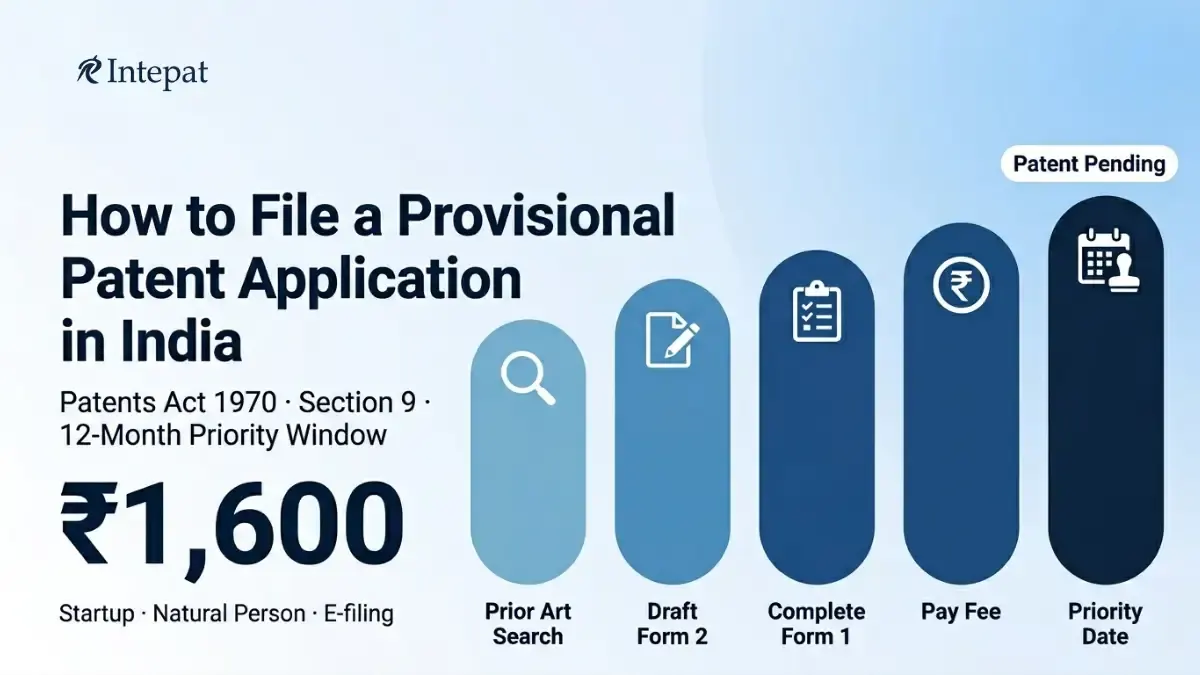
- Search first. Search Indian and international databases before filing to test novelty, using InPASS (the Indian Patent Advanced Search System) and WIPO Patentscope. A provisional filed on an invention already published buys nothing. Novelty is not the whole test: mathematical and business methods, algorithms and computer programmes per se, which the Act says are not inventions, cannot be patented in India, so settle that question with a registered patent agent before spending on drafting.
- Draft the provisional specification on Form 2, with the title, description and drawings, written broadly enough to support the claims you expect to file within the year.
- Complete Form 1, the application for grant of a patent: applicant and inventor details, the title, and the applicant category. A separate guide covers who should be named as applicant.
- Attach Form 28 if the applicant is a startup, small entity or educational institution claiming the reduced fee. The requirement applies to every document for which a fee is specified, not only the filing. A natural person pays the reduced fee without Form 28.
- If a patent agent files for you, the authorisation on Form 26 (or a power of attorney) is due within three months of the application; until it is on record, no action is taken on the application.
- Pay the official fee online at filing, according to the applicant category and the page count.
- Submit. The application number and filing date issue on submission, and the filing date is the date your later claims will look back to, to the extent they are fairly based on what the provisional disclosed. From that date you may mark the invention “patent pending”.
The forms not needed at this stage are Form 5 (declaration of inventorship), which is filed with the complete specification or, on request, within one month after it; Form 3 (the statement of foreign applications), due within six months of filing but only where a corresponding application exists or is filed abroad.
Form 9 (early publication) in practice follows the complete specification, and the examination requests on Forms 18 and 18A belong to the complete-specification stage. The Patent Deadline Tracker holds all of these dates from the provisional filing date.
Provisional Patent Filing Fees in India
The official fee for a provisional application is the fee for filing an application for a patent, whichever specification accompanies it, and it is the same fee you would pay for a complete specification.
The figures below are from the fee schedule as substituted by the Patents (Amendment) Rules, 2024, for a specification of up to 30 pages, verified as of September 2026.
| Applicant category | E-filing | Physical filing |
| Natural person | ₹1,600 | ₹1,750 |
| Startup (recognised under the Startup India initiative, or a foreign entity meeting its turnover and incorporation-period criteria and filing a declaration) | ₹1,600 | ₹1,750 |
| Small entity (an enterprise whose investment in plant and machinery, or in equipment for a service enterprise, is within the medium-enterprise limit under the Micro, Small and Medium Enterprises Development Act, 2006) | ₹1,600 | ₹1,750 |
| Educational institution (a university established or incorporated under a Central, Provincial or State Act, or another institution recognised by an authority designated by the Central Government, a State Government or the Union territories) | ₹1,600 | ₹1,750 |
| Other applicants (companies and other entities) | ₹8,000 | ₹8,800 |
Each sheet of specification beyond 30, excluding sequence-listing pages, costs ₹160 (reduced category) or ₹800 (others) by e-filing. Where an eligible applicant files jointly with a company, the higher fee applies. The complete specification filed after a provisional attracts no further application fee; the excess-page, excess-claim and sequence-listing page charges still apply to it. Estimate the full cost, including the complete specification and later stages, with the Patent Fees Calculator.
Worked example: a startup recognised under the Startup India initiative e-filing a 30-page provisional pays ₹1,600 to the Patent Office, plus the patent agent’s drafting and filing charges, which are a separate professional fee. The schedule also charges for each claim beyond ten (₹320 or ₹1,600 by e-filing), which becomes relevant when the claims arrive with the complete specification. For the wider cost and timing picture, see the guide to patent filing for startups in India.
DPIIT-Recognised Startups: The SIPP Scheme
Startups recognised by the competent authority under the Startup India initiative (in practice, DPIIT recognition) may be eligible for facilitator support under the Scheme for Facilitating Startups Intellectual Property Protection (SIPP), under which the government engages empanelled IP facilitators to help startups file and prosecute applications. Intepat IP is an empanelled facilitator under the scheme.
The scheme runs for notified periods; the last extension published by the Office ran to 31 March 2026, and its terms and current status are set out on the IP India SIPP page. Confirm them there before relying on facilitator support. Separately from SIPP, a recognised startup pays the reduced Patent Office fee shown above and may request expedited examination once the complete specification is on file.
The 12-Month Deadline and What Happens After You File
Filing the provisional starts one clock that matters above all others: the complete specification is due within 12 months of the filing date. Miss it and the application is treated as abandoned.
The deadline cannot be extended, and post-dating an application, which the Act allows for up to six months in some circumstances, is expressly subject to the 12-month rule and does not extend it.
Two other dates start at filing. If you have filed or will file for the same invention abroad, the statement of foreign applications on Form 3 is due within six months of the Indian filing date, and it must be updated within three months of the first examination report. And the 12 months is also the window for filing abroad: a PCT application may claim the priority of an earlier application filed in a Paris Convention country, on the conditions the Paris Convention sets, and the twelve-month convention period is the one Indian law itself applies to incoming convention applications, so a PCT or foreign application should be filed within 12 months of the Indian provisional.
What if the invention changes during the year? You may add detail, variants and improvements in the complete specification; the Act expressly allows claims to developments of and additions to what the provisional described, provided the applicant would be entitled to apply for them separately on the same footing as for a fresh application. Those additions, and any claim not fairly based on the provisional, take the later date. If the direction of the work changes substantially, discuss with a registered patent agent whether to file a second provisional and combine them; remember that the 12 months for the combined complete specification then runs from the earliest provisional. Once the complete specification is on file, the application is published 18 months from the priority date or the filing date, whichever is earlier, and the request for examination is due within 31 months of that same date.
Key Advantages of Filing a Provisional Application
Date secured immediately. From the filing date, the disclosed invention is on record, and once the complete specification is filed, claims fairly based on the provisional take the provisional’s filing date as their priority date.
Lower initial cost. The Patent Office fee is the same as for a complete specification, but the drafting cost is lower because claims are not required, and the second drafting cost is deferred until the invention has settled.
Twelve months to refine and test. Develop the invention, test the market, and talk to investors and co-founders before committing to the cost of a complete specification and prosecution.
“Patent pending” as a signal. The words may be used from the filing date and tell the market that an application is on file. They are a notice, not a right: no infringement action can be brought until the patent is granted.
Foundation for foreign filing. A PCT application may claim the priority of the Indian provisional, on the conditions the Paris Convention sets, and foreign filings are in practice made within 12 months of the Indian date for that reason.
Freedom to publish or present. Provided the complete specification is filed or proceeded with, use in India, or publication anywhere, of matter described in the provisional, after the provisional’s date, cannot by itself be a ground to refuse or invalidate the patent for that matter, so conferences, papers and trade shows can go ahead once the provisional is on file.
Five Provisional Patent Filing Mistakes to Avoid
Each of the five mistakes below costs the applicant the very thing the provisional was filed to secure: the date. None of them is a drafting subtlety; each is a decision made at filing or in the twelve months after it, and each has a simple rule that avoids it.
- Filing a thin or vague provisional. A short concept note fixes a date only for the concept. Claims to the mechanism, composition or method that give the patent its value will not be fairly based on it and will take the later date, or fail on prior art published in between. Treat the provisional as a near-final description and add only the claims later.
- Missing the 12-month deadline. There is no extension, and the Act treats the application as abandoned. Calendar the date on filing; in Intepat’s experience, six to eight weeks of drafting and review time before the deadline is a realistic buffer.
- Disclosing before filing. India tests novelty against anything published or used anywhere in the world before the filing date of the complete specification, and a claim fairly based on the provisional looks back to the provisional’s date only. A pitch deck without an NDA, a product listing or a social media post before filing can destroy novelty. A narrow grace period exists for display at a notified exhibition or a paper read before a learned society, but only if the application is made within twelve months of the exhibition opening or of the reading or publication of the paper; it is claimed on Form 31 with a fee, and it is not a substitute for filing first.
- Assuming the provisional and the complete specification can diverge freely. A claim not fairly based on the provisional loses the earlier date for that claim. The complete specification builds on the provisional; it cannot move to a different invention.
- Treating it as a placeholder. The absence of claims does not make the provisional a placeholder. In India it is the document your later claims will be measured against for fair basis, so the quality of the disclosure decides whether those claims obtain its date.
Patents (Amendment) Rules, 2024: What Changed for Applicants Filing Now
The Patents (Amendment) Rules, 2024 came into force on 15 March 2024, and several of their changes reach every applicant filing a provisional today. The substituted fee schedule applies at the provisional filing itself; the procedural changes below fall due at or after the complete-specification stage, so an applicant filing now meets them over the life of the application.
The request for examination is now due within 31 months of the priority date or the filing date, whichever is earlier, down from 48 months. The grace period for disclosure at a notified exhibition or before a learned society, available where the application is made within twelve months of that disclosure, is now claimed on Form 31 with a fee. A discretionary request to extend time or condone delay on Form 4 costs ₹10,000 a month by e-filing for a natural person, startup, small entity or educational institution and ₹50,000 a month for others, and it does not reach the 12-month deadline for the complete specification.
A divisional application may be filed for an invention disclosed in the provisional, the complete specification or an earlier divisional. And an inventor of a patent in force may request a certificate of inventorship on Form 8A, with a fee.
For what happens after the complete specification is filed, from examination to grant, see the request for examination guide and Patent Examination in India.
Start Your Provisional Patent Application
A provisional patent application costs ₹1,600 to e-file for an individual, startup, small entity or educational institution, secures the filing date for everything it discloses, and gives you 12 months to settle the claims.
The route works when the provisional is drafted with the depth of a final description; a thin one creates a risk that follows the application through examination. If you are ready to file, or want to know whether a provisional or a complete specification is the right first step, a registered patent agent can assess the invention and draft a specification that will support the claims you need.
Frequently Asked Questions
Yes. The Act lets an applicant draft the specification and act before the Controller, and the portal accepts own-name filings. An applicant with no place of business or domicile in India gives an Indian address for service, usually a patent agent’s. Applicants commonly engage an agent, because the provisional must support the claims filed within the year.
Not on its own. An application is published after 18 months from the earliest of its priority and filing dates, and an application abandoned for want of a complete specification is not published at all. The applicant may request early publication on Form 9, at ₹2,500 or ₹12,500 by e-filing depending on the applicant category.
The application is treated as abandoned and the filing date is lost. No extension exists for this deadline, the general power to condone delay does not reach it, and post-dating cannot extend it. You may file a fresh application, but it takes its own new date, and anything you published in between counts against it.
Yes. The Act allows claims to developments of and additions to what the provisional described, where the applicant would be entitled to apply for them separately. Claims fairly based on the provisional keep its date; claims resting on new matter take the date of the complete specification, and must meet novelty and inventive step on that later date.
After the complete specification is filed within 12 months, the application is published 18 months from the earlier of the priority and filing dates, and the request for examination is due within 31 months of that same date. In Intepat’s recent prosecution experience the whole route has typically taken three to six years from the filing date.
Possibly, under the SIPP scheme, which engages empanelled facilitators to assist recognised startups with filing and prosecution; Intepat is an empanelled facilitator. The scheme runs for notified periods (the last published extension ran to 31 March 2026); confirm current terms on the IP India SIPP page. Separately, a recognised startup pays the reduced fee of ₹1,600 for e-filing.
No. “Patent pending” is a notice that an application has been filed; it is not a right. No infringement proceedings can be brought until the patent is granted. Once granted, the patentee has the same privileges from the date the application was published, so damages can reach back to publication, but not to the provisional filing date.
Legal Disclaimer
This post is for informational purposes only and is not legal advice. Statutory provisions are cited for reference based on the Patents Act, 1970 and Patents Rules, 2003 as they stand at September 2026, verified against the instruments listed under Sources, including the Patents (Amendment) Rules, 2024. Laws and procedures may change; verify current requirements with a registered patent agent before acting.