




A US patent grants nationwide rights from the USPTO under a first to file system with a one year grace period for the inventor’s own disclosures. A European patent, granted by the EPO, reaches up to 40 member states through national validation, or, since 2023, an 18-state Unitary Patent enforced by the Unified Patent Court.
USPTO is short for the US Patent and Trademark Office, and EPO for the European Patent Office. The two systems also differ on best mode, publication, and how a granted patent can be challenged. This comparison covers US patent law under Title 35 of the United States Code and European patent law under the European Patent Convention, for any applicant weighing protection in both jurisdictions.
| Quick answer: |
| A US patent gives one nationwide right, with a one year inventor grace period and no real best mode penalty after the America Invents Act. A European patent gives no general grace period, needs country by country validation (or, since 2023, a single Unitary Patent across 18 EU states), and can be opposed for nine months after grant, alongside a separate set of challenge routes at the USPTO itself. |
Novelty and Grace Periods: US Patent vs European Patent Disclosure Rules
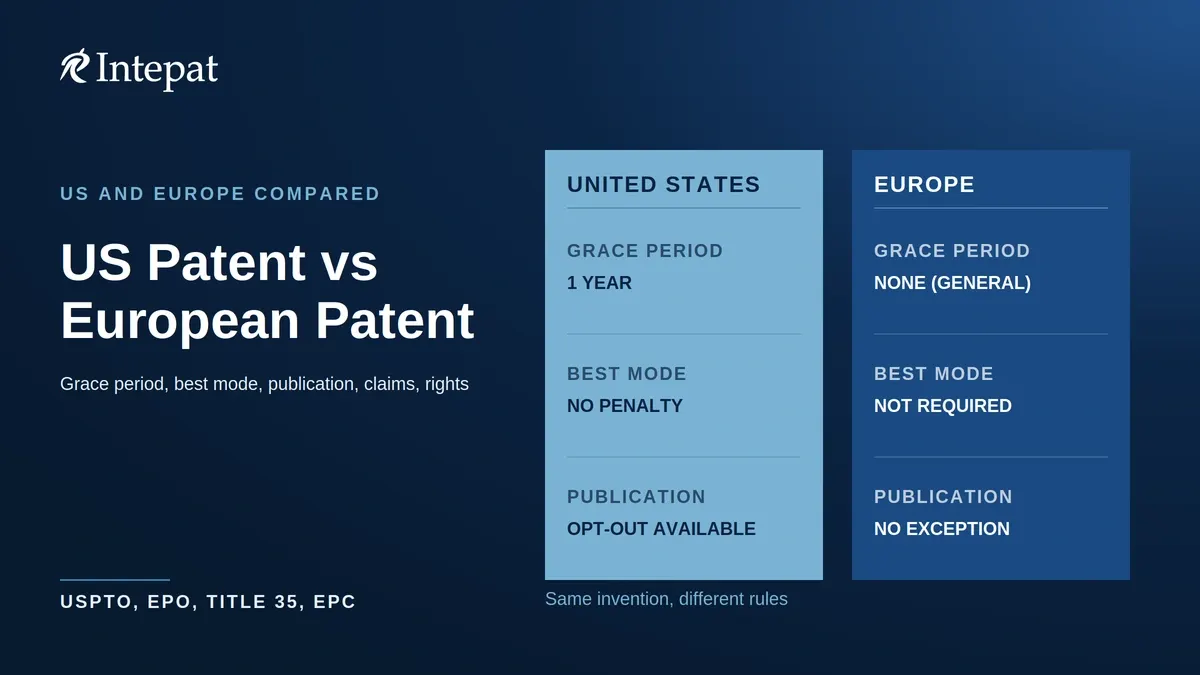
A European patent application is unpatentable if the invention forms part of the state of the art, meaning anything made public anywhere before the filing date. There is no general grace period. A narrow exception disregards a disclosure only if it happened within six months of the actual European filing date and resulted from an evident abuse against the applicant, or from displaying the invention at an officially recognised international exhibition, in which case the applicant must also declare this and supply evidence within a set period.
The USPTO applies a broader exception. US law gives a one year grace period: a disclosure made one year or less before the effective filing date is not prior art against the applicant’s own invention, provided it came from the inventor, from someone who obtained it from the inventor, or was already disclosed by the inventor before that. This exception does not apply in Europe: an inventor who discloses first and relies on the US grace period will usually have already destroyed novelty for a later European filing, since European law does not treat an inventor’s own routine disclosure as an exception outside the narrow abuse and exhibition grounds.
Who Owns the Invention: First-to-File Under Both Systems
Both offices now resolve competing claims to the same invention the same way: whoever files first owns it, regardless of who invented it first. The EPO has always worked this way; the USPTO moved to this position later. The Leahy-Smith America Invents Act was signed into law on 16 September 2011, but its first-inventor-to-file provisions did not take effect until 16 March 2013, and apply only to applications with an effective filing date on or after that date. Neither system leaves a true inventor without recourse: derivation proceedings in the US and the EPO’s entitlement procedure both let the true inventor reclaim priority from an earlier filer who derived the invention from them, though each is the exception, not the norm.
The priority date decides ownership in both systems, not the date of invention. The earliest filing, whether at the USPTO, at the EPO, or in another country later claimed as Paris Convention priority, sets the clock for everyone who comes after.
Patentability Standards: Non-Obviousness vs Inventive Step
Both offices ask a version of the same question after novelty: was the invention an obvious step from what came before? The USPTO applies a non-obviousness standard; the EPO applies its own inventive step standard through a problem-solution approach, starting from the closest prior art and the technical problem it solves. The two tests do not always reach the same answer on the same claim.
An argument that overcomes a US obviousness rejection does not automatically overcome an EPO inventive step objection raised on the same prior art. The EPO’s problem-solution approach anchors to one specific closest prior art document rather than a holistic view of the field, so arguments drafted for one office usually need reworking, not just resubmitting, for the other.
The Best Mode Requirement: No Longer a Ground for Invalidity in the US
The EPO has no best mode requirement. European law requires only that the application disclose the invention clearly and completely enough for a skilled person to carry it out, not the single best way of doing so.
The USPTO’s specification requirement still asks the applicant to set out the best mode contemplated for the invention at filing. Since the America Invents Act, that requirement has no enforcement teeth: failure to disclose the best mode is not a basis on which any claim can be cancelled, held invalid, or held unenforceable. The Act removed best mode as a ground for invalidity; it did not add one.
An applicant who omits the best mode still falls short of the letter of the law, but cannot lose the patent, or a later infringement suit, over that omission alone. An examiner can still raise the point during prosecution (the review process before a patent is granted), but the requirement no longer carries the invalidity risk it once did.
Publication Timelines, and the US Non-Publication Option
Both offices publish pending applications 18 months after the earliest priority date. Publication is not the same as grant, and neither office publishes an application withdrawn before the publication date. The EPO allows no exception once filed.
The USPTO allows one narrow opt-out. An applicant can request nonpublication at filing by certifying that the invention “has not and will not be the subject of an application filed in another country… that requires publication of applications 18 months after filing.” This route only works for applications that stay purely domestic, and it traps anyone who changes plans: certifying nonpublication, then later filing a corresponding Patent Cooperation Treaty (PCT, an international filing route) or European application, requires notifying the USPTO within 45 days of that foreign filing, or the US application is treated as abandoned. An applicant pursuing US protection alongside a PCT or European filing cannot make this certification truthfully from the outset, so publication happens on the ordinary 18-month schedule regardless.
Claim Drafting: Two-Part European Patent Claims vs Single-Part US Claims
A patent claim is the numbered sentence at the end of a filing that defines the legal boundary of what the patent covers, the part an infringement case actually turns on. The EPO generally expects claims in two parts: a preamble stating the invention’s subject matter with features already in the prior art, followed by a characterising portion, usually introduced with the phrase “characterised in that” or “characterised by,” setting out the new features. US practice does not require this structure, and most US applications use single-part claims, without separating prior art features from the inventive contribution.
Where a two-part European-style claim is carried over unchanged into a US filing, the pre-characterising portion can end up read as the applicant’s own admission of prior art on the US side. Claim sets are usually adapted for each office rather than filed identically in both.
US Patent Rights vs a European Patent: Nationwide Grant or National Bundle
A granted US patent gives its owner exclusive rights across all US territory from a single grant, for up to 20 years from the filing date. Nobody can make, use, sell, or import the invention in the United States without authorisation, enforced in the US federal courts under one body of law.
A European patent works differently at the point of grant. The EPO administers one examination and one grant, but for a classic European patent, that grant does not by itself create a single enforceable right. Instead, the patent has to be validated separately in each EPC member state where the applicant wants protection, then enforced state by state as a bundle of national patents under each state’s own courts. The EPC currently has 40 contracting states, as of June 2026, after Moldova’s accession as the 40th member on 1 June 2026, so validating everywhere is rarely worthwhile; the applicant chooses which states to validate in, trading broader coverage for higher cost. Since 2023, an applicant can also request unitary effect instead of validating state by state, covered next.
The Unitary Patent and Unified Patent Court: What Changed Since 2023
Since 1 June 2023, a granted European patent no longer has to be validated country by country for broad coverage. Within one month of grant, the applicant can instead request unitary effect, extending the patent across participating EU states under a single title, one renewal fee schedule instead of separate national fees, and centralised litigation before the Unified Patent Court (UPC). A Unitary Patent itself cannot opt out of the UPC. Classic, non-unitary patents fall under UPC jurisdiction by default during a transitional period (seven years from 2023, extendable to fourteen), unless the proprietor opts out, an election forfeited once any action is brought.
Unitary effect is not available everywhere the EPC reaches. It covered 18 EU member states as of mid-2026, after Romania’s ratification took effect on 1 September 2024. Spain, Poland, and Croatia are EU members that have not joined, and non-EU EPC states such as the UK, Switzerland, Norway, and Turkey cannot join at all, since the Unitary Patent is an EU-law instrument layered on an EPC grant, not the EPC itself. An applicant wanting coverage in a non-participating state still has to validate there separately.
Uptake has grown quickly: applicants requested unitary effect for 25.6% of all EPO-granted patents in 2024, up from 17.5% the year before. For a company weighing the cost of European protection against a single US patent, this changes the calculation: a single Unitary Patent covering 18 states, one renewal schedule, can now be cheaper and simpler to maintain than validating everywhere. That choice is worth making with counsel before the one-month window after grant closes. Intepat’s separate discussion of the Unitary Patent’s practical benefits and drawbacks goes further into that trade-off.
Challenging a Granted Patent: European Patent Opposition vs USPTO’s IPR and PGR
The EPO’s opposition procedure is a single route. Any person may oppose a granted European patent within nine months of publication of the grant in the European Patent Bulletin, on one of three grounds: lack of patentability, insufficient disclosure, or added subject matter beyond the application as filed. Both sides argue the case before the EPO, appealable to its Boards of Appeal, and a revocation binds every designated state at once.
The USPTO offers several post-grant routes. Ex parte reexamination lets a challenger submit evidence and then step back, with no further role in the proceeding. Since the America Invents Act, most contested challenges instead go through Inter Partes Review (IPR) or Post-Grant Review (PGR), adversarial trial proceedings before the Patent Trial and Appeal Board (PTAB), where both sides participate through to a final written decision, ordinarily within a year of institution, the point the case is formally accepted for review. IPR can be filed after the later of nine months from grant or the end of any PGR, on novelty or non-obviousness grounds based on patents or printed publications, and not more than a year after being served with an infringement complaint on that patent; PGR must be filed within nine months of grant but allows a broader set of grounds, closer to the EPO’s own scope. A losing challenger also pays a price the EPO’s “any person” opposition does not impose: it is barred, or estopped, from later raising, at the USPTO or in court, any ground it raised or reasonably could have raised.
Institution of either US proceeding is not automatic: the USPTO has applied materially tighter discretionary screening since an October 2025 policy shift centralised institution decisions in the Director’s office, so the formal availability of IPR and PGR is no guarantee a given challenge will be instituted. Check current practice before relying on either route.
Choosing Between the US and Europe: Why the PCT Route Is the Practical Default
For a typical applicant, the practical choice is rarely the US or Europe alone. Filing under the PCT preserves both national-phase options from a single international application, deferring the cost of committing to either system. The applicant then decides, closer to the 30-month US and 31-month EPO deadlines, how many EPC states to validate in, and whether unitary effect is worth the cost against a single US filing. A single international filing also keeps the priority date identical on both sides, which matters given how differently the two systems treat late disclosure. Intepat’s PCT application and PCT national phase services support the filings that follow.
Frequently asked questions about US and European patents
No. A European patent is granted by the European Patent Office under the European Patent Convention, a treaty separate from the European Union that includes non-EU members such as the UK, Switzerland, and Turkey. The Unitary Patent, available since 2023, is an EU-law instrument that sits on top of an EPC grant, for participating EU states only.
Yes. Once a classic European patent is validated, each national validation is renewed and enforced separately, so an owner can stop paying renewal fees in states that no longer matter and keep paying in the ones that do. A Unitary Patent does not offer this flexibility: it covers all participating states under one renewal fee, so it cannot be dropped in only some of them.
No. Grant still happens through the same EPC examination process. Unitary effect is an optional request made within one month of grant, extending that same grant across 18 participating EU states through a single renewal fee and centralised enforcement, instead of validating and renewing separately in each state.
Both systems cap the term at 20 years from the filing date, for both a US patent and a European patent. Both remain subject to periodic maintenance or renewal fees throughout that term, and neither term extends automatically for examination delays without a separate, specific mechanism.
The US allows a one-year grace period for the inventor’s own disclosure. The EPO does not treat an inventor’s own routine disclosure as an exception; only the narrow six-month allowance for evident abuse or an officially recognised exhibition applies. Disclosing before filing usually costs European rights even where US rights survive.
Not necessarily. Protection only stops others in the countries where the patent is in force, so the answer depends on where the invention will be made, sold, or licensed. Many applicants preserve both options with a single PCT filing, then commit to the US, Europe, or both closer to the 30-month and 31-month national-phase deadlines, once the commercial picture is clearer.
Yes. The usual route is the Patent Cooperation Treaty: file a single international application, then enter the US national phase and the European regional phase separately, each with its own deadline (30 months and 31 months from the earliest priority date respectively), fees, and, for Europe, the later choice between national validation and unitary effect.
This article explains US patent law and European patent law as at August 2026, for general information only, and is not legal advice in either jurisdiction. Patent office fees, deadlines, and procedures change; confirm current figures with the USPTO or the EPO as relevant before you file, and consult a registered patent agent or qualified IP practitioner for advice on your specific invention. Deadlines in this area are strict, and missing one, including the nine-month EPO opposition window or a PCT national phase deadline, can result in the permanent loss of rights.