




EV startups may seek patent protection for innovations in battery systems, battery management, motors, powertrains, and charging technology. For an EV startup filing in India, the practical questions are what is patentable under Indian law, how to reach grant faster, and what patents alone do not cover.
| Quick Answers |
| • A person resident in India must file the Indian application at least six weeks before any foreign filing (with no secrecy direction in force), or obtain prior written permission on Form 25 under Section 39; the exception in Section 39(3) applies where protection was first sought outside India by a person resident outside India • Request examination within 31 months of the priority or filing date, whichever is earlier • Startups and small entities qualify for expedited examination under Rule 24C • Different aspects of an EV product may require design registration, copyright protection, and confidential-information controls in addition to patents |
Where EV Patent Issues Commonly Arise
Patent filings in India crossed one lakh (110,375 applications) in the financial year 2024-25, according to the CGPDTM Annual Report. Electric mobility is among the sectors in which patent filings are being made, alongside broader clean-technology and manufacturing categories.
The technology areas where EV-related patent filings commonly arise include battery chemistry, battery management systems (BMS) and thermal management, motors and powertrain architectures, and charging infrastructure including battery swapping. Startups entering any of these areas should conduct both a patentability search (to assess whether the proposed invention appears new and inventive) and a freedom-to-operate (FTO) analysis (to assess whether the planned product can be commercialised without infringing enforceable third-party claims in the target market). A favourable patentability search does not, by itself, clear a product for commercial launch.
Government schemes such as PM E-DRIVE and the PLI-Auto and PLI-ACC programmes provide commercial incentives for EV manufacturing and battery production in India. These schemes do not change what is patentable, but they form part of the commercial context in which filing decisions are made.
What EV Startups Can Patent in India
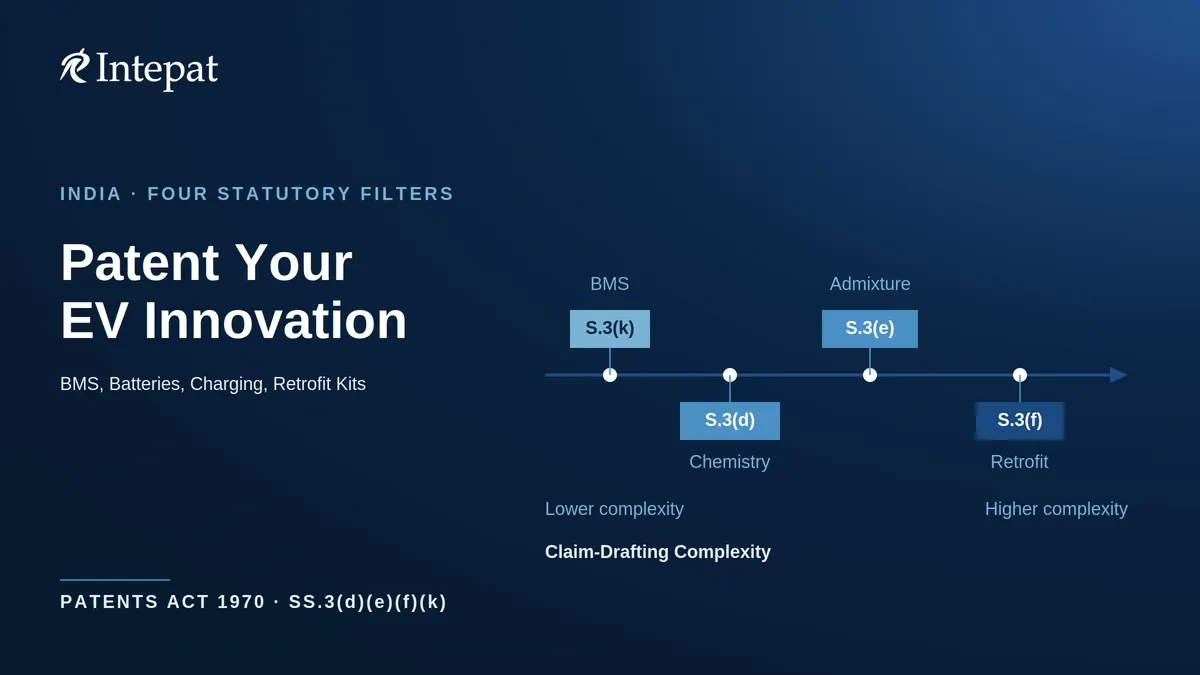
The most common misconception among EV founders is that software-driven components, particularly BMS algorithms, charging protocols, and telematics, cannot be patented in India because of Section 3(k) of the Patents Act, 1970. This overstates the exclusion.
Section 3(k) separately excludes algorithms and computer programmes per se from patentability. An algorithm running on a general-purpose computer, doing nothing beyond computation, falls within the exclusion. The algorithm itself does not become patentable merely because it is implemented in software or recited with standard hardware. However, a claimed BMS system or method may avoid the exclusion where, examined as a whole and in substance, its implemented technical features provide a specific and credible technical effect or technical contribution beyond ordinary computing. The CRI Guidelines applied by the Indian Patent Office confirm that novel hardware is not a prerequisite, but merely reciting a processor, controller, or sensor alongside an algorithm does not overcome the exclusion if the claimed invention, in substance, remains a computer programme per se. Surviving Section 3(k) does not by itself establish novelty, inventive step, sufficiency, or industrial applicability; those are separate inquiries. For a detailed treatment of how the Section 3(k) test operates in practice, see our guide to software patents in India and the CRI Guidelines 2025 analysis.
Battery chemistry claims face a different statutory filter. Section 3(d) excludes “the mere discovery of a new form of a known substance which does not result in the enhancement of the known efficacy of that substance.” The Explanation treats salts, esters, polymorphs, isomers, and other derivatives as the same substance unless they differ significantly in properties with regard to efficacy. This provision is engaged where the claimed subject matter falls within the known-substance/new-form framework. For a startup whose electrolyte or cathode composition does fall within this framework, the specification must demonstrate a measurable improvement tied to the relevant efficacy of the claimed invention, supported by an appropriate comparison. Properties such as cycle life, energy density, or thermal stability may be relevant, but they do not automatically establish enhanced efficacy.
Section 3(e) excludes substances obtained by mere admixture resulting only in the aggregation of properties. A composite electrode material that produces a synergistic performance gain can be distinguished from a mere admixture. The specification should include comparative data, as such data provides strong evidentiary support against a Section 3(e) objection.
Section 3(f) presents a risk for retrofit and conversion kit designs. It excludes “the mere arrangement or re-arrangement or duplication of known devices each functioning independently of one another in a known way.” A conversion kit that simply bolts an electric motor, controller, and battery pack to an existing ICE chassis, with each component functioning as it would independently, may fall within this bar. A kit whose components interact to solve a technical problem, for example, a regenerative braking integration that feeds energy back through a specifically designed circuit, can be distinguished from mere arrangement, but the claim drafting must make this interaction explicit. Overcoming Section 3(f) does not by itself establish novelty or inventive step.
Founders who understand these four filters before they begin drafting claims will file stronger applications and face fewer objections during examination.
How EV Startups Can Reach Grant Faster
Two procedural levers are underused by EV startups filing in India.
The first is the examination timeline itself. A request for examination must be filed within 31 months of the priority date or the filing date, whichever is earlier. If the request is not filed within this window, the application is treated as withdrawn. Under Rule 138, an extension or condonation of up to six months may be requested in Form 4 with the prescribed fee, subject to the Rule’s conditions and the Controller’s decision; this remedial route should not be treated as a routine planning tool. Applications filed before 15 March 2024 are governed by different deadlines. Founders who file provisionally and then wait are often surprised by how quickly the 31-month window closes once they account for the 12-month complete specification deadline and any priority claim.
The second is expedited examination under Rule 24C. Startups recognised by DPIIT, small entities, female natural person applicants, and several other categories qualify to file Form 18A and enter the expedited queue. Rule 24C prescribes shortened processing periods after referral to the examiner: the examiner’s report ordinarily within one month and not exceeding two months from the date of referral, the Controller’s disposal within one month, and the FER within fifteen days after disposal. Rule 24C does not prescribe when the Controller must initially refer every Form 18A request to the examiner and therefore does not guarantee FER issuance within a fixed period from filing Form 18A. Overall prosecution and grant timing may additionally be affected by objections, amendments, hearings, and pre-grant opposition. The proviso to Rule 24C(5) protects eligibility: a startup that has filed Form 18A does not lose its place in the expedited queue merely because it subsequently crosses the turnover threshold or its DPIIT recognition period lapses.
The expedited route is most effective when the complete specification is filed with the request for examination and the application is publication-ready. If the specification requires amendments after filing, the prosecution timeline extends regardless of queue position.
Startups and small entities also benefit from concessional filing and prosecution fees. The exact figures are set out in the First Schedule to the Patents Rules; Intepat’s patent fees calculator provides current figures for each filing stage.
When Foreign Filing Needs Permission First
EV startups with inventors or applicants resident in India frequently plan to file in the United States, Europe, or via the PCT system early in the product cycle. Section 39 of the Patents Act imposes a mandatory prerequisite that many first-time filers overlook. The obligation is triggered by the residence of the person making or causing the foreign filing, which can involve a more complex factual analysis where inventors, applicants, and filing instructions are spread across jurisdictions.
No person resident in India may make or cause to be made any application outside India for the grant of a patent for an invention unless one of two conditions is met. Either an application for the same invention has been filed in India not less than six weeks before the application outside India, and no secrecy direction under Section 35 is in force; or the applicant has obtained prior written permission from the Controller by filing Form 25 under Rule 71. The Controller is required to dispose of a Form 25 request within the prescribed period (ordinarily 21 days), subject to the defence/atomic-energy proviso.
Section 39(3) provides an exception: the section does not apply in relation to an invention for which an application for protection has first been filed in a country outside India by a person resident outside India. This exception may be relevant in multinational filing arrangements, but its application should be assessed from the identity, residence, and conduct of the persons who made or caused the first foreign application to be filed.
The consequences of non-compliance are twofold. Under Section 40, the corresponding Indian application is deemed abandoned, and any patent already granted on that application is liable to be revoked under Section 64. Separately, contravention of Section 39 attracts the penal provision under Section 118 (imprisonment up to two years, or fine, or both). For a startup whose Indian IP position may rest on a single patent family, filing-sequence planning with a patent agent is essential. For the full procedure, see our foreign filing licence guide.
What Patents Alone Do Not Protect in an EV
A patent protects functional innovation, but an EV product has protectable elements that fall outside patent scope.
Separate design applications may be considered for eligible visual features of vehicle bodies, charging equipment, and components. Registrability under the Designs Act, 2000 requires that the design meet the statutory definition, be new or original, must not have been disclosed to the public before the filing date or, where applicable, the priority date (subject to limited statutory exceptions), and must not fall within the exclusions for mode or principle of construction or mere mechanical devices. The protection term is ten years from the date of registration, extendable by five years. Intepat offers industrial design registration services for EV companies seeking this layer of protection.
Cell chemistry recipes, manufacturing process parameters, and supply-chain configurations may, depending on reverse-engineering risk, enforceability, and the commercial life of the innovation, be better protected as trade secrets than as patents, because patent publication exposes the details competitors need. A confidentiality framework combined with internal access controls can protect proprietary formulations for as long as secrecy is genuinely maintained. However, the choice between patent and trade-secret protection depends on the specific facts; an NDA does not by itself ensure indefinite protection.
Firmware and embedded software source code receive automatic copyright protection under the Copyright Act, 1957, as “computer programmes” classified as literary works under Section 2(o). Copyright protects the expression in the code, not the functional idea or technical concept behind it. Registration with the Copyright Office is not mandatory but provides evidentiary value in enforcement proceedings.
An EV startup’s IP strategy is strongest when it layers patents for function, design registrations for visual identity, trade secrets for proprietary manufacturing knowledge, and copyright for source code.
Patent Decisions EV Founders Should Make Early
Three decisions, taken early, shape the cost and strength of an EV startup’s patent portfolio in India.
First, identify the defensible technical contribution in each product before drafting begins. A BMS that implements a known algorithm on standard hardware without any technical contribution beyond the algorithm itself is likely to face a Section 3(k) objection. A BMS whose implemented technical features provide a specific and credible technical effect, such as integrating thermal feedback from a proprietary sensor layout to dynamically adjust cell balancing thresholds, may have a technical contribution that can be claimed, subject to the claim being examined as a whole and in substance. Whether the algorithm is novel or published is a separate question that goes to novelty and inventive step, not to the Section 3(k) excluded-subject-matter analysis. The characterisation of the technical contribution must begin at the disclosure stage, not after examination objections arrive.
Second, sequence filings correctly. Where Section 39 applies, a person resident in India must file in India at least six weeks before any foreign filing (or obtain Form 25 permission). Request examination early: the 31-month window is not as generous as it appears once internal review cycles are accounted for. Evaluate expedited examination eligibility at the time of filing. Early-stage startups that plan their filing strategy before their first investor pitch are better positioned than those who file reactively after a competitor surfaces. Separately, conduct a freedom-to-operate analysis before commercial launch; a patentability search alone does not assess infringement risk.
Third, treat the patent as a commercial asset from the outset. Granted patents in India carry a working-statement obligation under Section 146(2): every patentee and every licensee, whether exclusive or otherwise, must furnish Form 27 once for every period of three financial years. The statement must be filed within six months from the expiry of that period; the Controller may condone delay or extend the filing period by up to three months on a request in Form 4. Failure or refusal to furnish Form 27 may attract a penalty under Section 122(1) of up to Rs 1 lakh, together with a further penalty of Rs 1,000 for every day during which the failure continues after the first day. Separately, the substantive extent of working may be relevant in a compulsory licensing proceeding under Section 84, where the Controller considers whether the patented invention has been worked in India. Each granted patent should be reviewed periodically against its strategic and commercial value, because maintaining a patent attracts renewal fees even where the invention is not currently practised or licensed. For licensing options and commercial deployment of granted patents, see our patent licensing guide.
Frequently Asked Questions
Section 3(k) separately excludes algorithms and computer programmes per se. A claimed BMS system or method may avoid the exclusion where, examined as a whole and in substance, its implemented technical features provide a specific and credible technical effect. Surviving Section 3(k) does not by itself establish novelty or inventive step.
File a complete specification with a request for expedited examination on Form 18A under Rule 24C. DPIIT-recognised startups and small entities are eligible. Rule 24C prescribes shortened processing periods after referral to the examiner, but does not guarantee FER issuance within a fixed period from filing.
Section 39 must be considered where a person resident in India makes or causes the PCT application to be filed, including through RO/IN. Ordinarily, the same invention must have been filed in India at least six weeks earlier, or prior Form 25 permission must have been obtained, subject to the exception in Section 39(3).
Visual features of shape, configuration, pattern, or ornamentation applied to a vehicle or its components may be protectable through design registration under the Designs Act, 2000, provided the design is new or original and has not been previously published, subject to limited statutory exceptions.
Section 146(2) requires every patentee and licensee to furnish Form 27 at prescribed intervals. Failure to file may attract a penalty under Section 122(1) of up to Rs 1 lakh, with Rs 1,000 per day for continuing failure. The substantive extent of working may also be relevant in a Section 84 compulsory licensing proceeding.
This article is for informational purposes and does not constitute legal advice. Filing decisions should be made in consultation with a registered patent agent. Filing volumes and policy details may change.