




Intellectual property rights vs right to repair is not an abstract debate: patents, copyrights and trademarks give manufacturers tools to control who repairs their products, and the right to repair movement pushes back. 2026 is the year several open questions got answered, in court, in a settlement, and in a new EU law.
This is a comparative overview of right to repair India, EU and US positions: India, where a portal exists but no dedicated statute does; the European Union, whose Right to Repair Directive requires member states to apply repair rules from 31 July 2026; the United States, where the fight has moved from state legislatures to a proposed federal antitrust settlement; and Canada, which added a statutory repair exception to its Copyright Act in 2024. Readers looking specifically at the drafting side of this problem, sometimes framed as right to repair IP law, will find the licensing and exemption options set out toward the end.
| Quick answer: |
| IP law is not a blanket bar on repair. Patent law softens automatically once a product is sold (this is called exhaustion); copyright’s technological protection measures can block repair-related circumvention, though not automatically; and trademark law has been used, controversially, to stop independent repairers from using compatible parts. India relies on a voluntary portal and general competition law rather than a Right to Repair Act; the EU’s directive requires member states to apply repair rules from 31 July 2026; the US enforces repair access through state laws and a proposed federal antitrust settlement with John Deere. |
Intellectual Property Rights Vs Right To Repair: Where the Conflict Starts
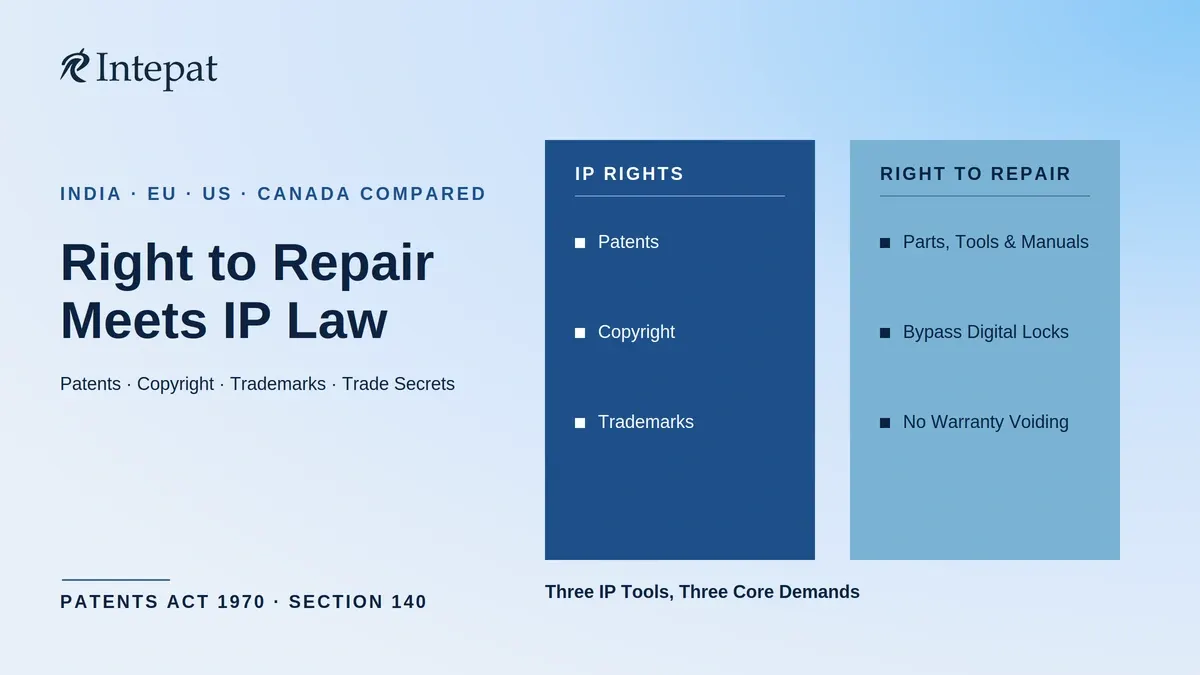
Patents protect the mechanism, copyright protects the software that runs it, and trademarks protect the branding on replacement parts; a manufacturer can use any of the three to make repair harder, even where none was designed for that purpose. A dispute can turn into a patent, copyright, or trademark case, depending on which right is enforced.
Patent protection over a specific mechanism does not usually stop repair once the product is sold; patent exhaustion (discussed below) limits how far a patent owner can control resale and repair. Copyright is the sharper tool where no repair exception exists: software behind a technological protection measure can make bypassing it, even to fix a paid-for device, a separate legal risk from the repair itself, which is the kind of exposure a copyright enforcement review is built to catch before it escalates. Trademarks control branding, but a manufacturer can also use them defensively, for example by printing a logo inside a part where no consumer will ever see it, so that an independent repairer importing a compatible part is deemed to be dealing in infringing goods, a pattern a trademark enforcement strategy has to account for on both sides of a dispute. Trade secrets add a fourth layer: diagnostic software and calibration data are often withheld as confidential business information rather than disclosed in a patent specification, which keeps them outside the reach of patent-exhaustion arguments entirely.
What the Right to Repair Movement Is Asking For
The movement’s core demands are consistent across jurisdictions: access to spare parts, tools and manuals on fair terms; permission to bypass a digital lock for repair purposes; a bar on voiding a warranty over third-party repair; and, where legislatures agree, a binding disclosure obligation rather than a voluntary one.
The environmental case sits alongside the legal one: extending a product’s life through repair reduces electronic waste, which is why repair proposals in India, the EU and several US states sit inside circular economy policy, not just consumer protection.
Case Law Shaping the Right to Repair Debate
Five decisions across four countries show how patent, copyright, trademark and competition law have each been used to expand or restrict repair access. Read together, they show the debate cutting across every IP right rather than sitting inside one of them.
Apple Inc. v. Henrik Huseby (Norway, 2020)
Norway’s Supreme Court held, on 2 June 2020, that Henrik Huseby, a one-man repair shop in Ski, infringed Apple’s trademark by importing a shipment of 63 non-original screens, 62 carrying unauthorised Apple marks concealed under removable ink invisible once mounted. The court found the concealment could be reversed easily enough that the mark still functioned as a trademark use, and Huseby was ordered to destroy the screens and pay Apple’s legal costs. The decision shows how a trademark claim, not a patent or copyright claim, can block a repairer’s parts supply.
Impression Products, Inc. v. Lexmark International, Inc. (United States, 2017)
The US Supreme Court held that once a patented product is sold, the patent holder’s patent rights over that specific item are exhausted, so patent infringement claims cannot enforce a post-sale restriction on repair, refill or resale, though an enforceable contract term might still bind the buyer separately. Lexmark had used patent claims to stop the resale and refilling of its printer cartridges; the decision confirmed that a lawful sale, not a patent licence condition, ends the patent owner’s control over what happens to that unit next. This exhaustion doctrine is the reason patent law is rarely, on its own, an effective tool against repair.
FTC and State Attorneys General v. Deere & Company (United States, 2025 to 2026)
The US Federal Trade Commission, together with the attorneys general of Illinois, Arizona, Michigan, Minnesota and Wisconsin, sued Deere & Company in January 2025 under Section 5 of the FTC Act and Section 2 of the Sherman Act, alleging Deere withheld its full diagnostic and repair software from farmers and independent shops while giving it to authorised dealers. The case survived a motion to dismiss in June 2025, and in July 2026 the FTC announced a settlement and filed a proposed stipulated order in the Northern District of Illinois; the FTC’s own case page still lists the matter as pending, and the order takes force of law only once entered by the court. If entered as filed, Deere would be required, for ten years, to make the same repair resources available to owners and independent shops that it gives its dealers. Separately, Deere agreed to a proposed USD 99 million farmer class settlement, preliminarily approved in May 2026 with a fairness hearing set for October 2026. This is shaping up as the most consequential right-to-repair enforcement outcome anywhere, resting on antitrust law rather than IP law.
Nintendo of America Inc. v. King and Go Cyber Shopping (2005) Ltd. (Canada, 2017)
Canada’s Federal Court awarded Nintendo roughly CAD 12.7 million against a seller of devices that circumvented the technological protection measures on Nintendo’s DS, 3DS and Wii consoles, rejecting an interoperability defence and holding that circumventing a digital lock was unlawful regardless of the seller’s stated intent. Parliament has since narrowed that position for repair specifically: since 7 November 2024, Section 41.121 of the Copyright Act exempts circumventing a technological protection measure “for the sole purpose of maintaining or repairing a product,” including repair carried out for someone else, provided the conduct does not itself infringe copyright. Nintendo remains good law for TPM circumvention generally, but it no longer describes Canada’s current repair-specific position.
Shamsher Kataria v. Honda Siel Cars India Ltd. (India, 2014)
The Competition Commission of India, in an order dated 25 August 2014 (Case No. 03 of 2011), held that Honda, Volkswagen, Fiat and eleven other automakers abused their dominant position by restricting genuine spare parts, diagnostic tools and technical information to independent repairers, forcing owners toward costlier authorised service. The Commission treated the spare-parts and repair aftermarket as a distinct relevant market from new car sales, meaning restrictive dealer arrangements could be assessed on their own competitive effects rather than folded into the broader vehicle market. It remains India’s principal precedent on repair access, decided under competition law rather than a right-to-repair statute, because India does not yet have one.
India: A Portal, a Patent Proviso, and No Dedicated Statute
India addresses repair access through a voluntary Right to Repair portal run by the Department of Consumer Affairs, covering farming equipment, mobiles and electronics, consumer durables, and automobiles, not through binding legislation. OEM participation is optional, so competition law, as in Shamsher Kataria, currently does more enforcement work than the portal itself.
Patent law adds a narrow, India-specific data point. Section 140 of the Patents Act 1970 voids a specific list of restrictive conditions a patentee attaches to a sale, lease or licence, such as tie-in requirements and exclusive grant-back clauses, but Section 140(4)(c) expressly carves out a lessor’s or licensor’s right to reserve to itself, or its nominee, the supply of new parts and the right to keep a patented article in repair. This is a narrow, specific carve-out, not a general statement of Indian repair law: a licensor can lawfully reserve repair and parts supply within a lease or licence, and businesses drafting those terms should structure the reservation clause deliberately rather than by default boilerplate. Copyright is the other point of friction, though less absolute than it looks: Section 65A of the Copyright Act 1957 penalises circumventing a technological protection measure only where done “with the intention of infringing” copyright, and Section 65A(2)(a) preserves circumvention for any purpose not expressly prohibited by the Act, so whether a repair-related bypass is unlawful depends on intent and surrounding conduct, not the bypass alone. Section 65B is a separate provision on rights-management information, not TPM circumvention. Neither provision has a settled repair-specific carve-out, which is where a freedom-to-operate review becomes relevant before a repair or aftermarket product launches.
The EU’s Right to Repair Directive: What Changes From 31 July 2026
Directive (EU) 2024/1799 was adopted 13 June 2024. Article 22 required member states to apply their measures from 31 July 2026; only some had formally notified the Commission of completed transposition as of this writing, so the enforceable position in any given country should be checked. Manufacturers of covered products must repair at a reasonable price and time, in and out of warranty, and cannot use contract terms or software locks to block repair.
Products in scope currently include washing machines, dishwashers, refrigerating appliances, vacuum cleaners, smartphones, tablets and several other Annex II categories, with the list expected to grow as further Ecodesign rules take effect. A consumer who chooses repair over replacement gets at least a 12-month extension to the statutory guarantee. Under Article 5(6), a restriction on independent repair must be justified by “legitimate and objective factors including the protection of intellectual property rights,” an open, non-exhaustive list rather than a closed set of defences, and the burden of justifying it sits with the manufacturer. Because member states transpose the directive individually, the repair obligation is harmonised EU-wide while the penalty for breaching it is set separately in each national implementing law.
The US Patchwork: State Laws and the Deere Settlement
The US has no single federal right-to-repair statute; repair access comes from a growing set of state laws and from antitrust enforcement like the Deere settlement above. California, Colorado, Minnesota, New York, Oregon and Washington require covered manufacturers to supply parts, tools and documentation on fair terms; Connecticut (1 July 2026) and Texas (1 September 2026) bring the enacted-state count to eight.
The FTC’s 2021 “Nixing the Fix” report framed the US approach around competition, correcting artificial post-sale barriers rather than creating a standalone consumer right to repair, and that framing still describes how most US cases, including Deere, actually get litigated.
Practical Approaches for Reconciling IP Protection and Repair Access
Manufacturers do not have to choose between enforcing IP rights and supporting repair; four approaches, used together, protect a portfolio while staying ahead of a regulator’s view of reasonable access. An IP audit and strategy review is usually where this planning starts, mapping which rights carry repair-access risk before any licence or design change is committed to.
- Licensed access: offering repair manuals, diagnostic tools and calibration software under a controlled licence, so genuine security and safety concerns are addressed without a blanket refusal to deal.
- Design for repair: standard fasteners, modular components and parts that can be replaced without specialised proprietary tools reduce the practical need to rely on IP claims to control repair at all.
- Scoped IP exemptions: carving a repair-purpose exception into anti-circumvention and trademark-enforcement policy, rather than leaving repairers to test the boundary case by case.
- Documented aftermarket policy: recording which parts and diagnostics are licensed, to whom, and on what terms, the same record that supports a patent portfolio audit or a defensible position if a competition or consumer regulator asks questions later.
Frequently Asked Questions
In the US, patent exhaustion under Lexmark ends the patent owner’s control once sold, covering resale, repair and refilling, though a separate contract term could still bind the buyer; this is exhaustion specifically, not a right overriding other law. In India, Section 140(4)(c) lets a licensor reserve repair supply to itself in a lease, so the position is not automatic.
It depends on intent and jurisdiction. Canada’s Section 41.121 (in force since November 2024) exempts circumvention done solely to maintain or repair a product. India’s Section 65A penalises circumvention only “with the intention of infringing” copyright, and Section 65A(2)(a) preserves circumvention for any purpose not expressly prohibited; Section 65B covers rights-management information, not TPM circumvention.
Not yet. India runs a voluntary Right to Repair portal covering four sectors, but OEM participation is optional and there is no dedicated statute; the Shamsher Kataria order shows competition law currently doing more enforcement work than any repair-specific legislation.
Member states must apply their national measures from that date under Article 22; covered manufacturers must then repair at a reasonable price and time, in and out of warranty, extend the guarantee by at least 12 months where repair is chosen, and justify any restriction on independent repair rather than relying on it by default. The exact position should be checked in the relevant member state.
Deere’s restriction was structural, not a licensing dispute: it gave dealers software access it withheld from owners and independent shops. That is a competition law question about market access, so the case ran under antitrust law; the FTC announced a settlement in July 2026, though the stipulated order still needs court entry to take effect.
This article is for general information on Indian and comparative intellectual property law and is not legal advice. Positions summarised here, particularly the EU transposition status and any pending US state legislation, should be verified against current official sources before being relied on for a specific transaction or dispute.
Sources
- Directive (EU) 2024/1799 of the European Parliament and of the Council on common rules promoting the repair of goods, Official Journal of the European Union, 10 July 2024, Articles 5(6) and 22.
- Federal Trade Commission, “FTC, States Secure Settlement with Deere & Company, Advancing Farmers’ Right to Repair,” press release, 8 July 2026, and case docket 211-0191 (status: pending).
- Shri Shamsher Kataria v. Honda Siel Cars India Ltd. & Ors, Case No. 03 of 2011, Competition Commission of India, order dated 25 August 2014.
- The Patents Act, 1970, Section 140.
- The Copyright Act, 1957, Sections 65A and 65B.
- Impression Products, Inc. v. Lexmark International, Inc., 581 U.S. 360 (2017).
- Nintendo of America Inc. v. King and Go Cyber Shopping (2005) Ltd., 2017 FC 246; Copyright Act (Canada), Section 41.121, in force 7 November 2024.
- Norway Supreme Court, Apple Inc. v. Henrik Huseby, HR-2020-1142-A, judgment of 2 June 2020.
- Department of Consumer Affairs, Government of India, Right to Repair Portal.